

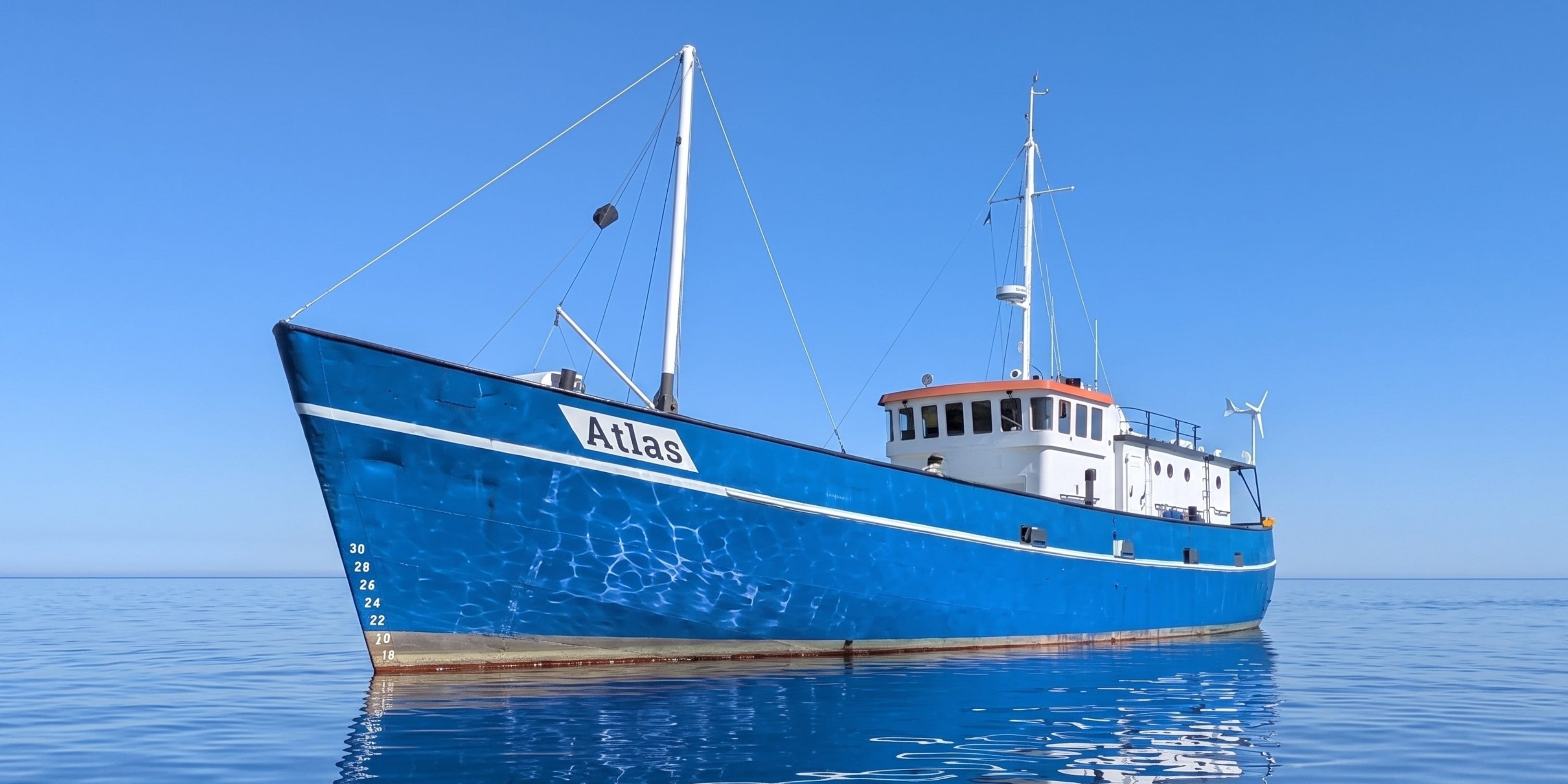
Most people who saw Atlas lying on calm water would assume she’s still earning her living in the North Sea as a rugged and very capable working vessel. She has the long blue steel hull, high bow and tall wheelhouse of a boat built to fish, and I love her steady sheer, the way her deck line sweeps up to that purposeful bow. Look closer, though, and the clues start to pop up on your visual radar. Her bow carries her name in big white letters rather than a fishing number, and there are bicycles, a RIB and a family sign reading “Atlas Initiatief” on deck. To the trained eye, or at least an eye with a sense for explorer yachts, she’s a home that happens to look like a fishing boat.
The story behind this boat is one of the many things that I love about her. A family spent 8 years turning a 1974 fishing cutter into the boat she is today, and they’ve lived aboard ever since. She’s now for sale privately in Bergen, Norway, at €195,000 (negotiable) EU VAT paid, roughly £164,000 or $219,000 at the ECB reference rates for 20 October 2026. For 24m of steel with a family home already built inside, that’s a figure that really does pique your interest.
So what does it take to keep a 24m converted working boat from 1974 as a home? Where the listing’s summary and the sellers’ detailed sheet differ, on draft, tanks and cabins, I’ve used the sellers’ sheet.
Atlas at a glance
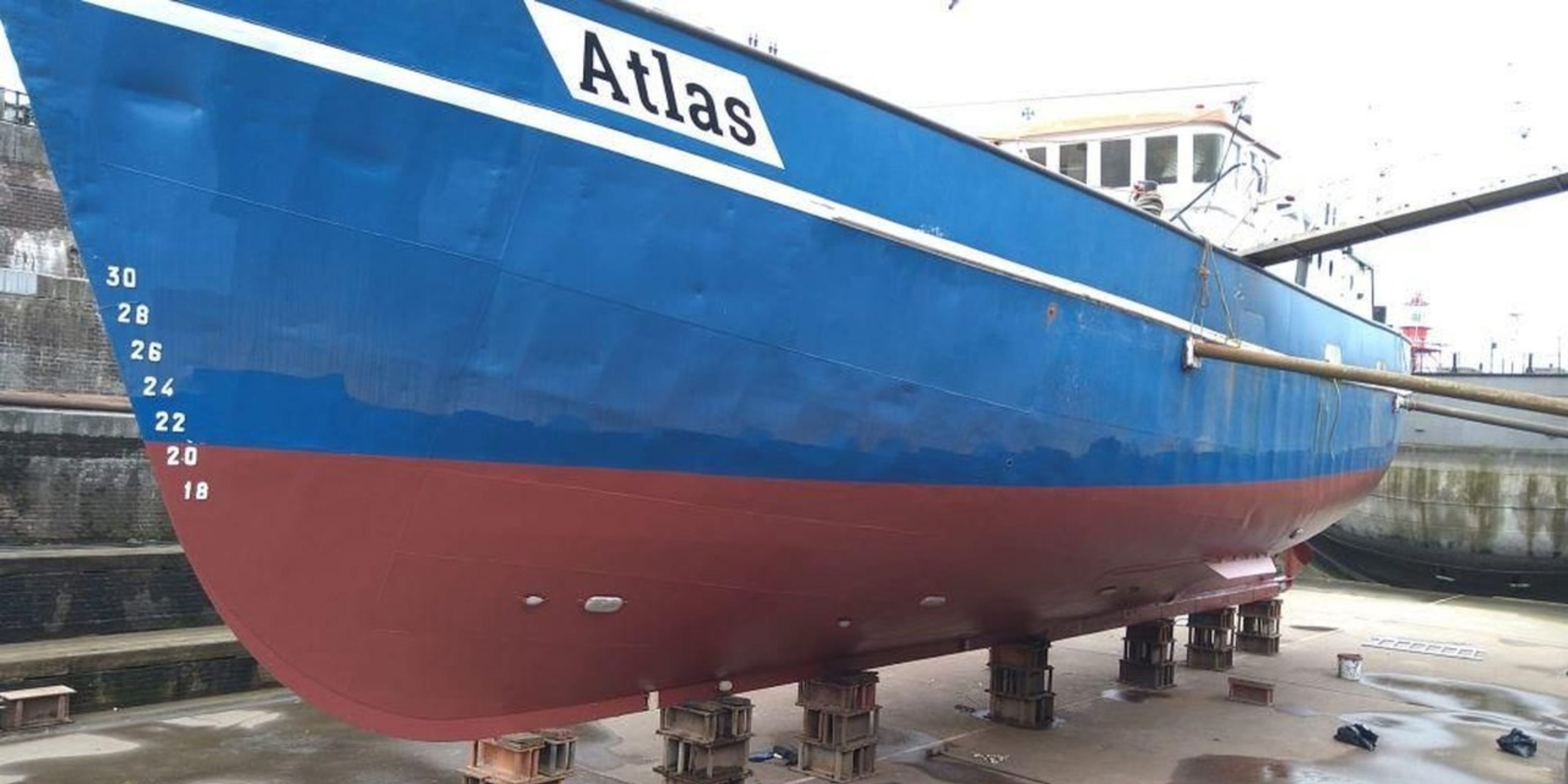
According to the sellers, Atlas was built in 1974 by the Ustka shipyard in Poland as a fishing cutter, a viskotter to the Dutch. After doing some research, I found that Ustka’s municipal history dates the yard’s first steel fishing vessels to 1971, so she’d have come from its early years. She flies the Dutch flag and, the sellers say, is officially registered as a sea-going pleasure craft.
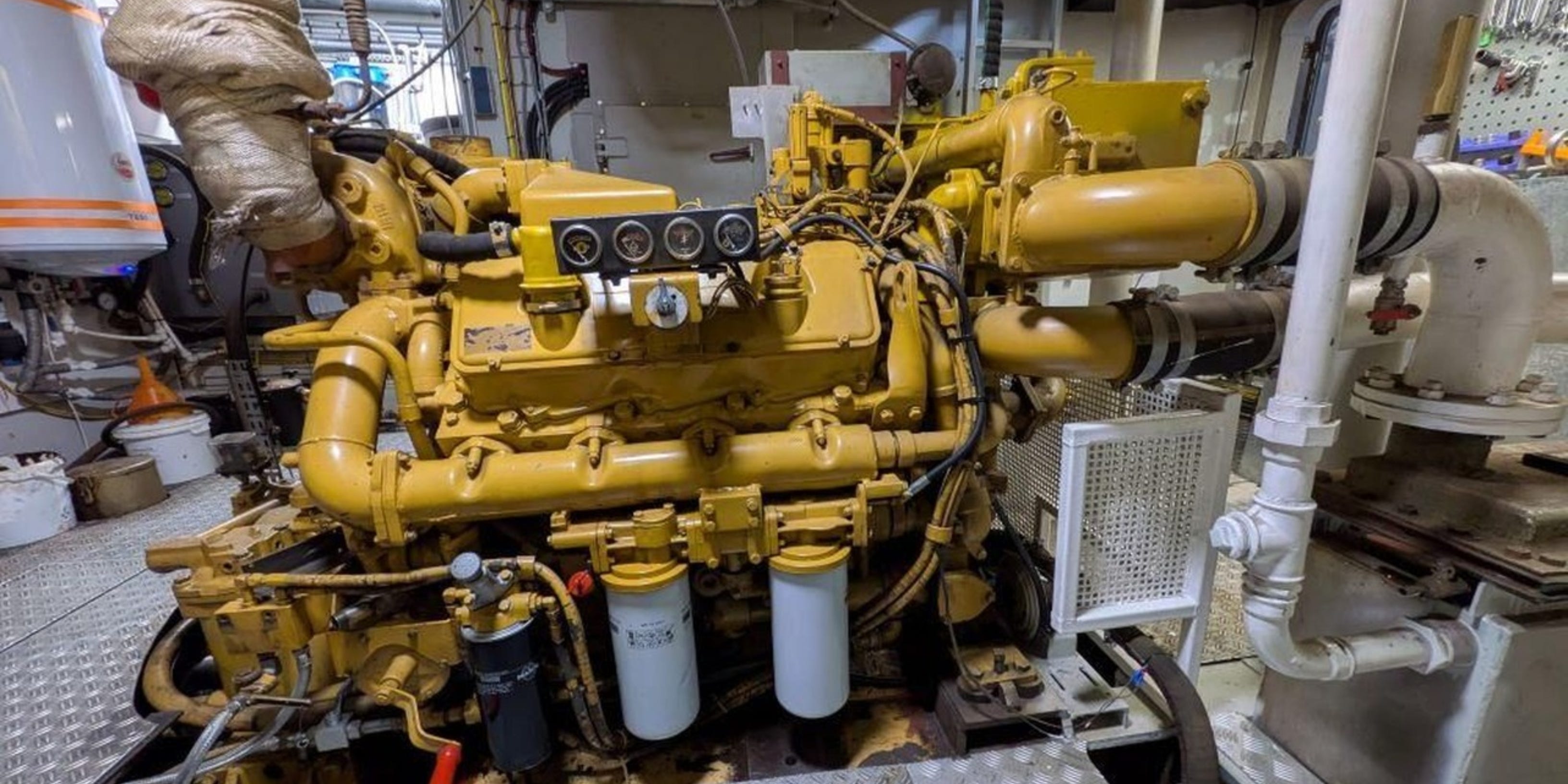
She’s 24.30m overall, 23.21m on the waterline and 6.59m in the beam, with a 2.50m draft on the sellers’ sheet and a 12.50m air draft. The draft and air draft point her at coastal cruising rather than Europe’s smaller canals, which is how the family have used her. Underneath is a steel displacement hull with a skeg, and a single Caterpillar 3408 PC driving a shaft through a Twin Disc 514 gearbox. The listing gives the Cat 365hp and 7,729 hours, and she carries 11,500 litres of fuel in two tanks.
The Breda years
The family say they refurbished Atlas in Breda, in the Netherlands, between 2015 and 2023 “with great care and enjoyment”, and moved aboard in 2023. Since then they’ve cruised the coastal waters of the Netherlands, England, France, Germany, Denmark, Sweden and Norway, and through their Atlas initiative, they say, artists regularly join them aboard to work on projects or research.
Plenty of us have looked at an old fishing boat and wondered what she’d be like as a home. This family found out, then kept her moving from country to country with people coming and going.
The skeg, and why I see it as a bonus
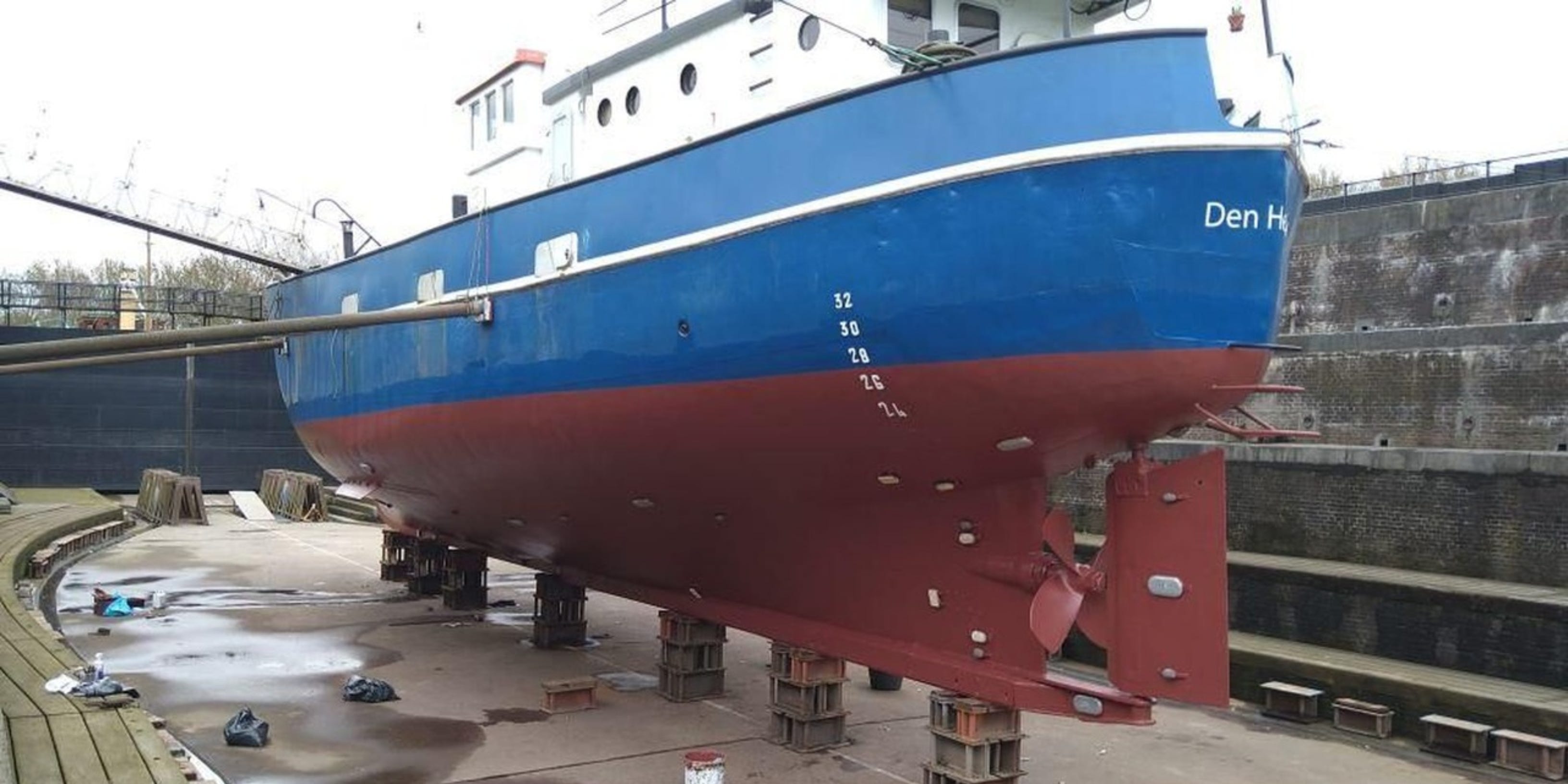
The dry-dock photos from her refit show something I’m always pleased to see on a single-screw boat: a substantial skeg running aft beneath the propeller to the foot of the rudder. For readers who might be unfamiliar with the term, Wärtsilä’s marine encyclopedia describes a skeg as a fin-like structure near the stern that, in a single-screw arrangement, supports the lower rudder and shaft area and helps directional tracking. On a long, single-screw hull like hers, that’s sturdy support for the rudder and a little extra help holding a steady course, especially in large following seas.
Handling her with one engine
No bow or stern thruster is listed in the sellers’ systems or the listing’s equipment, and the photos show none. Her next owner will handle 24m of steel with one propeller and a rudder, the way working boats like her have long been handled.
A single propeller kicks the stern sideways when going astern, known as prop walk, and the direction depends on which way it turns. Once you know it, you use it, picking the side you come alongside so the kick tucks her stern in. Springing on and off the quay with a line and a touch of power lets her pivot where you want, and a heavy hull carries her way, so approaches are planned early, taken slowly and, where possible, made into the wind or tide. It’s a satisfying skill once it clicks.
Life aboard
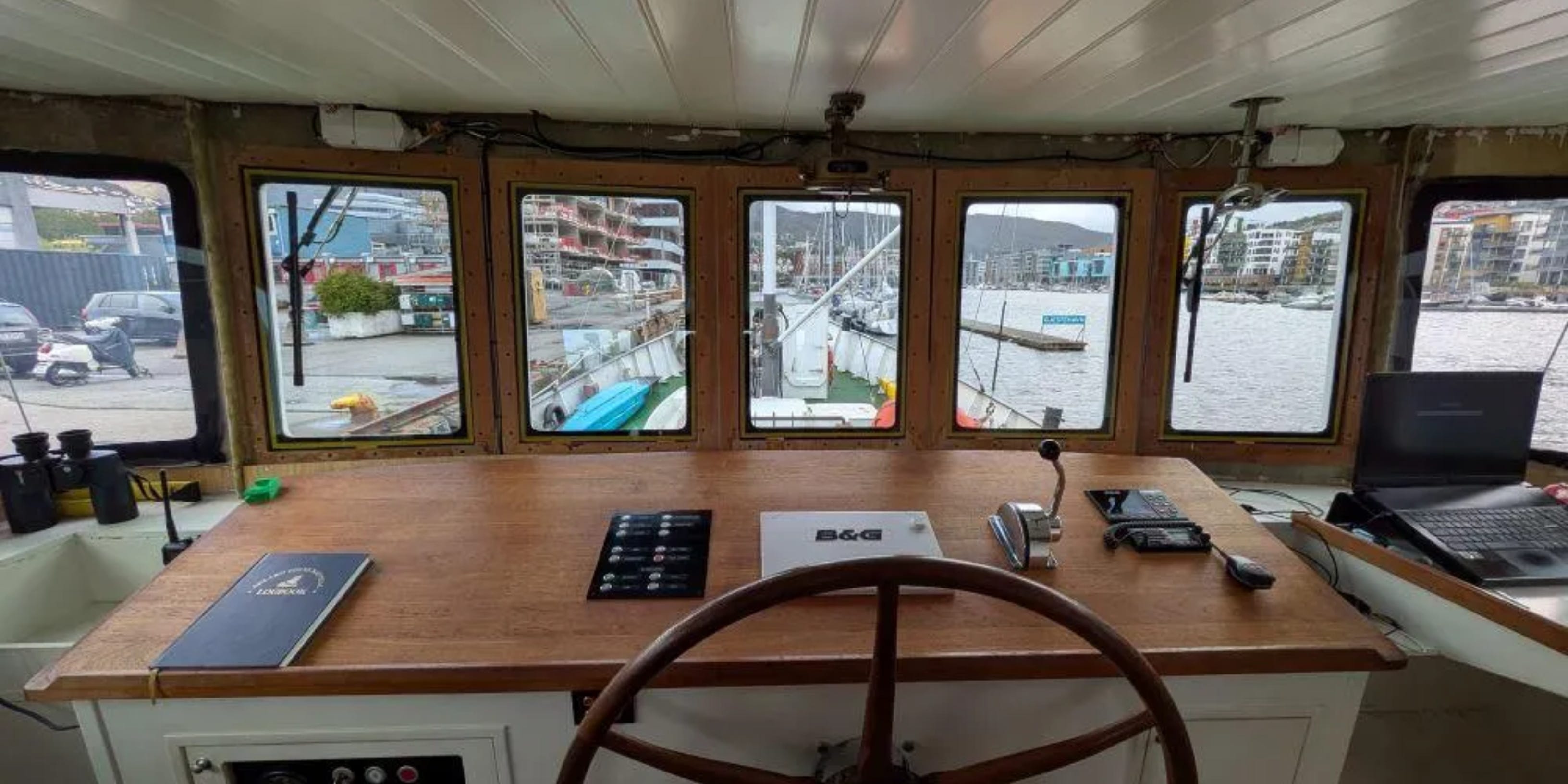
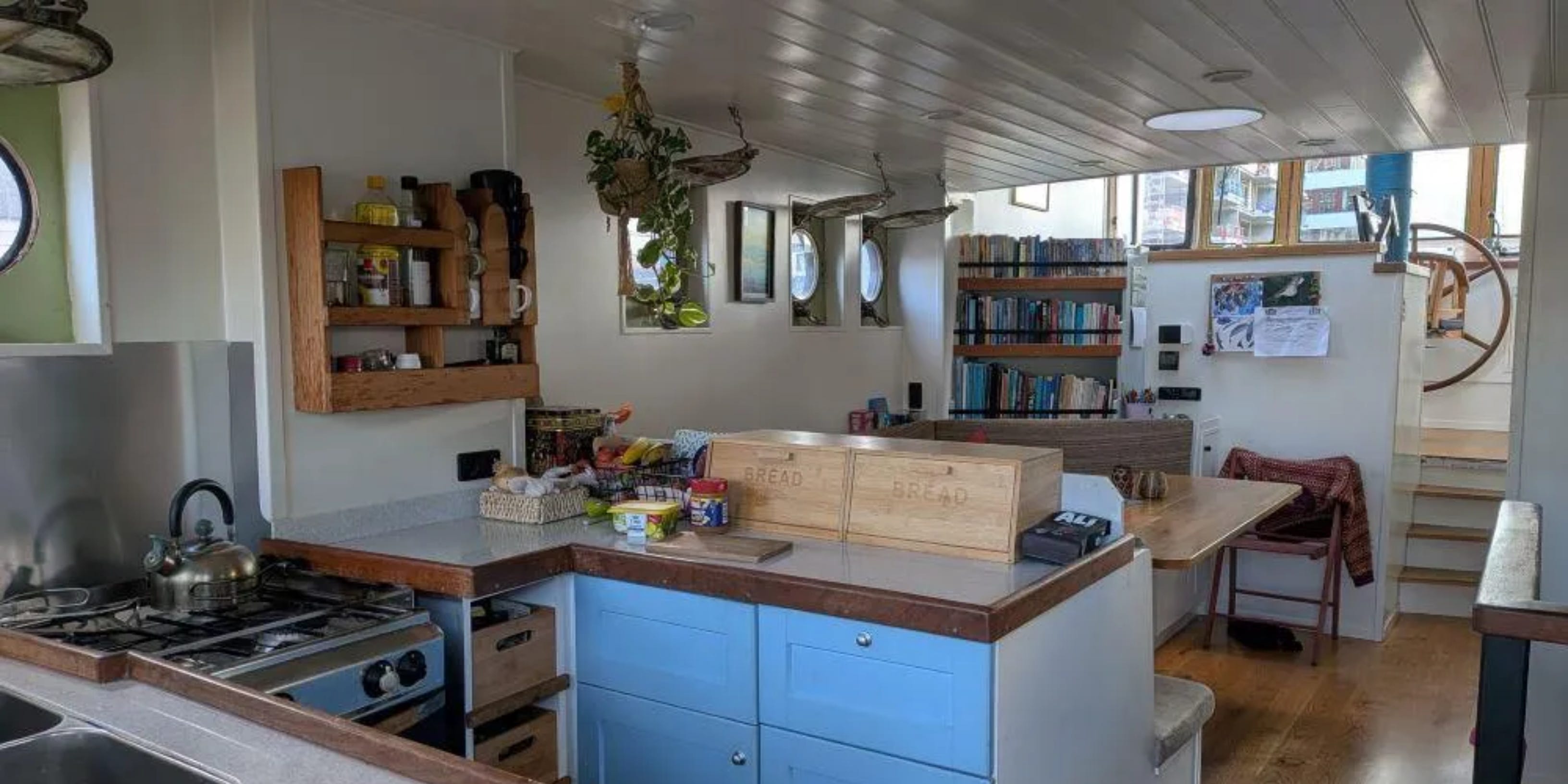
The conversion hasn’t hidden her character. Heavy portholes with hinged deadlights sit in light, modern walls, and timber steps lead up to a wheelhouse with a traditional wooden wheel and broad, timber-framed windows.
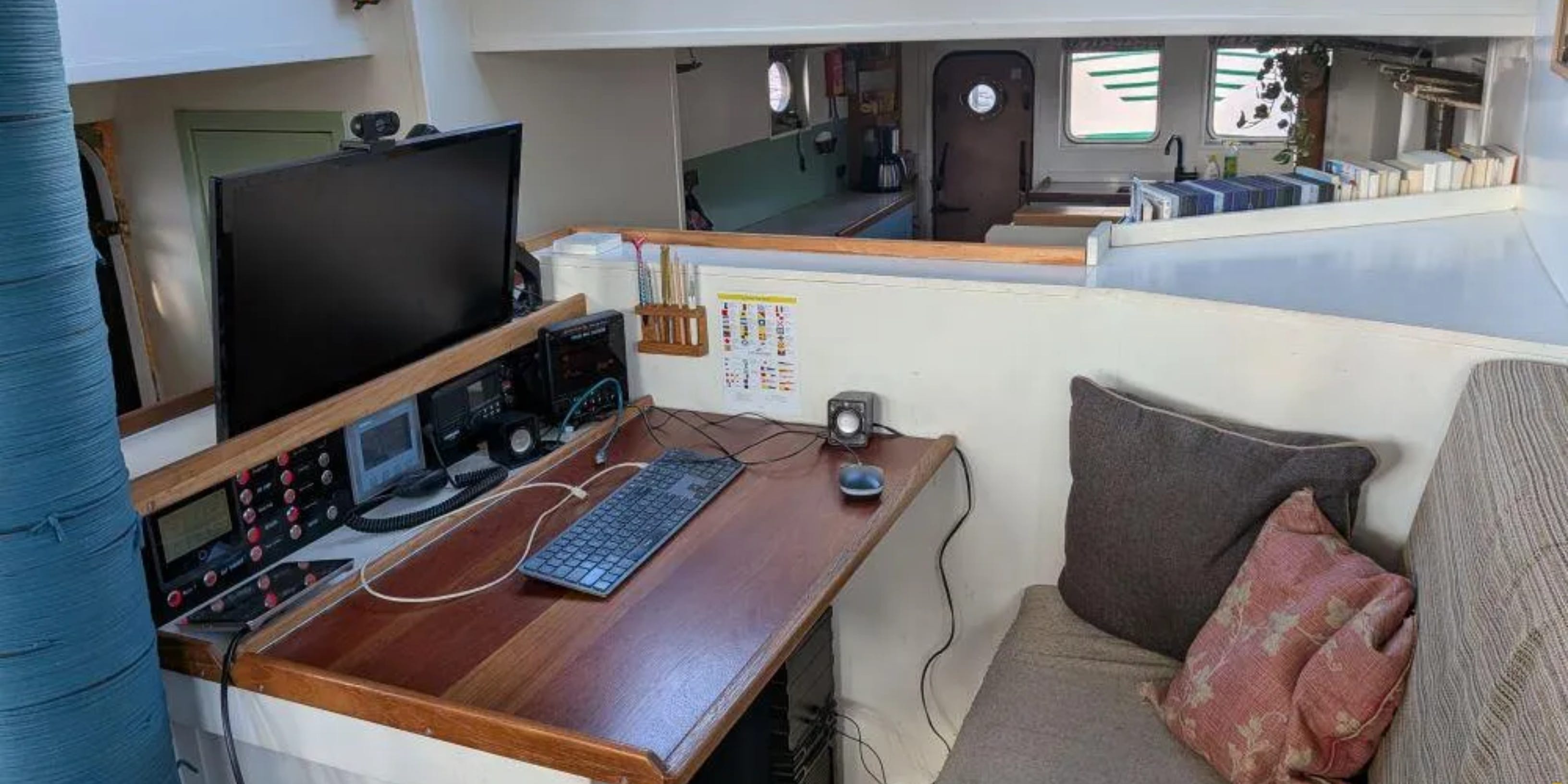
The sellers describe a double cabin, two single cabins and an alcove berth; a mess with storage under the benches and a second head they list as unfinished; a galley with a four-burner gas stove and oven, a 150 L fridge and a 70 L freezer; and a bathroom with a shower and washing machine. The wheelhouse has two captain’s chairs, a chart table and thermally insulated glass. Then there’s the multifunctional space, a room under a 2.50m x 1.25m deck hatch with its own wood stove, which could just as easily be a studio, an office or perhaps even a workshop.
The heating suits northern waters: floor heating in the cabins, galley, mess, wheelhouse and multifunctional space, a 12kW diesel water heater with a 150 L buffer tank, and that wood stove. Picture a wet October, like it is here now in London, or an evening in Bergen with the stove going and warm floors underfoot, and you can see why a family made her home.
Her two water tanks hold 1,275 litres. As an illustration, at 30 litres per person per day, the top of West Marine’s typical cruising range, that’s about 21 days for two or 10 for four, before laundry. The Schenker ZEN 150 watermaker is rated by its maker at 150 litres an hour on 600W, so at that rate it would make a day’s water for four in under an hour.
The sellers also list 2,500Wp of solar, a 48V 306Ah lithium bank (about 14.7kWh nominal), a separate 24V 720Ah service bank and a Kipor 10.2kW three-phase generator. That’s a generous mix of charging and storage for a liveaboard, though how long she’d go between charges depends on how you live aboard, and a winter in the northern latitudes gives the panels far less to work with.
That walk-around engine room
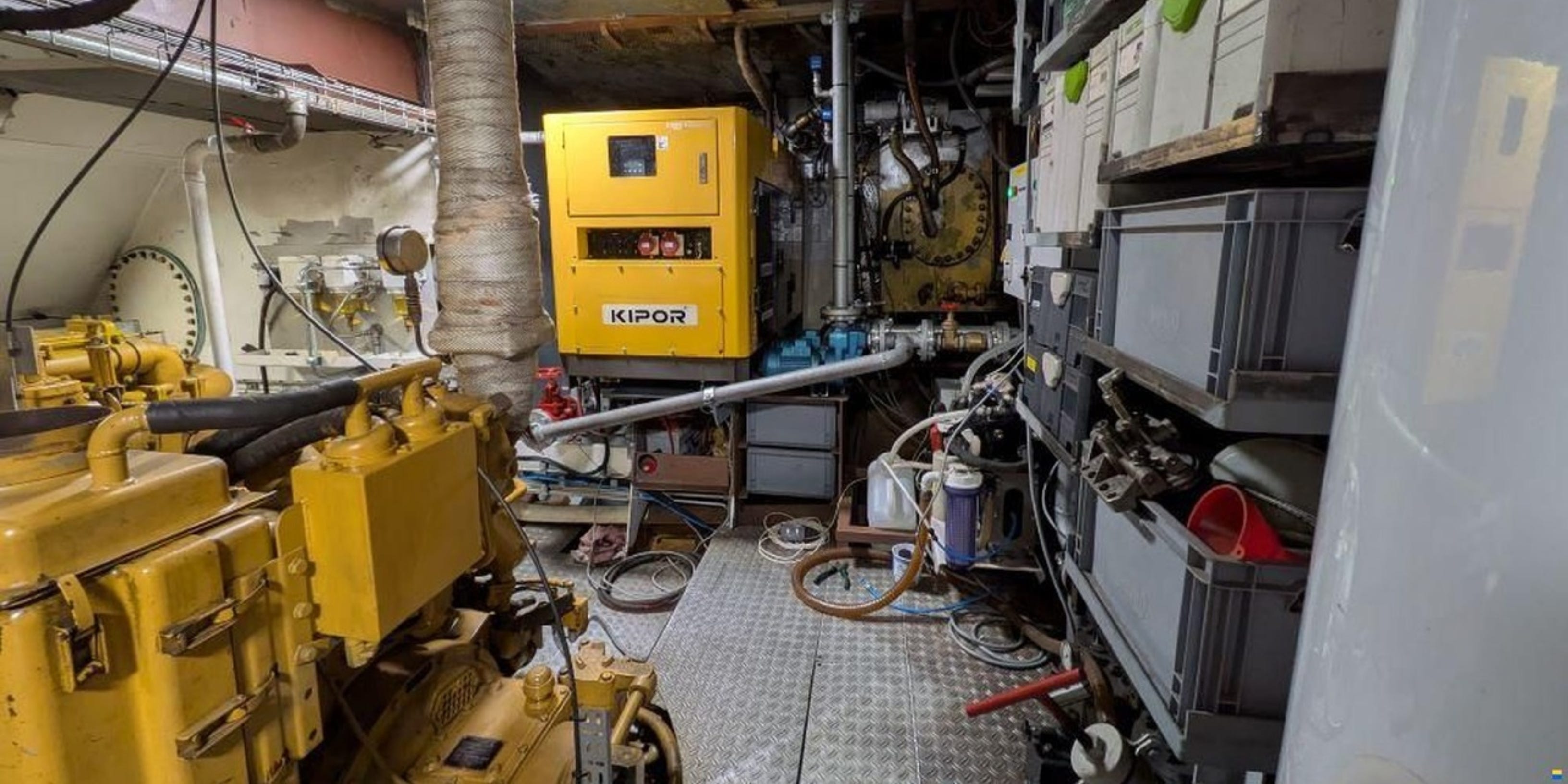
I love her engine room. It’s a large walk-around space with chequer-plate flooring around the big yellow V8 Cat, with the Kipor further along. Space to move around a main engine makes the routine checks easier to keep up, and on an engine like this, routine is what keeps it going for years.
How far she’ll go
The sellers give a range of 4,940 nautical miles at 6.5 knots, burning 15 litres an hour. In the premium section, I work out what that means once you keep a sensible reserve in the tanks. I also work out what her range would be at 7.5 knots rather than 6.5, as 6.5 knots tends to sit at the lower end of displacement speeds.
How she compares
As a private sale she has no broker’s stock to sit beside, but I’ve written about loads of converted working boats that make good company. Twelen, the 21.4m, 1979 ex-government sounding vessel, was asking €149,500 when I covered her in September; Atlas is about 2.9m longer, with a fishing past and a family home built inside. Jezebelle, the 84ft steel shrimp trawler in Bayou La Batre, was $175,001 when I wrote about her in August, a project still waiting for her conversion, whereas Atlas’s work is done. Salvator, a Belgian steel fishing trawler long converted as an explorer, shares her working-boat roots at a similar size. Those were prices at the time, not today’s market.
This article continues below, in “The Wardroom”
Thank you to every premium subscriber, existing and new. Your support keeps both the YouTube channel and this publication going, advert-free, and lets me keep writing about and filming boats like Atlas.
In the premium section, I cover:
- Her range worked out from the sellers’ figures with a 10% reserve, in hours, days and nautical miles, plus an estimate at 7.5 knots
- What every engine-hour and every mile costs in fuel at dated Dutch and UK diesel benchmarks
- What it takes to keep her: surveying a 1974 steel hull, the Cat at 7,729 hours, haul-outs, berths and insurance
- Her Dutch registration, EU VAT-paid status and the paperwork worth asking for
- What it would take to get her to the United States, under her own power or by ship
- My honest assessment: who she suits and what she asks of her next owner
Her range, worked out
The sellers’ range comes with no reserve stated, so I’ve added one and turned it into hours, days and miles. I’ve done the research, so you don’t have to!
