

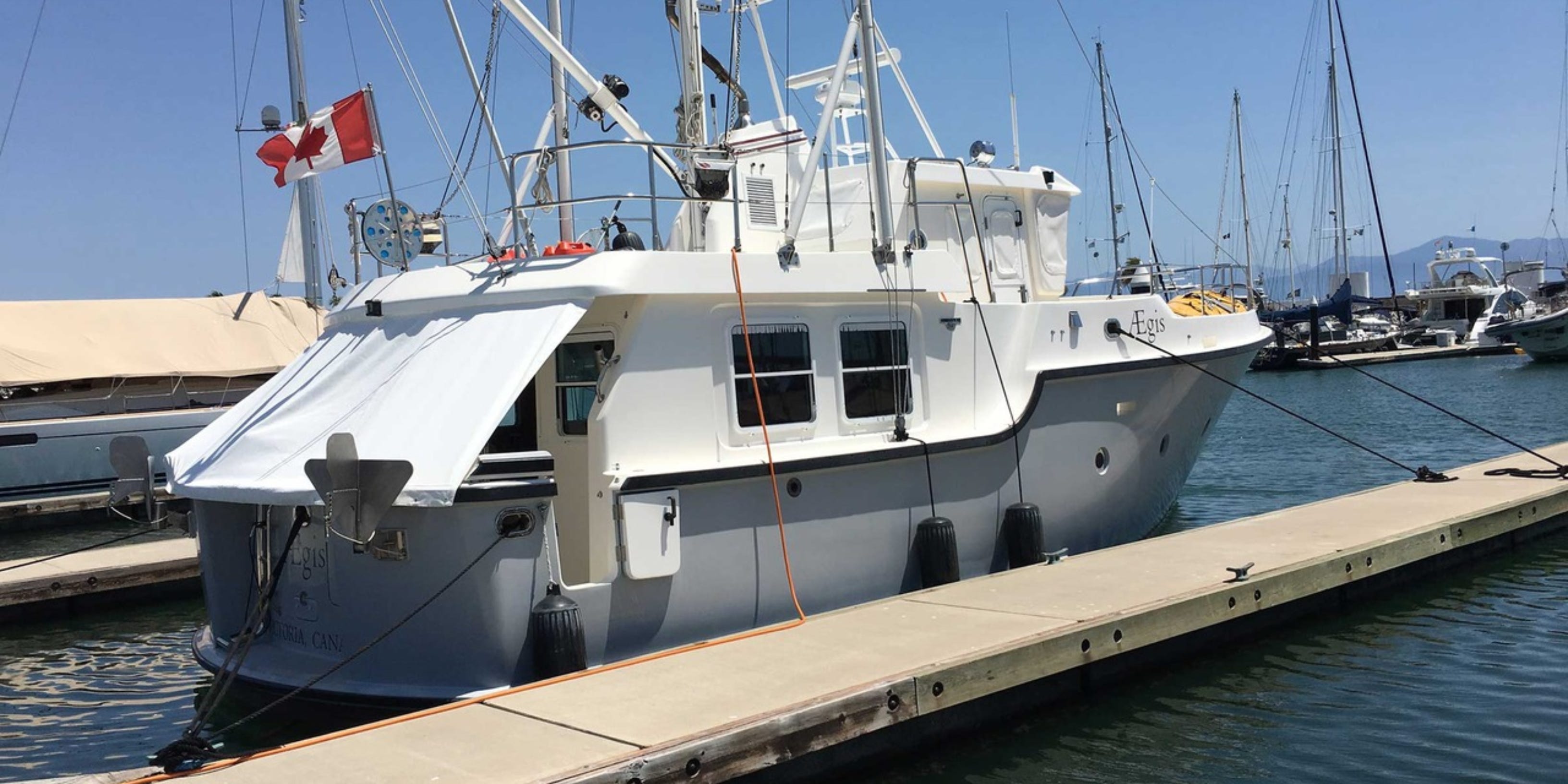
Nordhavn doesn’t build a 40ft boat any more. When PAE ended N41 production on 28 July 2026, which I wrote about in August, the smallest Nordhavn in build became the 46 MK II. If you want a Nordhavn this size now, the only way in is pre-owned, and that’s the first reason why ‘Aegis’ is being featured in this issue (link to listing below).
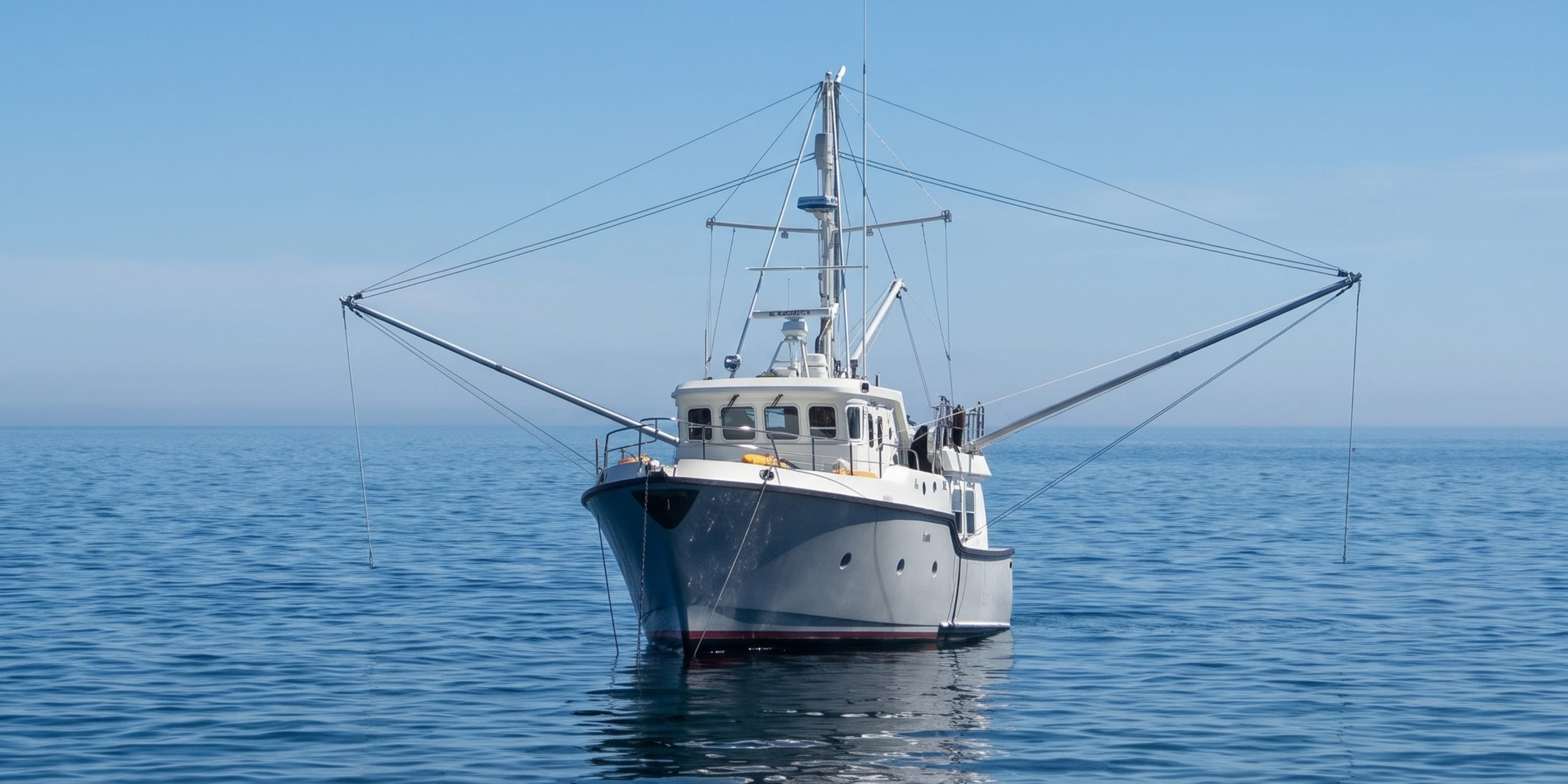
The second reason is simpler. I love the look of her with her flopper stoppers out, both booms swung wide and lines running into the water as she lies off a small rocky islet, looking for all the world like the fishing boats that inspired her design. It’s a profile with a working purpose, so that’s where I’ll start.
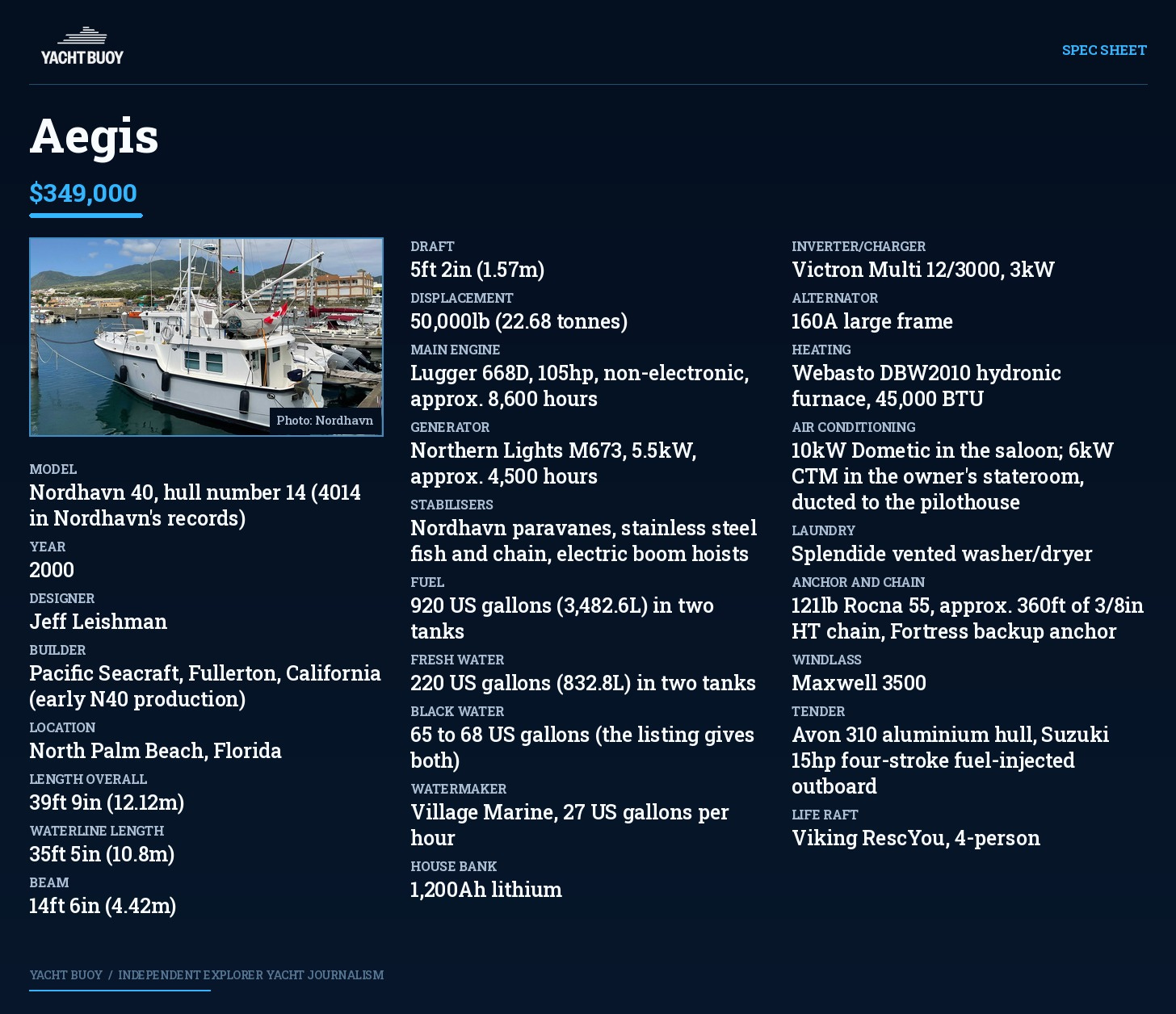
Aegis is a 2000 Nordhavn 40, hull number 14, listed by Nordhavn’s own brokerage team in North Palm Beach, Florida, at $349,000, roughly £261,000 or €312,000 at the ECB rate for 23 October 2026. For a small yet very capable ocean-going trawler with this much cruising kit, I think that’s worth a closer look. So what does it take to keep her going, starting with the 8,600 hours on her single engine?
Flopper stoppers, explained
Paravane stabilisers are about as old-school as stabilisation gets, which is part of their charm. NOAA’s guide to the US West Coast albacore fleet describes fishing boats hanging metal “flopper-stopper” plates from outriggers either side. On Aegis, a boom swings out from each side of the mast, and from each one a chain runs down to a weighted stainless “fish”, a shaped vane towed below the surface.
The fish is shaped to dive, so it wants to stay down. As she rolls, the fish on the rising side resists being lifted and the pull on the boom slows the roll. It won’t stop her moving altogether, but it takes much of the sting out of the side-to-side motion that makes a long passage so tiring. Electric boom hoists launch and recover the fish and chain, saving a good deal of heaving.
At anchor, the same booms can carry hinged plates that sink freely and resist being pulled back up, the classic fix for a rolly anchorage, as PassageMaker’s account of living with paravanes describes. Aegis’s listing names the fish and chain she uses under way.
Nordhavn says passive paravanes, “sometimes referred to as ‘flopper stoppers’”, are popular because they reduce roll at anchor, need virtually no maintenance and can be pulled out of the water when they aren’t needed, to avoid unnecessary drag. It calls active fins “the current method of choice for most Nordhavn owners”, and says they’re especially effective at a full-displacement hull’s cruising speeds.
Fins work at the touch of a button, but they’re a powered system with appendages under the hull. Paravanes have no hydraulics and nothing powered below the waterline. The price is a little routine: deploying and recovering the rig, keeping an eye on the booms, fittings, chain and fish, and allowing room either side and underneath while they’re out, so shallows and fishing gear need care. For a couple who like no-nonsense systems they can see and understand, that’s a fair trade, and to my eye she looks wonderful doing it.
The Nordhavn 40 story
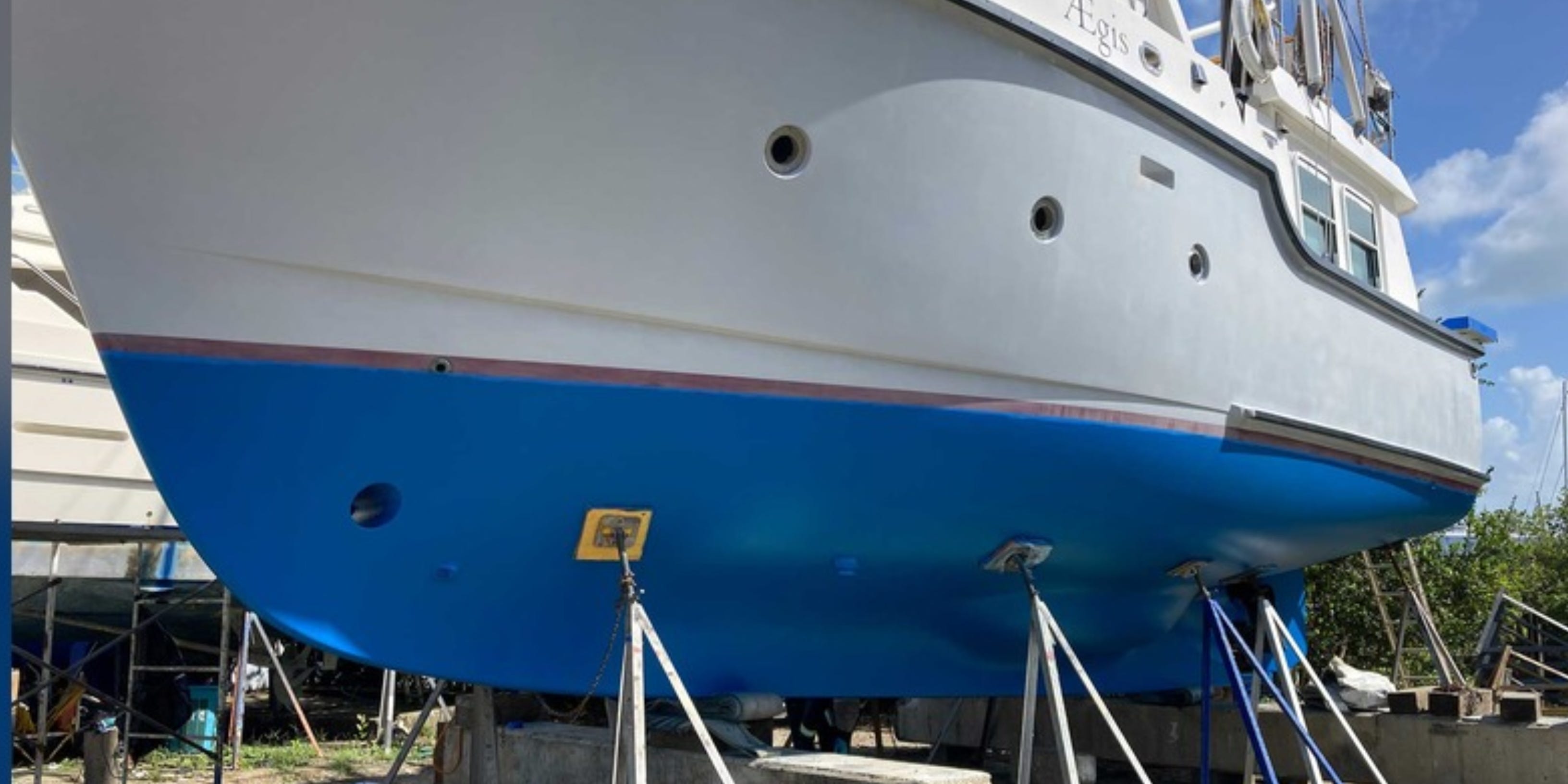
Jeff Leishman designed the N40 as a smaller full-displacement boat that could cross oceans with a couple aboard and room for the occasional guest. A 1999 PassageMaker article, still hosted by Nordhavn, notes the commercial fishing boat influence and names Pacific Seacraft in Fullerton, California, as the builder of the early boats, the run hull 14 comes from.
Then Nordhavn proved the idea. A production N40 circumnavigated between 3 November 2001 and 30 June 2002. Nordhavn’s detailed record gives 24,211 nautical miles and 151 days 3 hours under way, its overview describes 170 days at sea, and Nordhavn says the N40 holds the world record for the fastest circumnavigation by a production powerboat.
The round-the-world boat carried active fins as well as paravanes, and 26 years is a long time in any boat’s life. It does show the N40 was made for exactly the long, steady cruising Aegis has been doing. As far as I am aware, Nordhavn still has, or rather had, the only 40ft motorboat LOA that can be used to travel around the world safely.
Why a 40ft Nordhavn is now rare
PAE’s July announcement ended N41 and N51 production in Istanbul after 54 boats, 44 of them N41s, citing economic conditions in Turkey. The moulds for both will be destroyed.
That leaves the Nordhavn 46 MK II, which I looked at in August, as the smallest in build. She’s 46ft 3in overall with a 15ft 9.5in beam and 57,498lb displacement, against Aegis’s 39ft 9in, 14ft 6in and 50,000lb. Marinas charge by the foot, and the bigger boat is more for two people to handle and berth. The 46 MK II brings a current design and more room; Aegis offers the same ocean-crossing idea in a smaller footprint.
According to Nordhavn’s brokerage, the present owners are her second owners and have looked after her with great care for 18 years, living aboard full-time for the past 7, cruising extensively and logging many offshore miles. The brokerage also lists detailed maintenance records among her particulars. Nordhavn’s distance pennant record for Aegis lists 20,200 nautical miles, through British Columbia, Mexico and Central America. It’s a lovely story for a 40ft boat: designed to cross oceans, then used as a home.
Life aboard
Of course, access to fresh water, beyond what is stowed away in dry storage, decides how long you can stay anywhere. The Boat Galley’s authors logged about 7 US gallons a day for two adults and a small dog aboard their own boat, a frugal routine rather than a rule; at that rate her 220 US gallons would last a couple about a month (roughly 31 days). With a Village Marine watermaker listed at 27 US gallons an hour, water becomes far less of a reason to head back to a marina.
The 1,200Ah lithium bank, 3kW inverter/charger and 160A alternator add up to a substantial house-power system for time at anchor. How long she can go without running the generator depends on the bank’s condition and usable capacity, and on what you run, so it’s one for the survey.
A Webasto hydronic furnace is just what you’d want on a damp British Columbia morning, and the two air conditioners take care of a Florida summer. Separate 30A shore-power supplies for the house and the air conditioning, with a crossover between them, are a thoughtful touch.
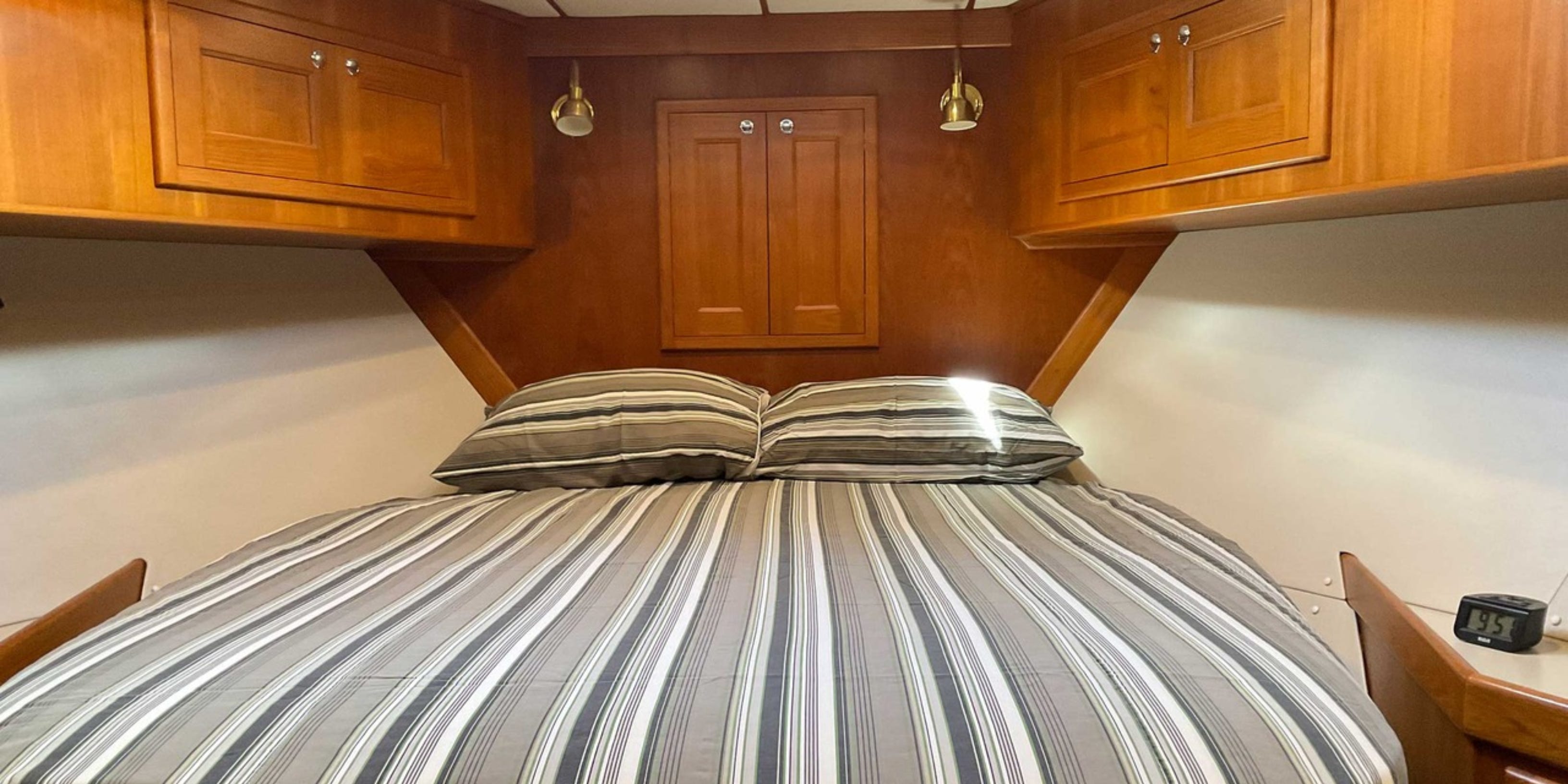
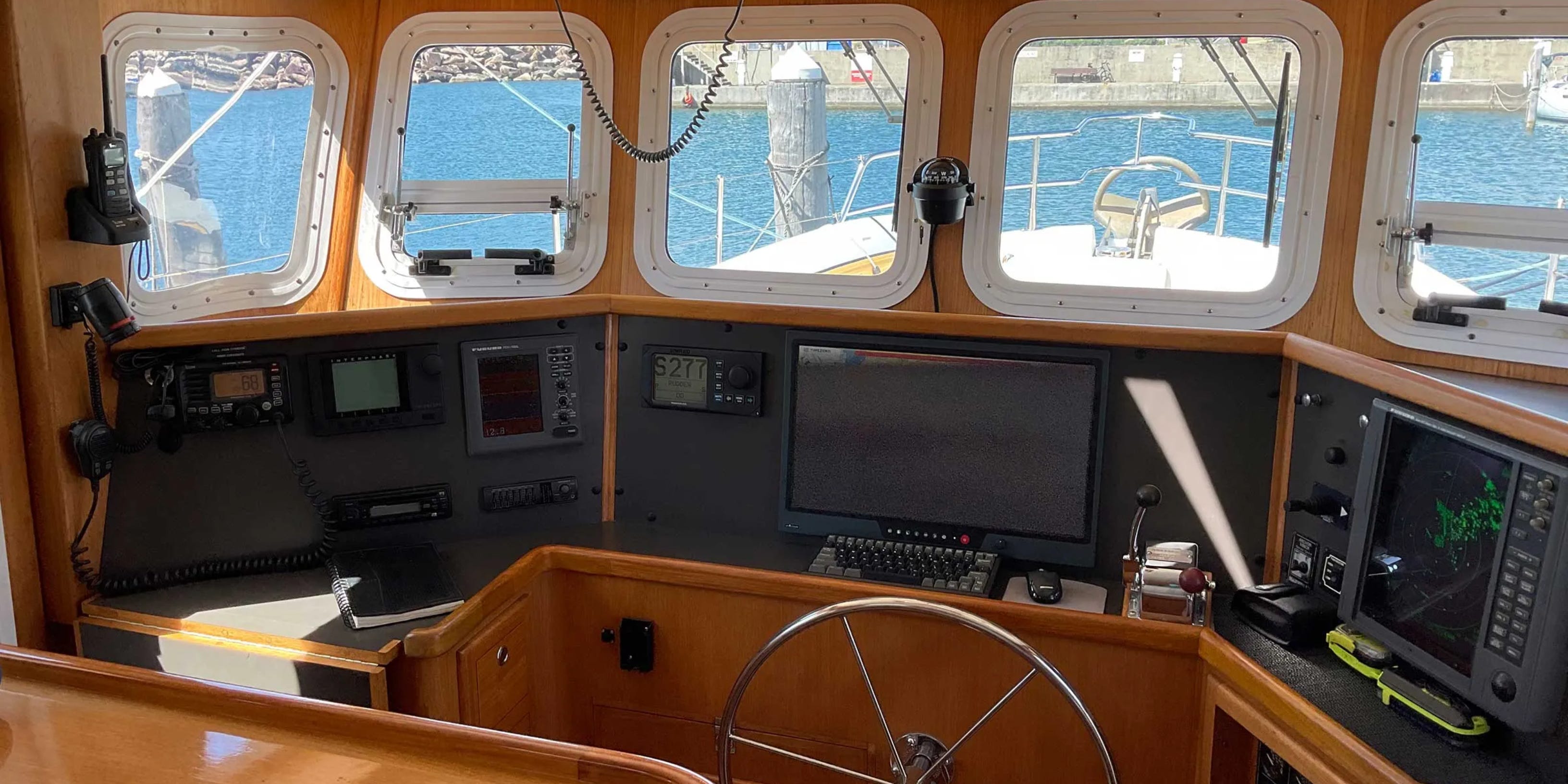
Inside, she’s warm, wood-lined and lived in, in the nicest sense. The galley has a Force 10 three-burner propane stove and oven, a double sink and Vitrifrigo drawer fridge and freezer. The saloon has a dinette and windows with cellular blinds, and there’s a Splendide washer/dryer, which anyone who has carried laundry round a strange marina will certainly appreciate. In the pilothouse, wraparound windows look forward from the helm, with a settee and table for a cosy second spot on passage.
Nordhavn’s N40 material describes a forward owner’s cabin and a guest cabin, true to that couple-plus-guests brief, with a double bed for the owners and a guest berth with its own storage.
On deck, a 121lb Rocna on about 360ft of chain, with a Fortress backup, is a generous anchoring set-up for a 40ft boat, and the Avon tender, Viking four-person life raft, and Para-Ring sea anchor complete the offshore kit. In fact, this is the first time I have come across a 40ft boat with 360ft of chain! Very impressive!
In the premium section below, I look at what those 8,600 hours mean and what she costs to run.
This article continues below, in “The Wardroom”
A huge thank you to everyone who supports Yacht Buoy with a premium subscription, whether you’ve been here from the start or joined this week. You keep both the YouTube channel and this publication going, advert-free, and you let me keep writing about and filming boats like Aegis.
In the premium section, I cover:
- What 8,600 hours on her Lugger 668D mean, and three things I’d ask for
- Her range, worked out from Nordhavn’s own N40 test figures
- Running her from Florida: fuel per 1,000 nautical miles at a dated diesel price, and the quotes to get
- Getting her to the UK or Europe, and the paperwork to check
- What a surveyor looks at on a 26-year-old Nordhavn 40
- My honest assessment: who she suits and what she asks of an owner
8,600 hours: what the number tells you
This is the question I’d want answered first, and I’ve done the research, so you don’t have to.
