$449,000 for Lady Grey: The Nordhavn 46 Whose Owners’ First Overnight Trip Was a 2,560 NM Pacific Crossing
Stu and Dominique Chizik had never spent a night aboard a boat. Here’s what their Pacific crossing shows about hull 80.

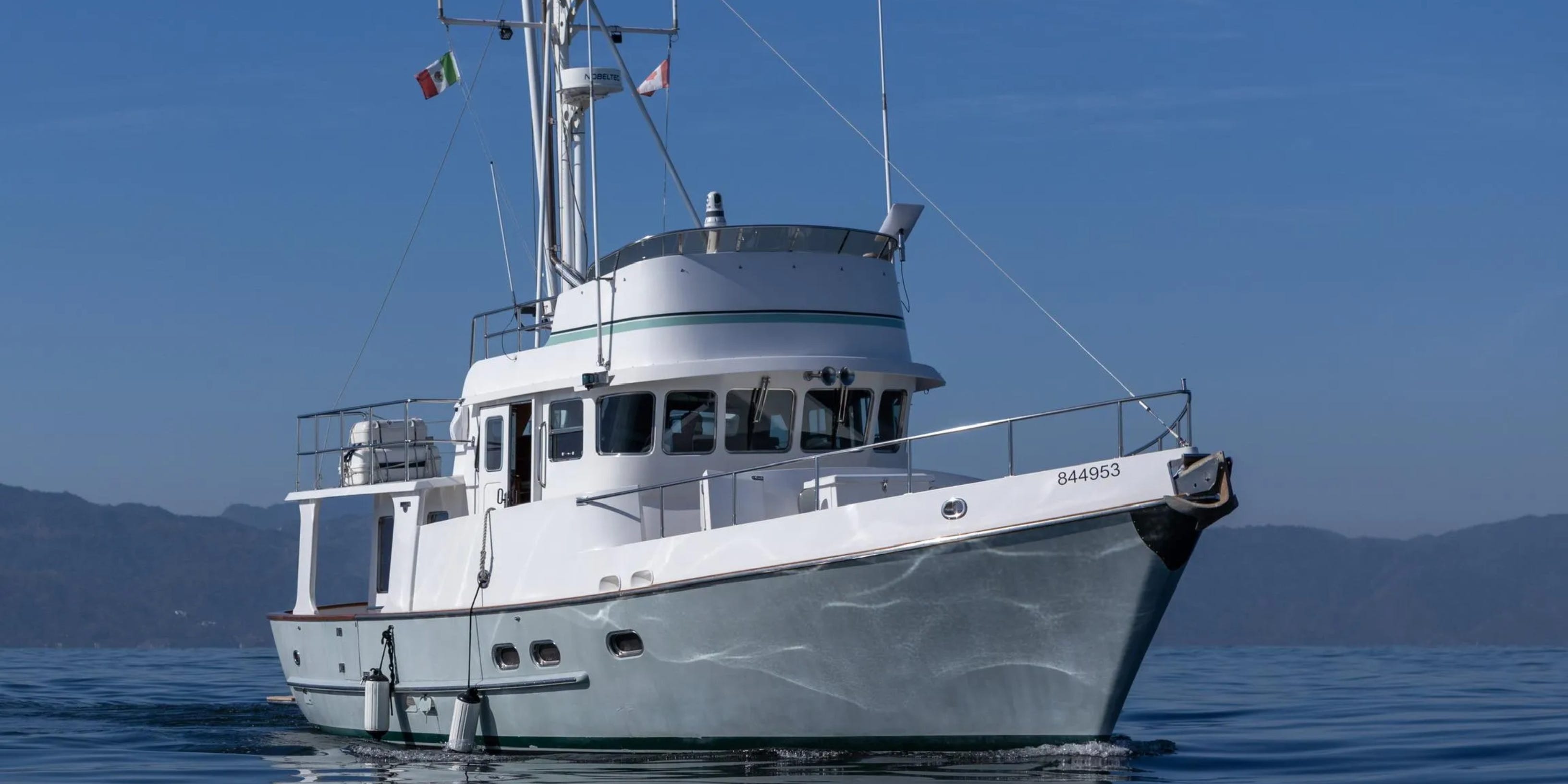
The first night Stu and Dominique Chizik ever spent aboard a boat was also the first night of a long Pacific crossing. With their 11-year-old daughter, they left Oahu in Lady Grey, their 2003 Nordhavn 46, and reached Ensenada, Mexico, 14.5 days and 2,560 NM later. They were heading upwind and loaded to the maximum, and because the watermaker was down and the parts couldn’t be had before departure, they carried every drop of their drinking water.
Stu got in touch with me on WhatsApp (”Appreciate your content. Interested to know how to get our boat featured”), sent me her listing and a Surfline surf film she’d been chartered for, and answered all my questions. If you own a boat with a story like this, you’re very welcome to do exactly the same.
Lady Grey, hull 80, lies in Puerto Vallarta, Mexico, and she’s for sale at $449,000 (link to listing below), having recently been reduced. For a later-series 46 with a Pacific crossing behind her, that will catch a few eyes. She’s Canadian-flagged and, according to her listing, was originally imported into the US with customs duty paid. She’s listed by Kevin Ryan via Nordhavn Yachts & Brokerage, Dana Point, who, Stu tells me, spent years commissioning Nordhavns of this vintage as a contractor for the builder, Pacific Asian Enterprises (PAE), fixing deficiencies and installing systems, and has spent nights aboard Lady Grey.
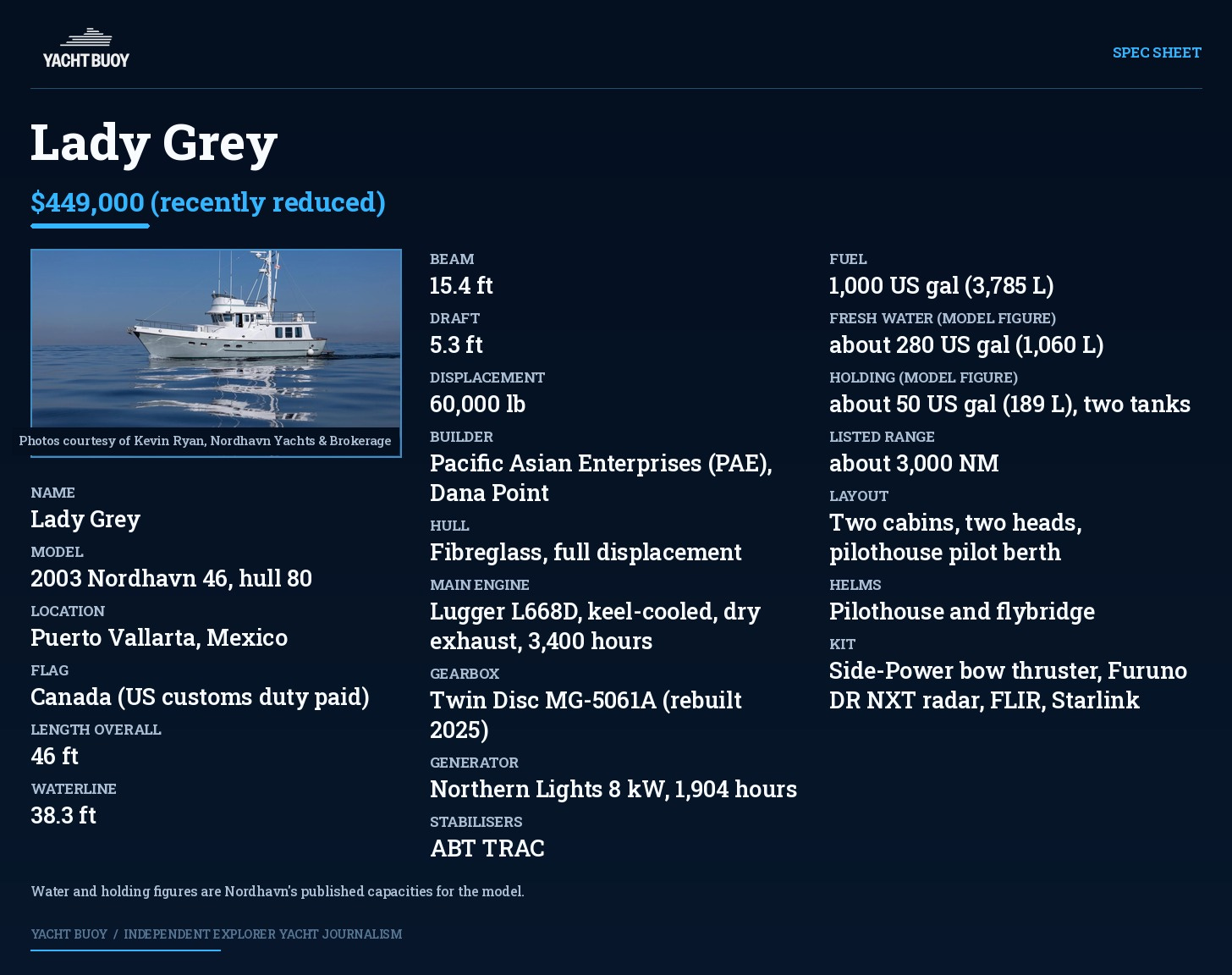
A 46 from near the end of the run
PAE launched the first Nordhavn 46 in 1989, a full-displacement, ocean-going no-nonsense trawler, and production ran until 2004, with 82 launched. After doing some research, I found that Nordhavn kept refining the design throughout that run, with owners’ experience feeding hundreds of changes, among them fibreglass fuel tanks, quieter mufflers and intakes, and more sound insulation. As Stu puts it, “She is hull 80 of 82 so all refinements from production run.”
Her previous owners, Stu tells me, ran her from California to Hawaii in the mid-2000s, and she spent most of her life out there, which is how a Canadian family came to buy their boat in Oahu.
Why a Nordhavn 46?
Stu always thought he’d scratch the cruising itch in a Contessa 26 or an Alberg 30, but living so far from the ocean left little time to learn to sail, and then he discovered long-distance trawlers. When an offer on a custom 60 ft steel trawler fell through at survey, the couple decided a production fibreglass boat would be lower maintenance and easier to sell if boating didn’t suit them. It’s a sensible way to approach a first boat (I’ve looked at [what it really costs to sell a boat](https://newsletter.yacht-buoy.com/p/what-does-it-really-cost-to-sell)).
The engine helped seal it. Stu grew up farming and knows John Deere diesels for their simplicity and reliability, and Nordhavn describes the 46’s Lugger L668D as based on a John Deere tractor engine. That’s a useful head start when it’s your only main engine.
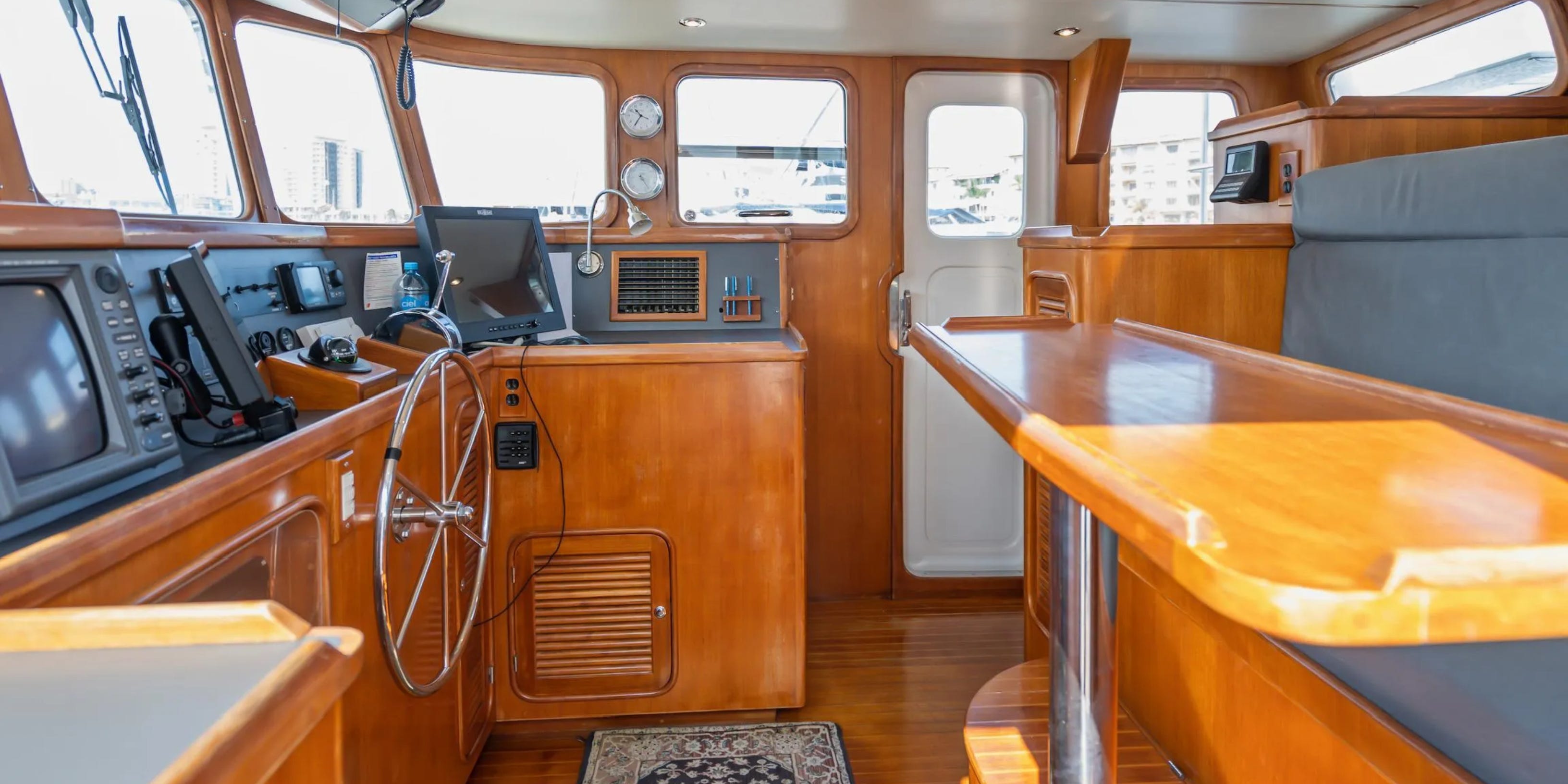
Their first night at sea
They bought Lady Grey in July 2021 and spent about five months on repairs and learning her systems. The plan, Stu says, was to run hard for the Pacific High and refuel in its calmer water, so alongside her 1,000 US gallons (3,785 litres) of main tankage they carried another 584 US gallons (2,211 litres) in Turtle-Pac fuel bladders. After refuelling, they had plenty in hand to keep up a fast pace.
They used 1,250 US gallons (4,732 litres), averaging 3.59 US gallons (13.59 litres) an hour at 7.3 knots, upwind and, in Stu’s words, “loaded to the max” with extra fuel and food. The 14.5 days include close to 12 hours lost to diversions, refuelling, and rough weather, and a freezer failed on day four.
Back in Canada, Stu and Dominique each drove 100 km a day on ice for work, which felt like normal life, yet in his view, “the highways are much more dangerous than an ocean trip.”
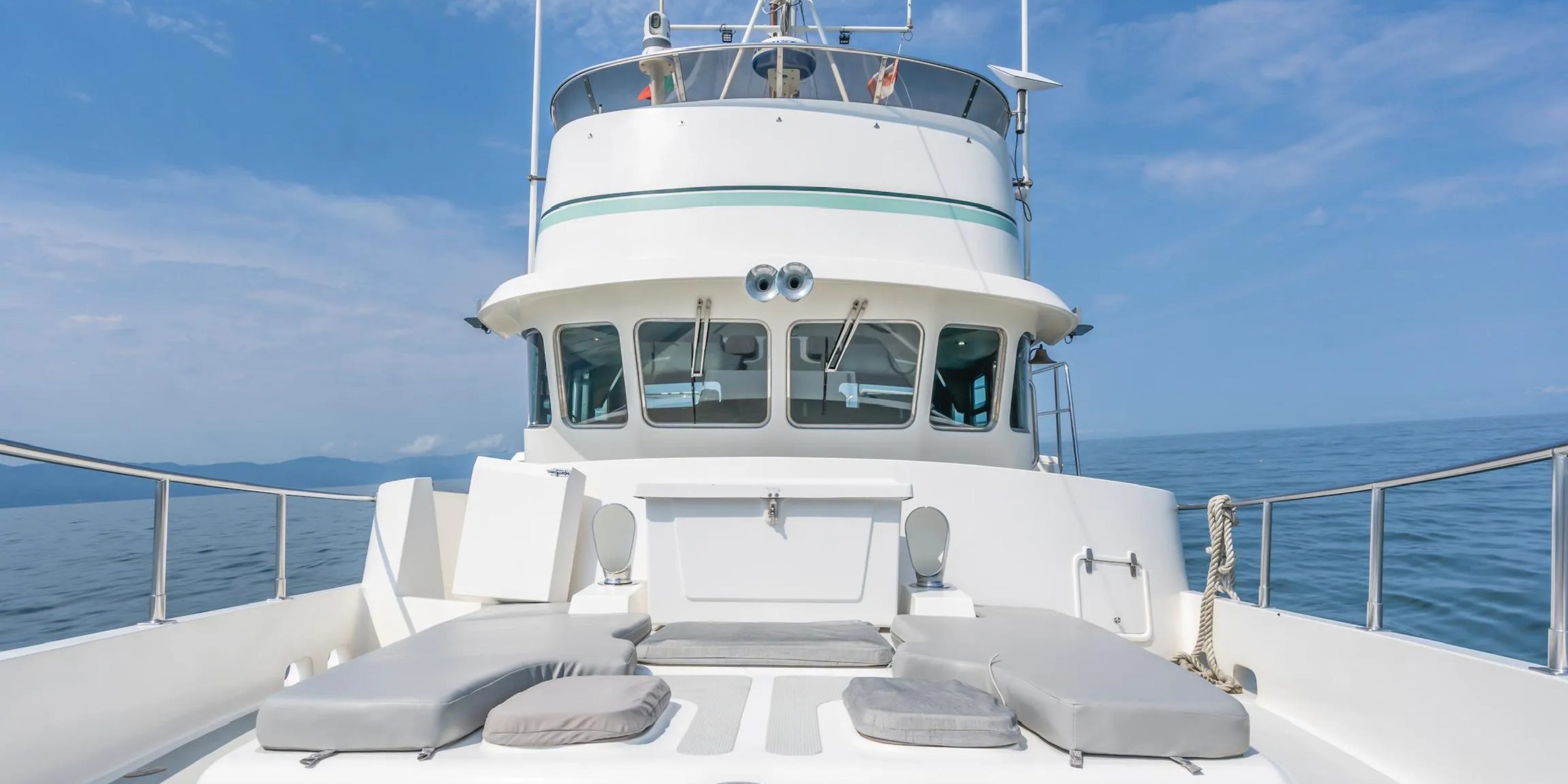
What hull 80 brings to a passage
The 46’s full-displacement hull is made for long days at modest displacement speed on one engine. Her Lugger is keel-cooled, its coolant running through a cooler outside the hull so that seawater stays out of the engine’s cooling circuit, and she has a dry-stack exhaust. A Portuguese bridge wraps around the front of the pilothouse, giving the crew a sheltered, high-sided route forward.
Stu points out that many early 46s were stabilised with paravanes or Naiad fins, whereas Lady Grey has ABT TRAC stabilisers. She also has a rare flybridge: her listing calls her one of the few 46s built with one, and Stu puts the number at nine. Reached from the raised boat deck, it has a second station with steering, thruster, shift, and navigation repeaters, very useful for a clear view all round when anchoring in a strange bay.
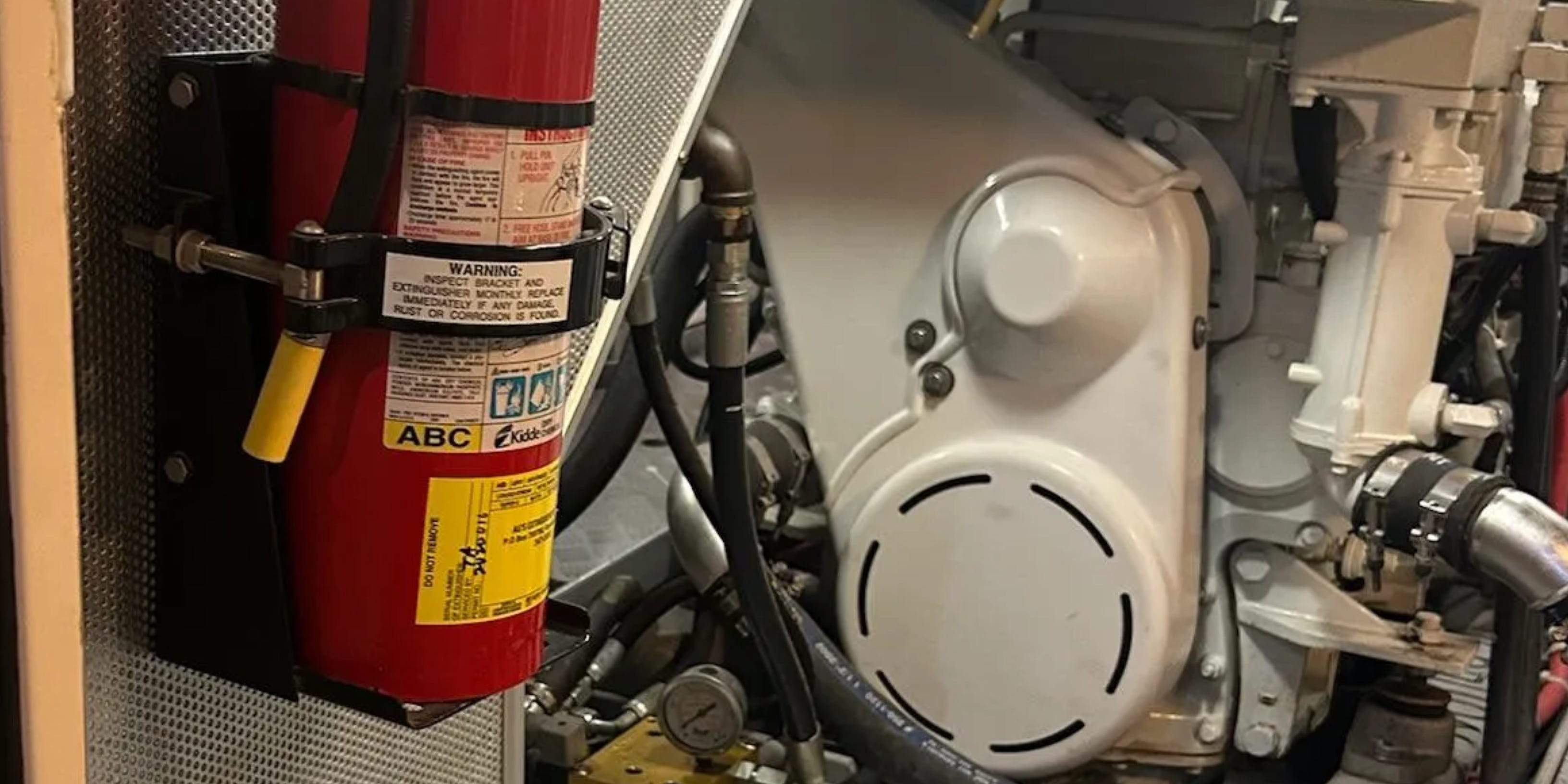
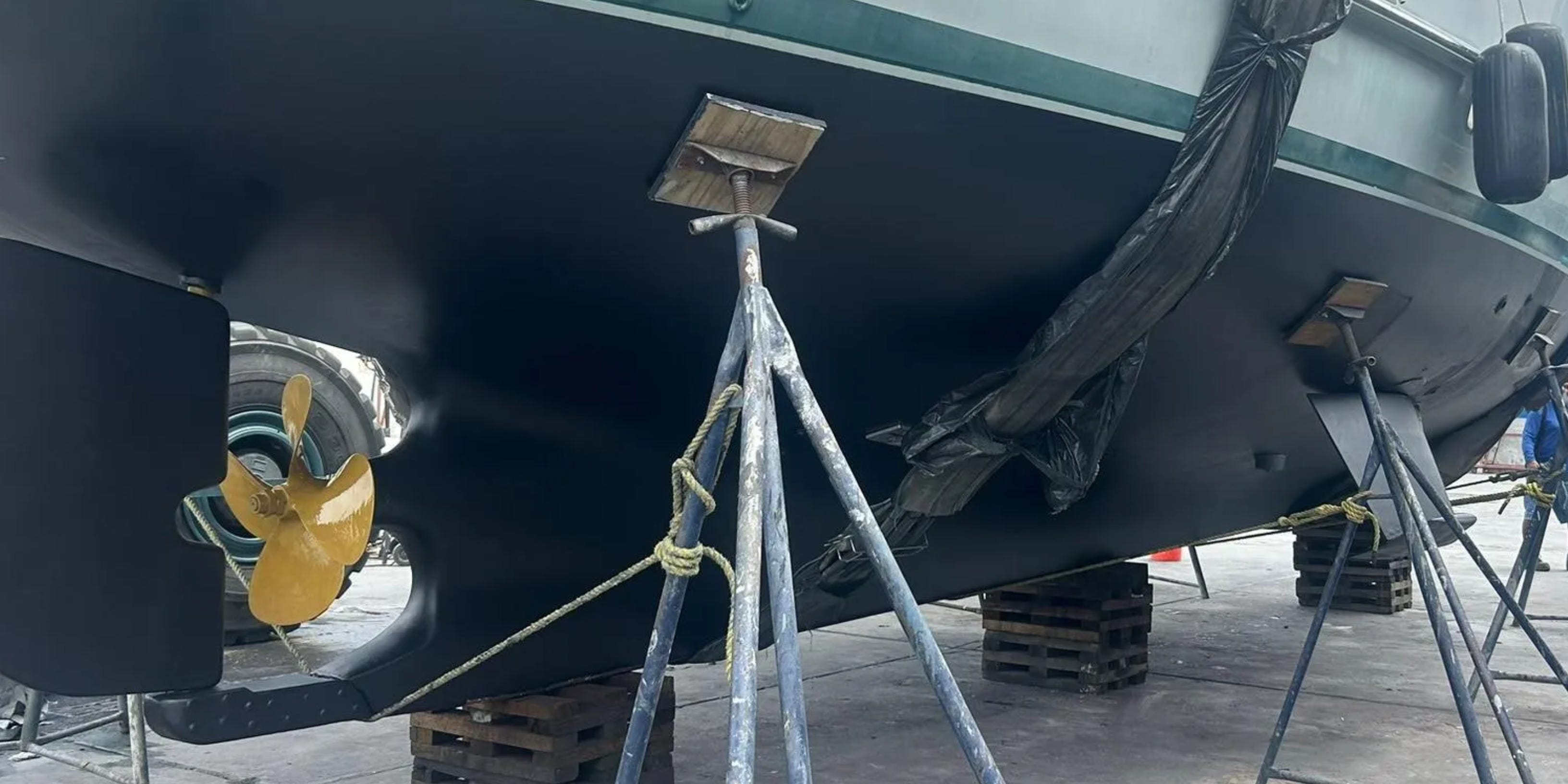
Her listing describes “an exceptional schedule of maintenance and refits” from 2021 to 2025, which in 2025 alone brought new below-waterline through-hulls and valves, a new keel cooler, rebuilt stabiliser rams, and a rebuilt Twin Disc gearbox.
Life aboard for a family of three
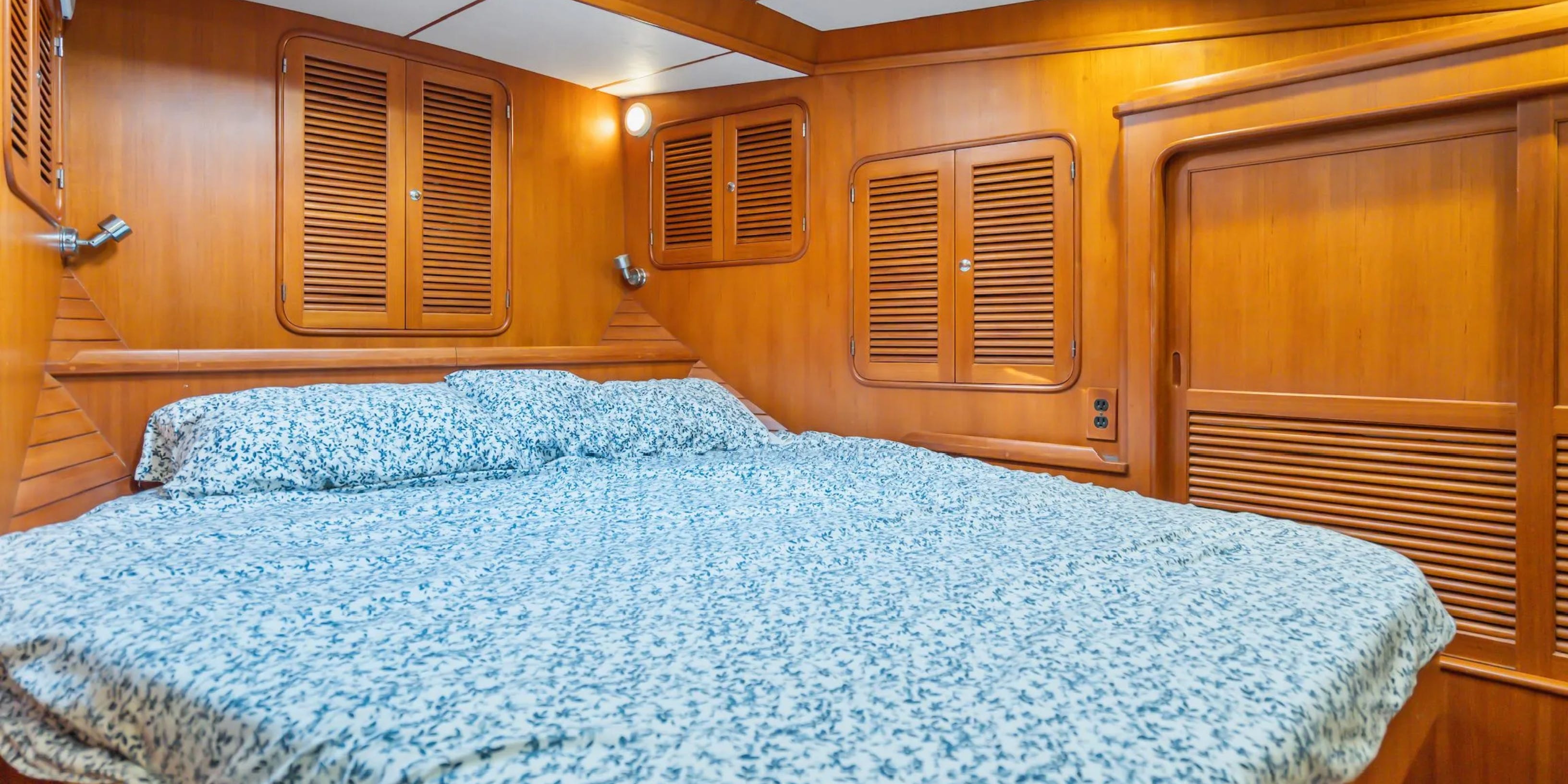
Inside, she has two cabins and two heads. The owner’s cabin forward has a centreline queen berth with access from both sides, so whoever has the next watch can slip out without climbing over anyone. The guest cabin amidships has over-and-under berths and a built-in desk, and the guest head has a separate stall shower. The saloon has an L-shaped settee, the galley runs athwartships to port, and the pilothouse has a raised settee and table with a pilot berth above and aft: a cosy spot for whoever’s off watch to rest close to the person on watch.
Nordhavn’s published fresh-water capacity for the 46 is about 280 US gallons (1,060 litres), a model figure, not a measurement of Lady Grey’s own tanks. At 5 US gallons (19 litres) per person per day, the middle of the 4 to 6 US gallons (15 to 23 litres) a SEA.NET provisioning guide suggests, a family of three would use about 15 US gallons (57 litres) a day, so the tanks would last about 18.7 days. That outlasts a 14.5-day crossing with the watermaker out of action, and it’s a handy yardstick for living aboard at anchor somewhere remote, too.
What the new 46 MkII kept and changed
Set Lady Grey beside the new Nordhavn 46 MkII I wrote about in August, and both are stabilised, ocean-going 46s. The MkII, though, has twin Nanni engines and Humphree 24-volt stabilisers, and Nordhavn says a Portuguese bridge would reduce her interior space, so she does without one. Lady Grey is the original recipe: one Lugger, a Portuguese bridge, and that rare flybridge.
Try her before you buy her
Lady Grey has worked as a charter boat, including a surf trip for Surfline, and Stu tells me a professional crew member looks after her every day. With the family back on their farm in Canada, he’s slowed the chartering down, but he still offers full-day or overnight charters on Banderas Bay (which can be a very useful introduction to anyone interested in buying her): $2,500 for a full day, or $3,000 overnight on a mooring with 12 hours underway, with the fee credited against the purchase, should a charter guest go on to become her next owner. If you are interested in chartering her, and don’t mind coming through me, then Stu has rather kindly said that he will pay me a referral commission, which helps to fund my travels when it comes to featuring explorer yachts on my channel.
This article continues below, in “The Wardroom”
A big thank you to every premium subscriber, existing and new alike. Your support keeps both the YouTube channel and this publication going, advert-free, so I can keep writing about and filming boats like Lady Grey.
In the premium section, I cover:
- What 1,250 US gallons (4,732 litres) across the Pacific would cost, and her hourly fuel bill on Banderas Bay
- How far her tanks take her at the crossing rate with a 10% reserve, with and without the bladders
- Why fibreglass fuel tanks matter on a Nordhavn 46, and the survey question I’d ask
- What I’d check on a trial charter day aboard
- What a single-engine ocean crossing asks of a crew
- My honest assessment: who she suits, and what she asks of her next owner
What 1,250 US gallons across the Pacific would cost
As ever, I’ve worked through the numbers from Stu’s crossing, so you don’t have to.
