‘£60 a Mile’: What It Really Took to Get Mat Armstrong’s 1991 Capri Across the Bay of Biscay
Part 2 of my Capri series: the jobs that made Mat Armstrong’s 35-year-old wooden yacht fit for sea, four days of fuel stops, a night with no radar, and what a trawler would have burned.

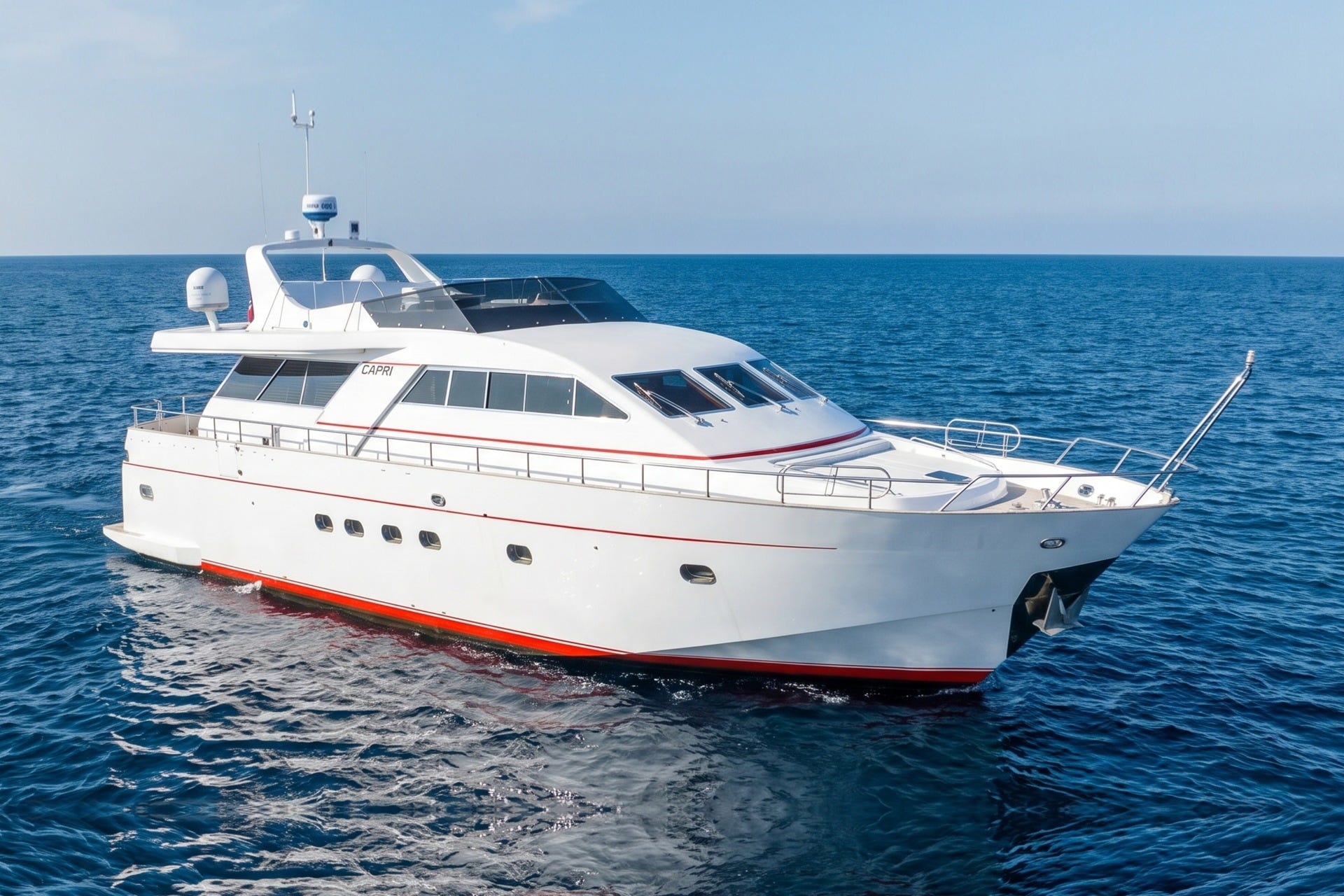
When I first wrote about Capri in October, Mat Armstrong had just found the closed seawater valve behind her overheating engines, and she still hadn’t left her berth. His second video about her went up on 1 November and had 15.9 million views within two weeks. It tackles the next problem: getting a 1991 Cantieri Navali Liguri Ghibli 22 from Santander, in northern Spain, to Southampton, where the full restoration can begin.
The professionals who looked her over didn’t think she was safe to sail as she was, and shipping her home on another vessel would have cost, in the words of Mat, over $70,000. So, guided by Maritime Yacht Services, Mat took the third option: fix enough to make her seaworthy, then take her across the Bay of Biscay himself, with a professional captain, James, his dad Tony and a small crew aboard.
Making her fit for sea
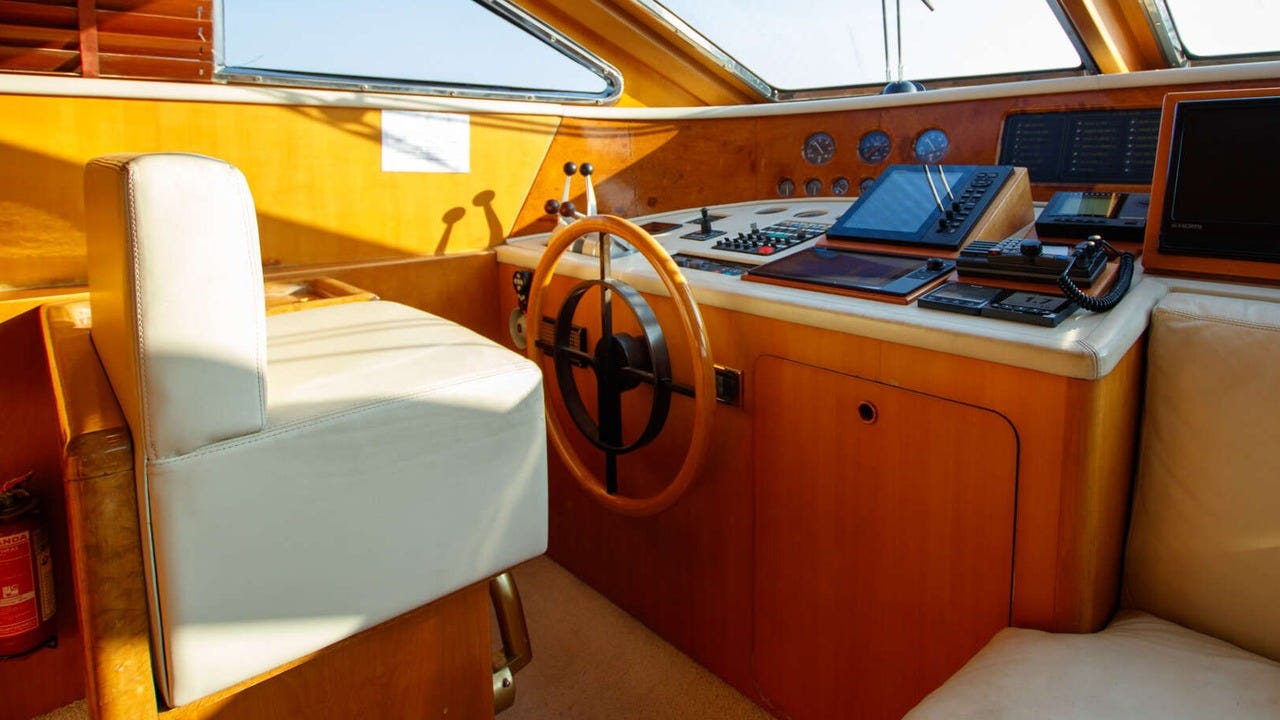
Photos from Capri’s earlier sale listing
Let’s start with the fuel. Capri carries 4,800 litres (1,268 US gallons) across three linked tanks that self-level (the old spec sheet I quoted last time listed two). One inspection cover was weeping diesel because its gasket had all but disintegrated, so the Maritime Yacht Services technicians pumped that tank across into the others, unbolted the cover and cut a new seal by hand, then did the same on the other two.
Then came the safety kit. All 16 of her domestic batteries were dead, so all 16 were replaced. The engine room’s old CO2 fire system was last serviced in 2010!? so it was switched to manual-only and two aerosol fire suppression units went in, set off by heat or from a control panel; without them, Mat says, he had no chance of insuring her for the crossing.

Four liferafts of unknown condition made way for two new 10-person ones, bilge pumps that didn’t work were replaced and rewired, and one generator had been bypassed with makeshift switches. The reason turned out to be its raw-water pump: the impeller was torn to shreds, most likely after a clogged strainer let it run dry, so the generator kept overheating and shutting itself down. Even the Italian switch labels at the lower helm were translated into English, which sounds trivial until you need the right switch in the middle of the night in a hurry.
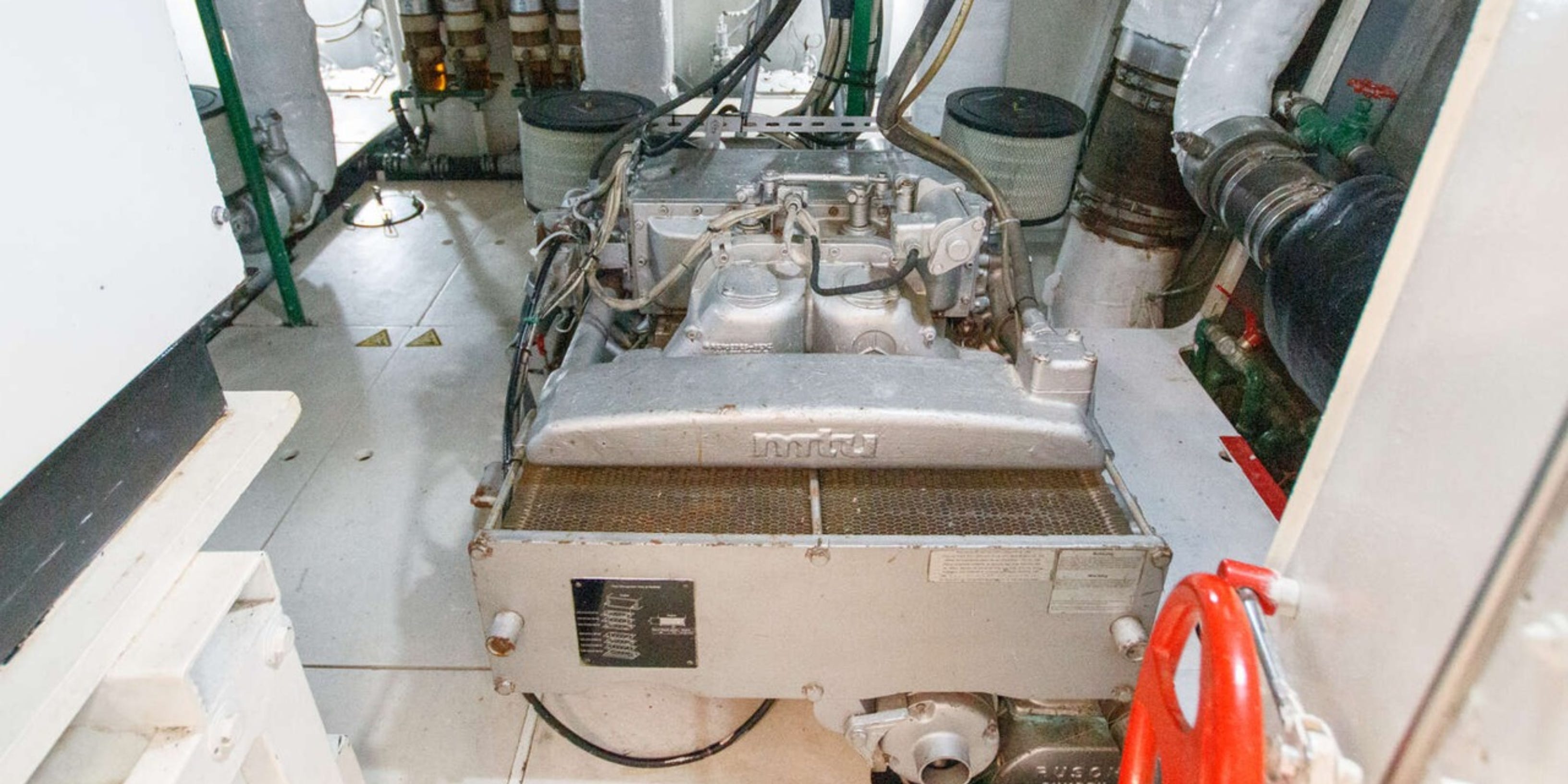
Both MTU V12s got a full service: 50 litres (13 US gallons) of 15W-40 each, hand-pumped out through the dipstick tube after a car fuel pump couldn’t cope with the thick oil, plus new oil, fuel, pre-fuel and air filters. A genuine MTU gasket cured a rocker cover leak; an oily boost pipe got a bead of RTV sealant that Mat himself called a bit of a botched job, good enough to get her home.
The fix I liked most cost nothing. In the first video, her starboard engine kept stalling at low revs, especially going into reverse. Reading the manual, Mat noticed the lever on that engine’s twin fuel filter housing was pushed hard over to one side, while the port engine’s sat in the middle. Mat thought that was the culprit, and once it was moved, the engine started first time with no sign of fuel starvation, although she did cut out once more on day three.
Housings like this are duplex filters, and the whole point of them is that you can shut one filter off and change its element with the engine still running. What the lever positions mean varies by make (on Volvo Penta’s, for example, normal running feeds through both filters at once). At sea, that ability to swap is your get-out-of-jail card, so which way the lever should sit is worth five minutes with the engine manual.
Four days, three flags
Before leaving, Capri swapped her Dutch registration for British, so the red ensign went up at the stern, with a Spanish courtesy flag. ‘Capri’ was already taken, Mat says, so she’s now ‘Capri One’.
Day one was the dream: calm water, about 90 NM from Santander to Hendaye, just over the French border, in around five hours, with a pod of dolphins playing around her. Biscay’s reputation comes from further out, where the seabed rises from more than 3,000 metres to around 100 metres at the edge of the continental shelf and Atlantic swell heaps up into a short, steep sea, which is why the plan hugged the coast in short hops. Even so, their second day at sea, bound for La Rochelle, turned into hours of slamming through the swell at a high rate of knots: ceiling lights came down, a plug socket worked loose, the fridge door kept flying open and the air filters shook off the turbos. They made 75 NM of a planned 140 and ducked into Arcachon.
Day three meant refuelling just north of La Rochelle with a predicted 25 cm under the keel, and the starboard engine cutting out on the way in, which the crew suspected was low or dirty fuel, then running on into the night. Day four was a dash for Brest, just ahead of Storm Austen.
Why she drank so much
Fuel was the shock of the trip. One fuel dock would only dispense €500 at a time before it ran out of diesel altogether, and by the stop north of La Rochelle, Mat said they’d already spent more than £4,000. That stop alone came to about €8,000 before his card reached its limit. Mat’s own round figure: “On average, it was £60 a mile.”
Mat put it down to speed and the rough sea, and the physics backs him up. Capri is built to go fast, with a listed 15-knot cruise and 30 knots top. Push any hull past its natural displacement speed and it has to climb its own bow wave, what PassageMaker’s Steve Zimmerman calls “climbing out of the hole”, and that transition is where fuel per NM climbs fastest. Slamming through a rough sea adds to it, and a 35-year-old wooden hull takes a beating at the same time. Easing back in conditions like day two is the cheapest thing a skipper can do, for the fuel bill and for the boat. So how much would slowing to 12 knots have saved? I’ve worked it out in the premium section, and it’s less than you might think.
A displacement trawler goes about it the other way. When I worked out Lady Grey’s 2,560 NM Pacific crossing for my article on her, the Nordhavn 46 averaged about 1.86 litres (0.49 US gallons) per NM, roughly $3.98 per NM at the fuel price then. The trade-off is time: at a trawler’s 7 knots, day one’s 90 NM would have taken about 13 hours instead of five. For a long passage, though, a hull that slips easily through the water is exactly why explorer yachts and trawlers are built the way they are.
Lady Grey is for sale on my website, see her listing, and you’ll find my other hand-picked explorer yachts for sale there too.
No radar, no AIS
On day three, Mat tied a sponsor’s flag to an antenna at the back of the boat because it looked good. The wind ripped the flag away and took the antenna with it, and the radar went too. I am not sure how or why a VHF antenna caused the radar to fail, as, when it comes to the magnetron in the radar ‘painting’ a picture of contacts on the radar screen, the two are completely separate from each other, so maybe it was just that the radar failing and the flag on the VHF antenna were coincidences.
That left about 40 NM, just over two hours, to run in the dark with no radar and no AIS into Saint-Nazaire, with wind farm lights flashing on both sides. James and the crew went up to the flybridge and picked their way in with old-school chart work and the cardinal marks.
Flags belong on a halyard, never an antenna; a courtesy flag, for instance, goes on the starboard spreader, according to the RYA.
Brest, and the right call
With Storm Austen’s amber warnings coming in, the crew made one more run to Brest, then stopped there rather than take on the Channel. “Kept everyone alive,” as one of the crew put it, and I think it was exactly the right call. The Bay of Biscay is behind her, both engines got her there, and Southampton is around 200 NM away.
This article continues below, in “The Wardroom”
A hugr you to everyone in The Wardroom, existing and new alike: your support keeps both the YouTube channel and this newsletter advert-free and independent, and lets me keep writing about and filming boats like Capri.
In the premium section, I cover:
The $70,000 question: what sailing her has cost so far on Mat’s own figures, and what a Nordhavn 46 would have burned over the same roughly 470 NM
What easing back from about 20 knots to 12 would have saved in fuel and money, and the speed where the real saving starts
The soft timber the crew found mid-voyage, and where I’d want a surveyor to start once she reaches Southampton
Why those hand-cut fuel tank seals deserve a second look before the Channel
What a boat under 400 GT can and can’t pump over the side
My honest assessment: shipping versus sailing, and what I’d sort before the last 200 NM
The $70,000 question
Mat’s video gives enough figures to answer it, so I’ve done the sums for you.
