

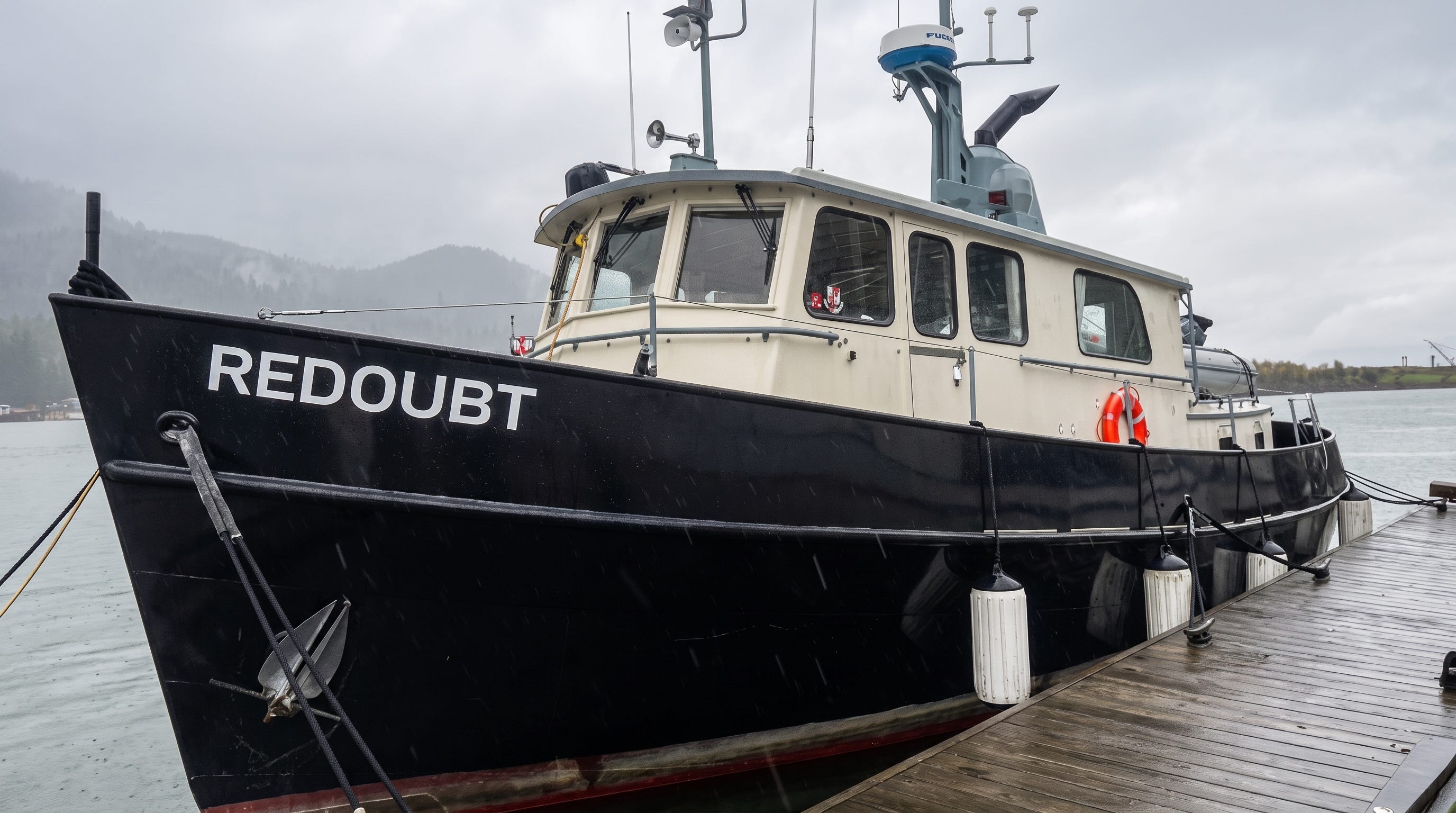
There is a certain type of capable explorer yacht (or ‘boat’ depending on your own interpretation of where ‘boat’ meets ‘yacht’) that gets built as a one-off because a visionary owner knows exactly what they need and, more importantly, what they do not need.
When a buyer finds a yard that understands this no-nonsense capability over luxury brief, then you get a very capable boat that has none of the usual “luxury” of a high-end motor yacht, but instead, all of the capability of a commercial vessel that is designed to be operated 365 days a year, in all weather types.
According to the register for Gladding-Hearn, a Somerset, Massachusetts yard that was established in 1955, hull number 34 of their build run was delivered in 1958 as a 39-foot vessel called ‘Pilgrim’, built for John Austin.
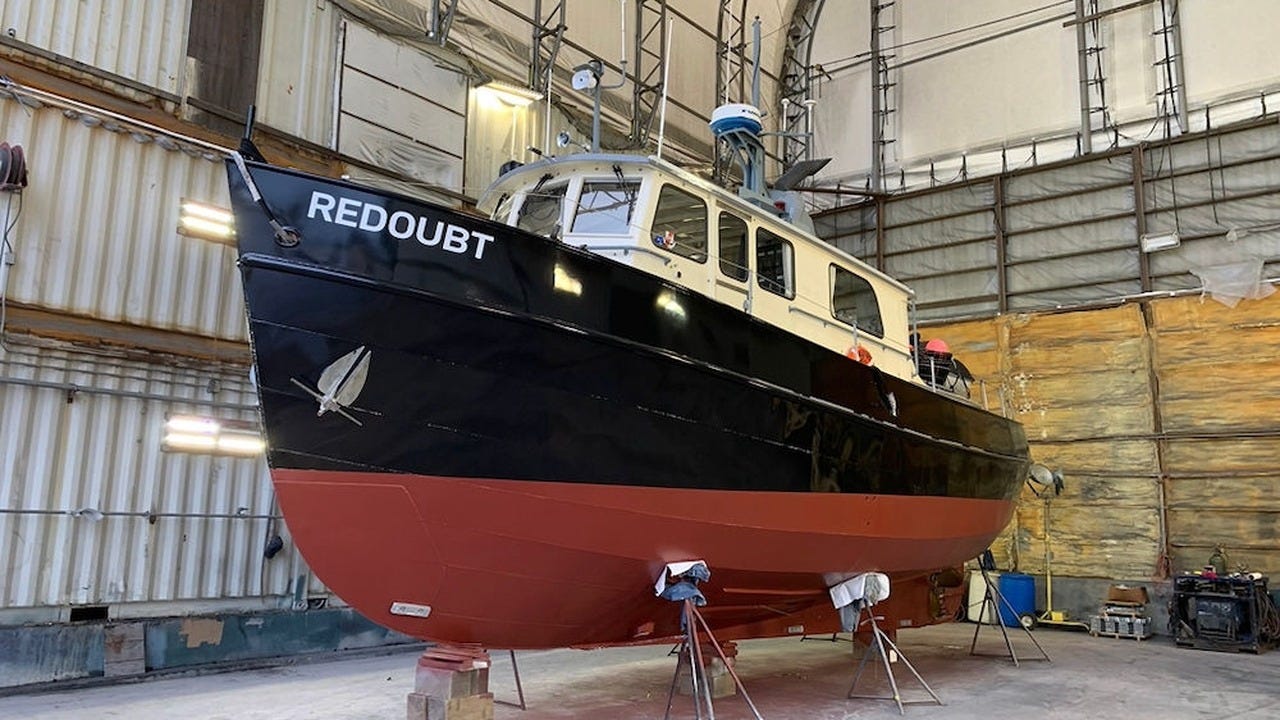
The same register notes that she is “now Redoubt”, the boat that I am going to feature in this article, and that is currently listed for sale for $147,000 and lying in Juneau, Alaska.
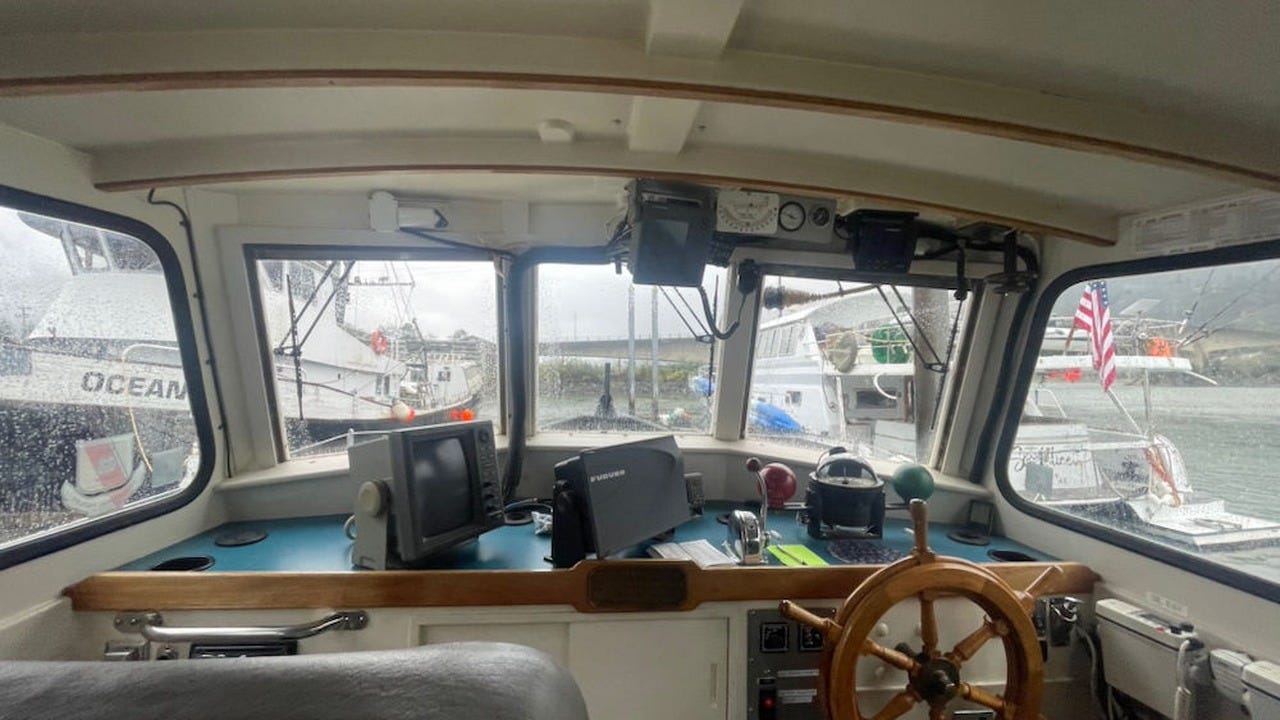
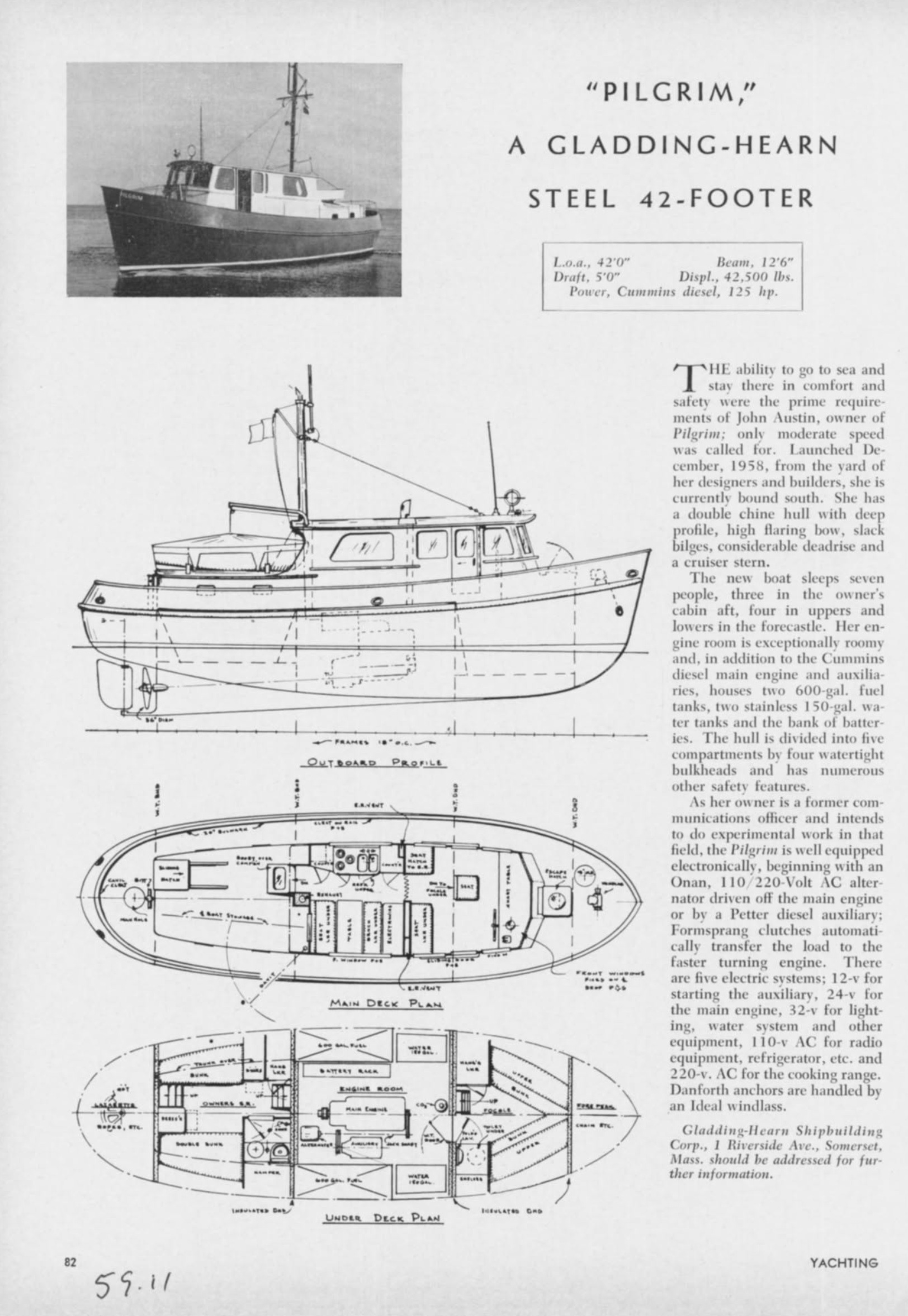
When I shared some pictures of Redoubt on my socials in order to let my 300,000 combined social media followers know about the boat that would be featured in my next article, a follower sent me a picture of what appears to be a 1950s feature written about ‘Pilgrim’in Yachting magazine.
The piece described her design brief, her original specifications, and her builder in great detail. It never ceases to amaze me when it comes to the collective knowledge of my social media followers, as this is something that my own research did not surface.
I am always humbled when I read the comments on my posts and realise that former owners, captains, designers (and their family members) are fed my content by an algorithm that seems to already know their connection to a boat that I am featuring, even if that connection happened decades ago.
What the Magazine Feature Describes
If the text in the image above is hard to read, the feature describes John Austin as a former comms officer whose brief to the yard was to build a no-nonsense boat that could head out to sea and stay there regardless of the season, wind or sea state. He was not bothered about a boat that could reach in excess of 20 knots. He was not in a rush, and did not want to have to worry about avoiding bad weather fronts that would keep most other boats tied up alongside.
The piece describes a double chine hull with a deep profile, a high flaring bow, slack bilges, considerable deadrise and a cruiser stern divided into five watertight compartments partitioned by four bulkheads.
For those who might be unfamiliar with the term, ‘slack bilges’ describes a hull geometry where the turn from the bottom to the topsides of the hull is a gentle, rounded curve rather than a sharp, hard angle.
Although a hard-chined hull offers good levels of stability when the boat is stationary, it can produce a harsh, almost snappy motion in large swells. So, slack bilges trade off that initial stiffness for ‘seakindliness’ offshore, allowing the hull to roll softly and more predictably in heavy sea states rather than fighting them.
Mr Austin clearly understood what it took to keep a boat at sea without having to worry too much about whether or not the boat was up to the challenge of gnarly weather.
The piece also gives an original engine spec of 125HP, a Cummins diesel and a displacement of 42,500lb. It goes on to describe an unusually elaborate electrical spec for a private motor boat of that era in the form of an Onan 110/220-volt AC alternator run off the main engine, a Petter diesel auxiliary, Formsprang automatic clutches and five separate electrical systems covering starting, the main engine, lighting, AC appliances and the galley.
The original tankage is stated as 2x600 gallon fuel tanks and 2x150 gallon stainless steel water tanks. The original sleeping arrangement comprised seven berths, three in the owner’s cabin aft and four forward in the forecastle. When the feature was published, she was reported as “currently bound south”, suggesting that perhaps she had recently left New England on an early delivery passage.
Pilgrim becomes Redoubt
What happened to this capable steel coastal explorer in the decades between her delivery in 1958 and her current listing status in Juneau is not something the available material that I could find documents.
The register gives her original length as 39 feet, whereas the current listing describes her length as 42 feet. A 3ft difference on a 1950s hull is usually a matter of documentation rather than being related to an actual structural alteration.
When ‘Pilgrim’ was originally entered into the yard’s register, length was often recorded as ‘Registered Length’ or ‘Length on deck’ and strictly measured the hull itself.
Today, most brokerage listings usually use ‘LOA’, which includes everything from the anchor pulpit or bowsprit to any swim platforms, etc.
The current fuel and water capacity (1,000 gallons and 270 gallons, respectively) is actually lower than the 1,200 gallons and 300 gallons in the original spec information. This could mean that her tankage was reconfigured at some point. But also, this loss of volume is a standard occurrence on vintage steel boats. As the original integrated tanks sometimes corrode over time, owners often install slightly smaller replacement tanks depending on their cruising requirements.
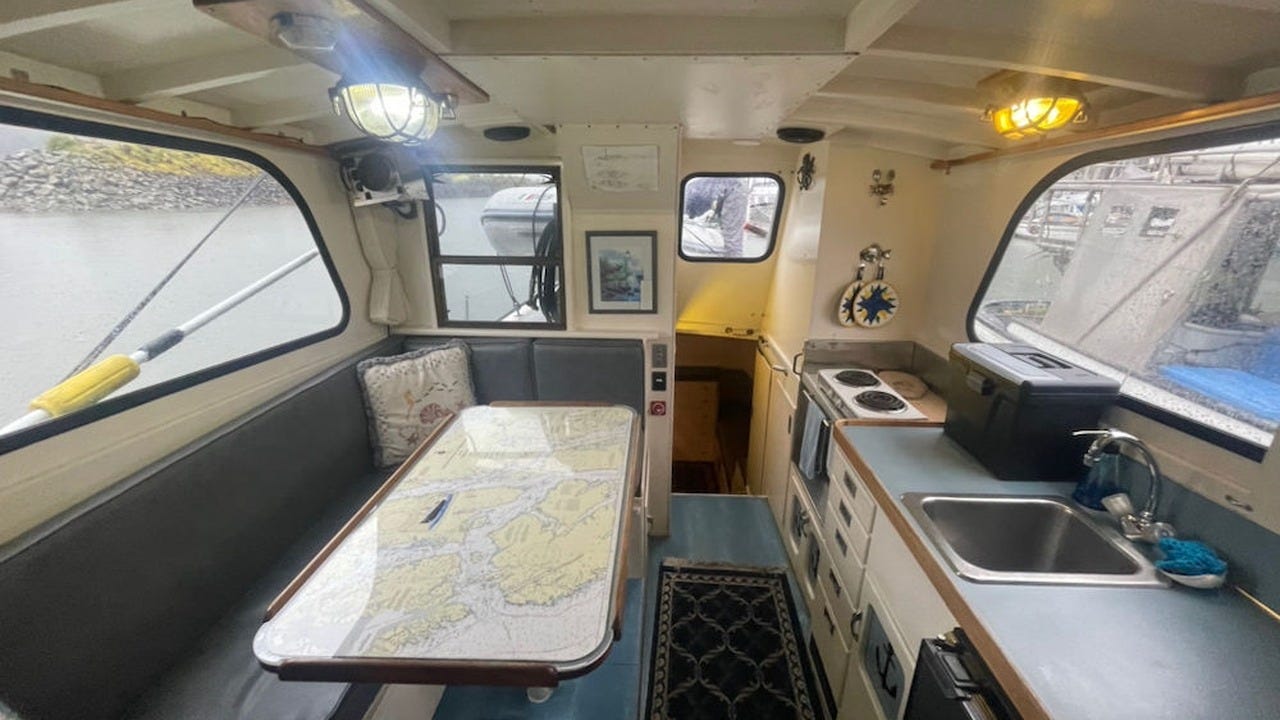
The current accommodation is advertised as 7 to 9 across two cabins as well as a convertible dinette.
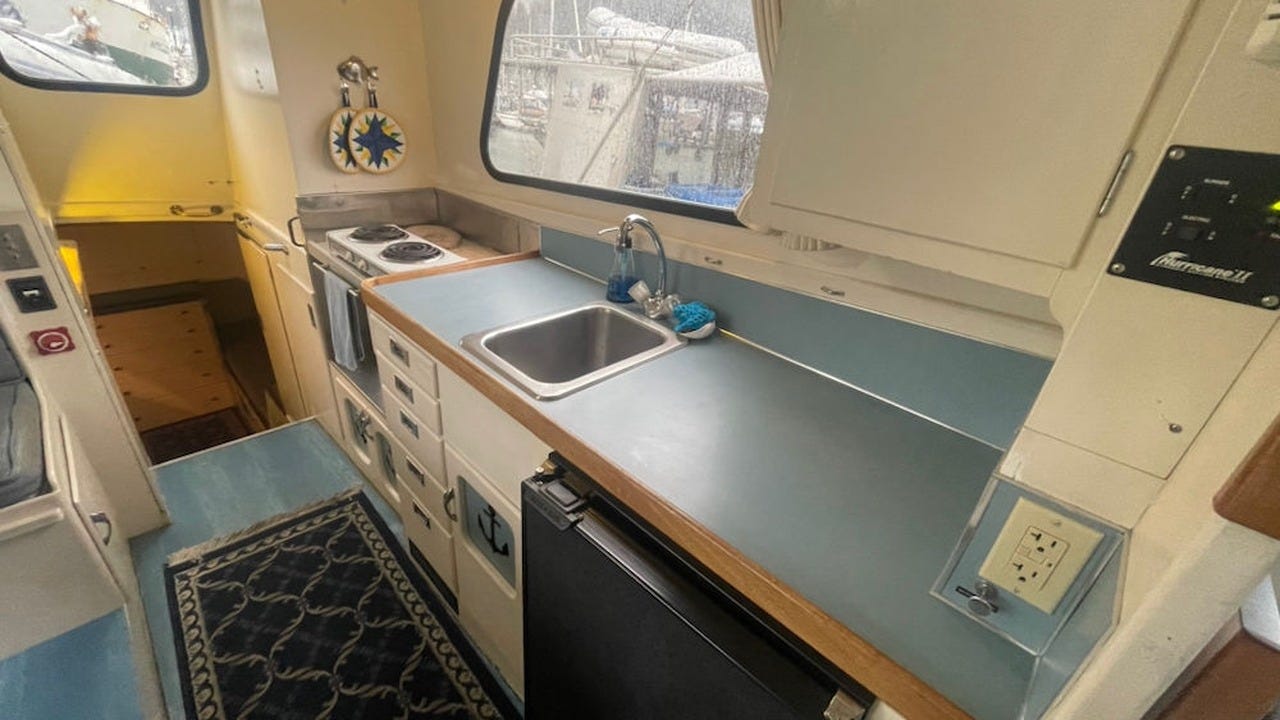
What Redoubt Offers Today
As per her current listing, Redoubt runs a single 175HP Cummins HR6M through a twin-disc MG509 gearbox. She has a dry exhaust, keel cooling and centrifuge oil cleaning. Since 2016, her engine has notched up 2,192 hours.
For readers who might be unfamiliar with commercial engine room specs, a centrifugal oil cleaner is a huge upgrade over the standard spin-on filters found in the bellies of most recreational craft.
By using engine oil pressure to spin a rotor at extremely high velocities, the device generates centrifugal forces that strip out microscopic soot and abrasive wear materials to literally a single micron.
This process prevents sludge, or dirty oil, from continuously looping through the bearings and cylinder liners, which in turn reduces internal wear and helps to preserve the mechanical integrity of the engine block. It is a very smart device to have installed.
The listing states a 7-knot cruising speed with a fuel burn of around 4 gallons per hour and a range of around 1,000 NM. When you run the numbers, you get a theoretical range of 1,750 NM before reserve and assuming normal load and conditions.
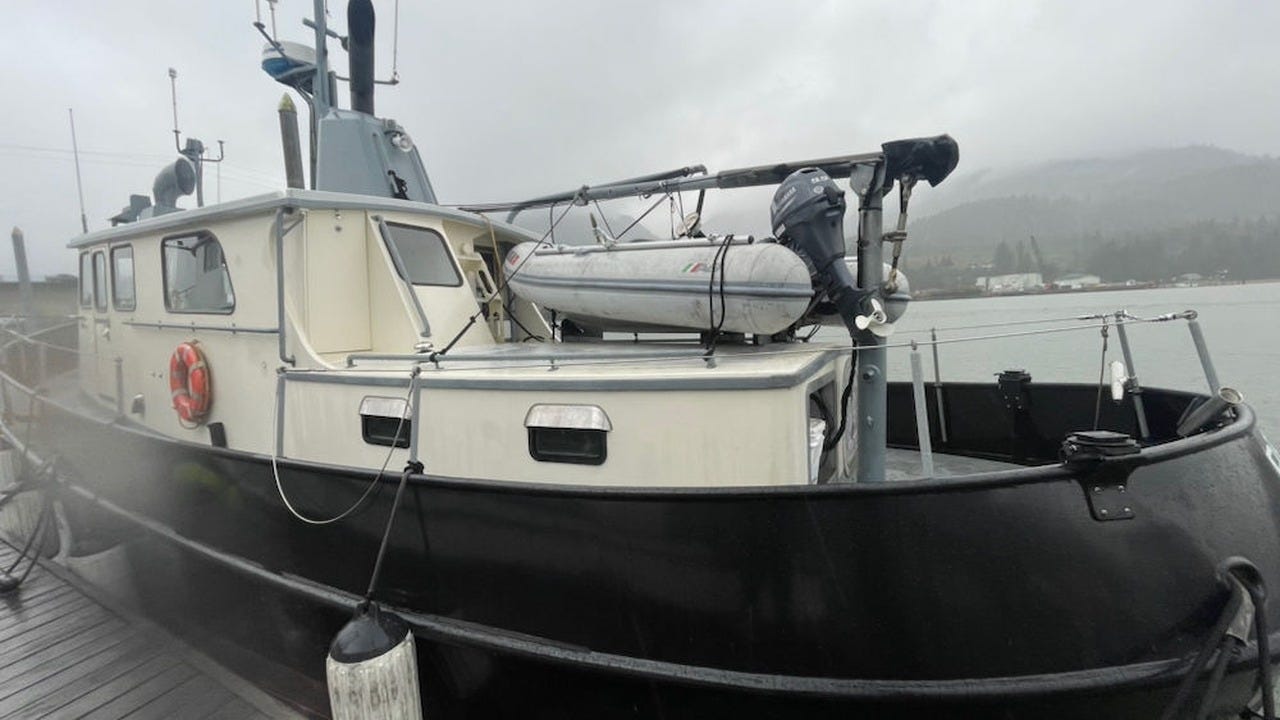
Beyond the equipment in her machinery spaces, the remainder of her equipment list reads exactly as a high-latitude explorer yacht should. The inclusion of hydronic heating and a Northern Light 6kW generator means that she can accommodate an owner who wants a four-season liveaboard platform.
Above deck, the walk-around deck allows safe line handling even in a seaway, whilst the pot puller, steel dinghy davit and Warn deck crane reflect her utilitarian priorities.
You might not be familiar with ‘Hydronic heating’, but it is a highly efficient climate-control system that uses a dedicated diesel boiler to heat a closed loop of recirculating water. The water is pumped through insulated lines to radiators of fan-matrix units, so you get dry heat to all zones without the big electrical load that a reverse-cycle AC unit needs.
I also love the fact that this boat has a pot puller, not because I like seafood; I actually cannot stomach eating anything that lives in the sea as it makes me want to heave, but it transforms the boat into a self-sufficient cruiser that is capable of harvesting its own food in remote anchorages.
This article continues below, in “The Wardroom”, as it’s my premium subscribers who enable me to keep this newsletter independent and advert-free. My premium Subscribers also enable me to travel around filming boats, which I think my audience will find interesting.
So, if you do become a premium subscriber, or are one already, then ‘thank you’
In the premium section below, I cover:
- What a nearly 70-year-old steel hull needs: ultrasonic thickness measurement, what it involves, and what a survey can and, perhaps more importantly, cannot tell you
- The engine and tankage questions worth finding out more about: a closer look at the horsepower difference and the current tank capacity
- The insurance conversation for older steel: what survey documentation insurers typically ask for
- My honest opinion of $147,00: what can and cannot be said about value without a survey and comparable listings in hand
