

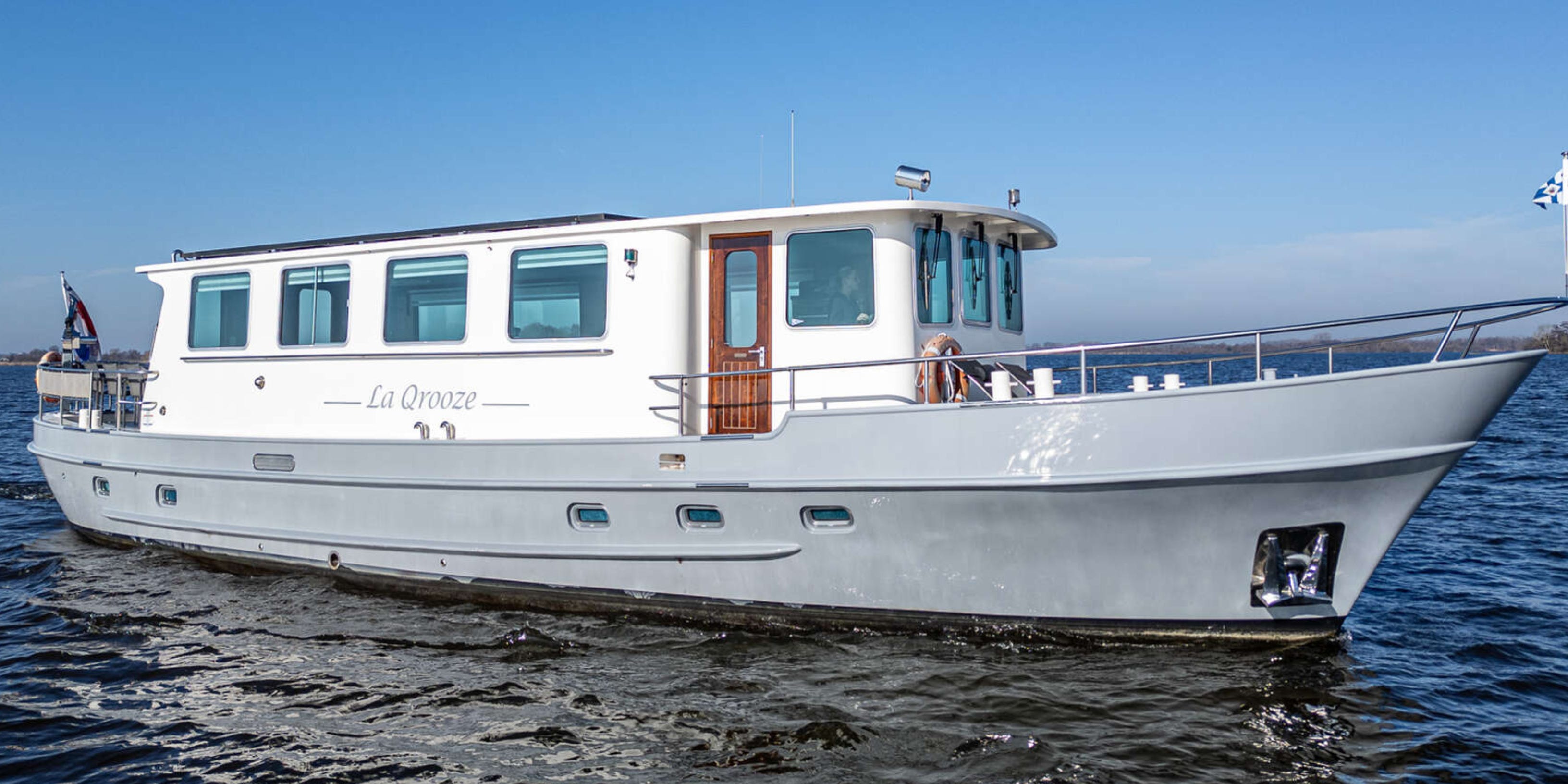
When I first spotted the designer credit on this vessel’s specification sheet, I did a double-take. Van Lent. Two words. Buried quietly in a line of Dutch technical data alongside steel hull colour and double-glazed windows. On almost any other boat of this age and asking price, that detail would pass without comment. On this one, it deserves a proper look.
Royal Van Lent Shipyard was established in 1849, with its roots in Lisse, in the bulb-growing heartland of the Netherlands. By 1877 the family had set up a working yard on Kaag Island, and by 1917 Cees van Lent and his brother-in-law Hein Akerboom had formally constituted Jachtwerf De Kaag, the yard that would carry the Van Lent name into the 20th century and beyond.
What came next is one of the defining chapters in Dutch maritime history: in 1949, Van Lent joined forces with Koninklijke De Vries Scheepsbouw and the naval architects De Voogt to form Feadship. That cooperative venture, born with the express ambition of targeting the American luxury market, would go on to build some of the most celebrated motor yachts ever launched. If you have seen a Feadship, you have seen the Van Lent legacy at its most refined.
This vessel was laid down in 1956, just 7 years into the Feadship era. She is not a Feadship, and she does not carry a Feadship price tag. But she carries Van Lent design pedigree from the period when that name was at the height of its creative energy, building bespoke steel hulls for owners who wanted craftsmanship over catalogue. That is a heritage worth understanding.
The vessel and her transformation
She measures 18.19 metres by 4.20 metres, with a draught of 1.85 metres and a displacement of 55 tonnes. The hull is steel, built to the round bilge form that characterised Dutch quality motor yachts of that era: smooth, sea-kindly lines that prioritise motion comfort over a sharp entry speed. She was built to last, and 70 years later, she is still very much in service.
In 2008, she underwent a comprehensive transformation into her current configuration as a high-specification live-aboard. The interior was stripped and rebuilt with a teak finish throughout, granite kitchen worktops, and a layout designed around sustained habitation rather than occasional weekend use. Three cabins accommodating eight berths, including a king-size owner’s suite with en-suite bathroom and a second king-size guest cabin. The third cabin runs four stacked berths. The salon features electric blackout blinds, an AEG induction galley, an AEG combination oven, a Liebherr fridge and dedicated Liebherr drawer, and an AEG dishwasher.
None of this feels like a boatyard’s interpretation of domestic comfort. It feels like a home, thoughtfully done, designed by someone who was going to live here.
She holds 4,000 litres of fuel and 2,000 litres of fresh water, which for an 18-metre vessel on the inland waterway network represents genuinely useful range and endurance. The 500-litre holding tank is correctly sized for the vessel’s displacement. The deck crane is electric. She has a deck shower, three LCD televisions, and a Bosch washer-dryer combination in the third cabin. She carries a 2025 CVO certificate, which means she has recently passed the Dutch inland waterway compliance inspection. That certificate matters: it is not a tick-box exercise.
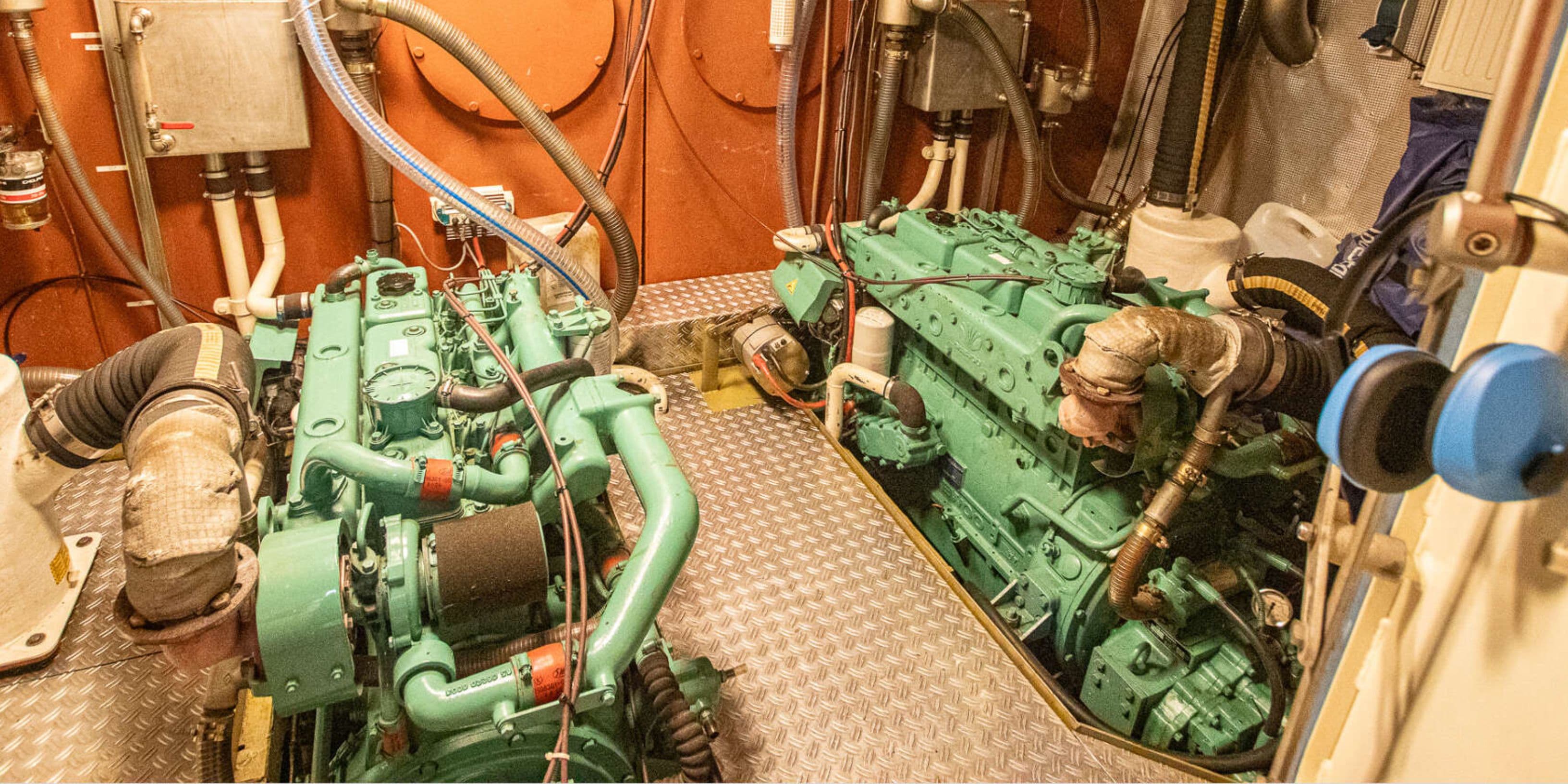
What is under the deck lid
The propulsion package is twin Daewoo MD126T diesels, each producing 200 horsepower at 147 kilowatts, driving fixed-pitch propellers via stainless steel shafts with hydraulic gearboxes. The Daewoo MD126T is a South Korean-designed marine diesel that entered commercial service in the 1990s. Daewoo’s marine engine division eventually became part of the broader Doosan Infracore group, and today the engines operate under Doosan branding in most markets. They have a workmanlike reputation: robust, straightforward four-stroke diesels without the complexity of modern common rail injection, which makes them relatively accessible for competent engineers. At 1,200 hours, these engines have not been pushed hard. For a vessel in this displacement class, 1,200 hours represents conservative use, and there is no suggestion in the specification of any major mechanical intervention.
The vessel also carries a Westerbeke generator with 923 hours recorded, running on what the spec describes as a silent separator configuration. Westerbeke is a dependable name in boat generator circles, with a long history of reliability in live-aboard applications.
Got a boat?
Know of a vessel, for sale, charter, or otherwise, that you would like me to feature in a future dispatch? You can send me a direct message or email me via john@yacht-buoy.com
On the electrical side, this is where the 2008 refit has clearly continued to be updated. The battery bank is marked as 2025, which means the cells are effectively new. Charging is handled by a Victron Quattro 24/8000/200 inverter-charger, an industry benchmark unit capable of 8,000 watts of inverter output and 200 amps of charging current. Battery monitoring runs through a Victron system, and the system also incorporates a Victron isolation transformer for shore power. Solar input comes from eight panels, managed by four Mastervolt Solar Charge Master 60 controllers.
This is a properly engineered off-grid electrical architecture, not an afterthought.
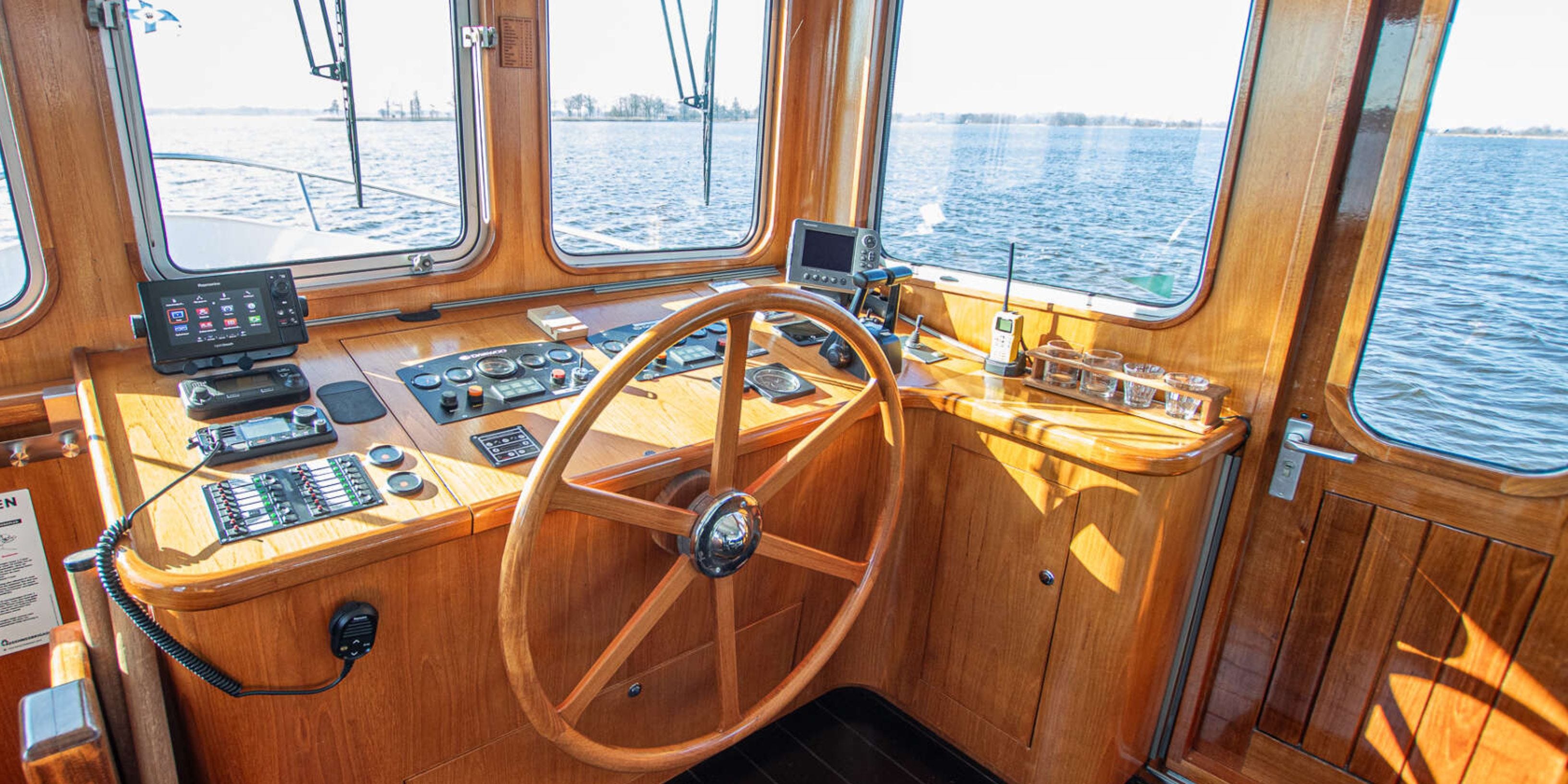
Navigation is Raymarine throughout: Hybrid Touch plotter, A70D depth/fish finder, autopilot, electronic compass, and an Em-Trak A100 AIS transceiver. For European inland waterways and coastal passages, this is a complete and functional fit-out. There is no radar in the specification, which is worth noting for anyone intending coastal use in reduced visibility.
Heating is central, via an ACV Alfa system. For northern European winters aboard, a reliable central heating plant is not a luxury item. The ACV Alfa is a Belgian brand with a solid reputation in the live-aboard community.
Who is this vessel for?
This is where the answer gets specific, and it is worth being direct about it.
The Custom Built Live Aboard 1800 is not a coastal passage-maker. Her draught of 1.85 metres and her 55-tonne displacement are comfortable for the Dutch inland waterway network and the broad canals of Belgium, France, and Germany. She will handle harbour approaches and river moorings without difficulty. She is not designed for open-sea passages in the manner of a bluewater expedition yacht.
What she is, is an exceptionally well-appointed floating home for someone who wants to live aboard in comfort across the European waterway system, with the ability to make protected coastal movements between countries. The CVO certificate confirms she meets the standards required for that use. The Victron electrical system, the central heating, the washer-dryer, the full galley with dishwasher and induction cooking, and the three-cabin layout make her genuinely liveable for a couple or a small family over extended periods.
She would suit a buyer who has grown out of marina-based living but is not yet seeking the Atlantic circuit. Perhaps someone with a flexible working life, a desire to spend months at a time in Amsterdam, Bruges, Paris, or the Rhine valley, and the confidence to manage a 70-year-old steel vessel with experienced professional help.
The premium section below covers the question a lot of you ask in the comments: what would it actually cost to get this vessel to North America, what are the customs and compliance hurdles, and is the maths realistic for a US buyer?
The cost of bringing her to America
This is a question that comes up every time I feature a well-priced European vessel on my YouTube channel, and it deserves a thorough answer rather than a vague hand-wave. Let me walk through the full picture.
