

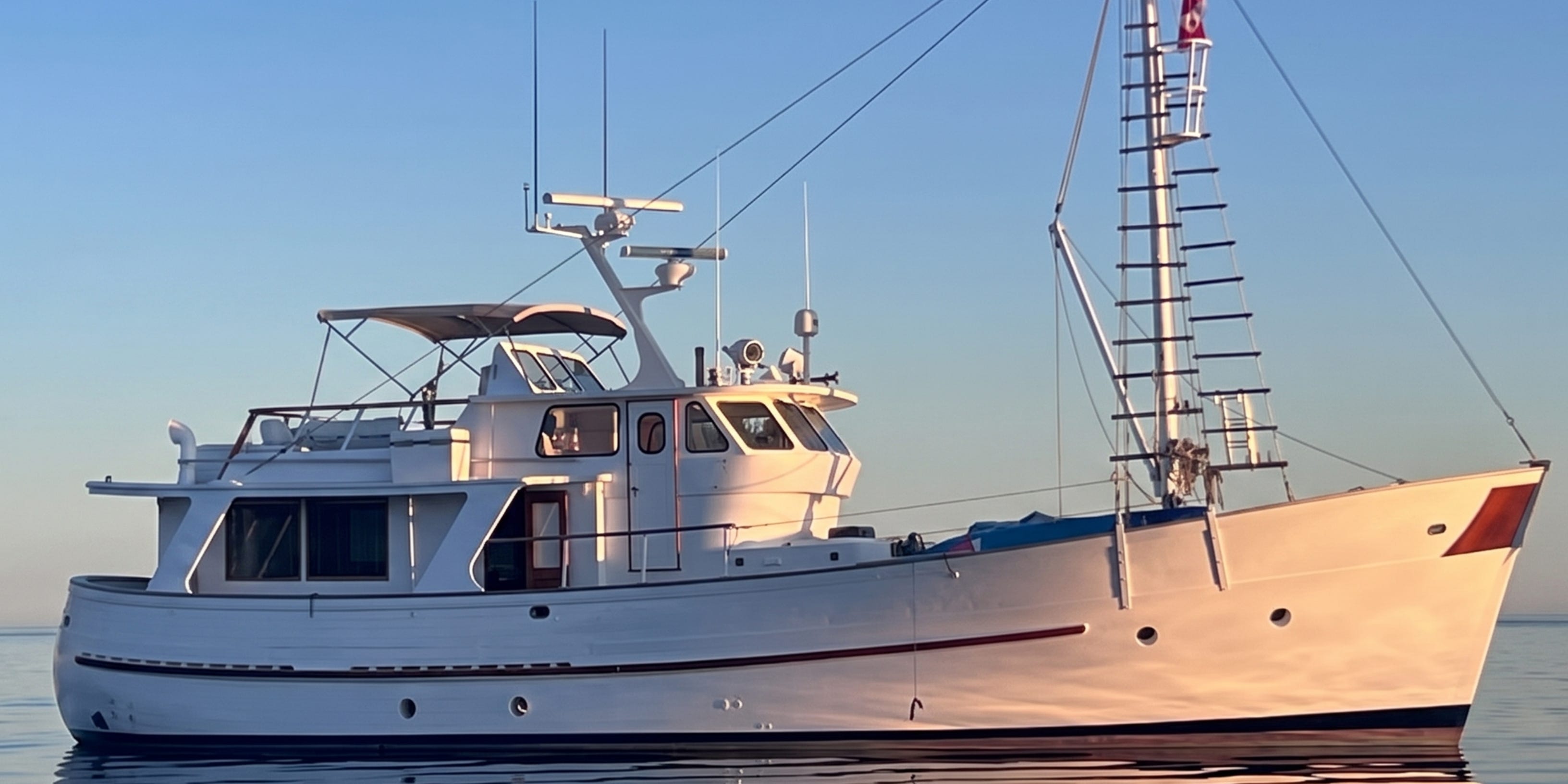
A reader got in touch to point me toward this one, and I am glad they did. If you know a boat with a story worth telling, I want to hear about it too.
I want to start with a video (credit: Off Center Harbor), because it puts you straight aboard in a way words on a page cannot.
It is a short piece, filmed by Off Center Harbor, one of the better classic-boat channels doing this kind of work, and it puts you on deck with George and Patrice, the couple who own and live aboard her now. George explains the boat in the first thirty seconds, and it is worth repeating word for word: “This boat was drawn by Bill Garden for neighbours of his near Vancouver Island, British Columbia. So it’s a very local boat in all kinds of ways. The materials it’s built with are local. Douglas fir, white oak, and red cedar.”
Then the detail that matters most to anyone actually considering a boat like this: “It’s a long-range seaworthy boat. And we’ve taken it to Southeast Alaska and back. So that’s the range of the boat since I’ve had it, Pacific Northwest to Southeast Alaska.”
That is an owner, on camera, telling you exactly where he has taken his boat.
Her name is Arctic Light, however, as is often the case, she was not always called that.
The Name She Was Born With
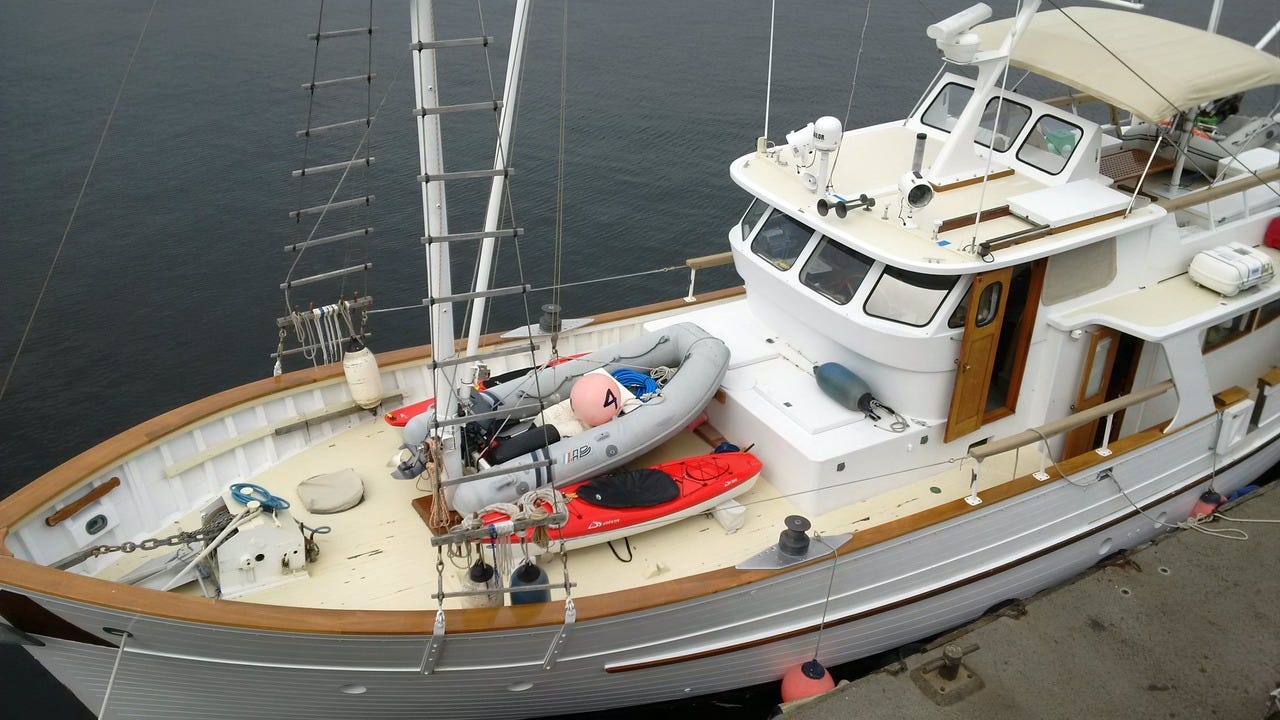
Before Arctic Light, she carried two other names. She was launched as Ocean Lady, the name she kept for her first year or two on the water, before becoming Nisku, the name she held for the 25 years Duane owned her. She was later renamed Griffin during a subsequent owner’s tenure, before taking on her current name, Arctic Light. She was drawn in 1970 by William Garden, one of the most significant naval architects the Pacific Northwest has ever produced, and built by Bent Jespersen, working alongside Dave and Kathy Thomas, at Philbrook’s Boatyard in Sidney, British Columbia.
I have written about a Garden design before, a 1952 Fellows & Stewart trawler called JoAhna K, and if you read that piece you will already know why his name carries weight in the explorer yacht community (both owners and enthusiasts).
Garden designed more than 1,000 vessels spanning 60 incredible years, and an estimated 6,000 of them were actually built. His 36-foot Willard Vega effectively created the modern heavy-displacement trawler yacht category. His 42-foot Wanderer tri-cabin motoryacht was copied so widely by Taiwanese builders in the 1970s that it defined an entire era of production cruising boats. Mystic Seaport holds 675 of his designs in their permanent collection. In 2006, Canada made him a Member of the Order of Canada for his contribution to naval architecture and marine engineering.
Arctic Light is described, in the Classic Yacht Register’s own words, as “one of the most iconic of the yachts designed by William Garden” and a representation of “the finest of Pacific Northwest boat design and craftsmanship.” That is how the classic yacht world itself talks about her.
Got a boat?
Know of a vessel, for sale, charter, or otherwise, that you would like me to feature in a future dispatch? You can send me a direct message or email me via john@yacht-buoy.com
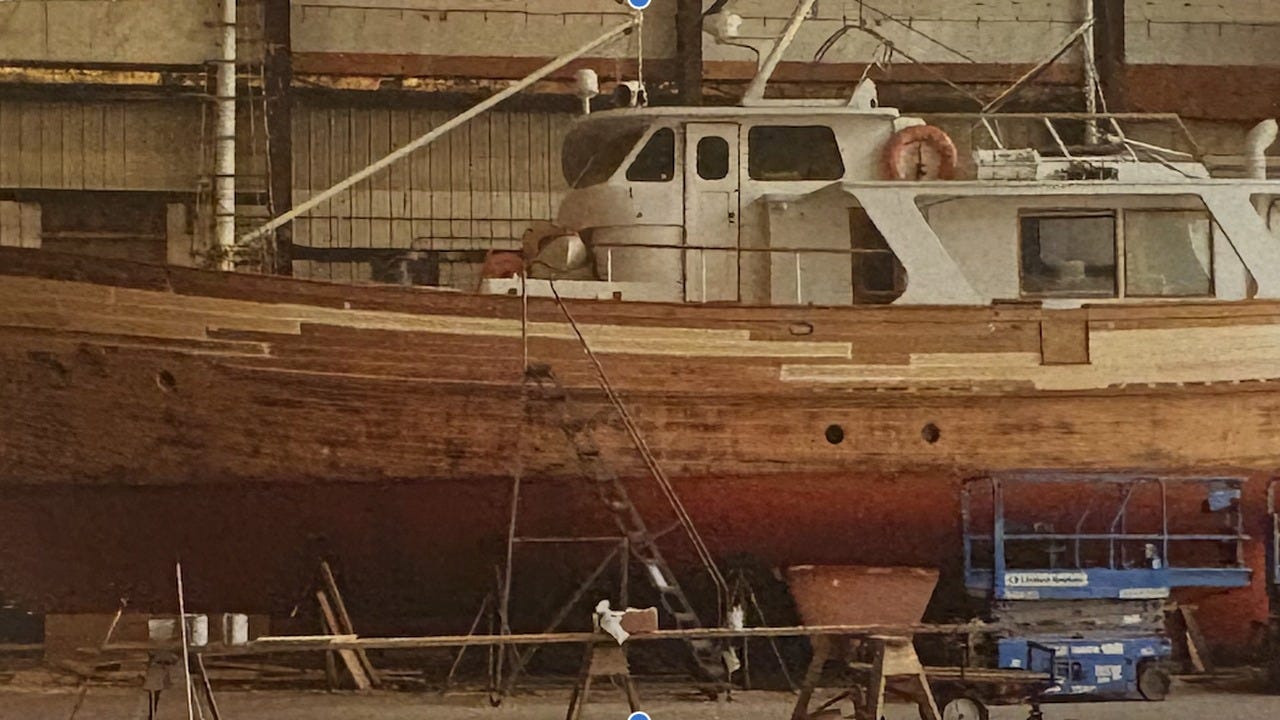
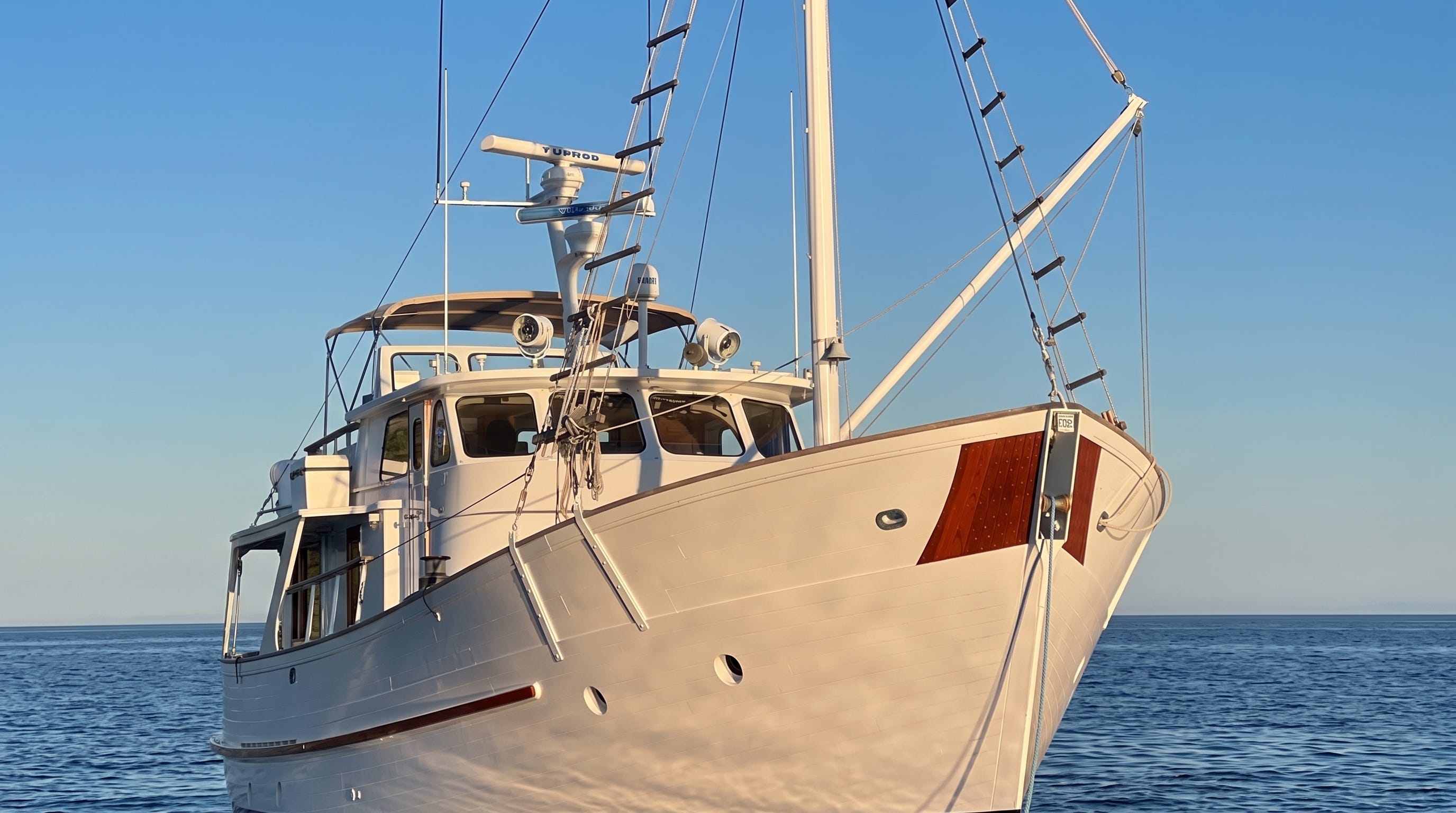
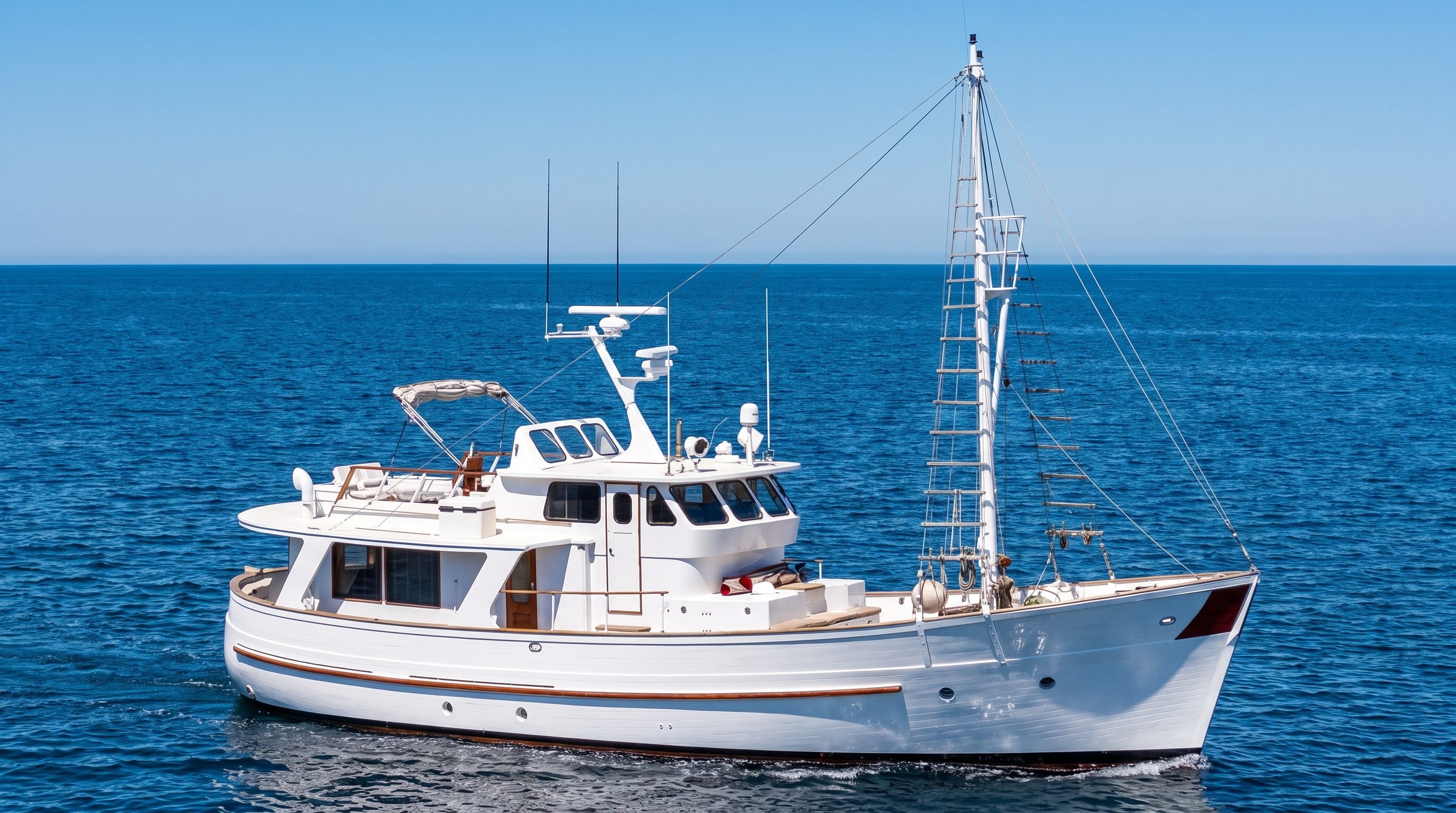
She is built the way boats from that yard and that era were meant to be built: red cedar and Douglas fir carvel planking over steam-bent white oak frames, on a 7.5-inch by 14-inch by 56-foot Douglas fir keel. A gum wood stem, raked, with a canoe stern. Deck beams of yellow cedar. Decks of vertical-grain Douglas fir over two layers of plywood and epoxy. This is not a boat that was built quickly, or cheaply, or to a production template. It was built by a small yard, to one man’s drawings, for a specific working purpose on a specific stretch of coastline.
None of those material choices were accidental. Douglas fir was the backbone timber of Pacific Northwest boatbuilding for good reason: straight grained and strong for its weight, and growing right on the doorstep of yards like Philbrook’s. It is why Garden specified it for the keel and the decking, the places that need to carry load without adding unnecessary weight aloft.
White oak went into the frames because it bends beautifully under steam and holds its shape once it cools, exactly what a hull full of curves needs. Red cedar did the planking work because it resists rot and marine borers naturally, stays light, and has been the timber of choice on this coast for boats and canoes alike for longer than anyone has kept records. Put together, it is a hull built from what the coastline itself provided, chosen because it worked, not because it was cheap or fashionable.
That combination of timbers was about to earn its keep. Her working life began at Hakai Pass…
The Lodge at the End of the World
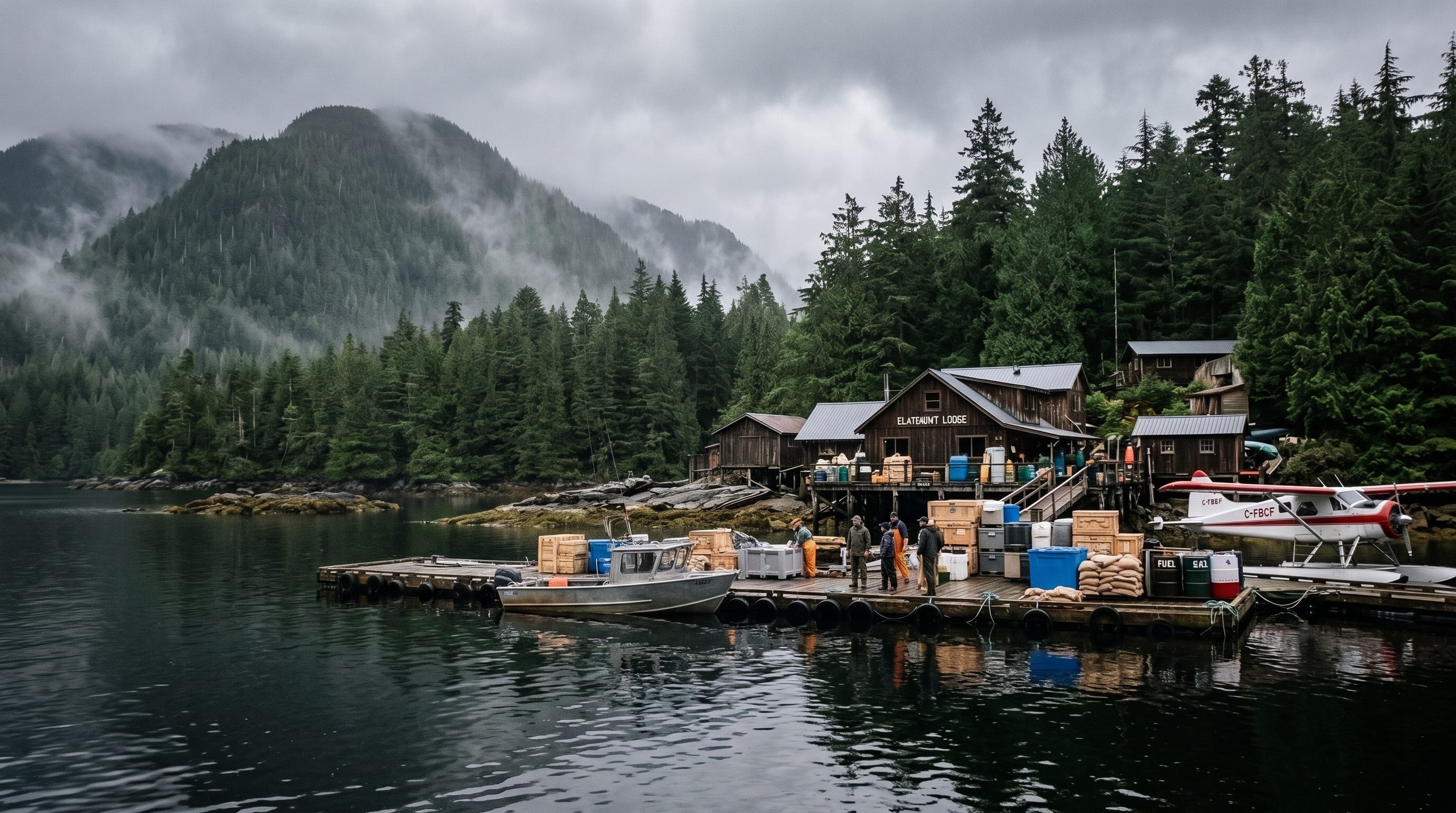
If you have never heard of Hakai Pass, you are not alone, and that is rather the point. It sits on the remote central coast of British Columbia, inside the Hakai Lúxvbálís Conservancy, reachable only by boat or floatplane, and it has been quietly famous among serious salmon and halibut anglers for decades as some of the best fishing water on the entire Pacific coast.
For many years, Nisku, as she was then known, worked those waters under Dwain Howard, supporting the construction and operation of what became the premier fishing lodge at Hakai Pass. This was not decorative work. A remote lodge on an unreachable stretch of coastline needs a genuinely capable vessel to keep it running: moving people, moving supplies, moving equipment, in conditions that do not care whether you are in a hurry. That is exactly the kind of work a William Garden North Sea Trawler Yacht was drawn to do, and exactly the kind of work she did.
A boat that has spent years earning its keep on a coastline like that has nothing left to prove about seaworthiness. The only remaining question is what happened to her afterwards.
From Working Boat to Expedition Life
What happened afterwards is that she found her way to two people who understood exactly what they were looking at.
Her current owners are, in their own words, an expedition ship captain and a documentary filmmaker. That is not a casual pairing of professions. One of them has spent a working life at sea, likely on vessels considerably larger and more demanding than Arctic Light, and understands precisely what a boat needs to be reliable somewhere remote. The other has spent a working life capturing places most people never see, and understands precisely what it takes logistically to get a crew and equipment there and back safely.
Between them, they have kept Arctic Light not as a museum piece but as a genuinely operated vessel. All mechanical, structural, household, navigation and safety systems have, per the owners’ own account, been modernised, upgraded, or determined to be satisfactory. This is a boat being used the way she was designed to be used: on the coastal waters of the Salish and Haida Nations, up through British Columbia and into Alaska. George’s own words in the Off Center Harbor video confirm it directly. Southeast Alaska and back.
On camera, Patrice talks about the salon as “really one of the most important spaces on the vessel, because this is where we do a lot of our socialising,” and points out the galley: “We’ve got a really good gas stove because I love to cook, and this was a really nice feature in stainless steel to match the fridge.” George talks about the foredeck as one of the features that drew him to the boat in the first place, a place “to experience whatever region we’re in, wildlife encounters, bird encounters, your environment.” Patrice again: “This is a great place to hang out, especially on the sunny days, because you just have this great vista where you can stand out and see all the nature, wildlife. It’s awesome.”
George sums up what the boat actually is for them in a single line: “This boat is really a vehicle for the natural world.”
That is not language written by a copywriter trying to sell a boat. That is two people who live aboard her, describing what she means to them.
What She Is, In Numbers
Set the story aside for a moment, because the specification stands on its own.
Arctic Light measures 58 feet on deck, with a 16.5-foot beam and a 7.5-foot draft, displacing 120,000 lbs. She is powered by a single Caterpillar D-333 diesel, with approximately 2,000 hours on a rebuild. She carries 2,000 gallons of fuel and 600 gallons of water, and cruises at 8 knots burning approximately 3 gallons per hour. Work that through and her theoretical range comes out at roughly 5,300 nautical miles on a single tank. Real-world range always sits below the theoretical figure once current, weather and a sensible reserve are factored in, so I would plan around 3,200 to 3,700 nautical miles for actual passage planning. Either way, that is Pacific Northwest to Southeast Alaska and back with plenty in reserve, exactly the route George confirmed in the video above, and enough to make a good many other passages realistic too.
She is fitted with Naiad 254 active roll stabilisation, two Northern Lights generators (an 8kW and an 18kW unit), and an Accusteer/Comnav autopilot. She is a U.S.C.G. documented vessel, imported into Canada, and currently berthed at Van Isle Marina on Vancouver Island, in Sidney, British Columbia, not far from the yard where she was built more than half a century ago.
A single main engine on a vessel like this is worth pausing on, because, as always, it is a genuine point of discussion, and I will come back to it in detail in The Wardroom below, alongside what a Caterpillar D-333 actually means for parts availability, serviceability, and passage planning in 2026.
The Part That Makes This Different
Here is where this story departs from most of what I write.
I went looking for a brokerage listing for Arctic Light. There is not one. Not on YachtWorld, not on boats.com, not on BoatTrader, not through Camper & Nicholsons or Northrop & Johnson, not even through Van Isle Marina’s own current inventory, where she is berthed. She is simply not there.
What that tells me is that this is being handled quietly, off-market, direct between owner and buyer, or through a channel that has not yet reached the major portals. It happens more often than you would think with vessels of genuine pedigree. The right buyer for a boat like this is not scrolling YachtWorld on a Tuesday evening. They are the kind of person who already knows what a William Garden North Sea Trawler Yacht is, and who hears about a good one through exactly the kind of network this story is part of.
There is no asking price attached to Arctic Light, at least not one I can find anywhere public. She is, as far as I can tell, offered at POA. I am not going to invent a number to fill that gap, and I would encourage you to treat anyone who does with some suspicion.
What I can tell you, in The Wardroom, is what a boat like this is actually worth working out for yourself: what a single Caterpillar D-333 means for reliability and running costs against the twin-engine alternatives more common in this size range, what a 1970 timber hull of this specification should cost to maintain on the BC coast, what buying a boat with no listed price actually looks like in practice, and how her Hakai Pass working history should factor into any serious survey.
This article continues below, in “The Wardroom”
In the premium section, I cover:
- The single-engine question: what a lone Caterpillar D-333 means for redundancy, serviceability and parts availability compared with the twin-engine layout more typical of vessels this size, and what I would want confirmed before any offer
- The timber hull reality: what 56 years of red cedar, Douglas fir and white oak actually costs to maintain on the British Columbia coast, and the survey questions that matter most given her working history
- Buying a boat with no price: how a genuine POA sale actually works in practice, why the current market makes a fixed asking price genuinely difficult to justify, and how to approach an off-market vessel like this without a broker in the middle
- My honest assessment of what Arctic Light is actually worth: a realistic value range based on comparable William Garden trawlers, her Hakai Pass provenance, and the condition her current owners describe
The Wardroom
The Single-Engine Question
A lot of buyers see a single main engine on a 58-foot expedition boat and instinctively read it as a compromise. On Arctic Light, I would argue the opposite.
