

When Billy Joel acquired this explorer yacht back in 2007 and renamed her ‘Audacious ’, he did not select the sleekest profile or the most fashionable builder, in the traditional sense. He chose a 95-foot steel trawler-style motor yacht that was built by a Brazilian shipyard better known for building fishing vessels and naval craft than luxury yachts. But that decision reveals something important about what enables genuine ocean crossing capability versus what appeals at the dock.
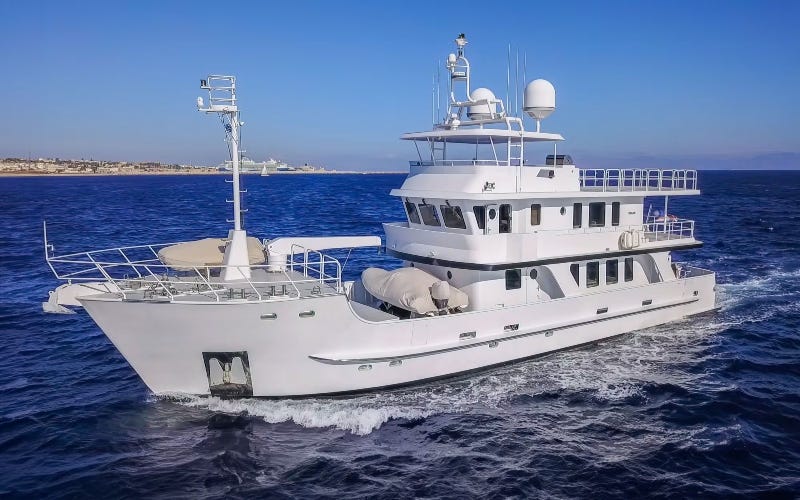
The vessel in question is MISS SARAH J, a 29-metre Inace-built explorer yacht that now lies in Corfu, Greece with a last-known asking price of €2,200,000.
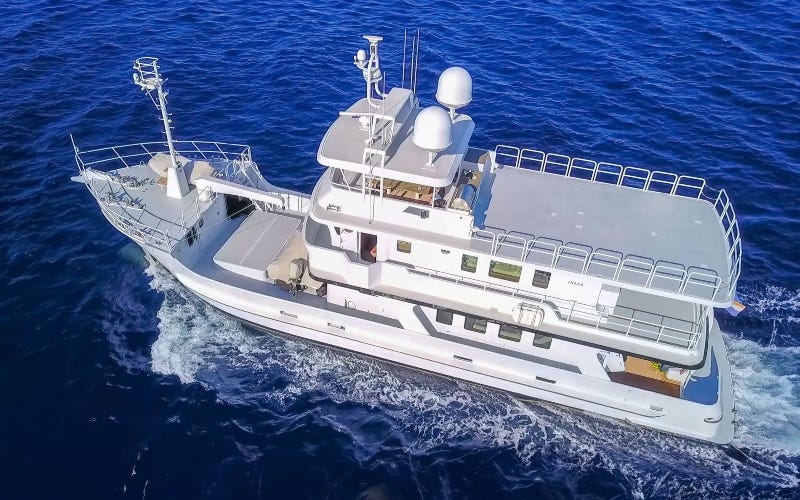
Originally launched in 2003 as a traditional aft-raised pilothouse trawler, she underwent significant engineering evolution under Joel’s ownership, including the addition of a fuel-efficient bulbous bow, a 5ft stern extension with helicopter-capable deck, and customisation for extended world cruising.
She has since changed hands, undergone further refits in 2019-2022, and carries the modifications that reflect a knowledgeable owner’s long-range cruising priorities rather than a designer’s aesthetic vision.
Billy Joel’s involvement matters because he understands boats at a technical level uncommon among celebrity owners. He has designed vessels himself and approaches yacht ownership with an engineer’s mindset. During his ownership, he adapted MISS SARAH J for long voyages across multiple oceans and added specialized storage for his collection of motorcycles, allowing exploration by both sea and land once the vessel reached anchorage. Those choices signal priorities: range, reliability, and the ability to operate far from support infrastructure.
The builder behind that capability is Inace, Indústria Naval do Ceará, founded in 1968 in Fortaleza, Brazil. The yard began by supplying vessels to Brazil’s extensive fishing industry and the Brazilian Navy. They constructed commercial fishing boats, tugs, patrol craft and supply vessels for decades before pivoting toward high-end expedition yachts in 1987. That transition reflects a strategic recognition that the same qualities required for commercial ocean work translate directly to serious cruising: robust steel construction, redundant systems, practical deck layouts and hull forms designed for seakeeping rather than maximum interior volume.
I toured an Inace 86 named Beleza for the Yacht Buoy channel, a vessel that shares the same builder philosophy evident in MISS SARAH J. Beleza operates commercially for charter, demonstrating how Inace's commercial heritage translates to practical expedition platforms. Walking through that vessel revealed the builder's priorities: robust steel construction, straightforward systems access, deck layouts designed for operational efficiency rather than styling impact, and machinery installations that prioritise serviceability. The experience reinforced what makes Inace platforms distinctive within the expedition yacht category. Readers interested in seeing Inace's approach to construction and layout can view the Beleza tour by clicking HERE.
MISS SARAH J represents the pinnacle of Inace’s sub-30-metre output. She carries a steel hull with aluminium superstructure, twin Caterpillar 3406 DITA diesels producing 365 horsepower each, and a claimed range of 5,000 nautical miles. That range figure is not marketing exaggeration. It reflects the fundamental design decisions embedded in her hull form, machinery installation and fuel capacity. For owners planning extended passages between continents, that autonomy becomes operationally decisive.
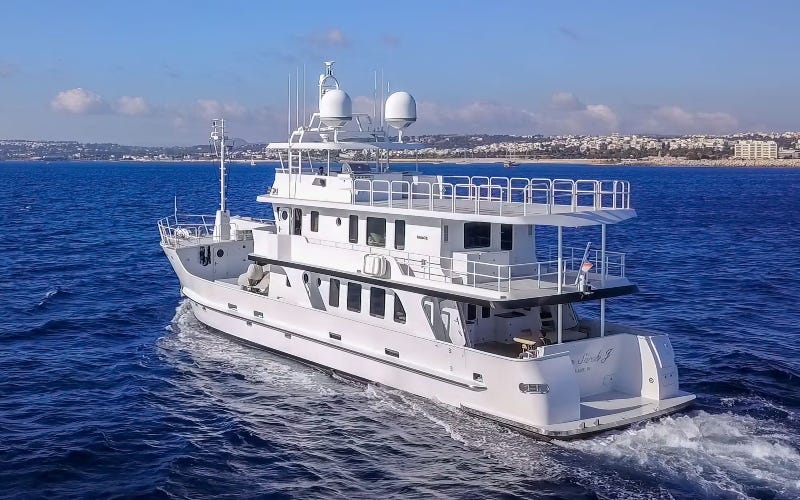
The exterior profile reveals her pedigree immediately. This is not a yacht styled to maximise flybridge entertainment space or create dramatic visual impact at anchor. The raised aft pilothouse sits high, providing commanding visibility for navigation. The foredeck extends long and clear, offering safe working space for anchor handling in exposed conditions. The bulbous bow, added during the 2007 refit, protrudes visibly below the waterline, a feature almost never seen on recreational yachts but common on commercial vessels designed for efficiency at displacement speeds. The overall beam measures 6.7 metres, relatively narrow for a 29-metre yacht, prioritising fuel efficiency and seakeeping over interior volume.
The hull form itself follows classic trawler displacement principles. Round bilges, moderate flare, a long keel and fine entry at the bow all contribute to a platform that moves through water efficiently rather than pushing it aside. That efficiency translates directly into range. At conservative cruising speeds of 8 to 9 knots, the twin Cat 3406 diesels consume approximately 30 to 40 litres per hour combined. Over a 1,000-nautical-mile passage, that fuel consumption totals roughly 3,400 to 4,500 litres. With substantial onboard tankage, the vessel achieves genuine ocean-crossing autonomy without requiring mid-passage refuelling stops.
The machinery philosophy reinforces that approach. Caterpillar 3406 engines are legendary within the trawler community for their durability and simplicity. These are mechanical fuel injection engines, not electronically controlled common-rail systems. That distinction matters profoundly for remote cruising. Mechanical injection requires no complex electronics, no diesel particulate filters, and no emission control systems vulnerable to failure in regions where technical support is scarce. The 3406 originated in the trucking industry, designed to operate continuously for hundreds of thousands of miles with minimal intervention. Applied to marine use, that heritage produces engines capable of running for 10,000 to 15,000 operating hours between major overhauls, with parts availability through Caterpillar’s global network.
Billy Joel would have understood that trade-off. Modern common-rail diesels offer better fuel efficiency and lower emissions, but they demand sophisticated diagnostics and component-level repairs that require specialist facilities. In the Azores, French Polynesia or remote Pacific atolls, finding technicians capable of diagnosing electronic fuel injection failures becomes difficult. A mechanical Cat 3406, by contrast, can be serviced by any competent diesel mechanic with basic tools. For an owner planning genuine world cruising rather than coastal hopping between marinas, that reliability becomes more valuable than marginal efficiency gains.
Got a boat?
Know of a vessel, for sale, charter, or otherwise, that you would like me to feature in a future dispatch? You can send me a direct message or email me via john@yacht-buoy.com
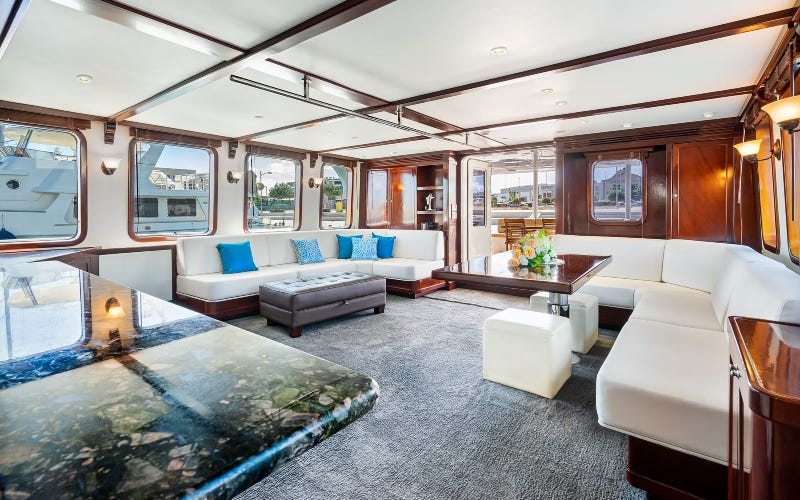
The interior layout reflects practical priorities rather than styling trends. The master cabin occupies the full-beam main deck space aft, positioned directly below the raised wheelhouse with wraparound windows providing exceptional natural light and privacy. This arrangement separates the master suite from guest accommodations, which are located forward on the lower deck.
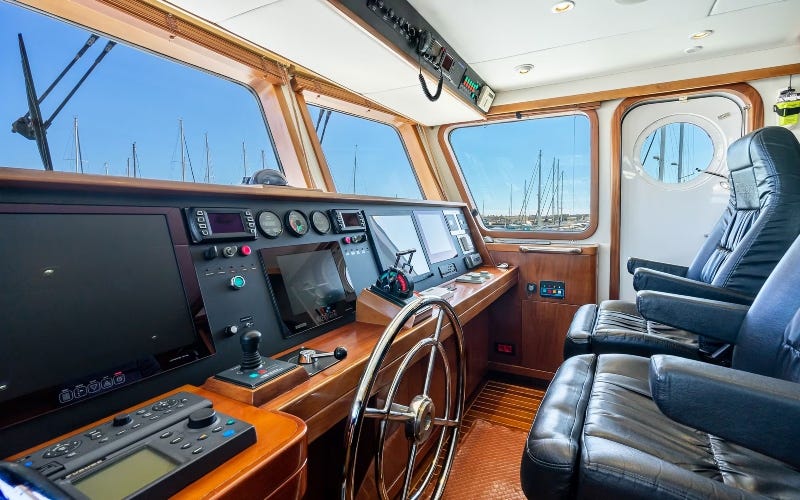
Three additional guest staterooms accommodate six more guests, bringing total capacity to eight. The main deck saloon sits forward of the master cabin, prioritising natural light through large windows and providing direct access to both the cockpit aft and the foredeck forward. The galley integrates with the saloon on the main deck, allowing provisioning and meal preparation without isolation from the vessel's operational spaces. The bridge occupies the raised aft position above the master suite, offering 360-degree visibility and operational separation from living spaces below.
That arrangement follows commercial practice. Fishing vessels, tugs and small cargo ships typically place the wheelhouse aft and elevated, providing the helmsman clear sightlines for navigation and deck operations. Recreational yachts often prioritize forward visibility for aesthetic reasons, placing the helm lower and forward to create dramatic profile lines. MISS SARAH J’s layout sacrifices that styling convention for operational advantage. The helmsman sits high, sees clearly in all directions, and monitors deck activity without leaving the helm position.
The helicopter-capable deck added during the 2007 refit extends that practical philosophy. The deck is rated for light helicopters such as the Robinson R44, providing the option for shore access in locations where tenders cannot operate safely. That feature appears unusual on a 95-foot yacht, but it reflects the vessel’s expedition mandate. In regions with challenging surf landings or restricted anchorages, helicopter access becomes the only practical method for crew transfers or medical evacuation. Joel’s decision to incorporate that capability suggests planning for genuinely remote operations rather than Mediterranean island hopping.
The vessel’s evolution since leaving Joel’s ownership reinforces her expedition credentials. Between 2019 and 2022, she underwent large-scale engineering and navigational updates, bringing systems to modern standards while preserving the fundamental platform characteristics that enable long-range operation. Those updates typically involve electronics replacements, machinery overhauls and systems modernisation rather than structural modification. The underlying hull, propulsion and tankage remain as originally configured, which is appropriate. Changing those elements would undermine the design philosophy that makes the vessel capable in the first place.
Understanding what Billy Joel recognised in this platform extends beyond the profile and pedigree. The full operational reality of an Inace expedition yacht requires research into maintenance protocols, ownership budgets and the regulatory structures that affect purchase decisions in European waters. That research takes time and specialist knowledge. Because I currently do not run advertisements on my Substack, the premium section is what allows me to deliver this depth independently.
Below the paywall, I examine the Cat 3406 maintenance reality that makes mechanical diesels preferable for remote cruising, the annual ownership budget at this scale, the Greek commercial registration advantage that affects EU buyers, and who should prioritise expedition capability over recreational styling.
Let us examine what owning an Inace expedition yacht actually requires.
The Caterpillar 3406 Reality
Why Mechanical Diesels Enable Remote Cruising
The twin Caterpillar 3406 DITA engines installed aboard MISS SARAH J represent a specific philosophy about reliability versus efficiency. Each engine produces 365 brake horsepower at 1,800 revolutions per minute, providing combined output of 730 horsepower. That figure sits well below the power-to-displacement ratios common on fast cruisers or planing hulls. The design intent is not speed. It is continuous operation at displacement speeds over extended durations without requiring frequent service intervals or specialist technical support.
