

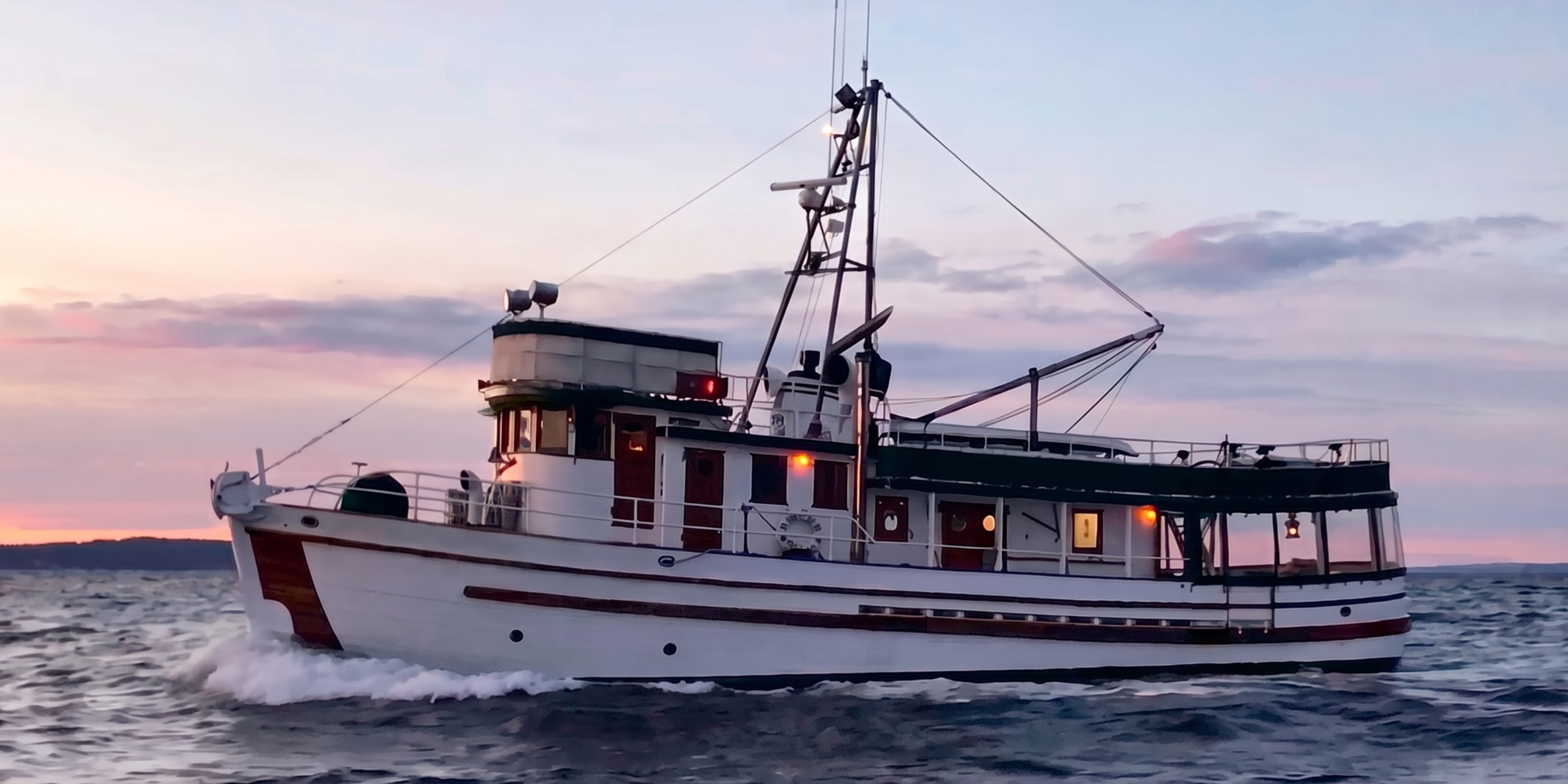
When Patricia fell for Hecate Ranger, she and Clive were living in a house with 11 acres on Denman Island, and, like many of us, she’d grown tired of life ashore. She wanted to get back to a nomadic life on the water. “I fell in love with her lines and her space,” she wrote when I asked her about it, “and could imagine us living aboard.”
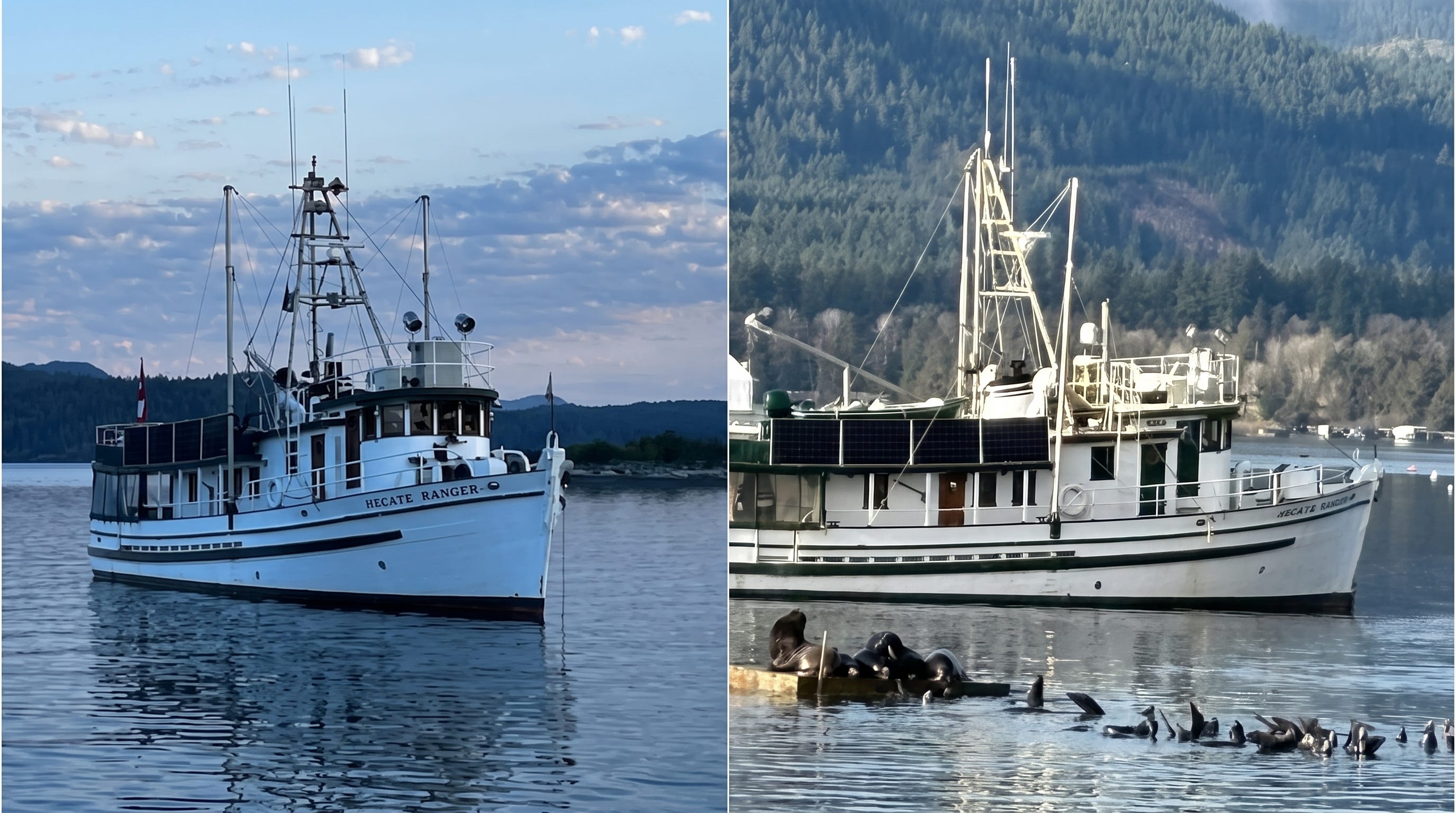
You can see what she meant. M/V ‘Hecate Ranger’ is a 66-foot wooden workboat with a white funnel banded in green, cowl ventilators, and a mast and boom on her upper deck, with room enough behind that working profile for a cosy home. Patricia and Clive are selling her privately (details below) at C$250,000, which is roughly US$175,400, £132,700 or €156,500 at the Bank of Canada’s rates for 5 October 2026. She lies at a marina in Cowichan Bay on Vancouver Island, flying the Red Ensign.
By Clive’s figures, she’s 66 feet long, 18.5 feet in the beam and 9.5 feet in draft. She was built in 1962 by West Coast Salvage & Contracting in Vancouver, carvel planked in fir on oak frames, and she cruises at 9.2 knots on a single 435hp Caterpillar 352 diesel turning a 4-foot propeller, with a bow thruster for close quarters.
Patricia and Clive have lived afloat since 1990. Hecate Ranger is their third liveaboard boat: Clive built the first, they converted the second, and the third was Patricia’s decision. “Clive is the Captain, and I am the Admiral,” as she puts it. They bought her in September 2021, and an American captain brought her home to them in BC from the States.
In Patricia’s words, selling is “a simple matter of age and health”, and she needs someone younger and adventurous enough to take her to sea, where “she runs so well and is proud and strong.” It’s a story of stewardship, and it raises the question at the heart of this piece: what does it take to own and look after a classic wooden working vessel as a home today?
The majestic queen of the Forest Service fleet
She was built for the BC Forest Service’s survey and patrol fleet, to work Hecate Strait and the waters around the Queen Charlotte Islands, now Haida Gwaii. The Classic Yacht Register calls her the largest boat the service ever built and “the queen of their fleet”. She worked under the Canadian Red Ensign; Canada didn’t adopt the maple leaf flag until 1965.
After the Forest Service auctioned its fleet in 1984, her first private owner cruised her to Alaska again and again. Then came the two men who owned her for about 22 years and, as Patricia says, turned her from a working vessel into what you see today. In 1999, Anderson Shipwrights in Seattle enclosed her aft tow-winch deck as a covered fantail, extended the upper deck and rebuilt and reinforced the bulwarks. Where a winch once earned its keep, there’s now a round table with windows all round.
In the winter of 2016, according to the Register, Haven Boat Works in Port Townsend refastened and recaulked her hull from the waterline down, with 4,000 new fasteners and 285 linear feet of new planking.
What a heavy wooden hull does well
An older survey describes 2.5-inch fir planking on 4 by 2.25-inch oak frames, under a 2-inch plywood deck. That’s a heavy wooden structure, and it has real advantages.
Carvel planking can be renewed a piece at a time, and the 2016 work shows it: new planks and fastenings went in below the waterline, and the boat that came out was still the 1962 boat that went in. Timber is also a natural insulator, so wooden hulls generally avoid the cold, sweating inner surfaces of uninsulated metal ones, and heavy wooden displacement boats are known for a steady, easy motion and a quieter, softer ride. They’re qualities of the type, and they’re why boats like her keep their admirers. I went into this further when I wrote about Capri.
Of course, wood does ask for attention, and she’s had it. In 2021, Clive tells me, the engine was rebuilt, the cutless bearing replaced and the bow and stern gunwales rebuilt, and this year she’s been painted throughout. Patricia and Clive haul her every 2 years by choice. “She’s our home so we want to know how her hull is doing,” as Patricia puts it, though their insurer only asks for a haul-out survey every 5 years. The latest was done at her June 2026 haul-out at Menzies Bay Shipyard, and the owners say it’s available to view. Clive describes her as being in “very good condition”.
Starting on air
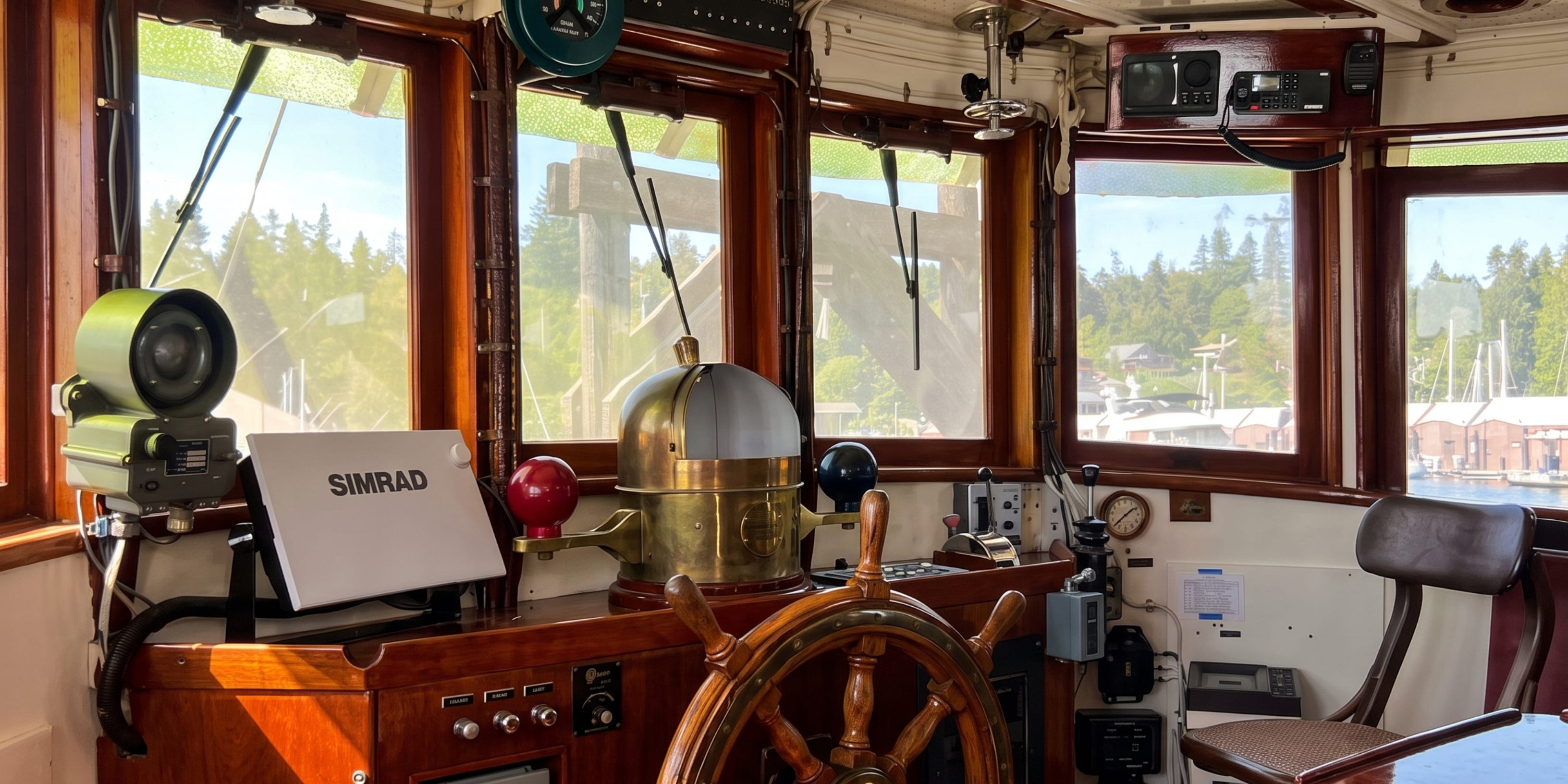
Her Caterpillar is an air-start engine. Instead of an electric starter motor, stored compressed air provides the force to crank it. Big commercial diesels have long been started this way because a reservoir of air can turn a heavy engine over hard, and it’s a lovely piece of working heritage. The wheelhouse pairs that heritage with a Simrad suite of radar, autopilot, AIS, rudder angle indicator and jog stick, plus VHF, a compass, Wi-Fi and Starlink. In Clive’s words, her 12,000-litre fuel tank is always kept full.
Life aboard
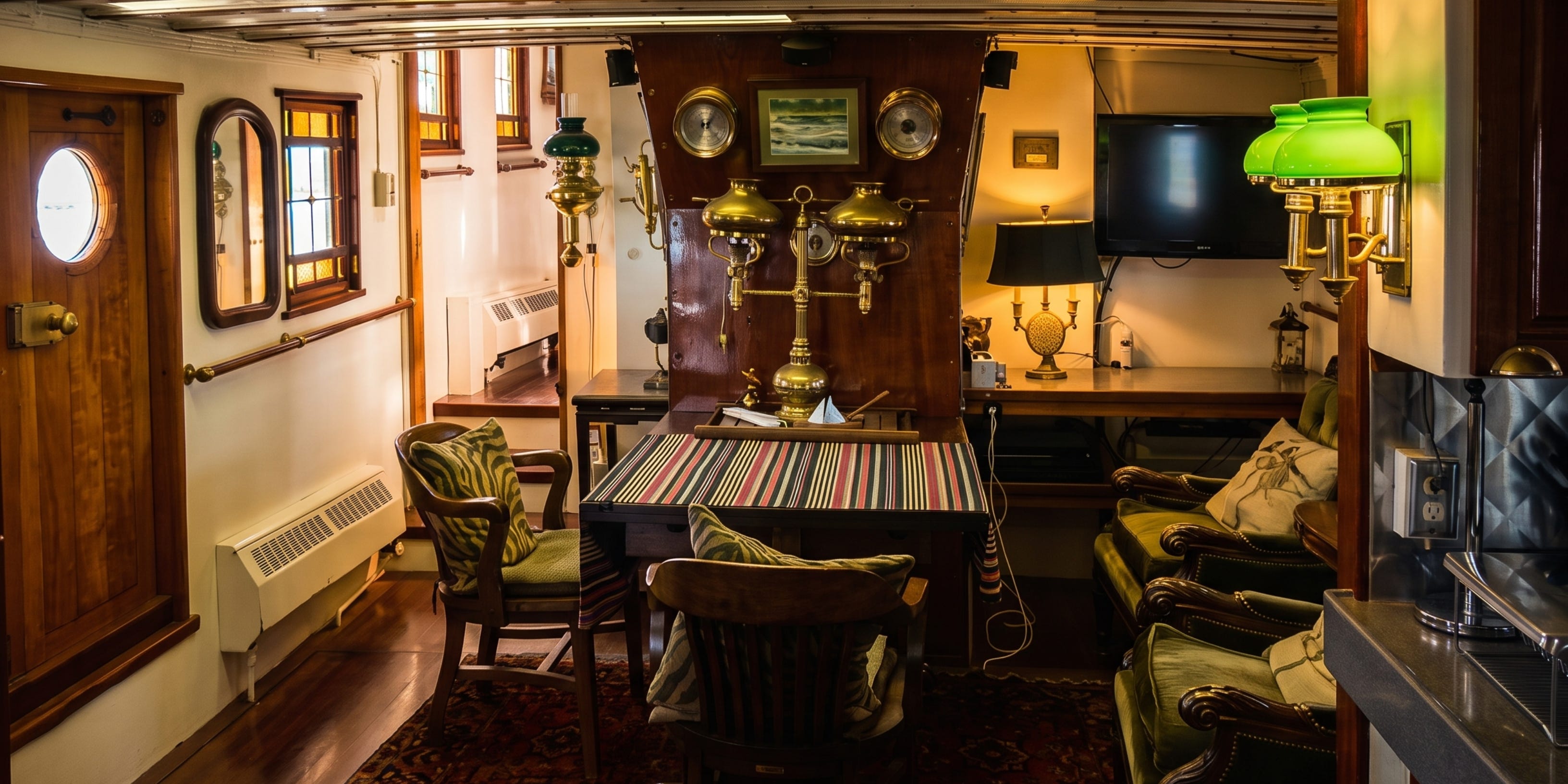
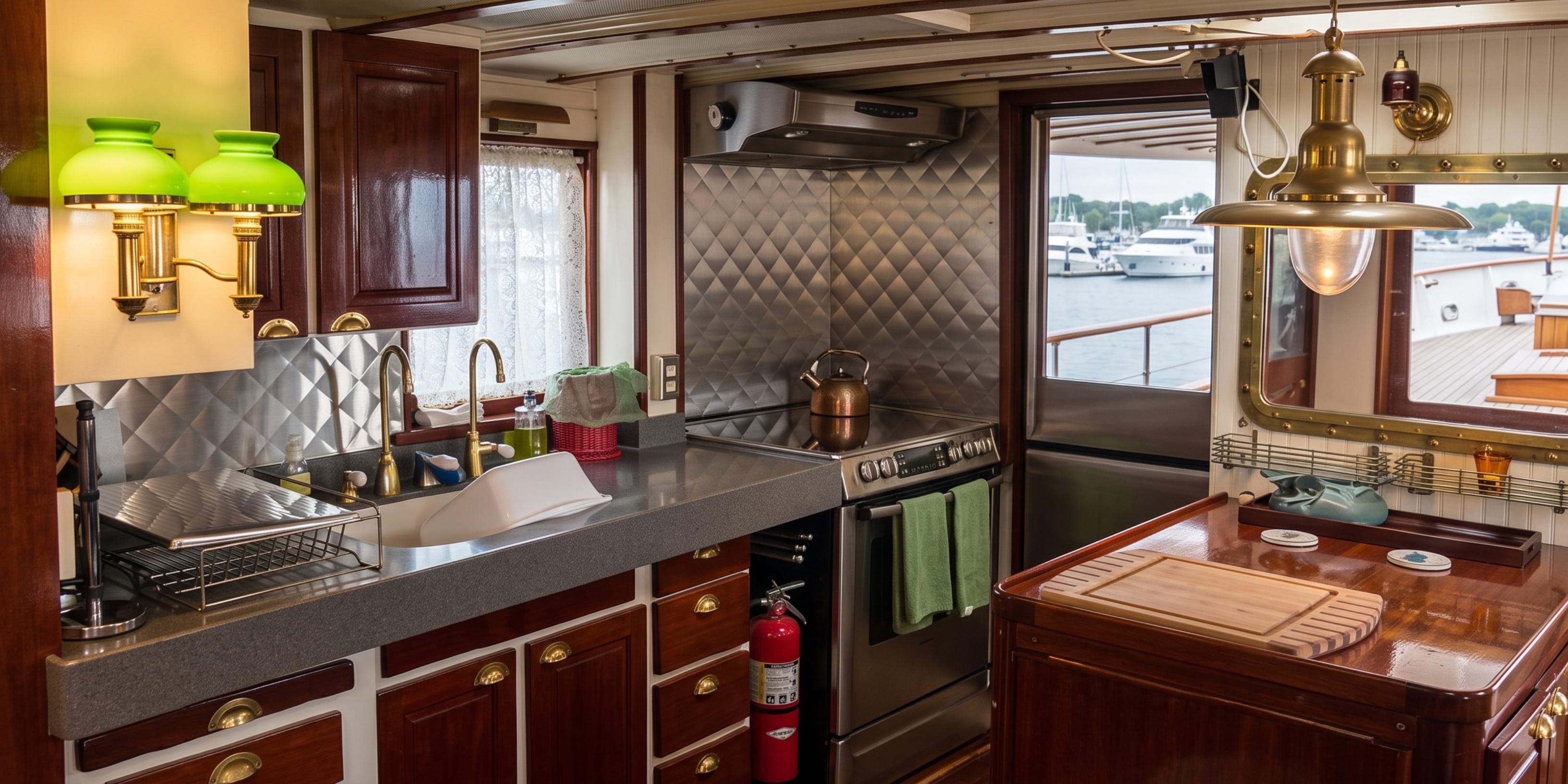
In the photos I’ve seen, the wheelhouse is varnished timber, with a big spoked wheel, a brass binnacle, a helm chair and forward windows with wipers. The saloon has a dining table and chairs, settees and a door with a decent-sized porthole. The galley has varnished cabinetry, a stainless range and oven, a sink, an island and a door straight out on deck. Aft, through a stable door, the enclosed fantail has a round table, chairs, windows all round and a ladder up to the upper deck.
The Captain’s quarters, just off the pilothouse, have a double berth. Below, on the lower deck, there’s a cabin with a double berth conversion and a single berth in another. There are two heads: the main one on the main deck, with a toilet, sink and shower, and a second on the lower deck with a toilet and sink.
Heating comes from a Kabola hydronic system with a hot water tank (you can see radiator panels in the saloon), plus propane on-demand hot water. Power comes from a 35 kW Nissan generator, a solar array making about 6 kWh a day, a 24-volt Rolls Surrette battery bank and Outback inverters, which is kit chosen for living aboard rather than visiting.
She carries 1,035 gallons of fresh water, which is around 20 days for two, even at a generous 25 US gallons each a day. A 14-foot Lifetimer tender with a relatively new 30hp outboard, serviced every year, rides on the roof and is launched by a 1-ton crane. Her Cowichan Bay marina allows year-round living aboard, and although the slip doesn’t go with her, Clive says it’s very likely a new owner could carry on mooring there.
A fair comparison
After doing some research, as I always do for these pieces, I found one wooden Pacific Northwest classic of similar size currently for sale: Wyrill, a 1931 Boeing Custom in Seattle, listed at US$199,950 when I checked on 6 October. She’s 62 feet long, with a 15-foot beam, 6 feet of draft and a 2013 Cummins 5.9-litre diesel of 210hp, and her broker says she was mostly used to entertain senior management of a pulp and paper company at Ocean Falls, BC.
So one carried executives and the other patrolled. Hecate Ranger is 4 feet longer, 3.5 feet broader and 3.5 feet deeper, and her C$250,000 is about US$175,400. These are asking prices, not valuations, and the boats differ in age, machinery and history, but together they sketch a small, rather special corner of the market.
From speaking with the owners of Hecate Ranger, it is clear just how much love and affection they have for this beautiful vessel. They are not selling her because they want to, and I mention this only because, having featured over 500 boats now, both here in this newsletter and on my YouTube channel, I have learnt that when you can feel the love that an owner has for their boat, then you can easily deduce from that passion that a lot has gone into making sure that the boat is the best it can be.
And for a buyer, that connection often means something far deeper than just another boat listing.
This article continues below, in “The Wardroom”
In the premium section below, I cover:
- What she costs to keep as a home: the yearly figures Patricia and Clive have shared
- Running her: what an air-start engine, a single propeller and a bow thruster mean for the people handling her, and her fuel
- What I’d check if I were acting for a buyer, from the June 2026 survey to the turnkey inventory
- The handover, and Clive’s offer to show the next owner how to run her
- My honest assessment: who she suits and what she asks of an owner
It is thanks to my premium subscribers that I am able to keep my YouTube channel and this publication going. So, if you are a premium subscriber or if you become one, then I would like to say a huge ‘thank you’ for your support.
