There is a moment, in the world of explorer yachts, when a brief stops being a brief and becomes a statement of intent.
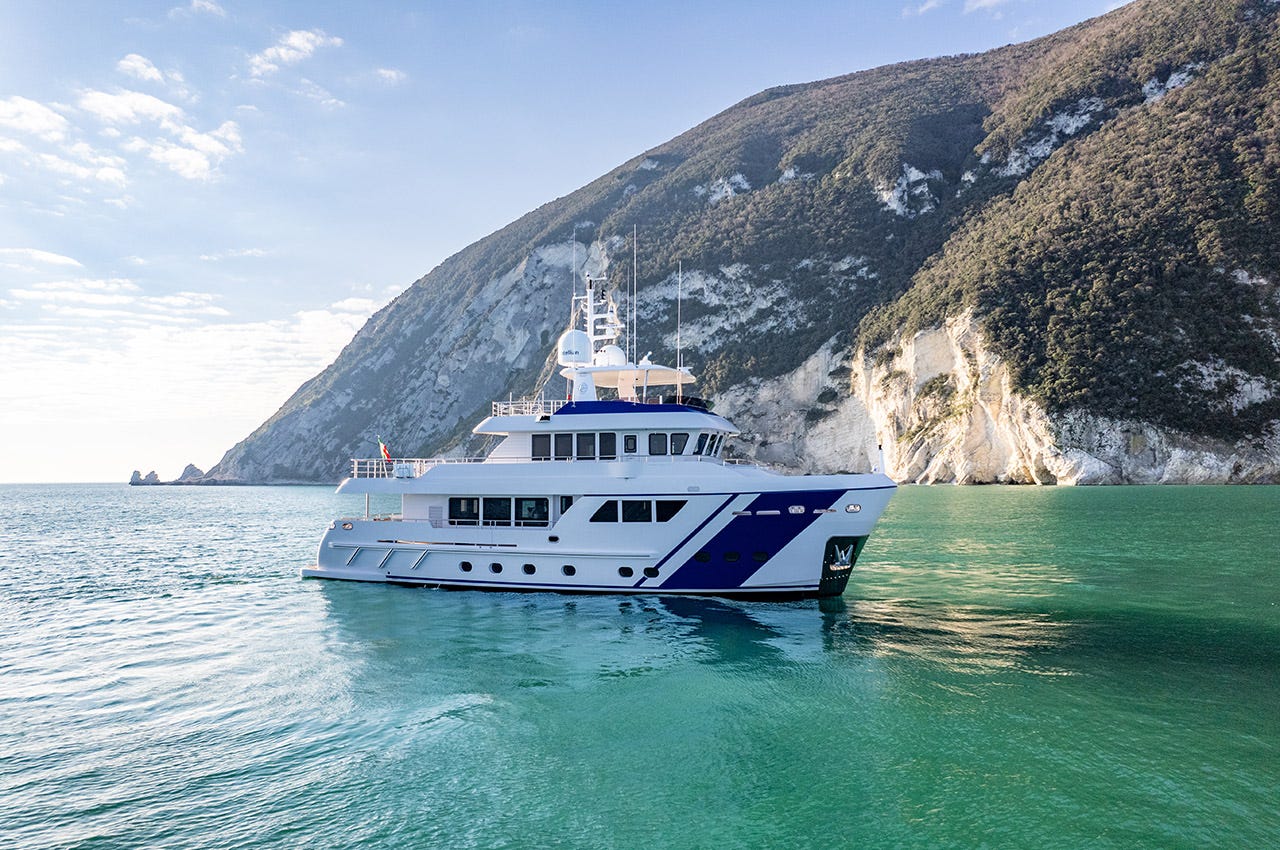
Cantiere delle Marche - the Italian yard that has made its name building serious offshore expedition machines - has produced some remarkable vessels over the years. But MY Empire, a 26-metre explorer yacht delivered in June 2024, stands apart even within that distinguished fleet. Not because she is the largest. Not because of the name on the hull. But because of what is inside the hull.
I want to tell you about the bulletproof steel plates.
Cantiere delle Marche: The Yard That Means Business
Before we get to the vessel herself, it is worth understanding who built her, because CdM’s pedigree matters here.
Cantiere delle Marche, CdM, as they are universally known, is based in Ancona, on the Adriatic coast of Italy. The yard was founded in 2010 specifically to build expedition and explorer yachts, and in the years since, they have become arguably the most respected name in the sector. Their approach is unusual for the yachting world: CdM operates as a semi-custom yard that genuinely means it when they say custom. They have produced everything from 24-metre day-cruising explorers to 60-metre offshore passage-makers, and the engineering quality throughout has been consistently outstanding.
Their hulls are built in steel. Their engineering spaces are real engineering spaces, not afterthoughts. When a client brings CdM an unusual brief - and their clients frequently do - the yard has the capability to execute it properly.
MY Empire sits on the yard’s Darwin 86 platform, designed by Hydro Tec, the Roman naval architecture practice that has a long and productive relationship with CdM. The interiors are the work of Alessandro Massari. But really, what defines this vessel is not the design studio behind her. It is the owner’s brief.
The Numbers, Briefly
Let us get the specifications on the table.
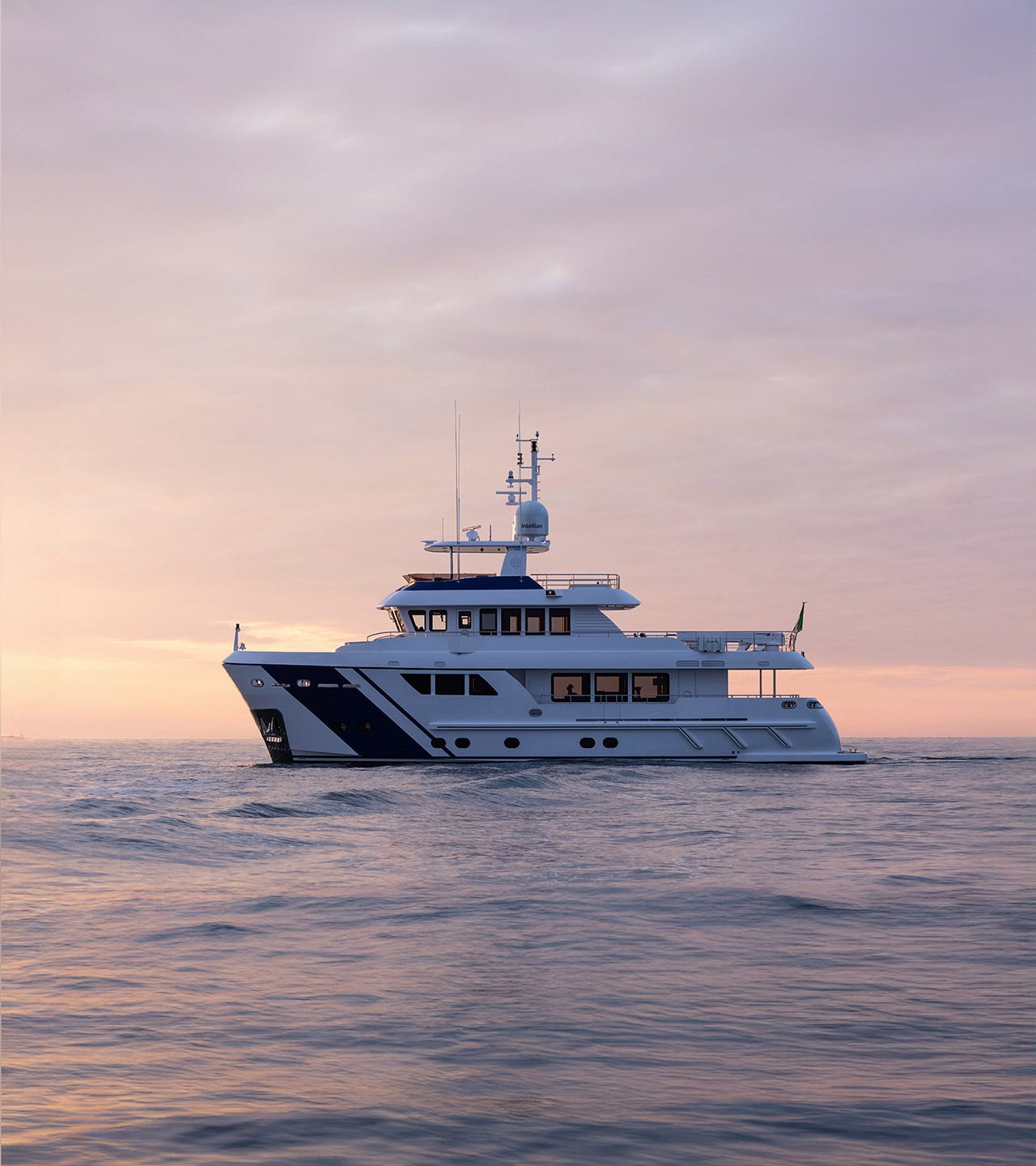
MY Empire measures 26.03 metres overall, with a beam of 7.43 metres and a draught at full load of 2.42 metres. She displaces 210 tonnes. Her propulsion comes from twin MAN 16-450 engines, each delivering 331 kW — serious, well-supported commercial powerplants with global parts availability. Two 55 kW Kohler generators handle the electrical load. Fuel capacity stands at 38,400 litres.
The range figure is what you would expect from a serious expedition yacht: 4,000 nautical miles at 10 knots. Maximum speed is 11.5 knots. Fresh water at 3,400 litres — modest, but perfectly manageable with a watermaker running on passage.
These are impressive numbers. But none of them are why I want to write about Empire.
An Ice Belt, Reinforced Rudders, and Bulletproof Steel
The hull of MY Empire was designed for high-latitude operations. She carries an ice belt at the waterline — a reinforced steel band that protects against brash ice and light pack — and her hull plating and rudders have been uprated to handle contact with ice in remote waters.
This is not unusual for a serious expedition yacht. Several CdM vessels are built to ice-class standards. What is unusual is what comes next.
The hull of MY Empire has been partially constructed using bulletproof steel plates.
Armour-grade steel, incorporated into the hull construction. The exact positioning and ballistic rating have not been published — which is entirely understandable — but their presence tells you everything you need to know about the owner’s priorities and the waters they intend to navigate.
This is not a vessel for the Côte d’Azur. This is a vessel for places where the word “remote” means something quite different.
Accompanying the armoured hull is an anti-intrusion system — a sophisticated security installation whose purpose is self-evident. MY Empire is designed to be taken to places where uninvited guests are a genuine operational concern, not an abstract possibility.
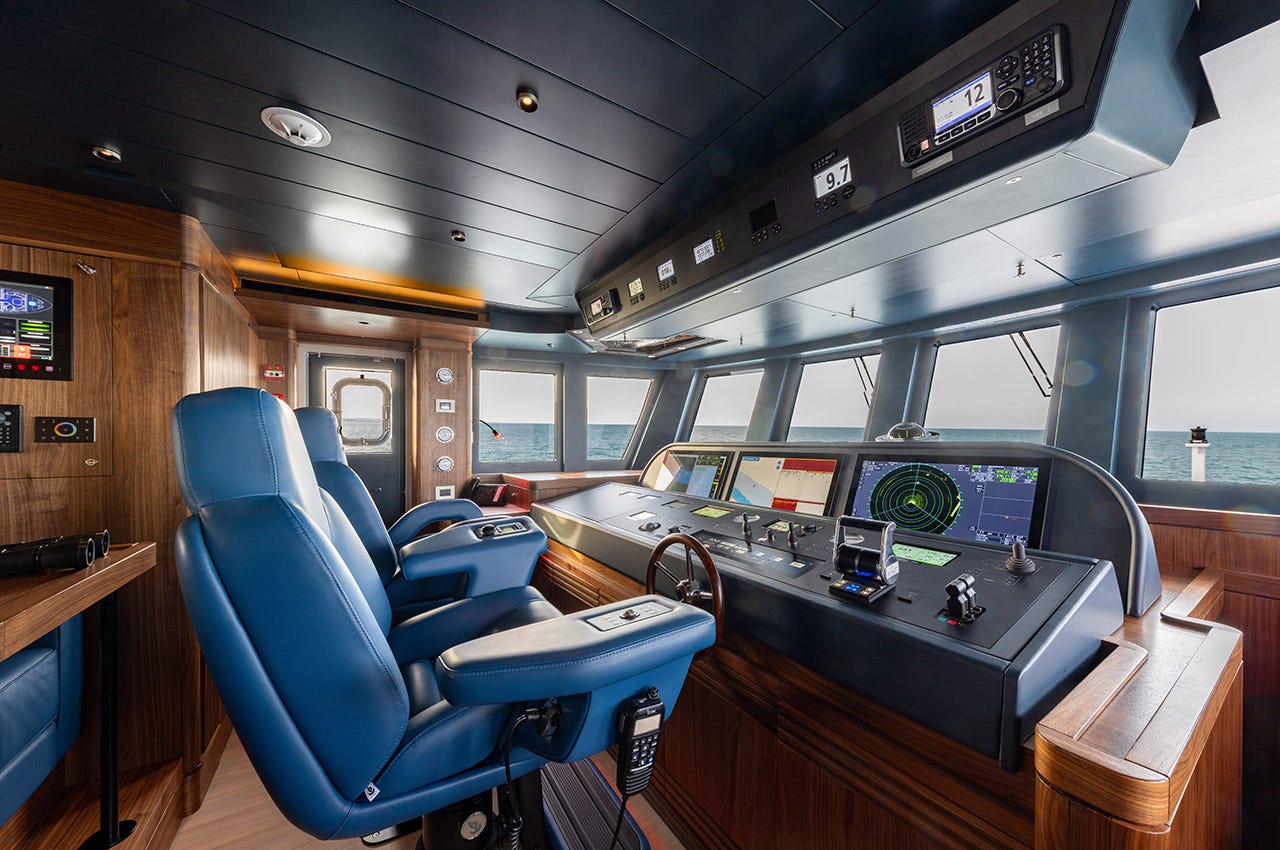
Then there is the fourth pilot station, located in the engine room. That detail is the one that really tells you something. Most expedition yachts have a primary helm and a flying bridge station. Adding a third station, buried in the machinery space, is a contingency measure — a last-resort command position if the upper stations are inaccessible. Whoever wrote this brief had thought through scenarios that most yacht owners never contemplate.
Accommodation and the Life Aboard
For all her offshore capability and security specification, MY Empire is not a spartan platform. She accommodates guests with genuine comfort.
The owner’s stateroom sits amidships on the lower deck — the best position for motion at sea, centred on the rolling axis and away from the pitching at the bow. There are two twin cabins with Pullman berths and a forward VIP suite on the lower deck. Crew quarters are forward on the main deck, with a dedicated crew mess and a separate staircase to the wheelhouse. The working of the vessel stays properly separated from the guest areas, which matters on a long passage.
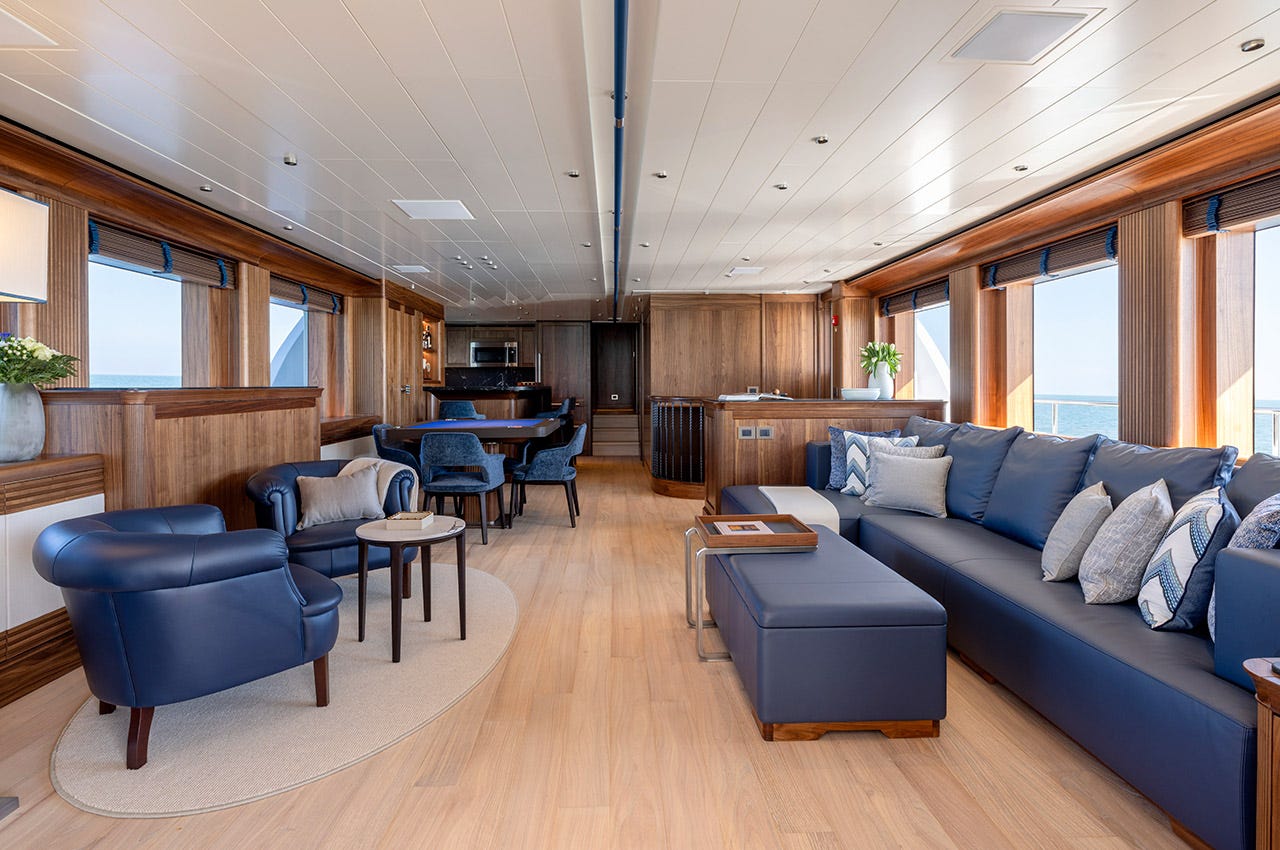
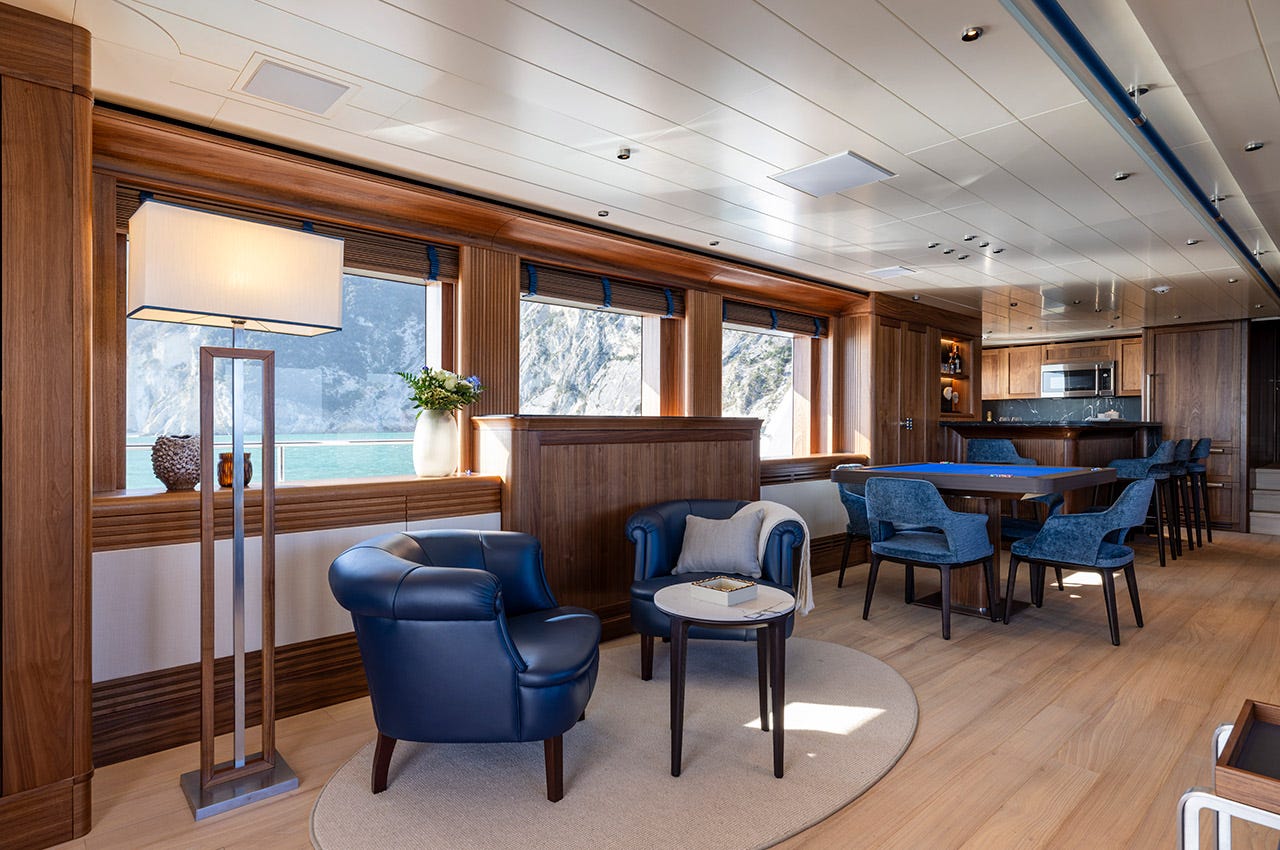
The main deck is where social life happens. Indoor and outdoor lounging areas, a bar, a well-equipped galley. On the upper deck, a gym that doubles as a lounging area opens onto a stern terrace. The sun deck provides open-air relaxation with loose furniture and sunbeds.
None of this is revolutionary. CdM knows how to lay out an interior for offshore life. What strikes me about Empire is simply that it is genuinely liveable at sea, not just in harbour. That is the test that matters.