

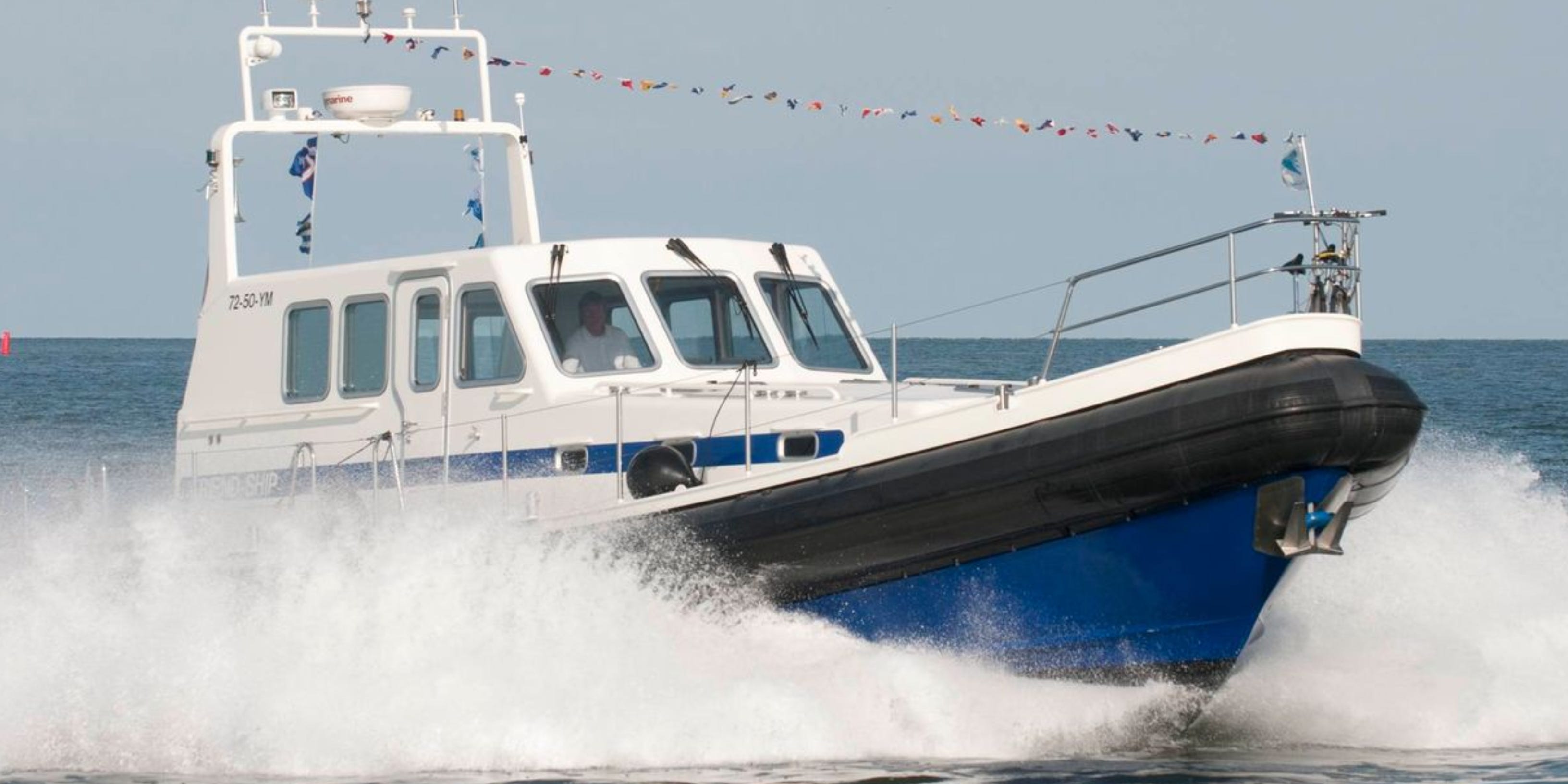
In the video, I told you I had spent time with M/Y ‘Friend Ship’ at No Limit Ships in Groningen, NL, and that I had put together a full companion piece with everything the tour could not cover. Here it is….So, grab a coffee (or a beer).
I have her confirmed current asking price (if that changes, then I will update this article) the contact details for buying her, my honest view on who this boat is built for, estimated running costs, and what it would realistically cost you to get her shipped to North America or Australia, because so many of you are based in those two places (or in those time zones) and this question comes up every single time I cover a European vessel.
Let us get into it.
The Current Asking Price:
€750,000 VAT paid
Who Is Friend Ship Built For?
This is probably the most useful question I can answer, because the No Limit 1550 is a very specific kind of vessel, and she is not the right boat for everyone.
Friend Ship is built for someone who wants to go places quickly and comfortably, in almost any conditions, without spending the next decade worrying about the boat underneath them. She is a high-speed, CE Category A certified steel and aluminium motor yacht from a yard with a serious reputation for building very safe boats that last. The first owner has been sailing No Limit vessels since 2001 and trusted the yard enough to buy two of them. That kind of loyalty tells you something.
Concretely, she suits:
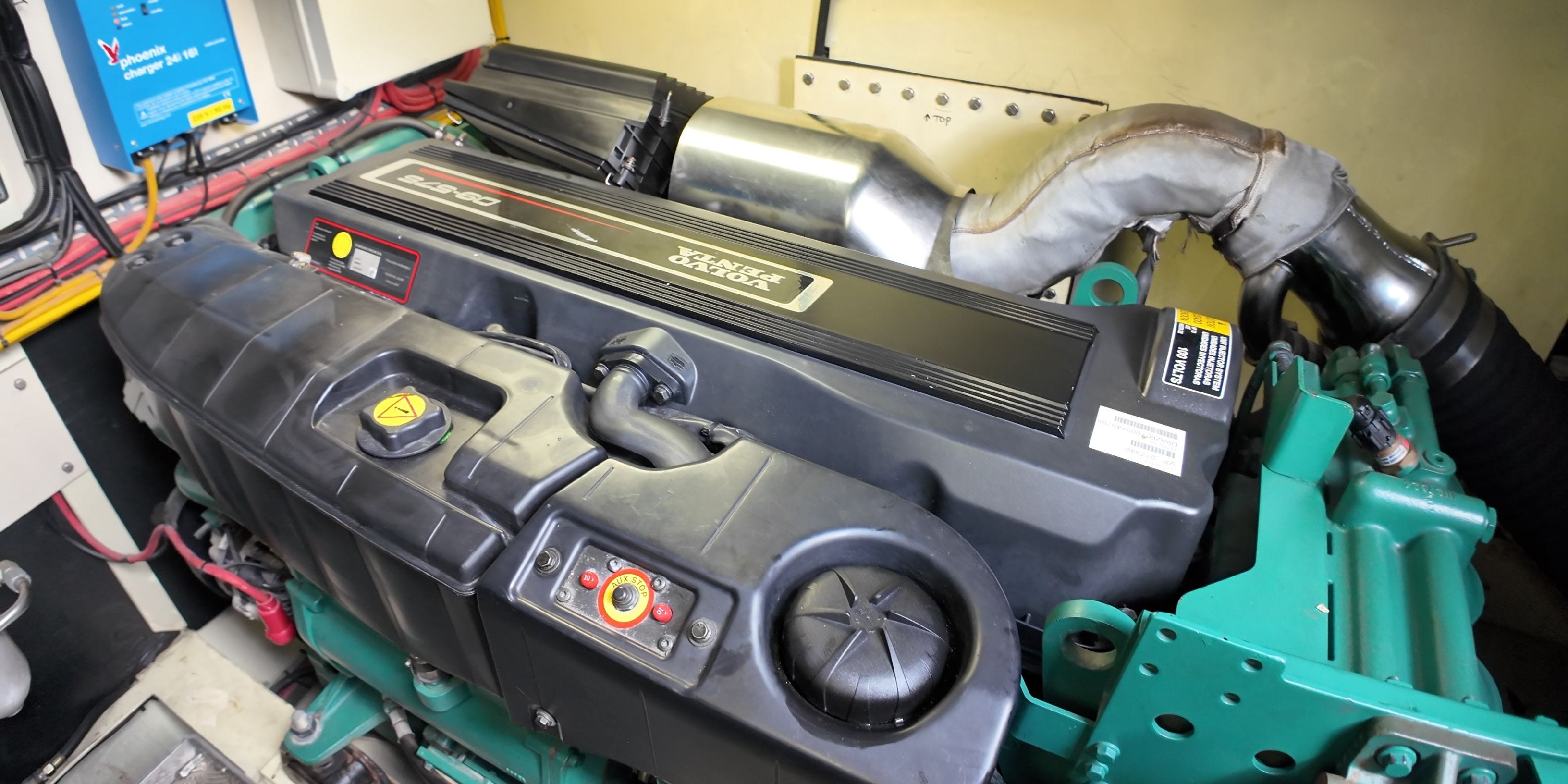
The serious weekend and holiday cruiser who wants real performance. With twin Volvo Penta D9 575hp engines and a top speed of 25 knots, Friend Ship will get you from A to B fast. At cruise speed of 9 knots, her 3,000-litre fuel tank gives a range of approximately 1,500 to 1,800 nautical miles, depending on sea state, load and general conditions. She will handle the North Sea, the Baltic, the Adriatic, and the Atlantic seaboard without drama, all year round.
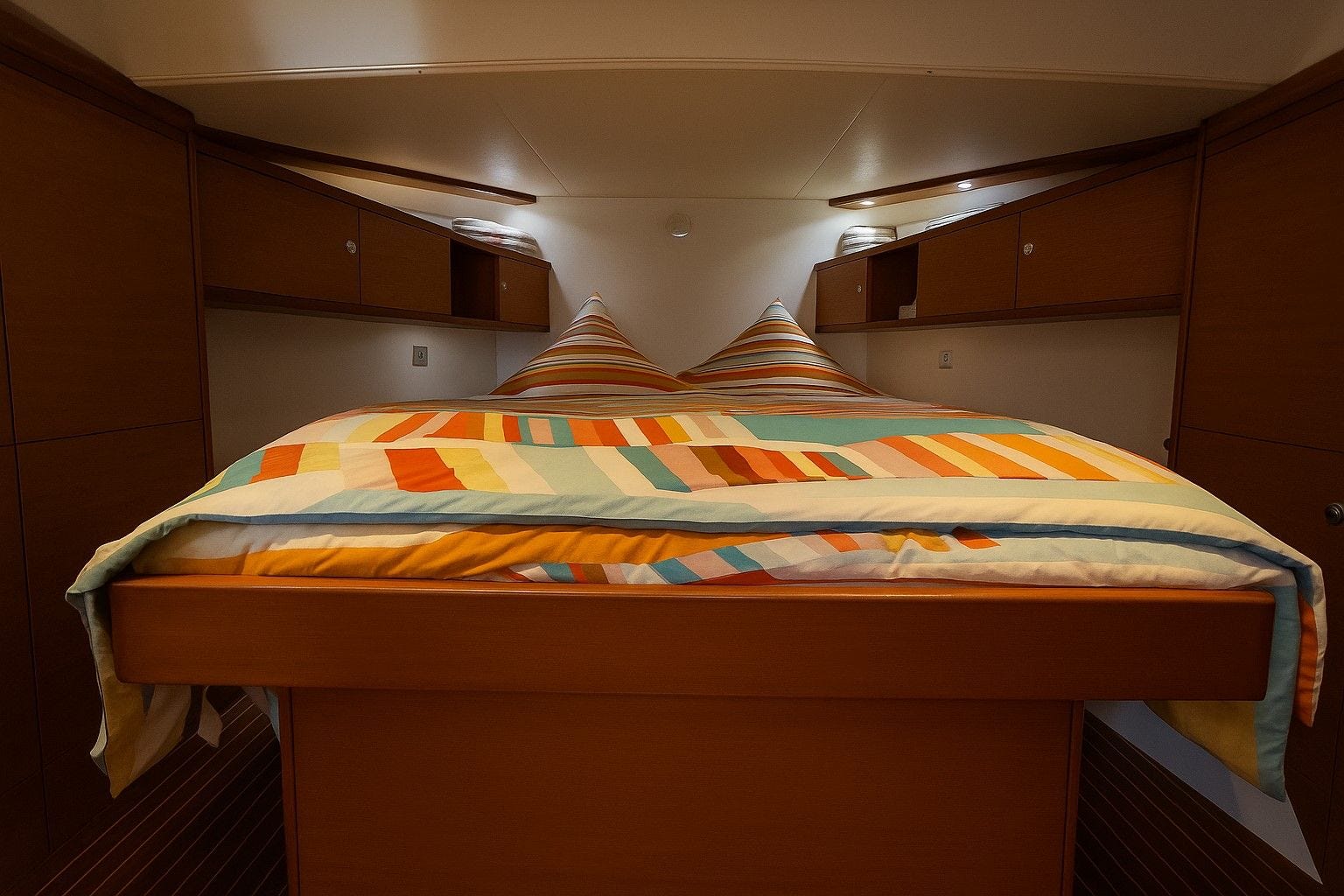
The couple or small family who want to go extended cruising. She has an owner’s cabin and a guest cabin, both finished to a high standard. As you no doubt saw in the video on my YouTube channel, the saloon is bright and spacious with panoramic views. The galley is fully equipped for extended stays aboard. She is designed for living on board and not just day trips.
The buyer who values low maintenance. No Limit Ships’ construction philosophy is methodical: blasted steel, fully re-blasted for adhesion, epoxy coated inside and out, elastic epoxy filler, UV-resistant topcoat, hard epoxy coating in the bilge and cockpit. The decks are wear-resistant non-slip. The propeller shafts are water-lubricated and described as maintenance-free. These are not marketing phrases from a glossy brochure that has been put together by someone who has never lived at sea; this is how the yard actually builds, and it means the ongoing maintenance burden is lower than you might expect for a vessel at this performance level.
The buyer who wants CE Category A certification. CE Category A is the highest general offshore certification available, covering oceanic use in significant wave heights and wind speeds above Force 8. Friend Ship carries it as standard. That opens up passage routes that a lesser-certified vessel cannot legally or safely attempt. Why purchase a vessel that you can only use in fair weather!?
She is probably not the right boat for someone who wants a large liveaboard with four or more cabins, or someone whose priority is long-range passage-making at low displacement speeds with enormous range. There are other vessels better suited to those briefs. But for spirited, safe, capable coastal and offshore cruising for 2 to 4 people, with the build quality to match, Friend Ship is a very compelling case.
Estimated Running Costs
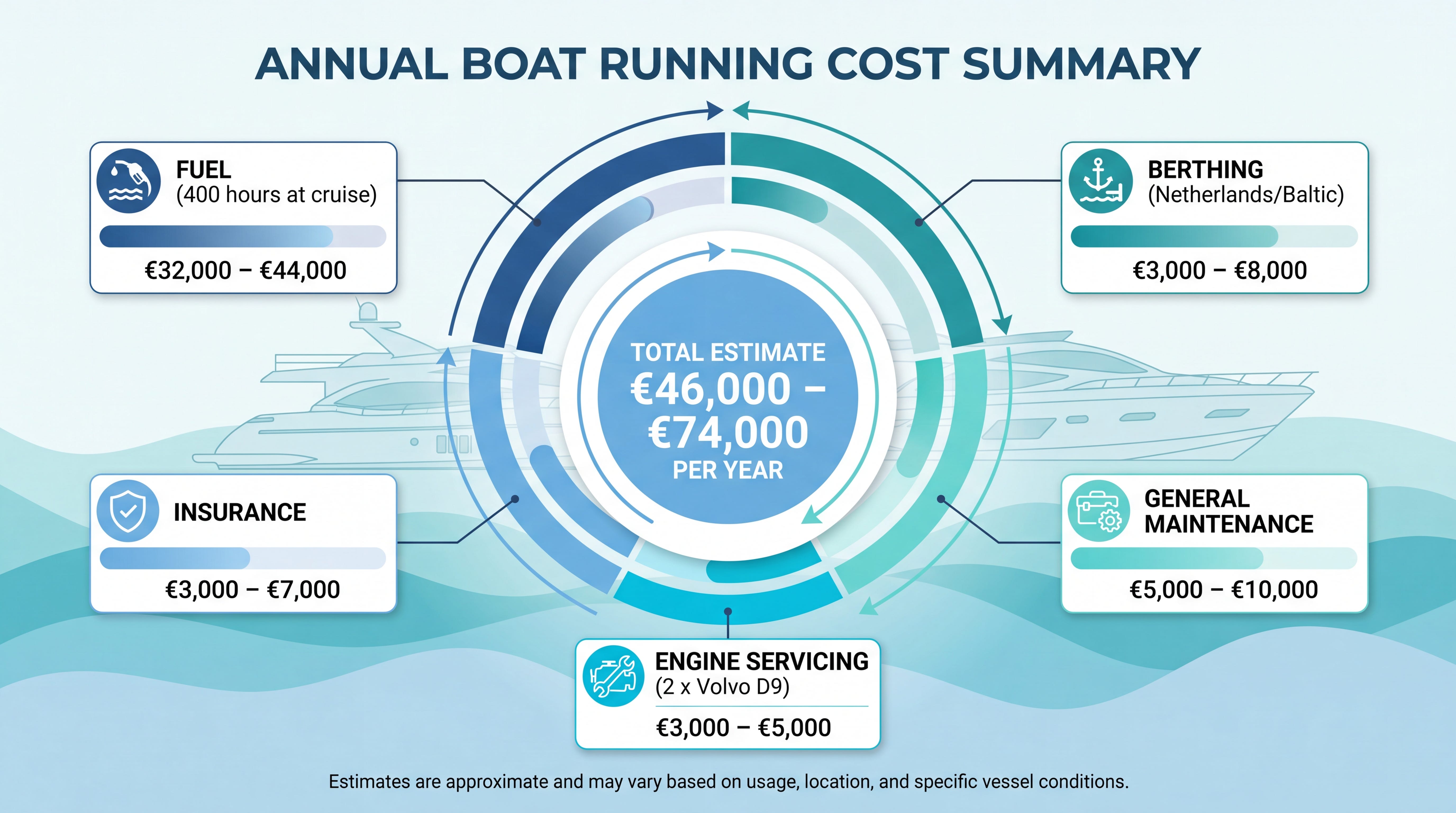
I want to be honest about these figures: they are estimates based on the vessel’s specifications and standard industry benchmarks for a vessel of this type and age. Please do not hold me to these exact numbers, but this is what my research suggests.
Fuel
The twin Volvo Penta D9 575hp engines are electronically controlled and fuel-efficient by design, particularly at lower loads. At cruise speed (9 knots), No Limit describes the fuel consumption as comparable to a single-engine cruiser due to the low load on each engine. A reasonable estimate is 40 to 55 litres per hour at cruise.
At 45 litres per hour and €1.80 per litre (current European marina diesel price), that is roughly €81 per hour underway. If you cruise 400 hours per year, that puts annual fuel at approximately €32,000 to €44,000. Reduce your hours, reduce your costs proportionally.
Berthing
In the Netherlands, a 15.50-metre vessel will cost somewhere between €3,000 and €8,000 per year for marina berthing depending on location and whether you are on a waiting list for a premium berth. Mediterranean marinas are higher, typically €6,000 to €15,000+ for a season, depending on the port. If you are mooring in a North Sea or Baltic marina year-round, budget toward the lower end.
Insurance
For a vessel of this specification, CE-A certified and in near-new condition, marine insurance typically runs between 0.75% and 1.25% of the vessel’s value annually. On an asking price in this bracket, that suggests annual insurance premiums of approximately €3,000 to €7,000, depending on your cruising area, your experience, and your insurer. Extended offshore passages and high-latitude routes will push that figure higher.
Servicing and Maintenance
Volvo Penta D9 engines should be serviced every 250 to 300 hours, or annually at minimum. A full service (filters, impellers, belts, fluid change, injector inspection) runs approximately €1,500 to €2,500 per engine through an authorised Volvo Penta centre. For two engines, budget €3,000 to €5,000 per year.
General maintenance on the hull, running gear, and systems for a well-built vessel in this condition should be manageable at €5,000 to €10,000 per year, more if you are undertaking a major haul-out or antifouling.
Again, treat these as an informed starting point, not a guarantee. Your actual costs will depend heavily on how much you use the boat, the sea state she is operated in, where you berth her, and how much of the maintenance work you can oversee yourself.
Getting Friend Ship to North America
This is the section I know many of you have been waiting for. Friend Ship is currently in Groningen, in the Netherlands. Getting her to the United States or Canada is entirely possible, but it involves some planning and, of course, some cost.
Option 1: Yacht Transport (Heavy-Lift Shipping)
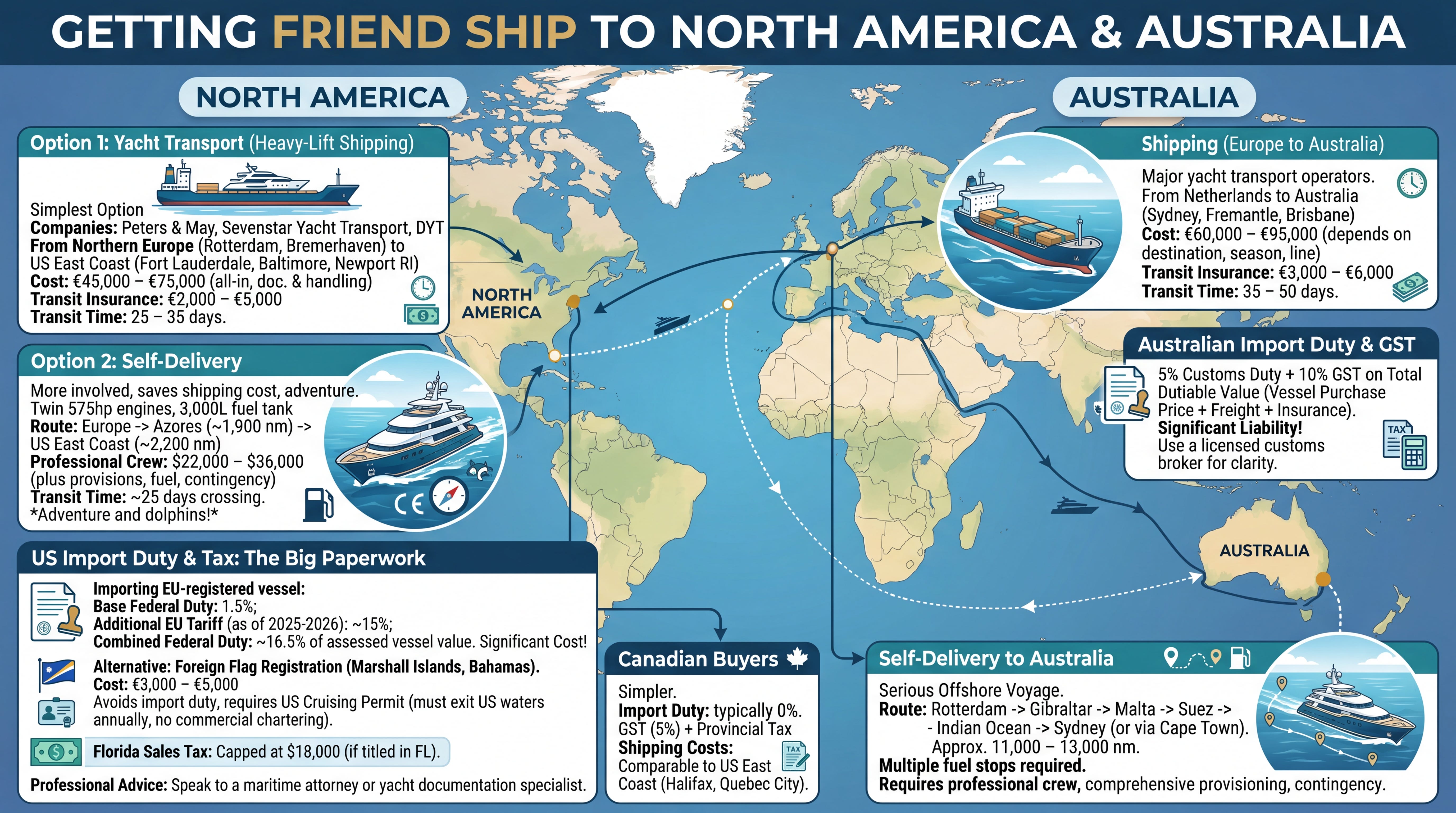
This is the simplest option. Companies like Peters & May, Sevenstar Yacht Transport, and DYT operate regular transatlantic yacht transport services. A 15.50-metre vessel like Friend Ship transported from a northern European port (Rotterdam or Bremerhaven are the typical loading ports for the Netherlands) to the US East Coast (Fort Lauderdale, Baltimore, or Newport, RI) will typically cost in the range of €45,000 to €75,000 all-in, including documentation and handling. Add €2,000 to €5,000 for transit insurance.
Transit time is typically 25 to 35 days.
Option 2: Self-Delivery
Friend Ship has twin 575hp engines, a 3,000-litre fuel tank, and CE Category A certification. She is capable of crossing the Atlantic with proper planning, professional crew, and a favourable weather window.
The typical routing for a motor yacht of this type is: European departure port, Azores (fuel stop), US East Coast. The Azores leg is approximately 1,900 nautical miles; the Azores to Florida leg is approximately 2,200 nautical miles. Friend Ship’s range at cruise will cover each leg with an appropriate safety margin if fuel is topped up in Ponta Delgada. Personally, I would take fuel bladders with me as well.
Professional crew for a 25-day Atlantic crossing will cost approximately $22,000 to $36,000, plus provisions, fuel en route, and contingency. The self-delivery route is more involved, but it saves you the shipping cost and the vessel arrives under her own power. Also, you might just want to enjoy the trappings of an atlantic crossing yourself.
In fact, that is exactly what one buyer who saw one of my earlier videos did.
He saw the yacht tour that I did aboard M/Y ‘Anna’, purchased the boat and then took her back to the US under her own power. I was lucky enough to be sent a couple of videos, showing the new owner passing the Azores, escorted by a pod of dolphins! This is why so many people love the explorer yacht lifestyle! Anyway, I digress!
US Import Duty: The Number Most People Miss
Here is where it gets a bit paperwork intensive for American buyers. Importing a European-registered vessel into the United States currently involves:
- A base federal import duty of 1.5%
- An additional EU tariff (as of 2025–2026) of approximately 15%
- Combined federal duty: approximately 16.5% of assessed vessel value
On a vessel in Friend Ship’s price bracket, that could represent a significant additional cost. There is a legal and commonly-used alternative: registering the vessel under a foreign flag (the Marshall Islands and Bahamas registrations are the most popular) rather than US-flagging her. This avoids the import duty entirely. The cost of foreign-flag registration is approximately €3,000 to €5,000, and you obtain a US Cruising Permit on entry. The trade-off is that the vessel must spend a couple of months outside US waters annually to renew the permit, and she cannot be commercially chartered in US waters.
Florida also levies a sales tax on vessel transactions, but it is capped at $18,000, which is a meaningful saving for a vessel at this price point if you do import and title her in the state.
My honest advice: if you are a US buyer seriously considering Friend Ship, speak to a maritime attorney or yacht documentation specialist before proceeding. The duty question is real and the answer depends on your specific circumstances.
Canadian Buyers
Canada is simpler. Transport Canada does not apply the same EU tariff structure, and import duty on vessels is typically 0% under most trade frameworks. GST (5%) and provincial tax applies on the purchase. Shipping costs from the Netherlands to a Canadian East Coast port (Halifax or Quebec City are typical) are comparable to US East Coast rates.
Getting Friend Ship to Australia
For Australian buyers, the logistics are longer but straightforward.
Shipping Costs (Europe to Australia)
A 15.50-metre motor yacht shipped from the Netherlands to Australia (typically Sydney, Fremantle, or Brisbane) via one of the major yacht transport operators will typically cost in the range of €60,000 to €95,000, depending on the destination port, the season, and the shipping line. Transit time is approximately 35 to 50 days. Sevenstar Yacht Transport and Peters & May both run regular Europe-to-Australia sailings.
Transit insurance on top: budget an additional €3,000 to €6,000.
Australian Import Duty and GST
Australia currently applies a 5% customs duty on imported vessels, plus a 10% GST (Goods and Services Tax) on the total dutiable value (which includes the vessel purchase price plus freight and insurance). On a vessel at Friend Ship’s price level, the combined duty and GST liability is a significant figure and should be factored into your budget from day one.
A licensed customs broker in Australia can assist with the import paperwork and duty calculation before you commit. It is worth the consultation fee to have clarity on the total landed cost before you fall in love with a boat.
Self-Delivery to Australia
Self-delivery from the Netherlands to Australia is a serious and perhaps unlikely voyage offshore voyage. But, what the heck! It was interesting to run the figures: Rotterdam to Sydney via Cape Town or the Suez Canal is approximately 11,000 to 13,000 nautical miles, depending on routing. Friend Ship’s range means multiple fuel stops would be required. The Suez Canal route (via Gibraltar, Malta, Suez, Indian Ocean) is the most common for modern motor yachts, with fuel available at major ports throughout. This is not a casual undertaking, but it is done, and some buyers genuinely want the adventure of delivering their vessel personally. Budget for professional crew, comprehensive provisioning, and a realistic contingency.
The brochure notes that Friend Ship comes from her first owner, who has maintained her with consistent specialist attention throughout. She was professionally repainted 5 years ago and is described as presenting in near-new condition. The current owner has been sailing No Limit vessels since 2001 and chose to build two of them at the same yard.
Of course, none of that replaces an independent survey, and I would always recommend commissioning one before any purchase at this level. But it is a notably clean provenance: single owner from new, builder-backed maintenance, and a yard that truly stands behind their product (the owner has chosen them as his “broker”).
How to Buy Her
Friend Ship is listed directly through No Limit Ships in Groningen, the Netherlands, the yard that built her and the people who know her best. If you are interested in viewing or buying her, reach out directly:
The chap I have been speaking to, is Hans Molenaar (h.molenaar@nolimitships.com)
Given that this is the vessel’s builder selling on behalf of the first owner, you are dealing with the people who built her from new. That is not always the case with brokerage listings, and it matters. They know what went into her, they know her service history, and they know exactly what condition she is in today.
Tell them you saw the boat on Yacht Buoy. It will not change the price, and I get nothing in return in terms of £££ but it does help me continue making content that pays for trips to yards like this one.
The Wardroom: For Members Only
*The following section is for paid Yacht Buoy subscribers.*
The Numbers in Full
I want to take the running cost analysis a step further for Wardroom members, because the headline figures above are a starting point, not the complete picture…[article continues below]
