

In 2019, a Belgian businessman named Thierry Verstraete sold his trucking company. He had spent 30 years building it, 350 employees and 7 locations, and when the transaction completed, he did not buy a villa or retire to a golf course. He commissioned an expedition yacht.
Not for the summer. Not for the Mediterranean. He commissioned a vessel capable of crossing any ocean on the planet, then immediately set about proving she could.
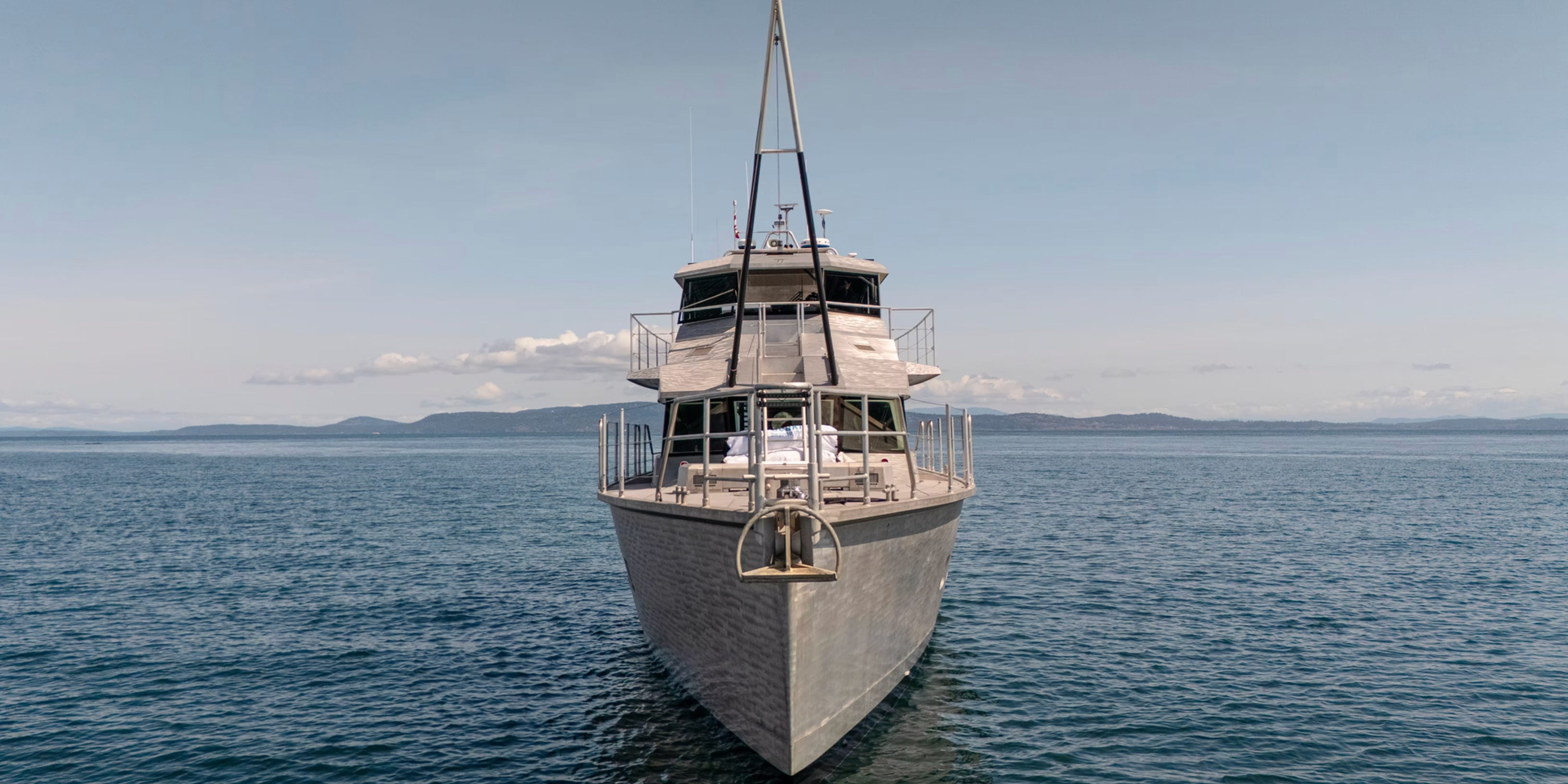
What he built, and what he lived aboard for the 5 years that followed, is now for sale in Victoria, British Columbia. She is called ‘Deo Juvante’, a Latin phrase meaning “with God’s help,” and she is one of the most carefully considered expedition yachts I have come across in some time. There is a reason for that, and it starts with the yard that built her.
The Yard
If you have spent any time in the world of long-range passage-making, you will know the name Circa Marine. The Whangarei-based aluminium builder is responsible for something rather significant in the history of the explorer yacht: every single vessel in Steve Dashew’s FPB series.
The FPB, or Fast Passage Boat, was Dashew’s life’s work translated into metal. The FPB 64, which launched in 2005, was described at the time as “ahead of its time, setting the standard for offshore power boats and passagemakers.” Circa Marine built all 11 of them. They went on to produce the FPB 78, a 26.7-metre aluminium hull with a 5,500-nautical-mile range and an 11-knot cruise speed, followed by the FPB 70 and the flagship FPB 97.
The philosophy that runs through every one of those vessels is the same: build it heavy, build it in aluminium, build it to go places no ordinary motor yacht would consider, and build it to come back in one piece. Multiple redundancies on all main systems. Structural integrity engineered for extended all-season blue-water passage-making. Self-reliance as a design principle rather than an afterthought.
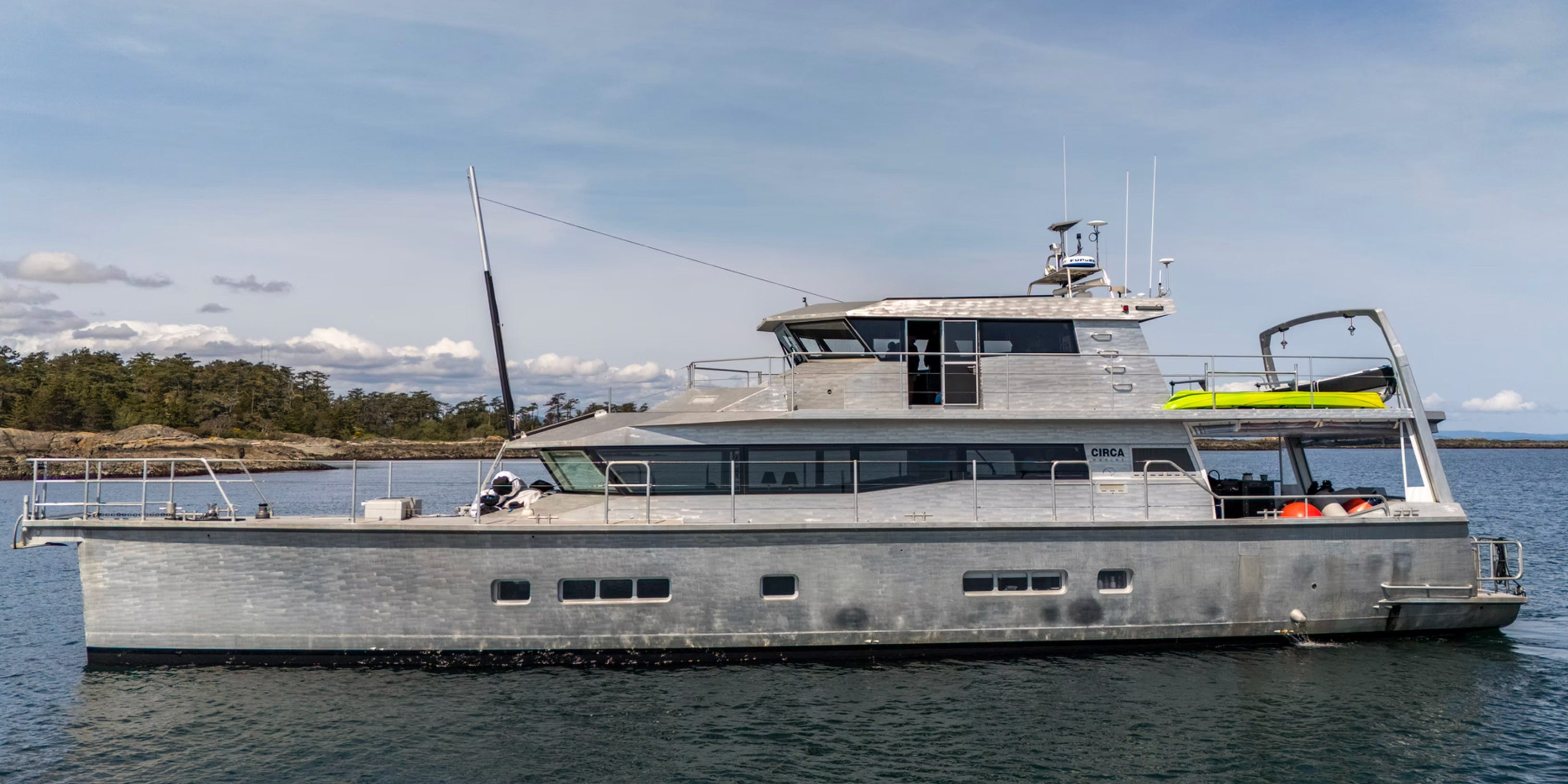
When Thierry Verstraete decided he wanted an expedition yacht, he went to Circa Marine. He did not commission an FPB. He commissioned something to his own specification, realised by the best aluminium builder in the Southern Hemisphere. The result is a 25.9-metre vessel that sits squarely in the FPB family of thinking, the same range, the same cruising speed, the same unpainted aluminium construction, but built for a man who intended to live aboard her.
She carries HIN NZ-CIR24002E222. The CIR designation, for those not familiar, stands for Circa Marine. It is right there in the hull identification number.
What She Is
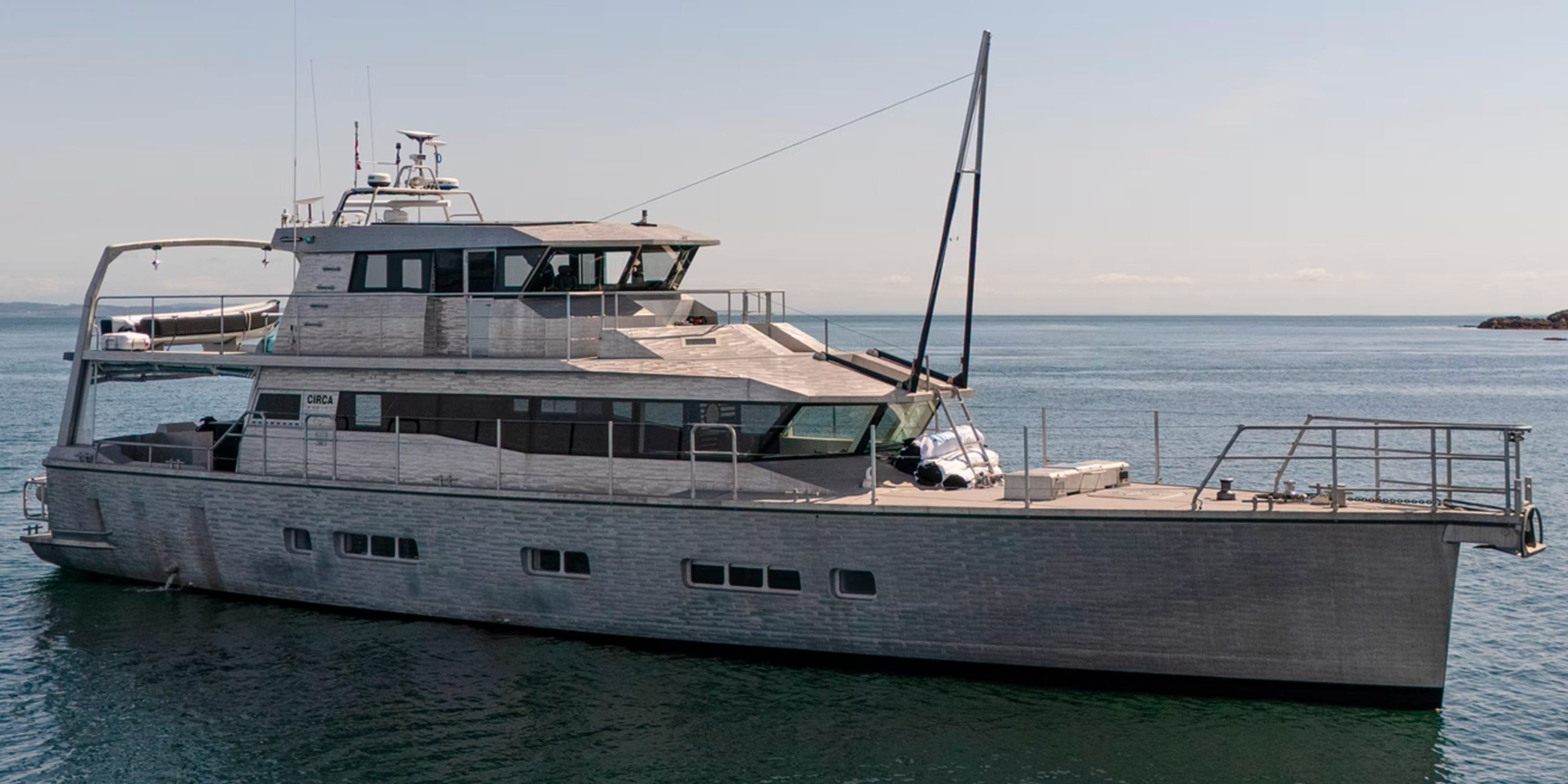
Deo Juvante measures 25.9 metres overall, with a waterline length of 24.7 metres. Her beam is 5.9 metres. She draws approximately 1.8 metres, shallow enough for genuine versatility across anchorages and approaches that would stop deeper-draughted vessels cold.
Her hull is full aluminium throughout: 12-millimetre plate below the waterline, 8-millimetre topsides. She is unpainted, which is both a statement and a practical choice. There is nothing hiding the welds and nothing to blister, delaminate or peel. What you see is what you get, and the independent marine survey conducted in April 2025 confirmed that what you get is very good indeed. The ultrasonic hull readings came back clean across the board. The weld seams were described as excellent.
Displacement runs to approximately 77 tonnes fully laden, which gives her the mass to handle open-ocean sea states without the violent motion that plagues lighter, shallower-bodied yachts in a quartering swell. This is not a vessel that needs flat water to perform comfortably.
Fuel capacity stands at 14,000 litres, giving her a credible range of 5,000 nautical miles or better at economical speed. Fresh water capacity is 5,000 litres, supplemented by an 1,800-gallon-per-hour watermaker. She could, in practice, be away from a marina for a very long time.
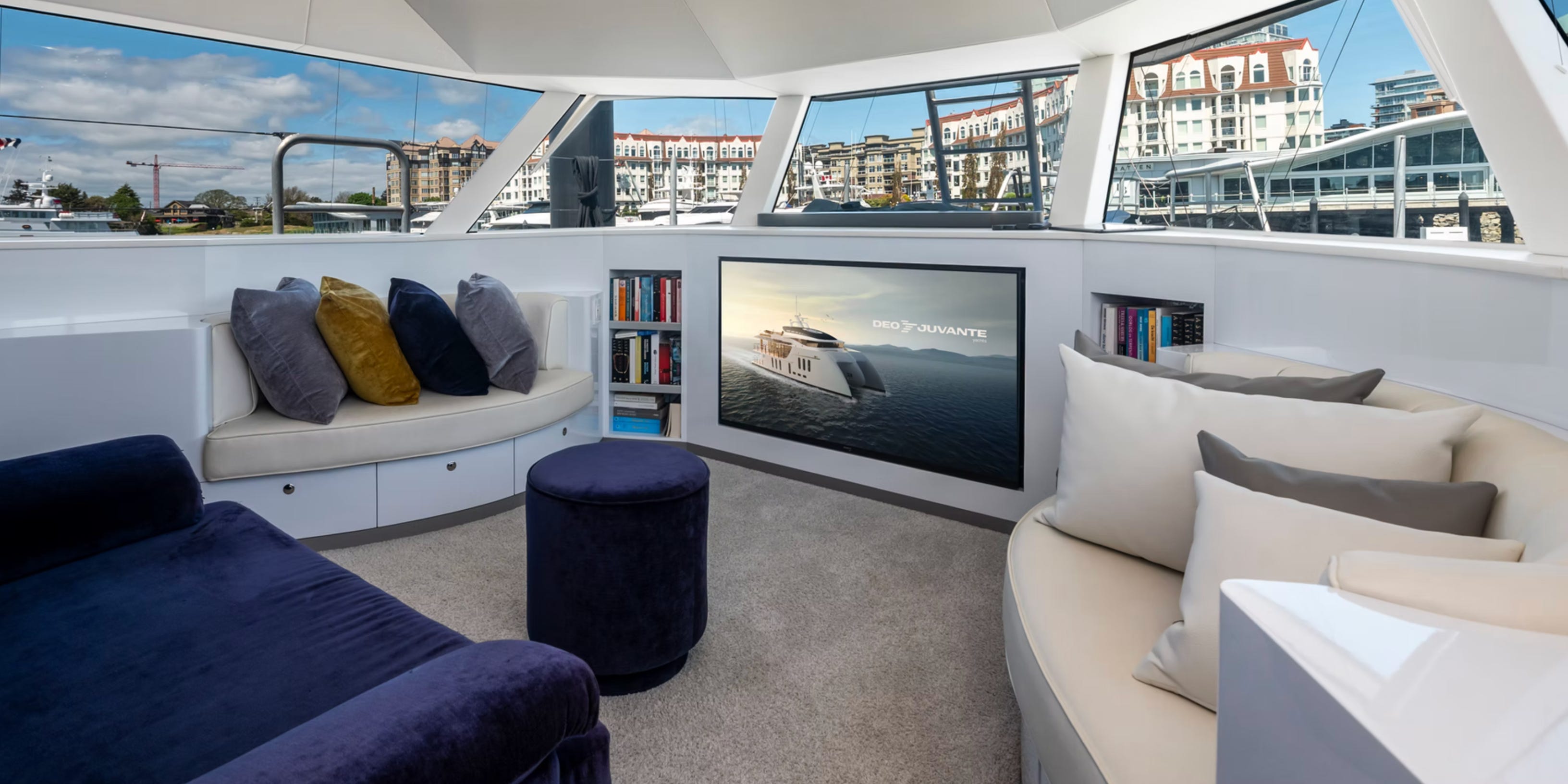
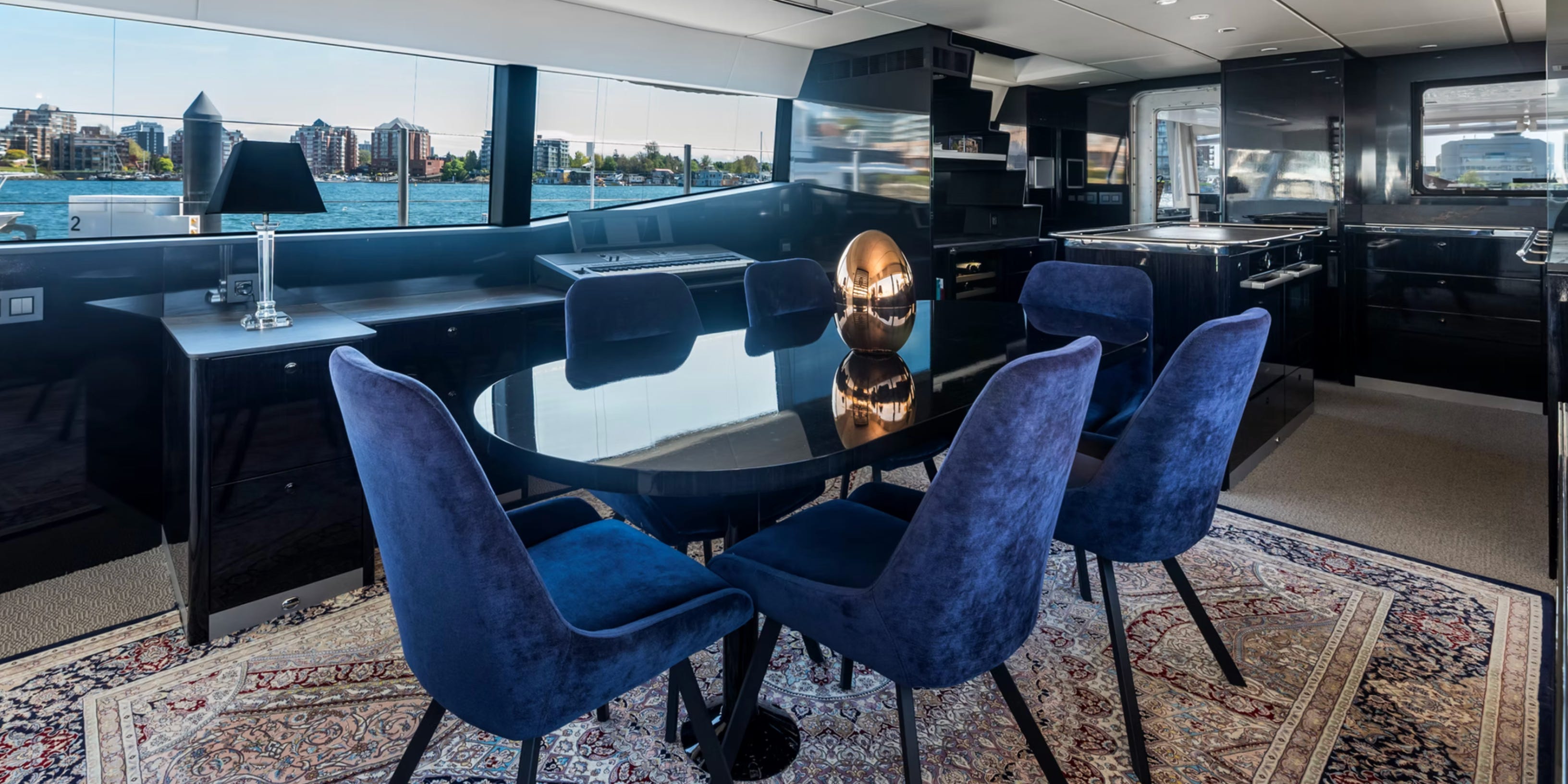
Accommodation runs to 4 cabins and 4 bathrooms: a forward master cabin, 2 guest cabins and a crew cabin. The interior is fitted to a high standard, with Dekton Laurent porcelain stone countertops, Flexiteak flooring and 24-volt LED lighting throughout. But this is clearly not a superyacht interior in the ‘showboat’ sense. It is the interior of a vessel built to be lived in, maintained at sea and cleaned after a fortnight in an Indonesian anchorage. There is a difference.
The Machinery
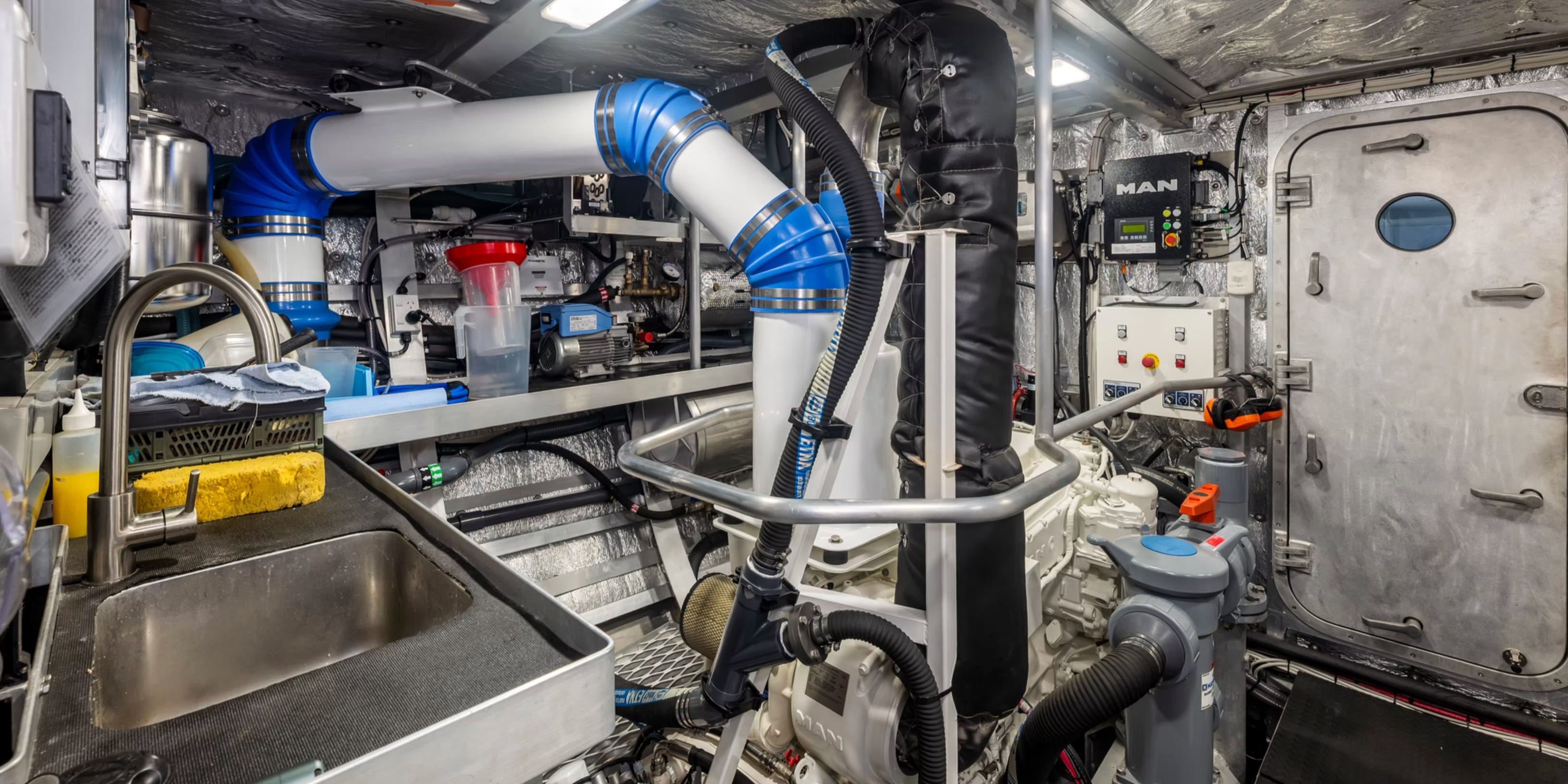
Twin MAN D2676 LE451 engines produce 500 horsepower each at 1,800 rpm, driving through ZF 550-1 gearboxes to dual 5-blade Nibral propellers on 3.5-inch stainless shafts. At survey in April 2025, the port engine showed 1,823 hours and the starboard 1,819. As of May 2026, Thierry reports approximately 1,880 hours on each, consistent with careful, moderate use in the intervening year.
The surveyor’s assessment of the engines was unambiguous: “great care and good maintenance... continuously serviced and fully maintained.” Shaft bearing wear was within tolerance at a maximum of 0.12 millimetres. Propellers and rudders were described as in excellent condition with fresh Propspeed antifouling coating recently applied.
Thierry added 4 hydraulic steering pumps to the standard configuration. The specification calls for 2. His reasoning is straightforward: if you are transiting Japanese coastal waters or navigating Alaska’s Inside Passage, you want redundancy on your steering that goes beyond what the yard supplied as standard.
This is the kind of modification that tells you something about the owner.
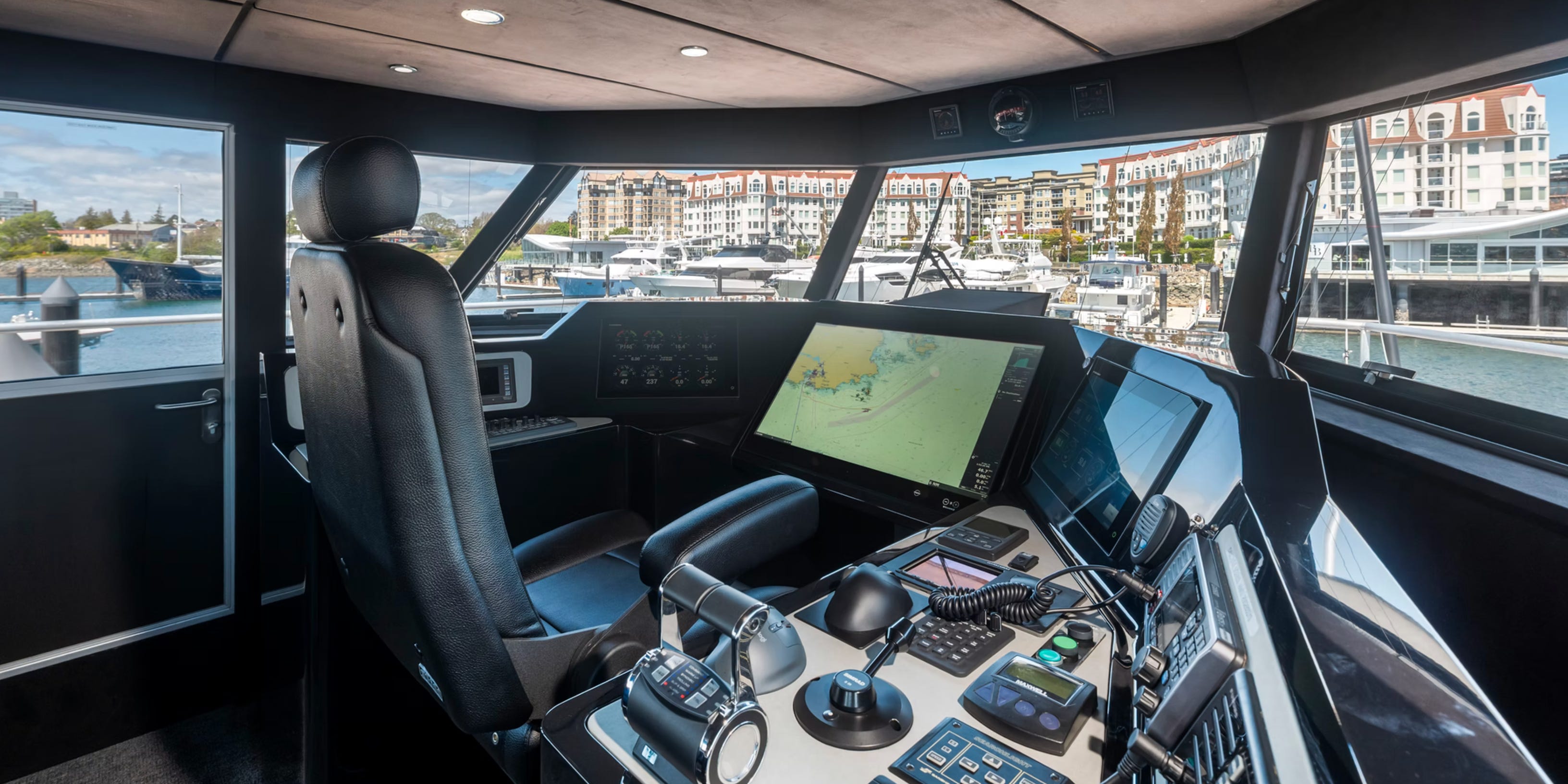
All-speed stabilisation is handled by Humphree electric fin stabilisers. Bow thrust comes from a Side-Power proportional unit. Navigation electronics run to a Furuno suite throughout, covering TimeZero chart system, dual Doppler radar (DRS25A-NXT and DRS4D-NXT), SCX20 satellite compass, Class A AIS and a forward-facing sonar that has earned its keep in coral-strewn anchorages. Autopilot is Simrad AP70. Communications include Starlink, Iridium GO satellite and SSB/HF radio.
The house battery bank, 10 Victron 12.8-volt 300-amp-hour lithium phosphate units, is substantial and relatively recent. Charging comes from the Cummins Onan 22-kilowatt generator, from shore power, and from the roof-mounted solar array with MPPT regulation.
The Kite
This is where Deo Juvante goes beyond the FPB template, and it is worth explaining properly.
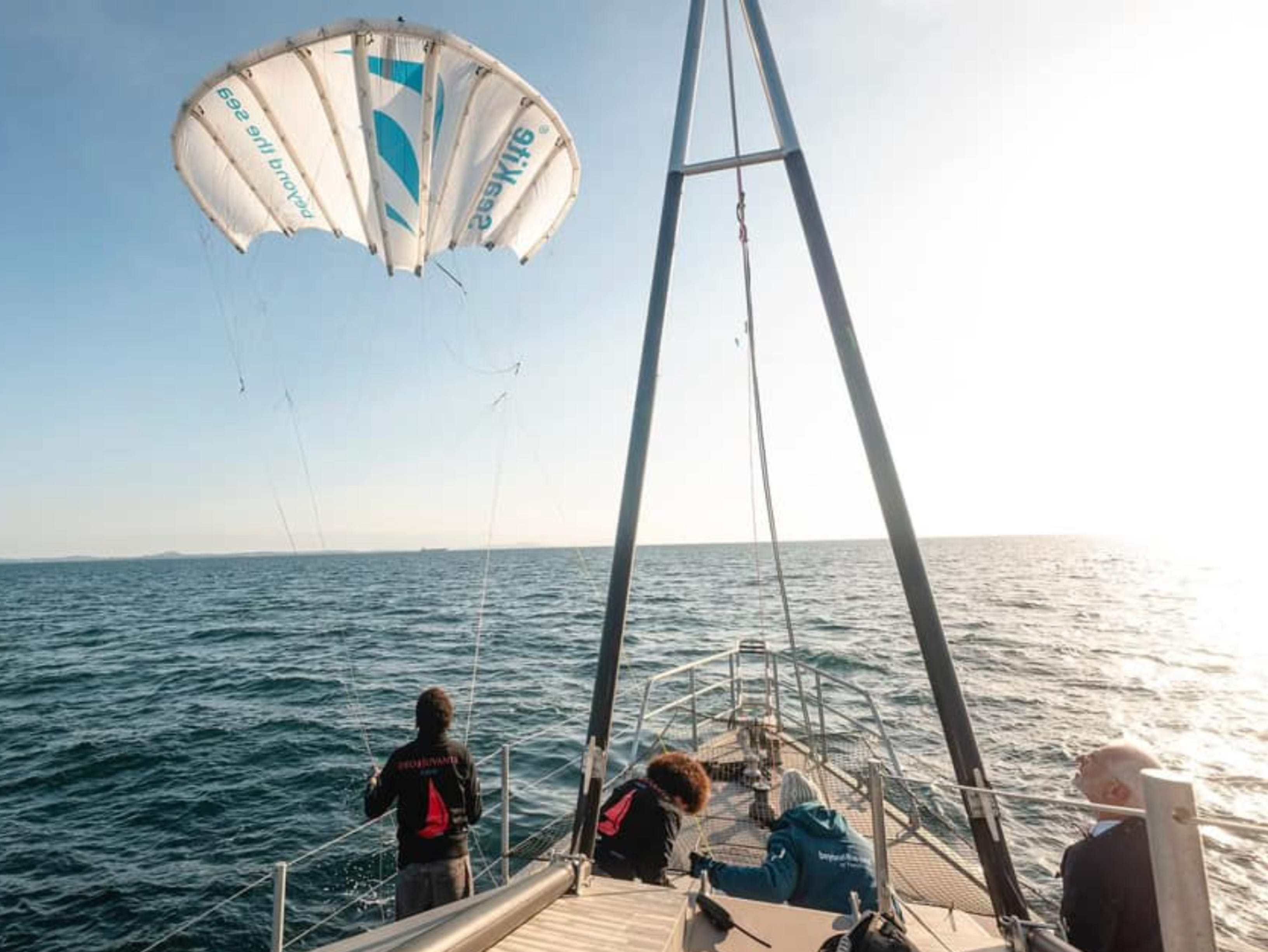
Thierry Verstraete was the first commercial customer for a propulsion kite system developed by Yves Parlier under his company “Beyond the Sea.” The system uses a tethered kite flown at altitude, where wind is stronger and more consistent, to generate forward thrust, supplementing or in favourable conditions largely replacing the main engines.
On Deo Juvante, the kite is capable of driving the vessel at 4.5 knots on its own in 15 knots of apparent wind, operated via an 8-figure manual control. Thierry estimates a fuel saving of up to 30% on passages where conditions are suitable. 3 kites are included with the sale, along with a €20,000 training voucher with Beyond the Sea.
This is not a novelty. Kite propulsion systems have attracted serious commercial interest from the shipping industry precisely because they work. On a vessel with a 14,000-litre fuel capacity making long ocean passages, a 30% reduction in fuel burn is a meaningful number.
The Passage
Deo Juvante was launched in Whangarei in April 2022. Her maiden voyage took her down the length of New Zealand’s North Island to the South Island, in winter conditions, which is not the gentle shakedown cruise most owners would choose. She handled it extremely well.
From New Zealand she crossed to Australia, then north to Indonesia, where Thierry navigated the challenging anchorages of the archipelago. From Indonesia the family continued to Japan, where they spent a full year. The children enrolled in a Fukuoka school while Thierry obtained his STCW Master 500 GT Unlimited certificate while living aboard the vessel in one of the world’s more demanding maritime environments.
From Japan, north to Alaska for 2 months, then south through the Inside Passage to Victoria, British Columbia, where she lies now.
I will mention the Bay of Plenty, because it is worth noting. During the earliest part of the voyage, Deo Juvante encountered 20 to 25 knots of wind and 3 to 5-metre waves in a night passage. She surfed at 27 knots and maintained 15 degrees of heel throughout. Thierry described it as exactly what you want to know about a new vessel early in a voyage. I 100% agree.
The Survey
In March and April 2025, independent marine surveyor Jason Caple Assoc IIMS of Broadwater Marine conducted a full pre-sale survey: an in-water inspection at Victoria, British Columbia, followed by an out-of-water inspection and sea trial at Port Angeles, Washington. The survey was commissioned by Thierry, not required by a buyer, which is a meaningful signal about how this sale is being conducted.
The overall assessment was “Above Average, Suitable for intended use.” Fair market value was assessed at USD $4,500,000. Replacement new build was estimated at USD $5,500,000.
The deficiencies noted were minor. Expired flares require replacement. The port stabiliser fin showed delamination at the tip, scheduled for repair at the next haul-out. Sacrificial wear patches were recommended for the rudders. Electrical, fuel, HVAC, navigation, domestic, deck and structural systems each returned no deficiencies at all.
The surveyor’s closing observation: “It is obvious from the overall condition that there has been great care and good maintenance done with the current ownership.”
The current asking price is €4,000,000 and she is listed directly with Deo Juvante Brokerage.
What follows covers the ownership economics in full: the running costs, the MAN engine servicing picture, what it would actually cost to bring her from Victoria to the UK, Europe, Australia or the East Coast of the United States, whether by sea or by ship, more pictures and an honest assessment of who this vessel is really built for.
The Price in Context
The asking price of €4,000,000 requires some context to interpret properly…[article continues below]
