

Since setting up my Yacht Buoy YouTube channel five years ago, I have featured hundreds of different boats (the same applies to this Substack, too). Steel trawlers, expedition yachts, heritage Dutch kotters, Royal Navy conversions. I thought I had a reasonably good picture of what this world looks like. And then a broker sent me a link to the Shine Down, and I had to look at it twice. In fact, more than twice!
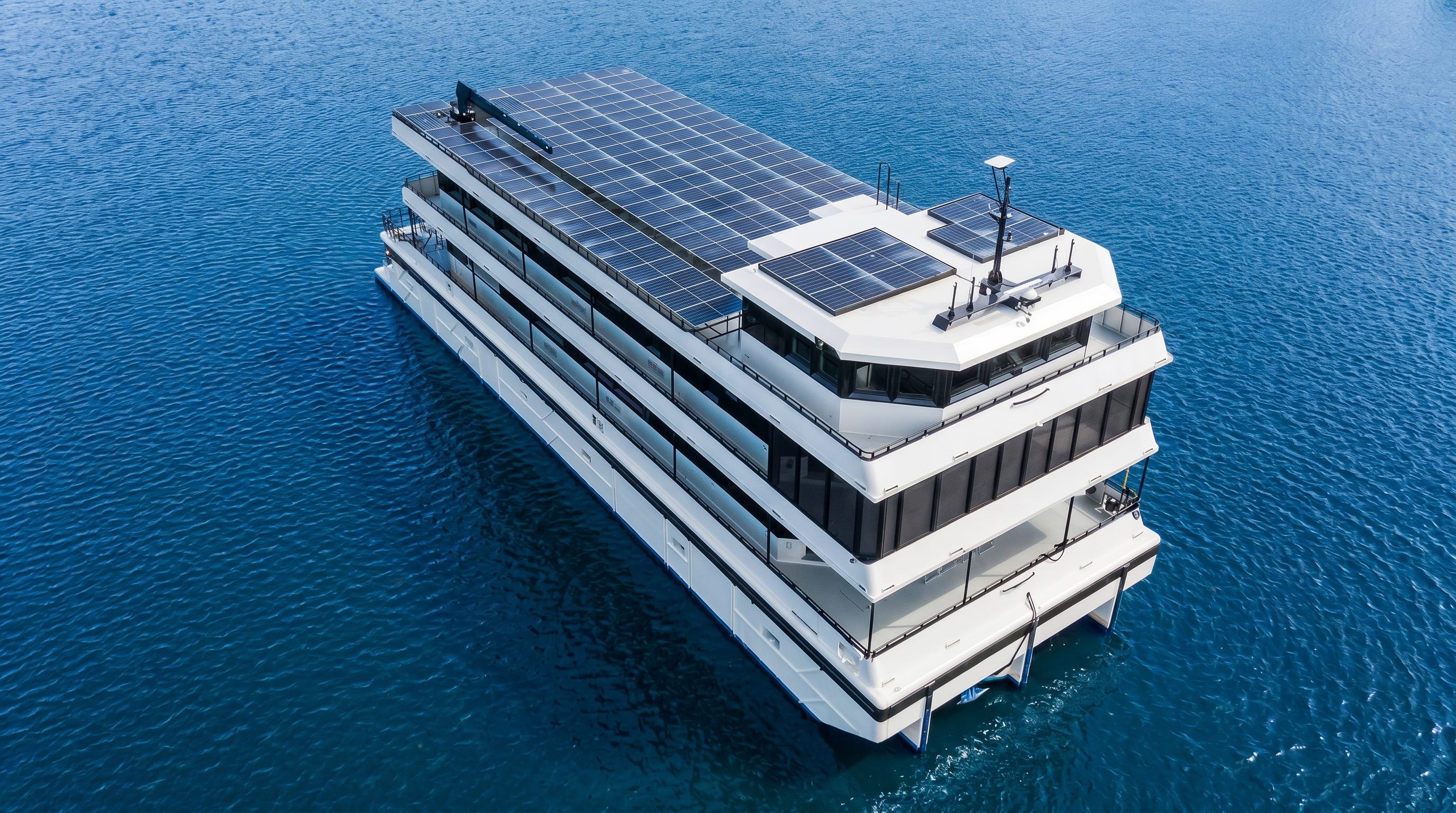
This is not a yacht. Not in any meaningful sense of the word. It is a 120-foot, four-storey aluminium floating building, with the entire rooftop tiled from edge to edge in solar panels, a 6-foot draft, and an asking price of $15,000,000 (listed with World Wide Yacht Sales Inc - broker’s details below). The owner, who is also the engineer and the designer, set out to build something that had never been built before: a truly self-sustaining floating estate, generating its own electricity, needing no connection to shore power, and moving under its own considerable power when the mood takes it.
What makes the Shine Down worth examining closely is the depth of engineering behind it. This is one of the most thoroughly considered floating estates ever offered for sale in America, and understanding the decisions the owner-designer made, and the thinking behind each of them, is exactly where the interesting story lives.
Before I get into the detail, I want to show you around her first. Words and photographs only go so far with a vessel like this, so, you really need to see the scale of her, the four decks of glazing, the solar rooftop, the interior. Have a watch, then continue reading and we will dig into the engineering.
The Builder You Might Not Have Heard Of
Breaux Brothers Enterprises was founded in 1982 in Loreauville, Louisiana, a small community in Iberia Parish, deep in Cajun country. For more than four decades, they built one thing: commercial-grade aluminium workboats. Fast supply vessels for the oilfields, crew boats, pilot boats, patrol craft. Their reputation in the commercial marine sector is, by all accounts, excellent. Their vessels have been described as the Cadillac of crewboats, which is exactly the kind of compliment that tells you a great deal about where a company’s expertise actually lies.
M/Y Shine Down is something entirely different. It represents Breaux Brothers’ first venture into luxury residential floating vessels, and the ambition on display here is striking. This was not a commission from a traditional superyacht buyer. The owner brought the concept, the engineering, and the design himself. He then took that vision to a yard he trusted to execute in aluminium at a commercial-grade standard, and what emerged from Loreauville is, at the time of writing, genuinely unlike anything else on the market.
The vessel was shown at the Suncoast Boat Show in Sarasota, Florida, and attracted considerable attention, which is not surprising, because at 120 feet with a beam of 38 feet and four fully glazed residential decks rising above a barge hull, she is not easy to overlook.
What She Looks Like
From the water, Shine Down reads as architecture rather than naval architecture. The hull is flat-bottomed aluminium, painted with a blue waterline stripe, with the freeboard of a working barge. Above it, four levels of living space rise in white-framed, floor-to-ceiling glazing, with wraparound balconies on the accommodation decks. And above all of that, covering virtually every square foot of the rooftop, are no fewer than 108 high-efficiency solar panels.
She is a rectangle. A deliberate, unapologetically residential rectangle. There is no bow sheer, no attempt to disguise what she is. The design language says clearly: I am not trying to be a yacht. I am trying to be the best floating home ever built.
The numbers support that framing. Over 6,400 square feet of enclosed interior living space across four decks, plus an additional 4,200 square feet of subdeck, for a total footprint exceeding 11,800 square feet. Five king-sized cabins, seven bathrooms. A gourmet kitchen with dumbwaiter service connecting the decks. Exterior spaces which function as both a party venue and an observation deck. A pool on the aft deck.
That is not a yacht specification. That is a Mayfair penthouse specification.
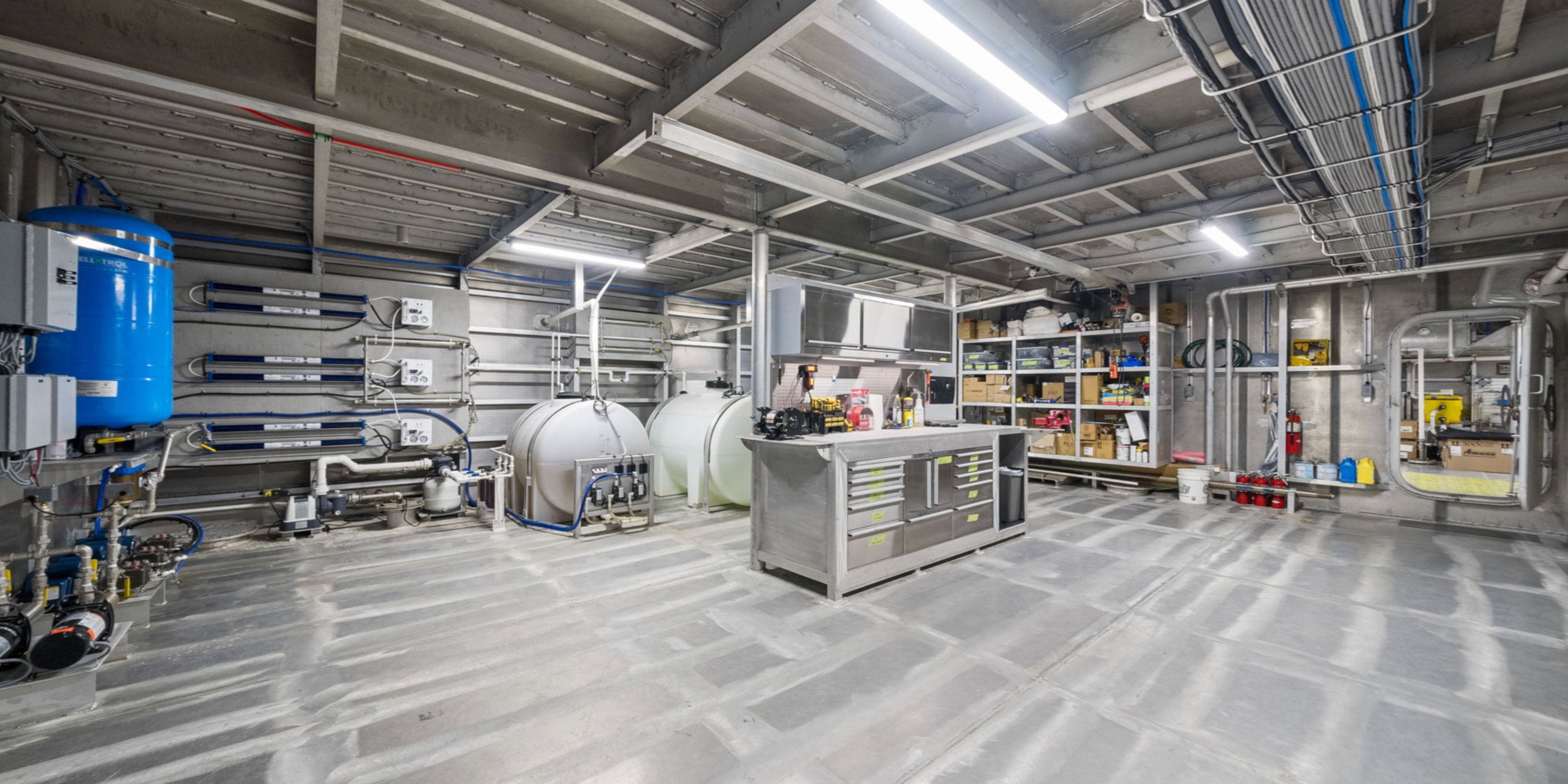
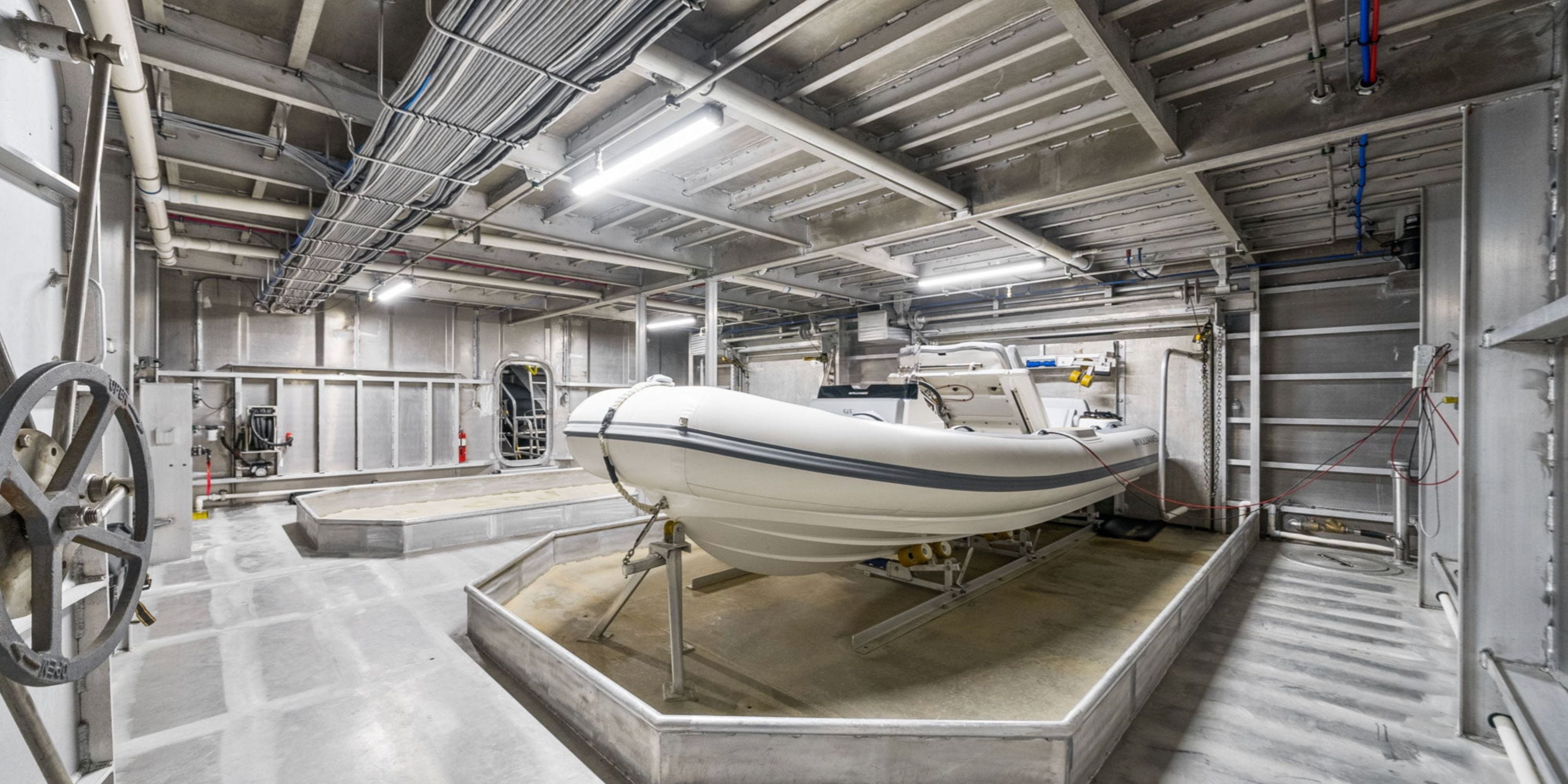
Beneath the living decks, the 4,200-square-foot subdeck is where the vessel’s self-sufficiency claims are backed by hardware. A fully equipped mechanical workshop, a water treatment and storage system, and an enclosed tender garage housing two large tenders on dedicated aluminium cradles. That last detail is worth noting: an internal tender bay is a feature you typically find on superyachts in the $30 million bracket, not floating homes of any description.
Inside the Shine Down
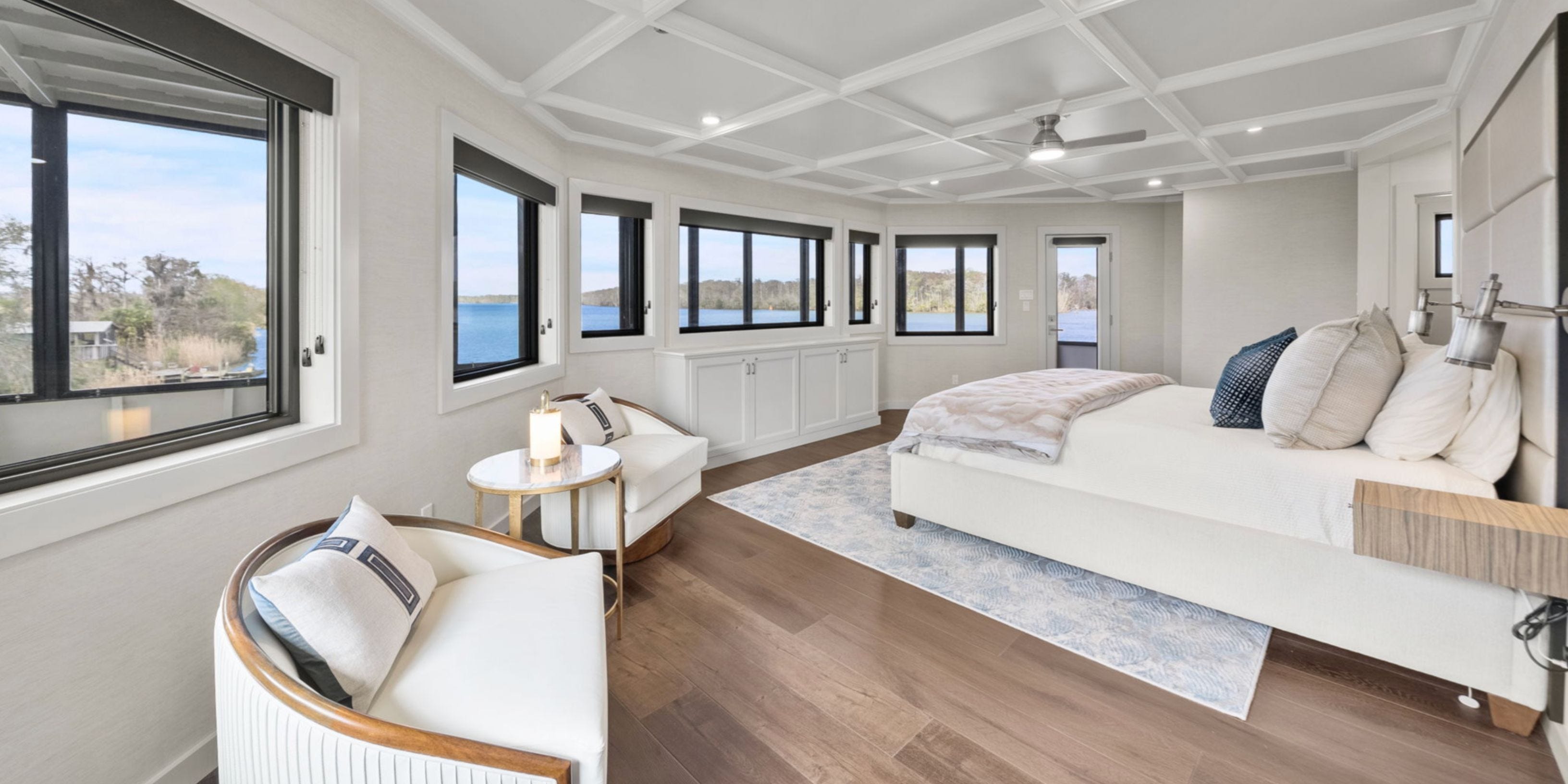
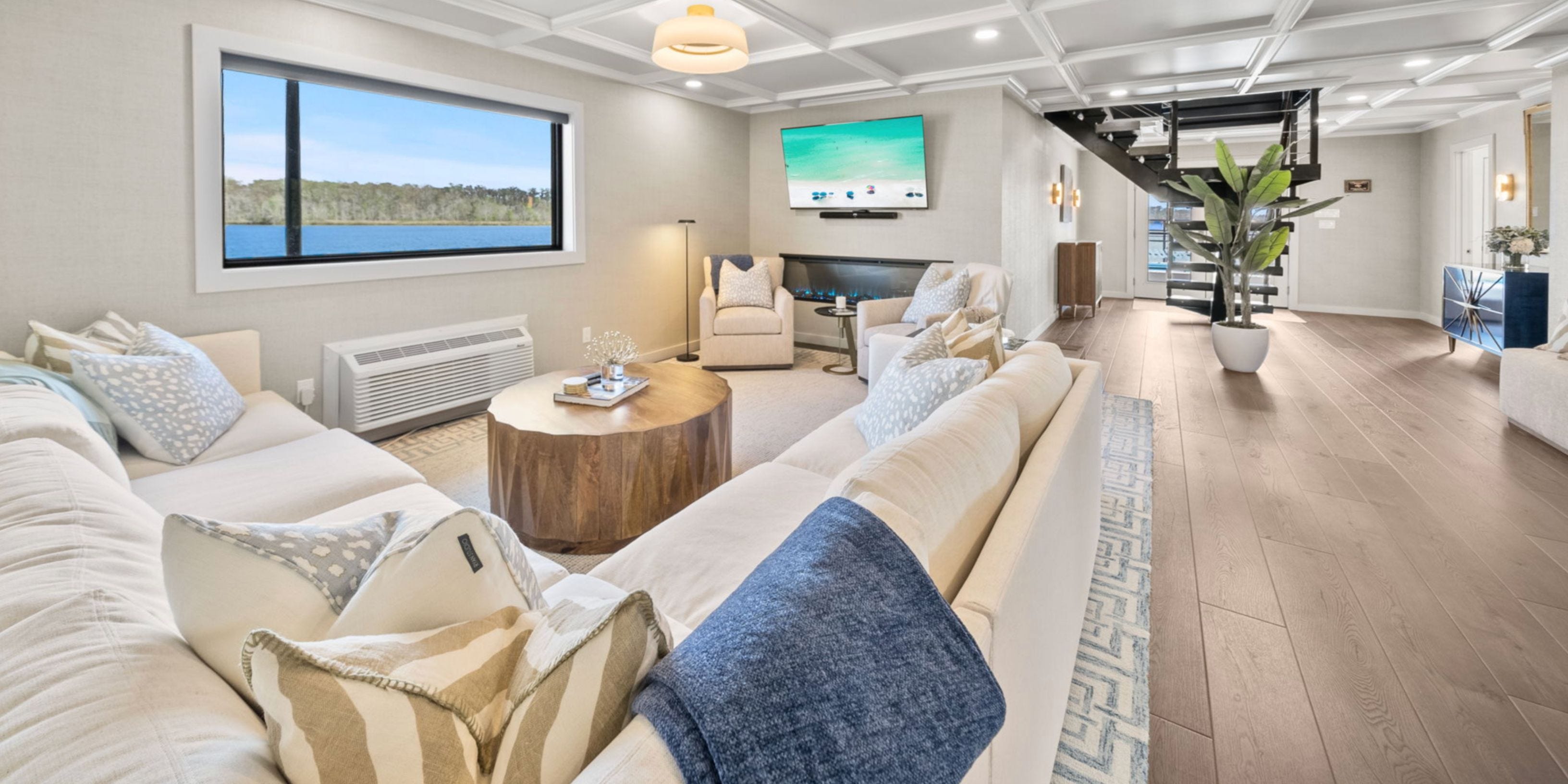
The interior was designed by Rita Durio and Associates, a Lafayette-based firm that has been working in high-end residential interiors since 1981. The choice is deliberate and telling. This is not a marine design studio in the traditional sense. There are no nautical references, no teak and holly soles, no stainless fittings. What Rita Durio has delivered is a residential interior of genuine quality, and the photographs make a strong case.
Coffered ceilings run throughout every living space on every deck, a serious architectural choice that adds height and formality, and gives the interior the feel of a well-built home rather than a converted vessel. Wide-plank hardwood flooring connects the spaces. The colour palette is coastal without being clichéd: cream, soft white, warm grey, navy accents.
The main salon stretches nearly the full width and length of the primary accommodation deck. Sectional sofas, a fireplace, a spiral black metal staircase rising to the upper decks, and views out across the water from multiple windows. It looks, unambiguously, like a good apartment in a luxury waterfront development.
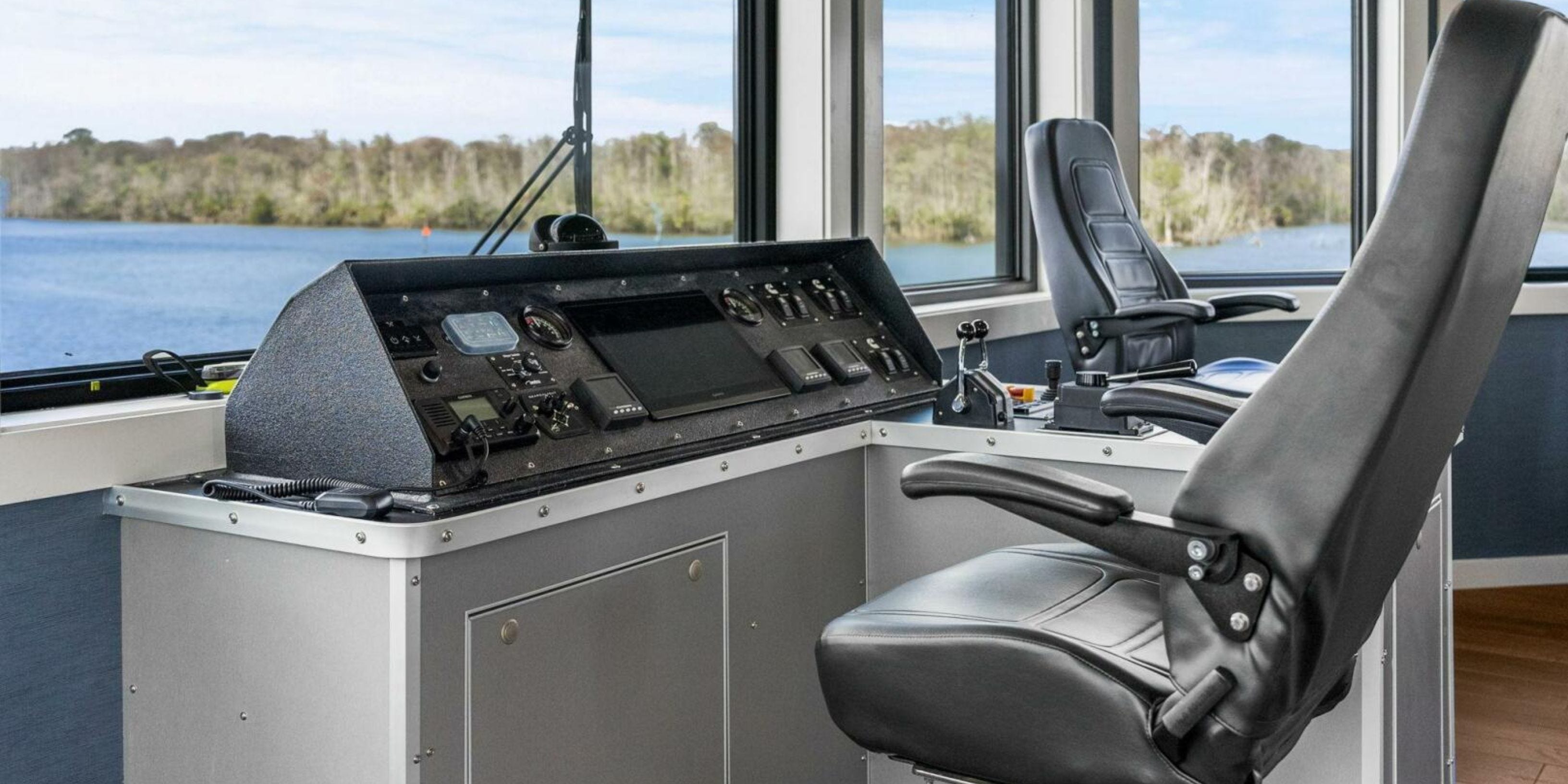
The helm deserves its own mention, because it tells you something important about the vessel’s intended use. The pilothouse is painted slate blue, with panoramic windows wrapping three sides and a centre navigation console. Immediately adjacent is a full-length granite bar island with four industrial-style bar stools. This is a social area that also happens to have a steering wheel. The owner was not building a passage-maker. He was building a destination.
But, he no doubt wanted to ensure that, as he motored towards his next destination, he could do so whilst still being a part of the social setup on board.
The Engineering That Sets Her Apart
Here is where the Shine Down becomes genuinely remarkable.
Most vessels marketed as solar-powered or eco-friendly maintain a shore power inlet as a safety net. The Shine Down has none. There is no shore power connection. The only role the diesel generator plays is charging the battery bank during extended periods of solar deflection (heavy cloud cover or multi-day rain events). For normal operations in Florida sunshine, the vessel runs entirely on the energy it generates itself.
The system backing that claim is substantial. 108 high-efficiency solar panels cover the rooftop. Those panels feed into a battery bank of over 300 kilowatt-hours of lithium iron phosphate storage, one of the most chemically stable and longest-lived battery chemistries available, with a service life of 10 years or more and minimal maintenance requirements.
And then there is the propulsion arrangement, which the broker described to me in terms that immediately heightened my attention even more. Shine Down is triple-screw: two conventional propeller shafts aft, and one forward thruster on an articulating arm. That forward thruster is not a conventional bow thruster. It is an azimuthing unit, derived directly from the dynamic positioning systems used on oilfield supply vessels and dive support ships. Those vessels use independently vectored thrusters in combination with GPS sensors and DP software to hold precise position without anchoring, even in current and wind. The engineering is complex, expensive, and, crucially, proven in demanding commercial service.
On a flat-bottomed barge hull with a 38-foot beam, conventional handling would be a significant challenge. A forward azimuthing thruster that can vector thrust in any direction, combined with the conventional twin-screw aft arrangement, gives this vessel a manoeuvrability profile entirely out of proportion to her size. She can hold position, crab sideways, and thread herself into tight anchorages in a way that a traditional hull could not.
That is oilfield engineering, applied to a floating living room. It is, frankly, impressive.
What the Numbers Say About “Off-Grid”
The solar and battery system is the centrepiece of the Shine Down’s marketing, and the headline claim that she operates without shore power is genuine and verifiable. The energy independence at this scale, in this climate, is worth looking at in even more detail. Because it is fascinating....
The Energy Maths: Living With the System
108 solar panels in the Florida sun is a meaningful generation system. A high-efficiency 400-watt panel in a Florida climate, with annual average solar irradiance accounting for cloud cover, seasons, and panel angle, produces approximately 1.2 to 1.8 kilowatt-hours per day. Across the full 108-panel array, that gives you around 130 to 194 kilowatt-hours of generation per day in typical Florida conditions..[article continues below, including broker’s contact details, more images and more in-depth coverage]
