

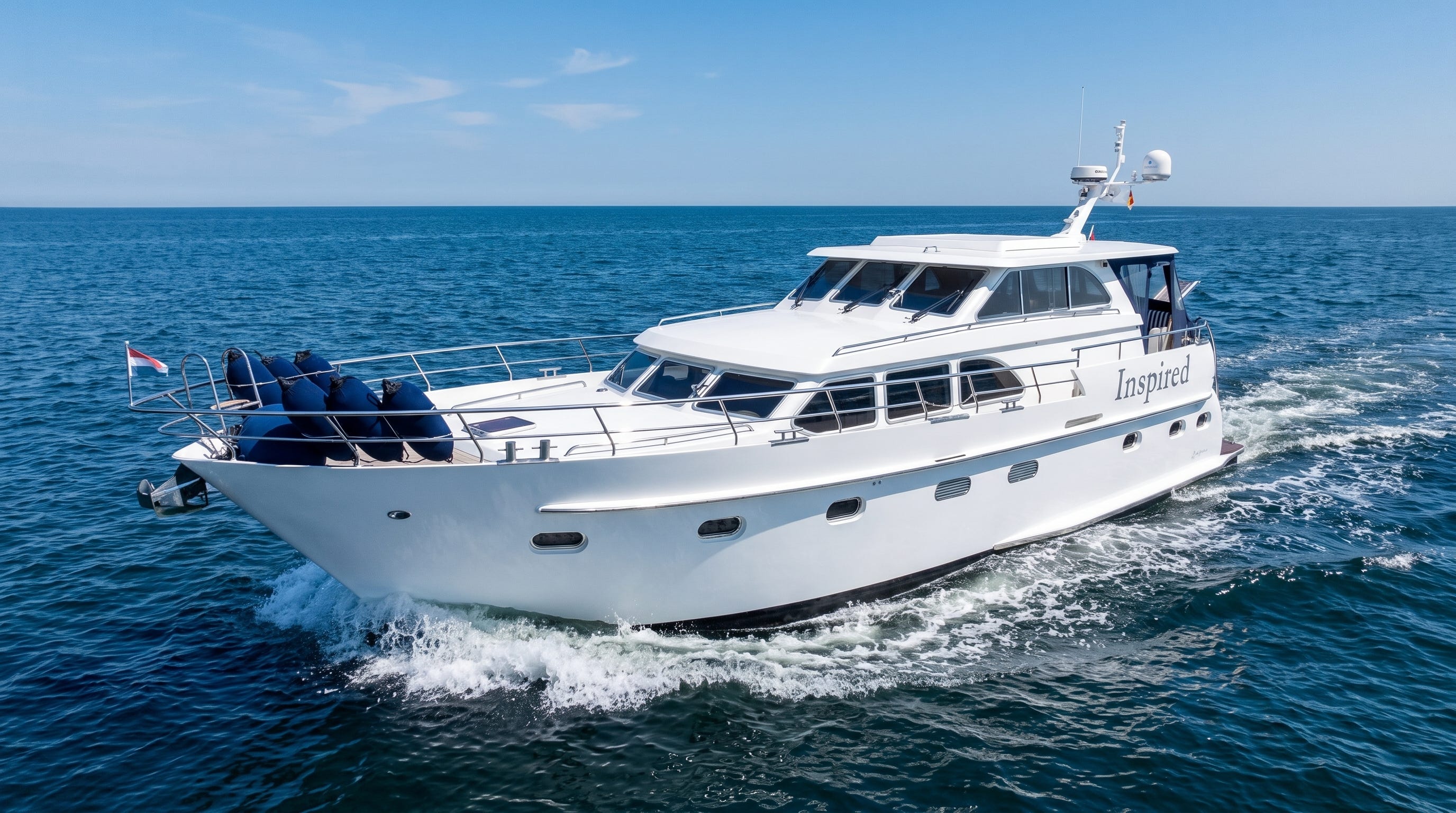
Van der Valk has been building high-quality steel motor yachts in their Waalwijk facility since 1967. By the time the popular Continental series arrived in the late 90s, the 15.50 had become their signature product and firmly put them on the coastal cruiser map outside of their native Netherlands. Inspired was built in 2007 and, by the listing broker’s own admission, is one of the best equipped examples of the 15.50.
First off, let’s start by taking a look at her steel hull. She was built with a hard chine, known in Dutch as “knikspant”. This means that, as opposed to smooth round-bilged hulls, the chine configuration has been set up with distinct angles. There are a few benefits of having a hard chine, and one of them is a more comfortable ride in the confused seas which you often encounter off the coast, especially here in Europe. A hard chine also means that the boat is more stable and predictable when motoring at displacement speeds. A round bilge hull is harder to engineer, but many of the explorer yacht owners I know prefer the motion of a hard chine hull.
Inspired’s hull is 5mm thick, and her superstructure is 4mm thick, so even though this vessel is a Cat B boat, she can still withstand some heavy weather; the type that is often encountered when you cruise in the North Sea, especially in the harsh winter months. The hull specs alone are a large part of why these boats have such a formidable reputation for holding their condition over long periods of time, rather than needing ongoing structural work that large steel vessels often require.
Watch the yacht tour and then come back to this article (assuming you have not already seen the video!)
She has an LOA of 16.10 metres, with a beam of 4.6 metres and a draft of 1.45 metres. This reasonably shallow draft means that the boat can be operated in parts of the Dutch and Belgian inland waterway networks where larger vessels simply cannot go. Being a Cat B vessel, you are not going to be crossing the Atlantic in this boat, so her next owner will no doubt find the relatively shallow draft a big bonus. Her air draft is just 3.45 metres, so worrying about clipping the radar mast as you edge under the countless bridges in Europe should not be a problem on most waterways.
She is fitted with twin Volvo Penta D4 diesels. Each one produces 180 horsepower, or 132kW, giving her a top speed of 10 knots, which is a few knots above general displacement speed. The twin engines, although more expensive to maintain, will no doubt appeal to many owners, not least because it means that even with a single fouled prop, you still have a means of moving. During my time in the RNLI, we would often respond to distress calls made by skippers who had fouled their props when moving west along the Thames.
With tides running at in excess of 5 knots, you only have a very small area to drift before you make contact with the shore or a ship! Personally, I think that twin engines for coastal cruising would be my preference.
When it comes to close-quarter manoeuvring, she has both a bow and a stern thruster. They are hydraulic, so if you are battling against the tide and the wind, you should not need to worry about the motors overheating, which is always in the back of your mind when you are using electric thrusters. I personally have never had to stop using a bow or stern thruster for fear of it overheating, but I know plenty of boat owners who have. She also has Naiad stabilisers as well, which for a boat of this LOA I think is a rare addition.
Liveaboard Credentials
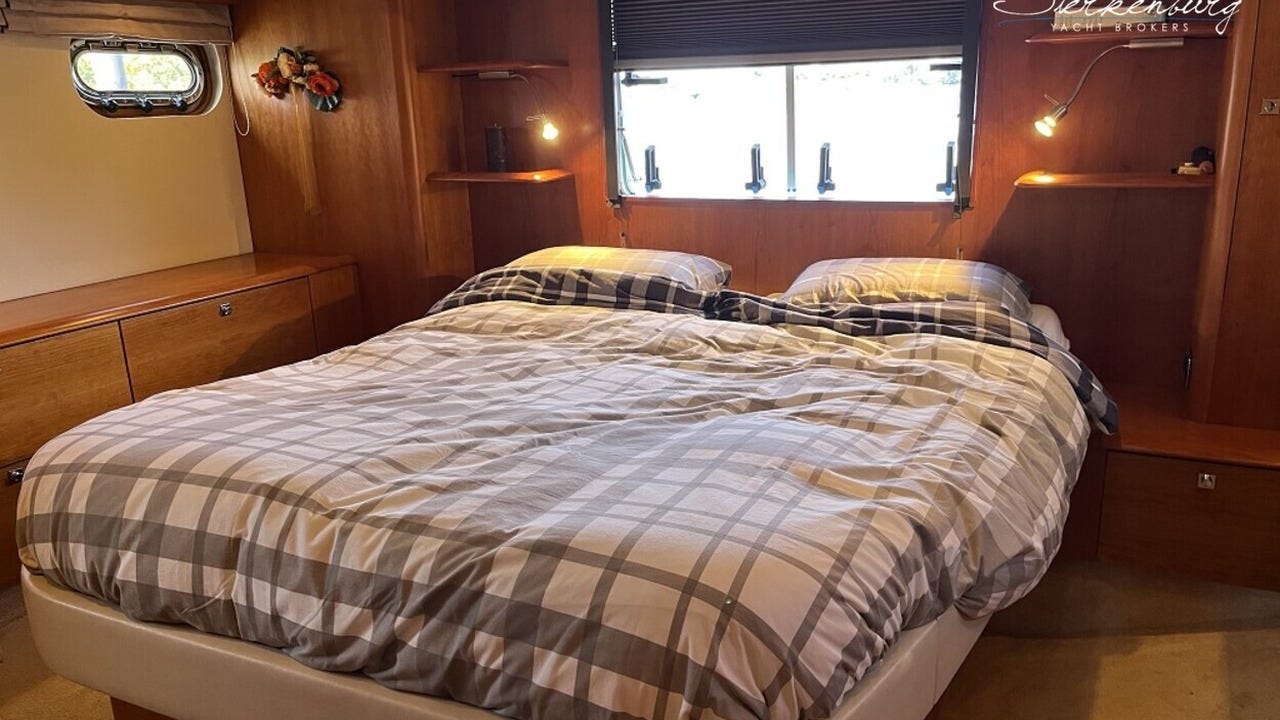
Inspired sleeps four across two cabins, with two bathrooms. The interior is finished in cherry wood, which is a choice that lends itself to a warm and cosy living environment. The saloon has also been recently restyled by her current owner, which says a lot about how this boat has been maintained. I have been on many boats where the interior has been left to degrade. Now, I am not saying that a degraded interior lends itself to poor machinery maintenance, but what I am saying is that a boat owner who looks after the interior rarely lets the machinery on board go beyond its regular maintenance cycles. Of course, there are always exceptions to the rule.
She also comes with a full Raymarine nav package with software that has been specifically designed for this boat. During the boat tour, I had some issues trying to figure out which function opened the large sunroof in the wheelhouse, but that is just because I do not speak Dutch (the broker did show me, but when I film boats, my short-term memory gets sacrificed in favour of concentrating on where and what to film!). Her dashboard has been updated, and she has new electrics including a 2-volt gel battery bank and a Quooker instant hot water tap in the galley. A nice touch.
Her central heating comes from a Kabola boiler, which is an incredibly popular installation on almost all explorer-style motor yachts. Kabola has a fantastic reputation, and I can understand why most of the boats which I feature have Kabola systems installed. She also has air conditioning and her washer/dryer means that you do not have to identify marinas to stay in based on their laundry facilities (or lack thereof).
In terms of tankage, she can carry 2,200 litres of fuel and has enough fresh water capacity for 1,100 litres. Black water capacity comes in at 500 litres. For my North American readers, that’s around 530 US gallons for fuel, and around 291 gallons of freshwater, so plenty of capacity for medium range cruising itineraries.
If I purchased this boat, then I would take her down to the Mediterranean as she is more than capable of making that voyage from the Netherlands, accross the north sea, over the English Channel, across the bay of biscay (without having to hug the coast) and then down to Gibralter, a place that is synomous with Royal Navy Sailors getting rubbish tattoos (something that I managed to avoid getting when I visited Gibralter when serving aboard HMS Sheffied (F96).
This article continues below, in “The Wardroom”, as it’s my paying subscribers who enable me to fund my trips aboard which allow me to feature boats like Inspired. If you do become a premium subscriber, then thank you!
In the premium section, I cover:
- What 2,200 hours on twin D4s really means: how these Volvo Penta diesels age, what servicing looks like at this point in their life, and the questions worth asking before survey
- Chine hull versus round bilge, clearly explained: the real handling and maintenance trade-offs of Van der Valk’s construction method compared with the round-bilged steel hulls used by other Dutch builders
- The market for well-equipped Continental 15.50s: how a fully specified example like Inspired compares with less complete boats of the same model on the market today
- My honest assessment of what this specification is actually worth: whether the equipment list here justifies a premium over a base-specification sister ship
What 2,200 Hours on Twin D4s Actually Means
