


Somebody always asks it after the third pint at the yacht club, or in the comments under a YouTube video of a boat with the curtains drawn and a light on inside. Does living on a boat in the UK cost less than renting a flat, or is that just something boaters tell themselves? The answer needs numbers, not a feeling, so here they are.
The quick answer? Sometimes, and it depends almost entirely on three things:
whether you own the boat outright or are financing it, where you are legally allowed to moor her, and whether you have set aside real money for maintenance rather than hoping for the best.
Get all three right and living aboard can beat renting by a real margin. Get any one wrong, and it can cost more than the flat you were trying to avoid.

What renting in the UK costs right now
The Office for National Statistics puts the average UK private rent at £1,388 a month as of June 2026 (a provisional, UK-wide figure across all property sizes, not a one-bedroom-specific number). That is the baseline figure I will compare both boat scenarios against.

Scenario one: the inland narrowboat
Narrowboats are a classic UK entry point into liveaboard life, partly because purchase prices can sit well below a coastal boat’s equivalent. Aqueduct Marina’s brokerage listings have shown a 59ft narrowboat at £89,995 and a 60ft boat marketed as “Ideal Liveaboard” at £179,995.
Under a standard Canal & River Trust licence, without a home mooring, boats must generally move every 14 days unless exempt, and a valid Boat Safety Scheme certificate or exemption is required. Continuous cruising is a genuine lifestyle and not a loophole for free permanent parking.
For a fixed mooring instead, Cambridge City Council’s published 2026/27 residential fees range from £1,356 to £1,992 a year, roughly £113 to £166 a month, though the waiting list is currently closed, so treat the fee as a benchmark, not guaranteed availability.
Insurance is comparatively gentle: Craftinsure’s narrowboat customers pay an average of £291 a year (roughly £24/month), including liveaboard cover.
Mooring and insurance together come to roughly £137 to £190 a month, well below the rent baseline on that subtotal alone. That excludes licence fees, fuel, heating, utilities and any maintenance reserve, so treat it as a floor, not a total.
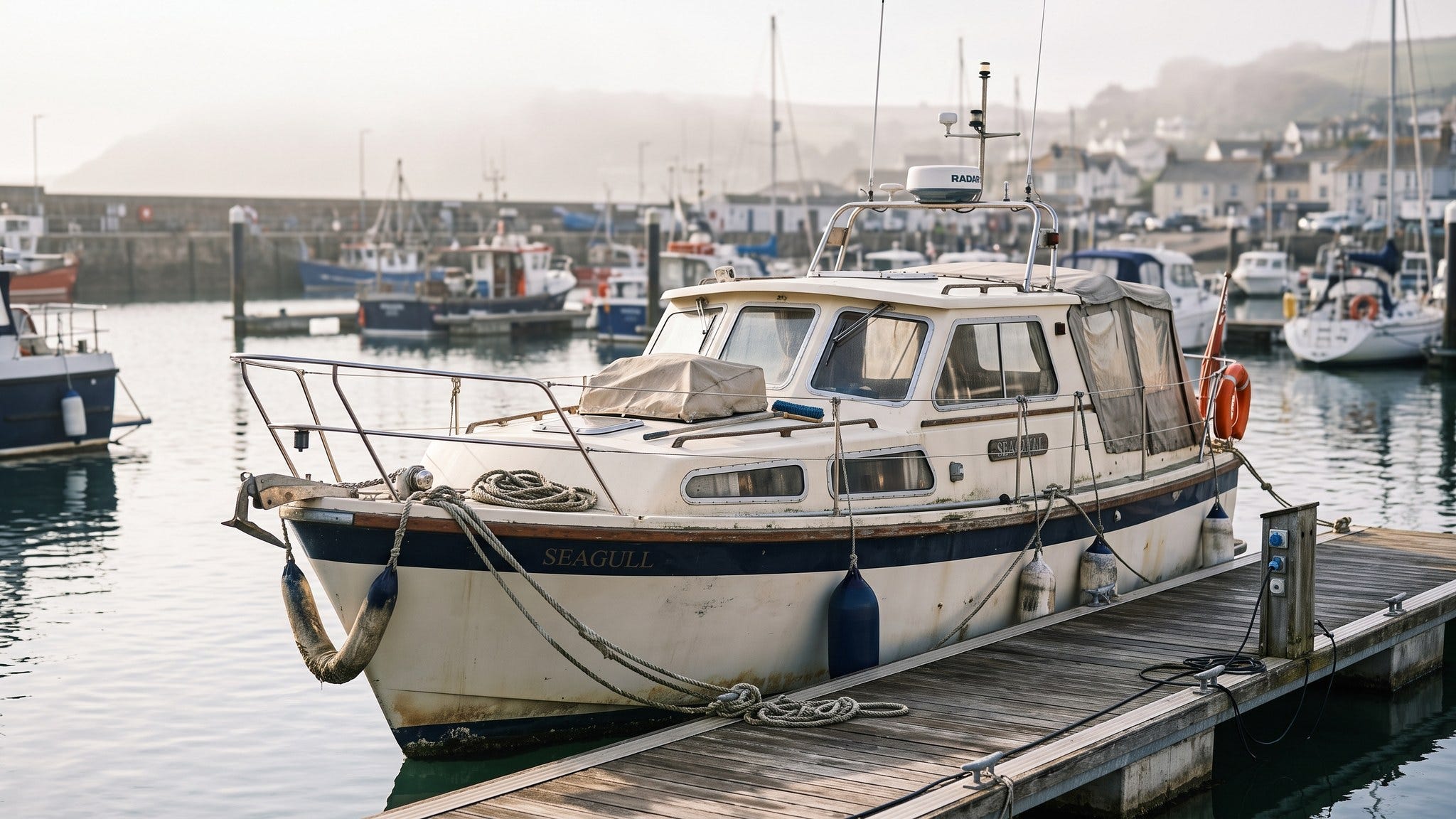
Scenario two: the coastal motor cruiser
This scenario perhaps matters more to my subscribers, since it is closer to coastal liveaboard life than a canal.
A modest coastal cruiser in the Fairline Turbo 36 class, roughly 12m LOA, has recently been listed at prices including £45,000 and £64,950. As a simple capital-allocation illustration, not depreciation or a finance quote, spreading that over 10 years works out to roughly £375 to £541 a month.
Berth cost is where location does the talking.
Falmouth Harbour’s 2026 rate for a 10m berth is £653/month, plus a 10% liveaboard surcharge, taking it to roughly £718/month, and Falmouth currently is not accepting liveaboard applications at all. On the Solent, Hamble Point’s 2025/26 rate for a 12.5m berth works out to roughly £1,189/month, still below the £1,388 baseline by around £200, before a boat, insurance or maintenance are added.
Head to Essex Waterways, my home county, and 2026 long-term rates run £14.97 to £22.05 per metre/month, so a 10m Premium Plus berth comes in at roughly £220.50/month, a very different proposition.
The legal reality nobody mentions
A liveaboard mooring licence is not a tenancy. Bristol City Council’s terms state the licence confers no property rights and requires marine insurance and a valid Boat Safety Scheme certificate. Council tax can also apply: GOV.UK guidance confirms a mooring used as a sole or main residence can be treated as domestic property for council tax, depending on the local authority’s valuation.
What determines whether it costs less
1. Ownership structure. A boat owned outright removes the biggest cost variable here. Finance changes the sums considerably, and a full comparison needs an actual quote, not the simple capital-allocation maths used above.
2. Where you legally moor. The gap between Essex Waterways at roughly £220/month and Hamble Point at roughly £1,189/month, for boats of similar size, is the clearest single number in this piece.
3. Whether you have budgeted for maintenance. The commonly quoted 10%-of-value annual rule is an informal guideline circulated in boating media, and not really an industry standard, and actual costs vary widely.
This article continues below, in “The Wardroom”
In the premium section below, I cover:
- The full itemised cost model both ways: every line item I can source, inland and coastal, set against the £1,388 rent baseline
- What licences and insurers ask for: BSS, mooring terms and the paperwork that catches people out
- The maintenance reserve, built correctly: how to work out a realistic number rather than relying on the 10% rule alone
- My honest assessment: when it genuinely beats renting, and when it does not
