

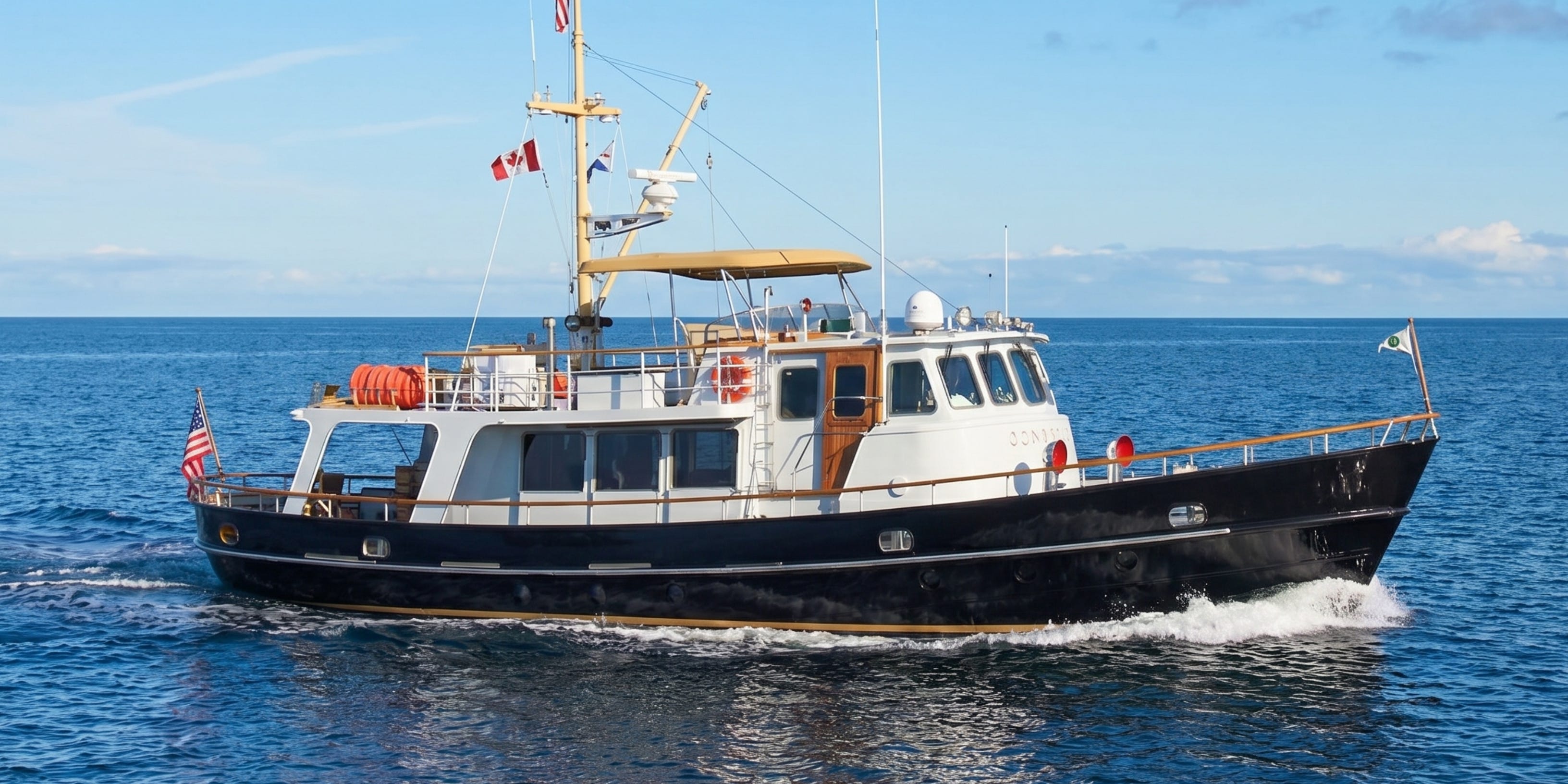
For me, the starting point with M/Y ‘CONSTANT’ is not aesthetics or pedigree. It is material and structure. This is a 19.2 metre Doggersbank 63 built in 1974 by Jongert Shipyard in the Netherlands, designed by Dick Boon of Vripack Naval Architects and constructed in Corten steel with substantial scantlings typical of Dutch offshore craft from that era. At the time she was the largest Doggersbank produced and one of the earliest examples intended for export outside Europe.
That origin matters, because the Doggersbank concept did not emerge from leisure yacht design. It grew directly from North Sea commercial practice where reliability, range and structural durability took priority over speed. The hull form reflects those priorities. A deep forefoot, round bilges, a full length keel and a canoe stern produce a displacement platform intended to track steadily offshore and remain predictable in following seas. Naiad hydraulic stabilisers were fitted to manage roll during extended voyages offshore. In practical terms this is the architecture of a working displacement vessel scaled for private ownership rather than a light, occasional-use recreational cruiser.
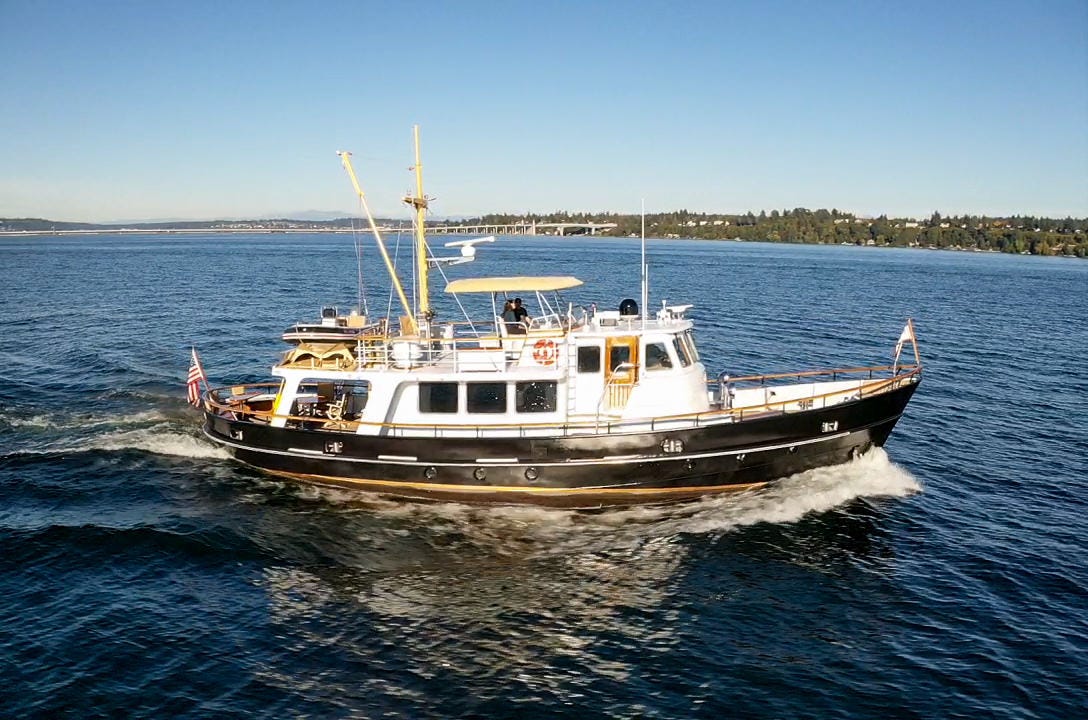
The operational record of CONSTANT reinforces that intent. In 1982 she was purchased by Jon and Ann Bowman of Anacortes, Washington who retained ownership for around 40 years. Their use of the vessel closely mirrors the design assumptions behind the Doggersbank platform. For the first four years they lived aboard full time and for decades afterwards they continued to spend roughly half of each year cruising.
Their operating area was the Inside Passage and the exposed cruising grounds of Southeast Alaska and coastal British Columbia. These waters impose practical requirements that reward range, stability and reliability rather than speed.
The Bowmans routinely operated away from marina infrastructure, anchoring for extended periods in remote inlets and motoring for long distances between fuel stops. With an estimated cruising range of around 3,500 nautical miles at around 8.5 knots, Constant was configured to operate autonomously for long periods without logistical support. Over four decades that operational pattern and actual use has provided a clear demonstration of the boats’s endurance and heavy weather suitability.
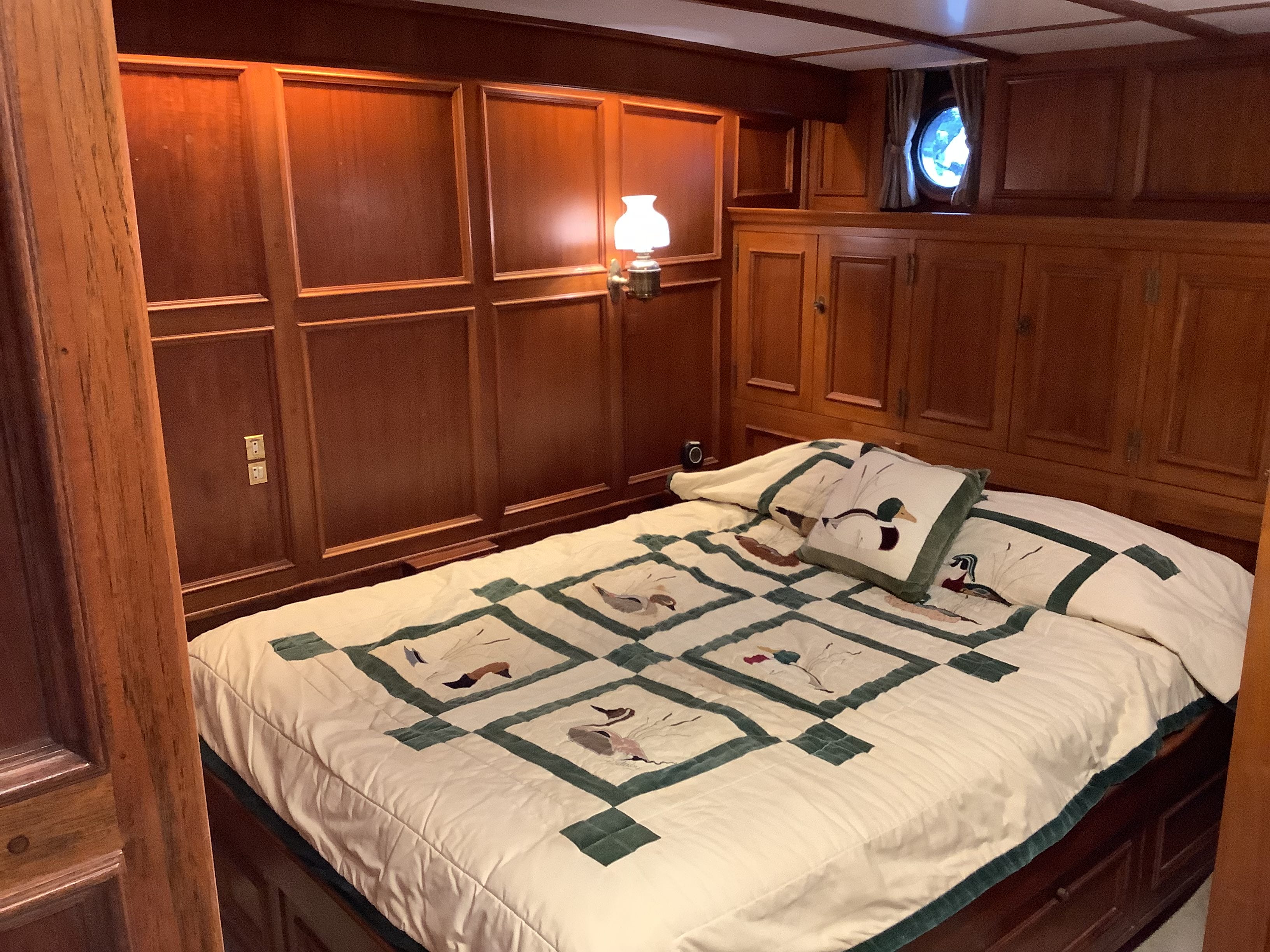
Propulsion comes from a Caterpillar 3408 producing 365 horsepower, turning a large bronze propeller through reduction gearing designed for low speed cruising. The configuration is relatively simple, heavily built and consistent with machinery installations found in commercial displacement vessels of the period. Fuel capacity is approximately 2,700 gallons.
The current owner has continued a maintenance approach that focuses on mechanical reliability rather than reinvention. Since purchasing the vessel in 2021 the work programme has concentrated mainly on systems and structural preservation. A full exterior repaint was carried out, the mast and rigging were overhauled, refrigeration systems were modernised and the exterior varnish cycle was renewed.
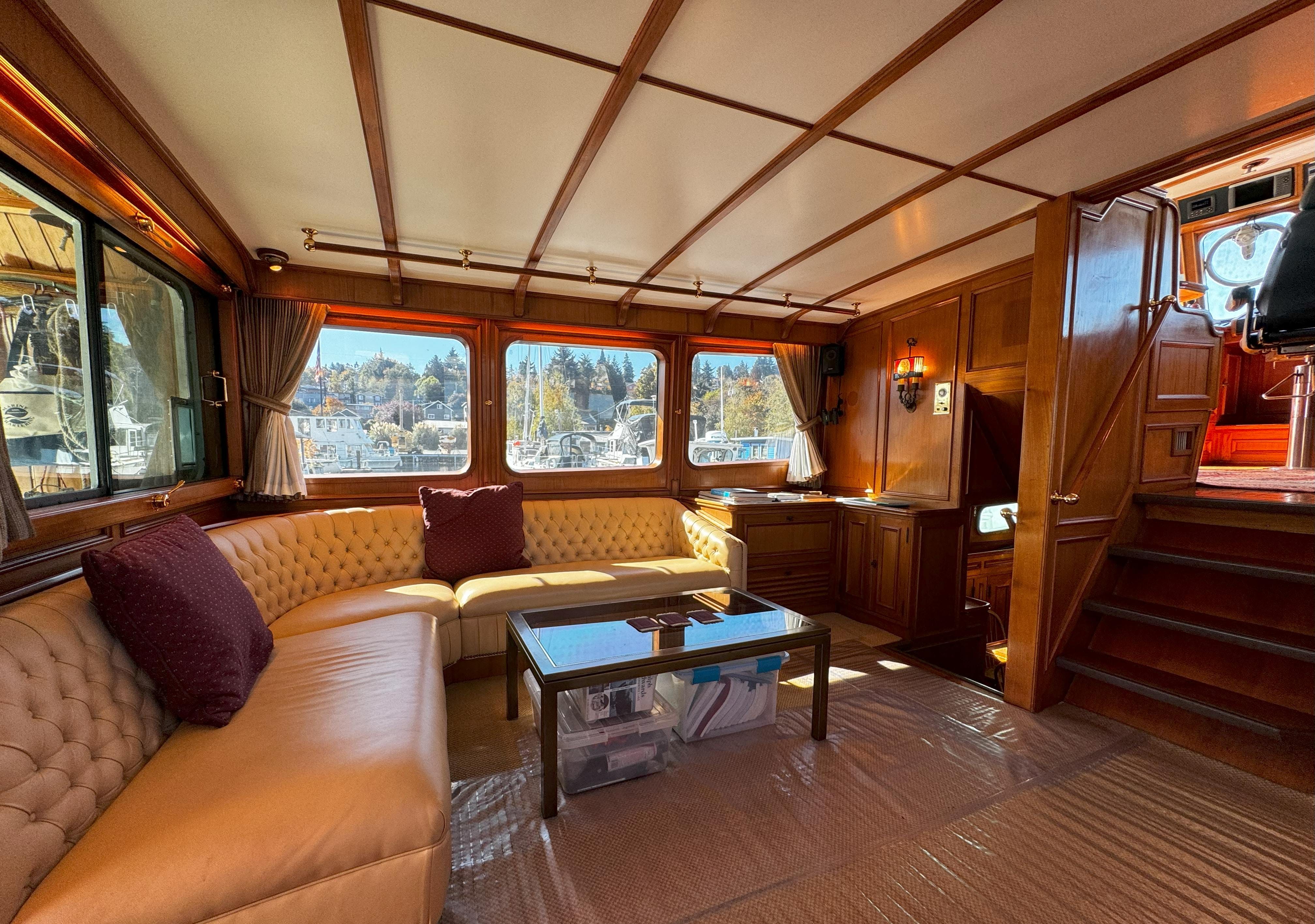
Mechanical work performed by Radtke Marine in Seattle included replacement of the turbocharger, seawater pump and cooling circulation pump on the Cats along with installation of a new exhaust manifold and stainless steel wet exhaust silencer. The work reflects a pragmatic focus on keeping the propulsion system serviceable rather than attempting to alter the vessel’s underlying engineering philosophy.
A comprehensive Condition and Valuation Survey conducted in November 2024 by Rodger G. Morris, NAMS-CMS reported the vessel’s overall condition as Very Good to Excellent. Historical ultrasonic testing of the hull plating confirmed the long term structural integrity of the steel structure and the survey produced no recommendations relating to hull structure or propulsion machinery. For a steel vessel approaching 50 years of age, those findings are impressive.
The yacht is currently offered for sale in Seattle by WS Yacht Brokers with an asking price of $695,000. That figure places Constant in a small category of heavy displacement expedition yachts with genuine offshore lineage. However a 1974 steel vessel should be evaluated through a somewhat technical lens. Ultrasonic plate readings, corrosion management, machinery service intervals and the true annual cost of maintaining a 19-metre displacement platform all matter far more than heritage.
This vessels Jongert pedigree, coupled with the recent $45,000 investments in her machinery spaces, are excellent indicators of her current standing.
To fully appreciate the scope of a 1974 Corten steel displacement hull, we should explore the comprehensive operational profile of a vessel of this calibre. Below, I detail the standard operating procedures and maintenance cycles for her commercial-grade Caterpillar 3408, the usual yard intervals expected for heritage steel yachts, and the annual operating model that allows an owner to keep a boat of this pedigree in peak cruising condition.
The Engine Room & Machinery Spaces
What Owning a Caterpillar 3408 Actually Looks Like
The propulsion system aboard CONSTANT centres on a single Caterpillar 3408 producing 365 HP at 1800 RPM. This engine family was developed for commercial service in trucks, construction equipment and workboats. In practical ownership terms that means durability, but it also means maintaining the engine on a disciplined service schedule similar to commercial practice.
Typical operating expectations for a mechanically governed Cat 3408 in displacement service include:
