

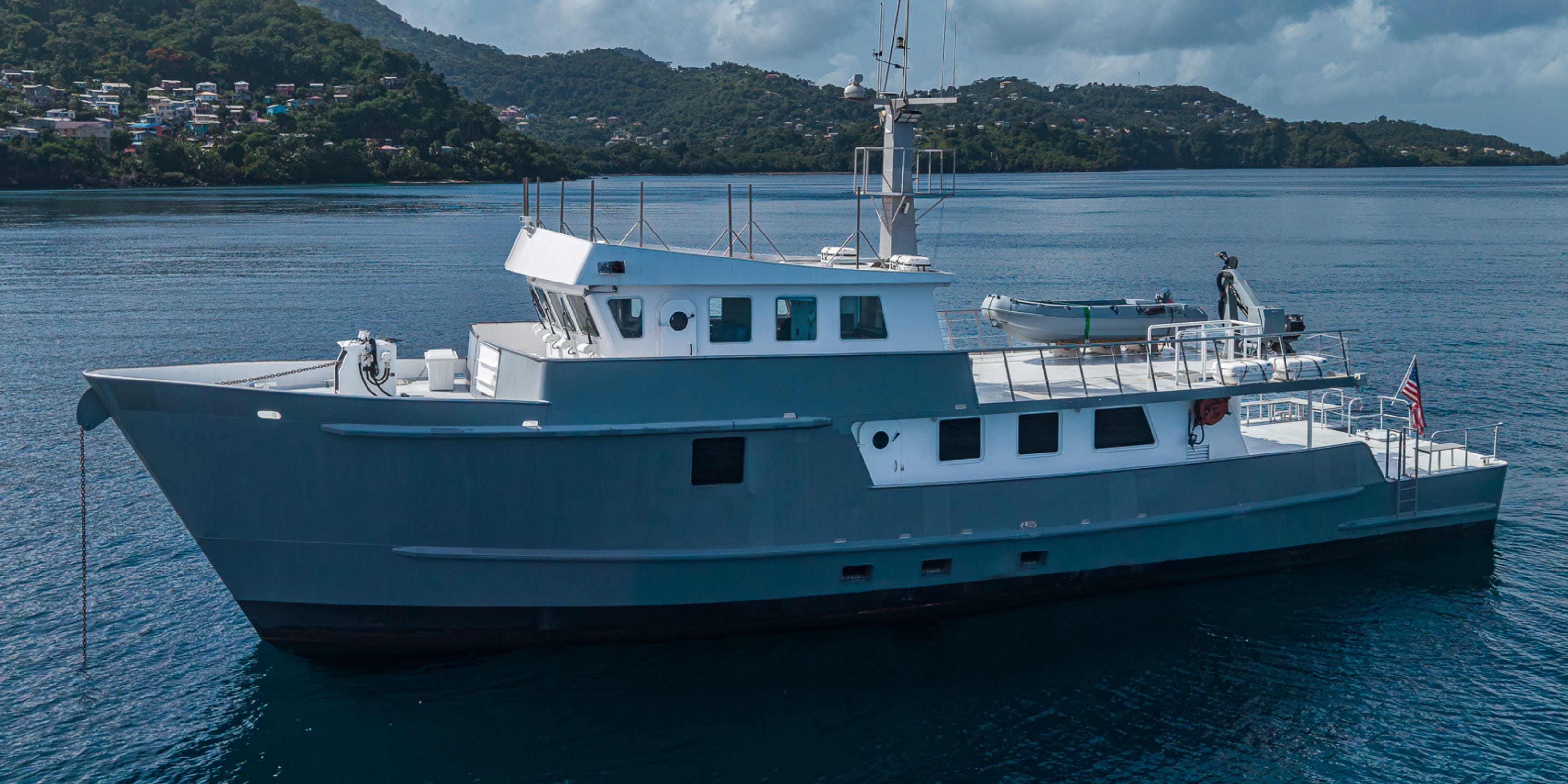
“I’m a bit biased, but I think it’s the greatest vessel ever made.” That was how her owner Adam, a Yacht Buoy reader and premium newsletter subscriber, put it when he got in touch and asked me to take a look at his boat. She’s M/Y ‘Care Bear’, a 95ft steel Ocean Voyager 95 Expedition listed for sale at $1,599,000 (link to listing below), and she’s about as far from a conventional 95-footer as you can get.
She was Adam’s first boat, and, to his credit, he runs her without any crew. In his words, “it’s great that I can single hand her as a 95’ twin screw. I just need my wife to throw the lines when parking.” She’s lying in Grenada at the moment, and he plans to cruise her back to America in January.
His message raises three questions: what it takes to run her without crew, what she costs, and what it would take to make her a family yacht. Adam shot some drone footage of her on a recent dive trip around the Grenadines, so here she is:
From tarpon mothership to relief ship
The listing broker notes her as a 2013 build “built around a proven commercial hull design”, and Adam tells me she was custom built in 2014 as an expedition vessel on a new trawler-type hull. As ‘Chagos’, her listing says, she was customised as a fishing mothership carrying three custom flats boats, the shallow-draught skiffs used to stalk fish in very thin water. She crossed from Fort Lauderdale to West Africa on her own bottom and anchored off river mouths as a floating base for guides, her owner, guests, and charter clients chasing record-class tarpon.
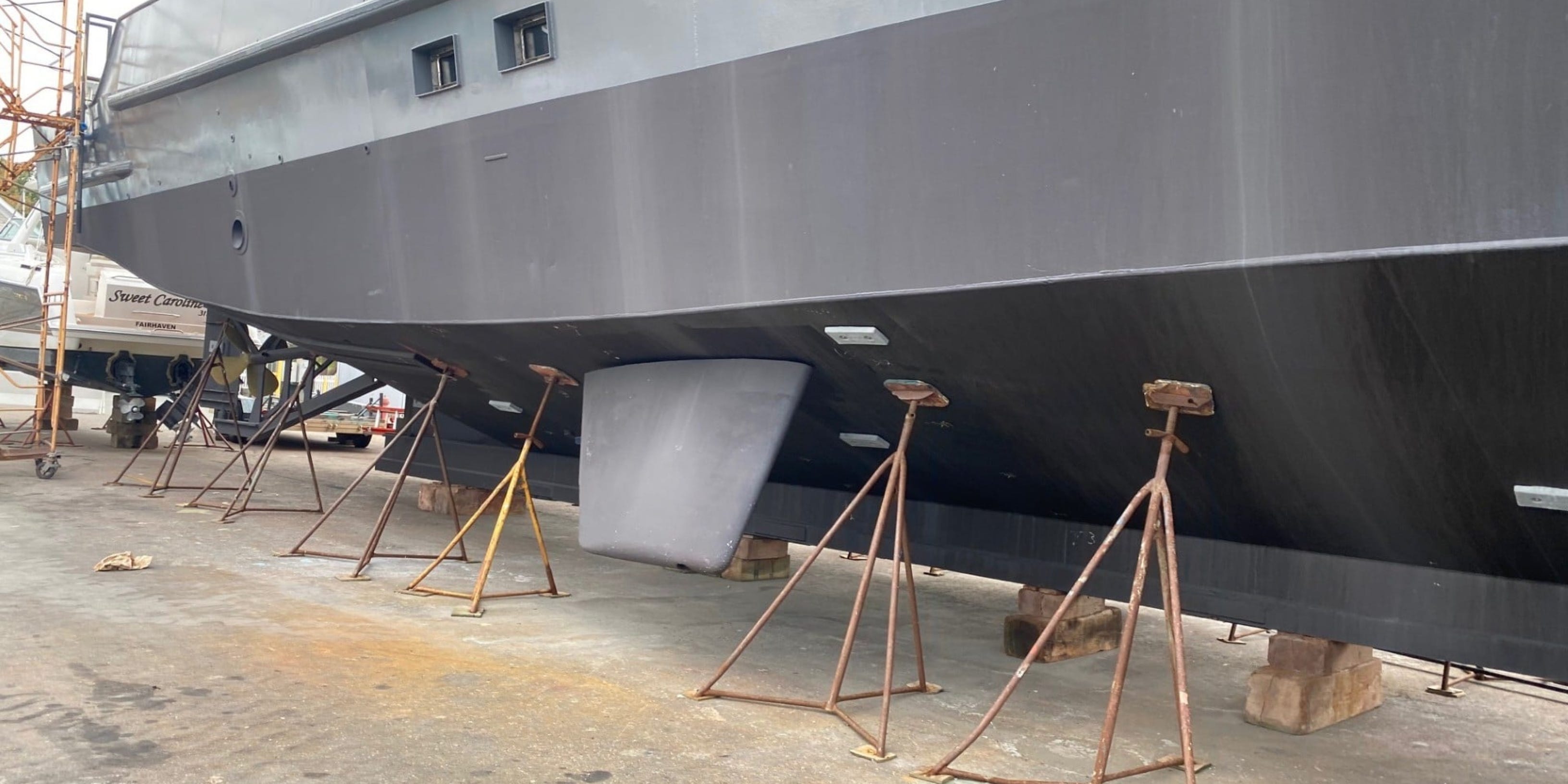
Next came a year-long refit at Fairhaven Shipyard in Massachusetts, which, Adam tells me, had just finished when he bought her. The previous owner commissioned it to make her a support vessel for a large sailing yacht, and her master cabin, master bathroom, and lounge were removed to carry cargo. Adam has “invoices for over $800,000 worth of work”, and says that including three military-grade FLIR cameras, “a bit over $1,000,000 was invested”. The work included rebuilt stabilising fins, new Garmin navigation, a new fuel polisher and fuel transfer station, a new day tank and water tanks, an all-chain anchor conversion, and her battleship grey paint.
Adam bought her in 2021, during COVID, “because I wanted to help”. He has experience working with a remote medical group, and he wanted the means to move his family, team, gear, and supplies a long way. “We helped out stateside during COVID, did a lot of training, and later assisted with other crews during the hurricane in Grenada,” he says. As the listing puts it, her name reflects that humanitarian work.
Built like a working ship
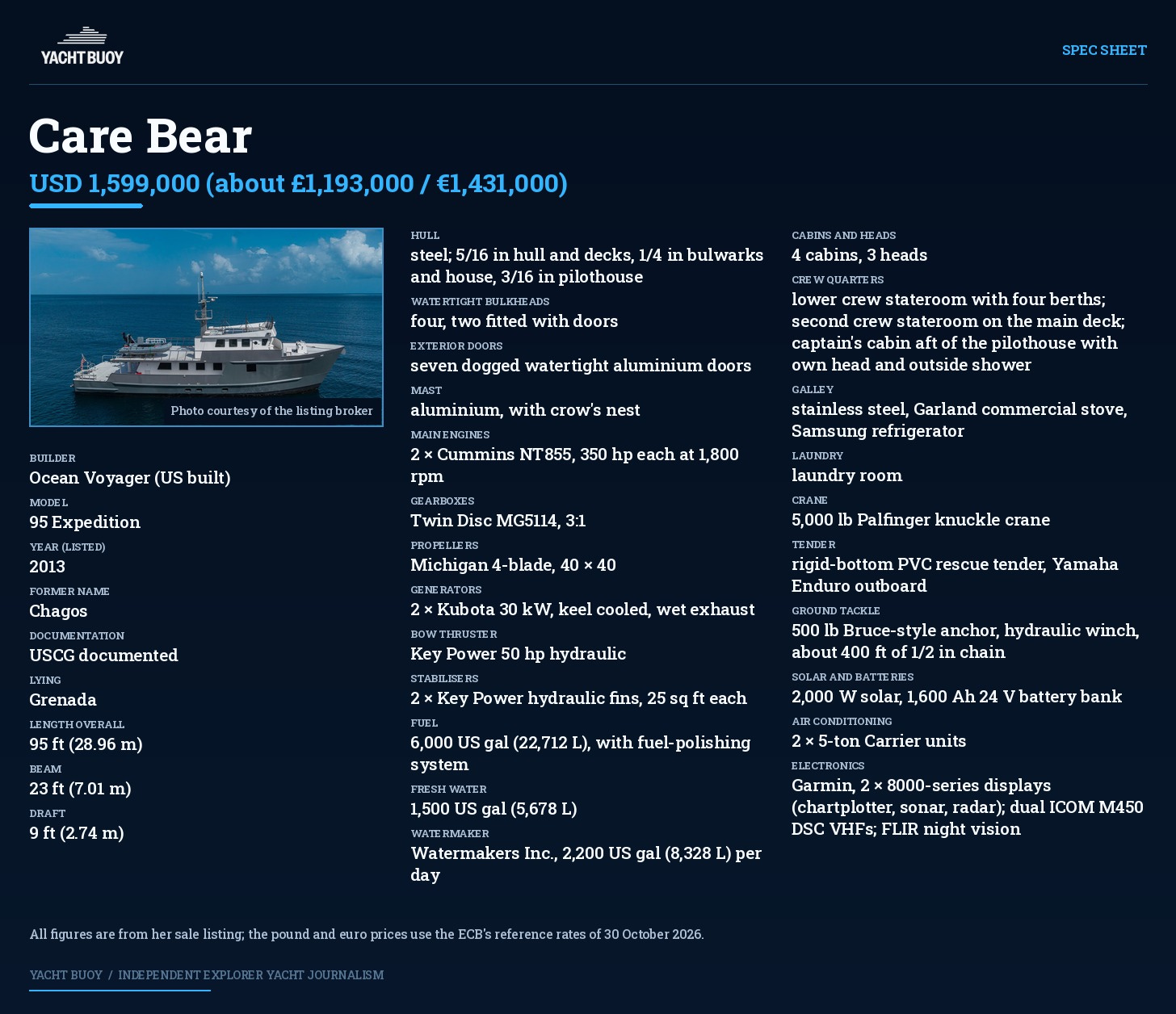
Her hull and decks are 5/16 in steel plate (about 8 mm), with 1/4 in (about 6 mm) for the bulwarks and house and 3/16 in (about 5 mm) for the pilothouse: the heaviest plate where the sea hits hardest, and lighter plate up high, where weight matters most. Steel also tolerates knocks and can be repaired by commercial yards far from home.
Four watertight bulkheads, two with doors, divide the hull into compartments designed to stop flooding in one space from spreading while the doors are shut. Seven dogged watertight aluminium doors, clamped hard against their seals, keep water out of the house if a sea comes aboard. That’s commercial-vessel thinking.
A 5,000 lb Palfinger knuckle crane serves her working deck. An aluminium mast with a crow’s nest gives her height, and Adam has found a clever use for the FLIR and colour camera at its top.
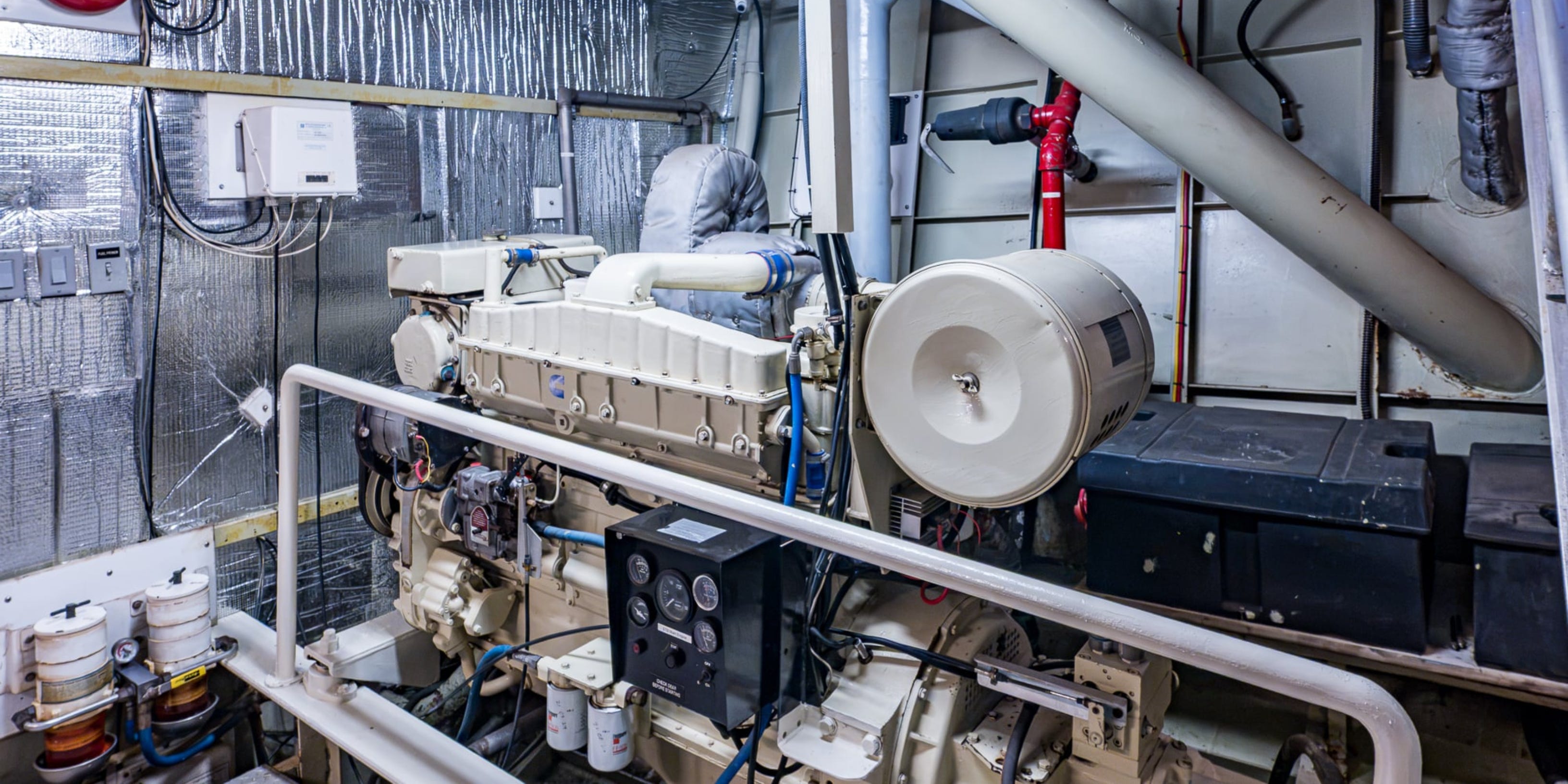
She runs on twin 350 hp Cummins NT855s, mechanical diesels turning big four-blade 40 in propellers through Twin Disc 3:1 gearboxes, a commercial-grade drive train built for hard-core endurance.
The refit’s new fuel polisher, day tank, and water tanks fit that brief. The polisher filters water and sediment out of diesel bought wherever you can find it, the day tank gives the engines a smaller, clean supply, and the transfer station moves fuel between tanks. Adam describes “redundant systems throughout”, and the listing shows two engines, two generators, and solar with a battery bank.
One man, 95 feet
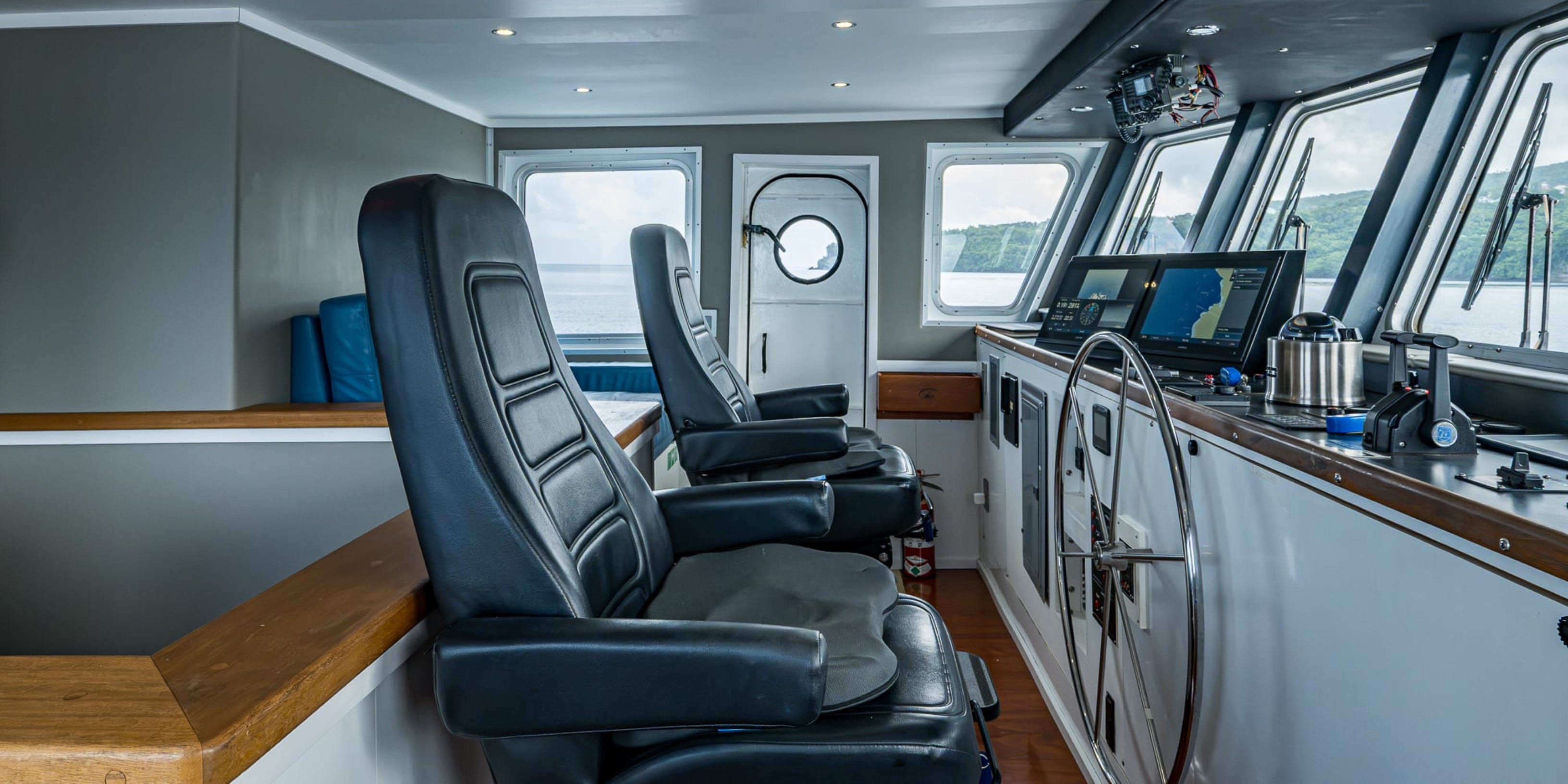
“It’s a very easy boat to operate,” says Adam, who credits the twin screws and ample power for making her easy to manoeuvre in harbour. With two propellers, you can twist her round by running one ahead and one astern. He’s unbothered by convention, too: “Many captains that I learned from don’t like to be seen using a bow thruster, but I find it helpful in strong winds for small adjustments.”
He also praises the wheelhouse visibility, and that masthead camera “makes parking a breeze when it’s pointed straight down”, giving him a bird’s-eye view as he comes alongside. At sea, he says her deep-V hull and stabilising fins give her “great manners in any seas”.
“It surprises many that I’m able to single hand such a large ship,” he says, “and it’s surprising to many that this is my first boat.” That’s Adam’s experience, built since 2021 with training from her previous captain, not a promise for every owner; more on that below.
Life aboard as she is now
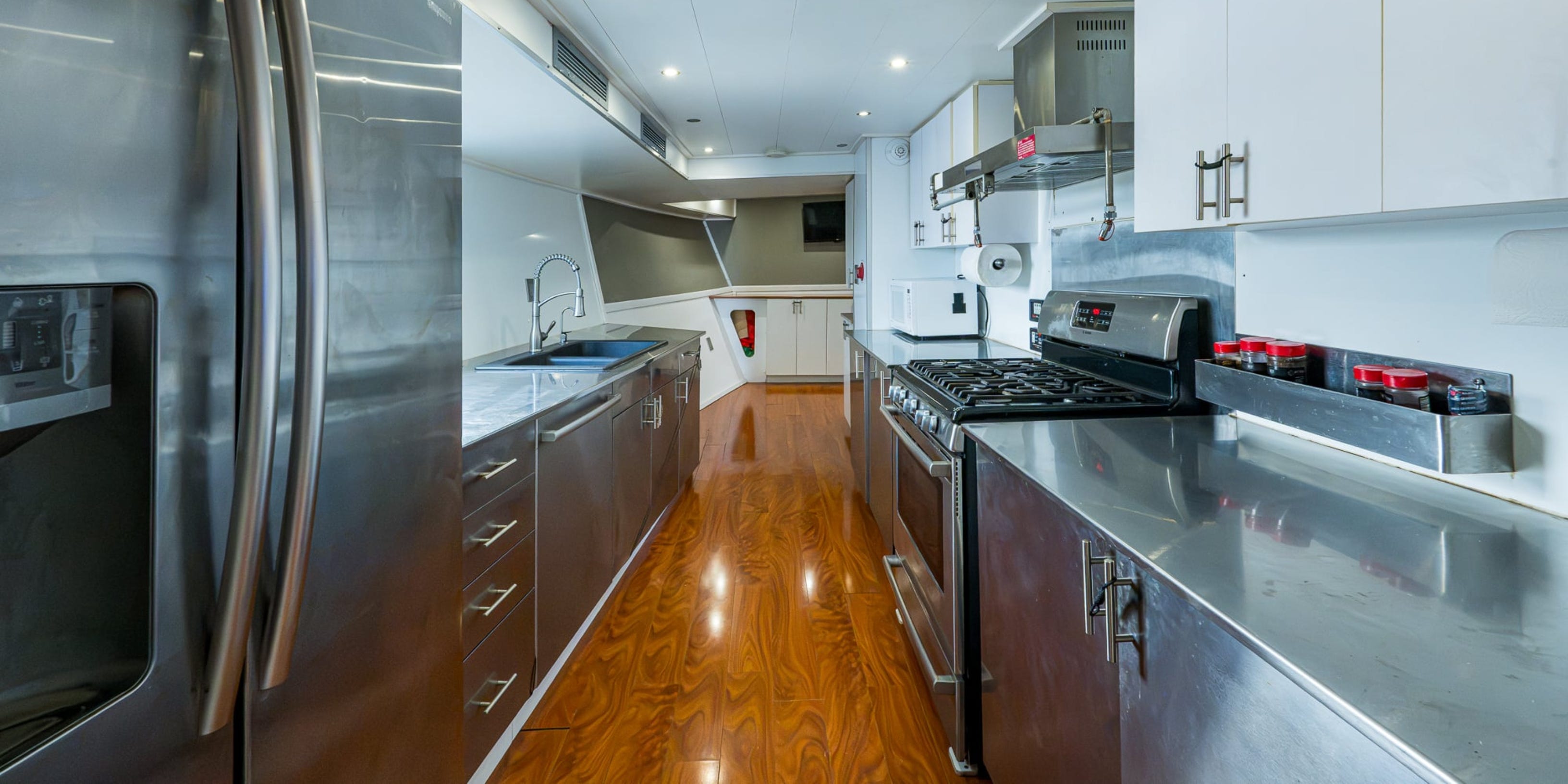
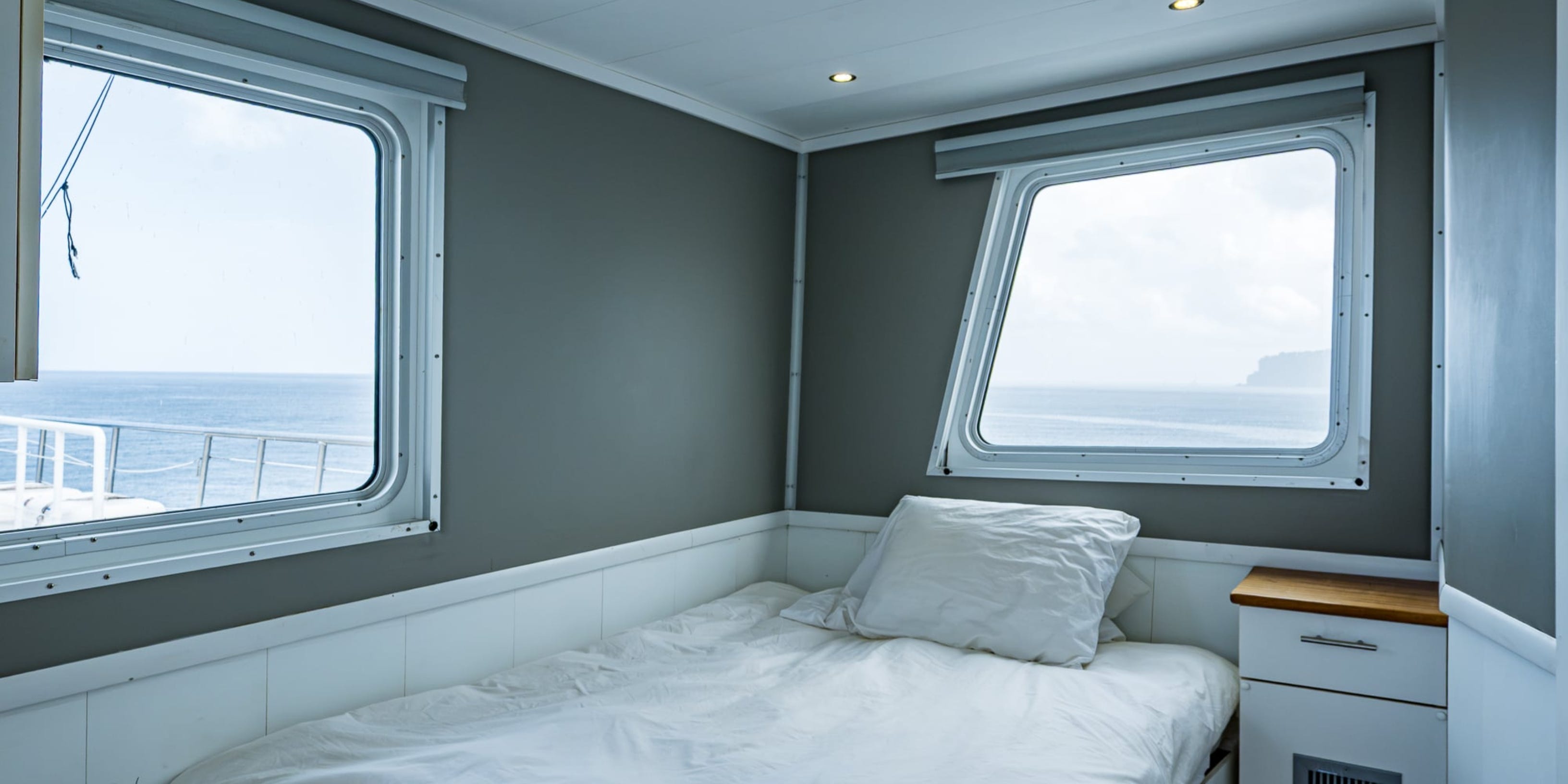
Her layout reflects her working life, and Adam himself expects that “a buyer is going to improve the interior”. Her listing describes three guest cabins below, three heads, and a laundry, plus a lower crew stateroom with four berths, while the former master cabin is used for storage. On the main deck are a second crew stateroom, a lounge, and a head, and the captain’s cabin sits aft of the pilothouse with its own head and outside shower. The stainless galley has a Garland commercial stove. For a family planning longer periods aboard, the obvious upgrade is getting back the private owner’s space the cargo conversion took away, and Adam already has a plan for it (more in the premium section below).
Water is where she looks like a ship built to stay out. West Marine’s guide puts comfortable liveaboard use at 4 to 8 gallons per person a day, so her 1,500 gallons would last a couple roughly 94 to 188 days, or a family of four about 47 to 94 days, from the tanks alone. The watermaker is rated at an impressive 2,200 gallons a day, enough on paper to refill them in under a day.
Two keel-cooled 30 kW Kubota generators are backed by 2,000 W of solar and a 1,600 Ah 24 V bank, so the batteries can take some of the load at anchor between generator runs. The Bahamas and the islands are Adam’s favourite cruising grounds, they love to dive and fish, and there’s a room set aside for dive gear.
How she compares
M/Y ‘Footloose’, a 2008 Cheoy Lee 95 Motor Yacht, is for sale at $2,199,000 in Jacksonville Beach, Florida. She’s the same length but a very different boat: GRP, twin 1,650 hp Caterpillar C32s, and a conventional four-cabin, five-head layout with a main-deck master. A yacht like that usually runs with paid crew. Care Bear trades a conventional layout for steel, deck space, and a crane, and although she has crew cabins too, her owner chooses to run her himself. They suit different ideas of what a 95ft boat is for.
I’ve covered working boats turned yachts before: [Jezebelle](https://newsletter.yacht-buoy.com/p/84-feet-of-steel-for-175001-the-true), an 84ft steel conversion (since sold) that needed a yard budget to finish, and [Atlas](https://newsletter.yacht-buoy.com/p/195000-for-atlas-the-24m-ex-fishing), a fishing boat a family spent 8 years turning into their home. Care Bear’s systems have already been refitted, so her interior is a choice for the next owner rather than an unfinished project.
In the premium section, I’ve worked out what she burns, how far she could go, and what a family refit involves.
This article continues below, in “The Wardroom”
If you’re already a premium subscriber, or you’re about to become one, thank you. Your support keeps both the Yacht Buoy YouTube channel and this publication going, independent and advert-free, so I can keep writing about and filming boats like Care Bear.
In the premium section, I cover:
- What she costs to run: fuel per 1,000 NM, range, and servicing
- Running a 95ft ship without crew: watchkeeping, US rules, and insurers
- Making her a family expedition yacht: Adam’s teak plan and how to scope it
- A buyer’s checklist for a 2010s steel ship
- My honest assessment
What she costs to run
Adam’s 15 gallons an hour, turned into dollars per 1,000 NM and a theoretical range. I’ve done the research, so you don’t have to.
