

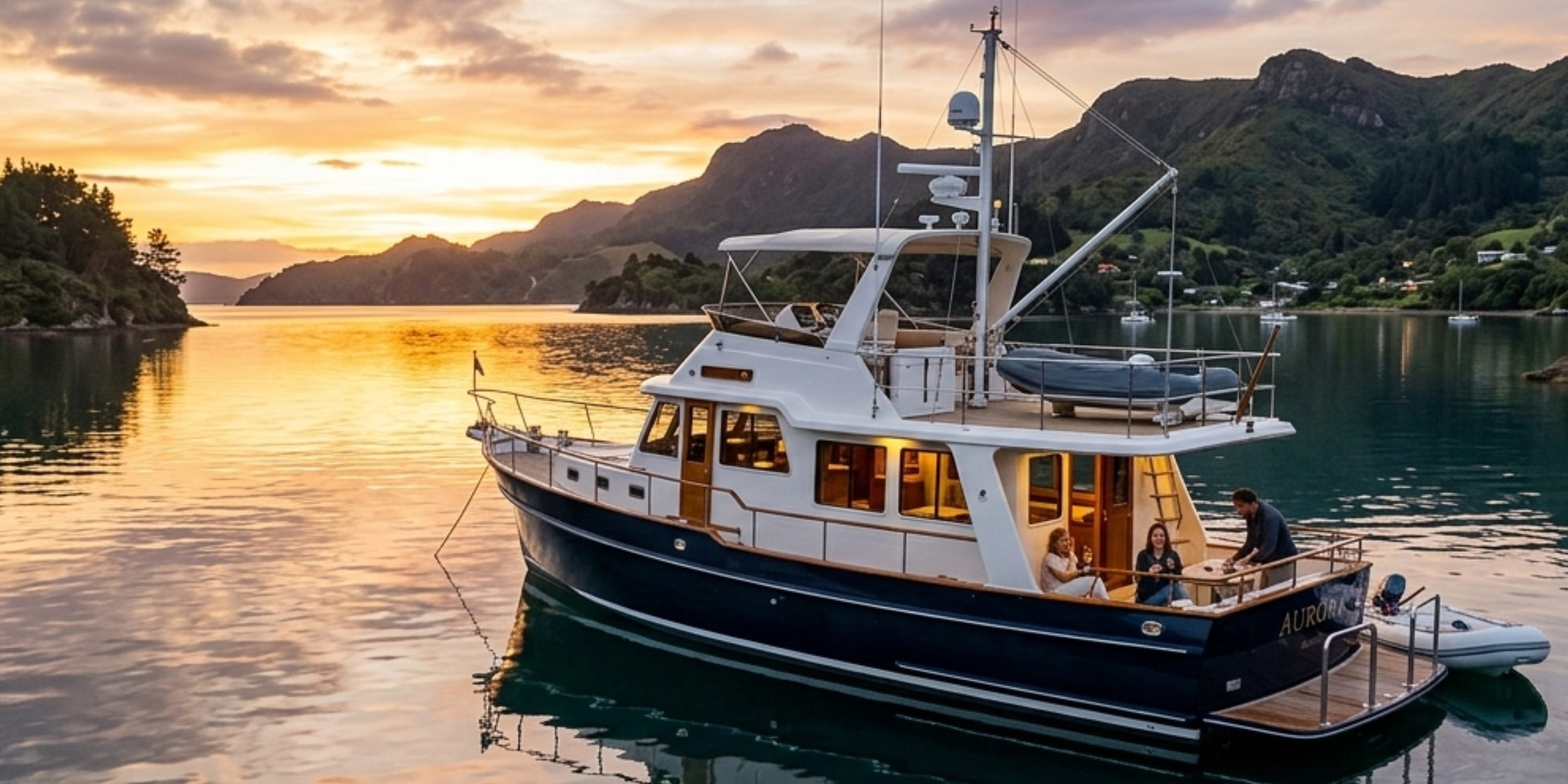
You have (probably) thought about it. Everyone who has ever stood on a pontoon at dusk, looked at a boat with the lights on inside and someone moving about in the galley, has thought about it. Sell the house. Clear the mortgage. Buy the boat. And then just, well, go.
Then the sensible part of your brain interrupts, and the sensible part of your brain does not have any numbers to work with, only fear and perhaps a bit of anxiety. It says things like “you’d never afford it” and “insurance must be a fortune” and “what happens when it gets cold.” None of those objections are wrong exactly. They are just vague. And vague fear is exactly the kind of fear that stops people doing something that might actually be within reach.
So the aim of this article is to replace the vague fear with real numbers.
I have spent years covering over 500 explorer yachts, including the Nordhavns and Berings and steel trawler conversions that people genuinely take offshore and live aboard for years at a time, not weekend cruisers that get called “liveaboards” by people who spend four nights a year on them. This piece is not about one boat. It is about the actual cost of this actual life, whichever of those three routes you take into it.
Here is the surprising part, the bit that changed how I personally think about the whole dream. Selling a mortgaged house does not just fund the boat. It stops a huge, ongoing bill. Mortgage or rent, council tax (or overseas equivalents), buildings insurance, gas and electric, the commute, the constant slow drip of home maintenance. Add all of that up in a typical UK or US city and you are often looking at somewhere between $1,600 and $4,300 (roughly £1,200 to £3,240 / €1,410 to €3,800) a month simply evaporating, whether you are aboard a boat or not. Most people budget the boat life against zero. They should be budgeting it against what they currently pay to live on land, because that number is really doing a lot more work than people give it credit for.

Right, the numbers.
At the accessible end, a well-maintained Nordhavn 40 or 43 on the used market runs $350,000 to $500,000. Step up to something like a Bering 65, built specifically for long-range expedition liveaboard use, and used examples (where you can find them, they are not common on the brokerage market yet) start closer to $600,000 to $800,000. Or go the value route: a converted Dutch or Belgian steel trawler, the kind of ex-working vessel that many yards in the Netherlands turn into serious long-range cruisers, and you are looking at €200,000 to €400,000 for something genuinely capable, not a weekend project boat with a paint job.
Three very different price points. Three very different running costs, too, and this is where most people’s mental model falls apart, because bigger and newer does not always mean proportionally more expensive to live on.
A comfortable, marina-based Nordhavn 43 liveaboard, someone anchoring out for part of the year rather than paying for a berth every single night, runs somewhere around $24,000 to $33,000 a year in running costs. A Bering 65, being actively cruised for 4 to 6 months of the year with a larger genset, bigger insurance premium, and a watermaker running constantly, lands between $39,000 and $57,000 a year. A converted steel trawler, owner doing their own maintenance, running 800-plus hours a year rather than sitting in a marina, comes in at €19,000 to €30,000 a year, and that is with the owner putting in real DIY hours to keep the number down.
Set any of those figures against what a mortgaged house in a city like London, San Francisco or Sydney actually costs to run each year, and the boat life stops looking like an indulgence and starts looking like ‘doable’ arithmetic.
Now for the number that surprised me most, and I think it will surprise you too. Insurance on a boat costs somewhere between 6 and 9x what you would pay to insure a house of the same value. A £350,000 house (roughly $464,000 / €408,000) might cost £800 to £1,200 a year to insure. The same value in a liveaboard boat costs £5,000 to £7,500 (roughly $6,600 to $9,950 / €5,830 to €8,750). And no, that is not a typo, and not everyone selling you the dream tends to mention it upfront.
There is a lot more to work out before you make this decision seriously.
What a marina berth actually costs depending on where in the world you keep the boat, and it varies by as much as 300% between locations. What heating costs in a genuinely cold winter, which is the single most underestimated line item in every liveaboard budget I have researched.
What an annual maintenance sinking fund honestly looks like, the real figure, not the hopeful one most first-time buyers write down before they own the boat. And what you stop paying for on land the moment you sell up, set against everything above, so you can see the real net picture rather than just one half of it.
This article continues below, in “The Wardroom”
In the premium section, I cover:
- The full berthing comparison across the marinas people actually use: Mediterranean, US East Coast, Pacific Northwest, and what the same 45 to 50-foot explorer costs to keep in each one, month by month
- The maintenance sinking fund maths that catches some first-time owners out: what haul-out, antifouling, engine and generator servicing, and watermaker upkeep actually cost across a Nordhavn, a Bering, and a converted steel trawler, with the honest figure, not the hopeful one
- The fuel, heating and systems running costs nobody quotes you upfront: including the winter heating bill that regularly runs higher than people’s entire fuel budget for the year
- My honest assessment of who this life genuinely makes financial sense for, and who should think again: the full net comparison against what you currently pay to live on land, and the specific circumstances where selling up and buying the boat is the better financial decision, not just the more romantic one
Some of these numbers will surprise you. One of them changed how I think about the whole dream. Paid subscribers also get The Wardroom, my private community where serious buyers and owners talk through exactly these decisions, anonymously if they prefer. If this kind of honest, numbers-first writing is useful to you, becoming a paid subscriber is what funds the filming trips and yard visits that make it possible. Come and see the real picture.
The Wardroom is Yacht Buoy’s members area. For just GBP 75 a year (that works out at roughly GBP 6.25 a month if you would rather pay monthly, or around USD 8.34 / EUR 7.31 a month), you get the full ownership picture behind every boat and every life decision I cover here, not just the brochure version.
What Living Aboard an Explorer Yacht Actually Costs: The Full Numbers…
I want to work through this in full, vessel by vessel, cost by cost, because the honest answer depends enormously on which route into this amazing ‘seafaring life’ you take, and where in the world you plan to keep the boat.
