

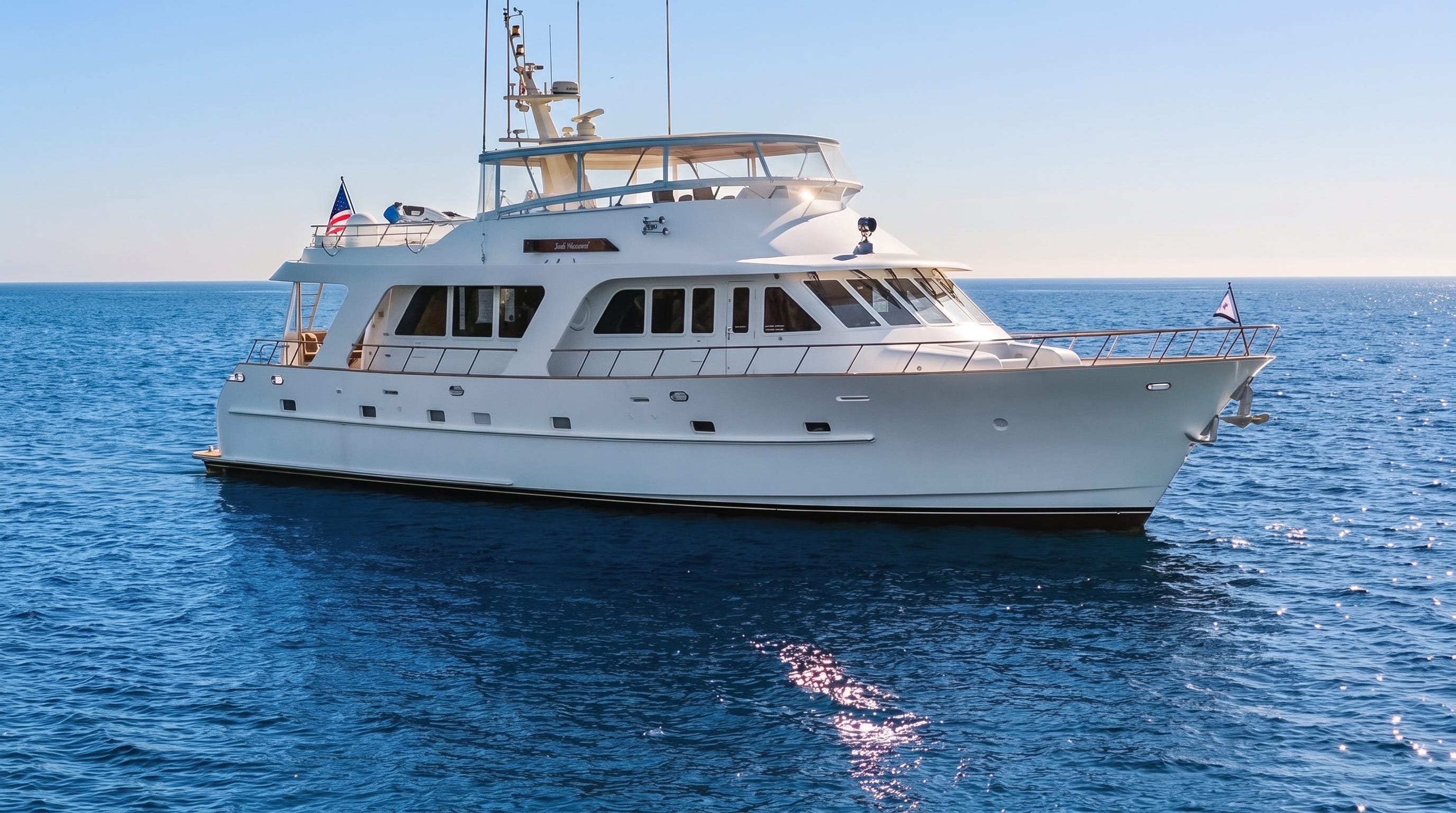
When I shared photos of M/Y ‘Jade Panama’ on my Instagram, they reached hundreds of thousands of people, and I knew I had to write about her. A forward-thinking staff member at Worth Avenue Yachts added me to their mailing list, which was a great move. Otherwise, I never would have known about this beautiful boat...
It isn’t hard to see why she travelled so far online. Worth Avenue Yachts, her listing broker (Scott Hauck, link below), says original invoices show she was priced at $6.9 million in 2001. Today she’s offered at $995,000, about 14 cents for every dollar on those invoices. Her story is every bit as appealing as the numbers: she was designed for a retired couple, “neither of whom were mechanics nor technicians”, so they could cruise far offshore without crew.
Getting aboard has become far more affordable. The question I wanted to answer is what it takes to keep her.
Meet Jade Panama…(video/image credit: Worth Avenue Yachts),
M/Y ‘Jade Panama’ was launched in July 2001 as Watermark, and later carried the name Chillin. She’s a Rayburn Custom Yachts 76 “Flush Deck”, built in British Columbia, Canada, to a design by naval architect Howard Apollonio.
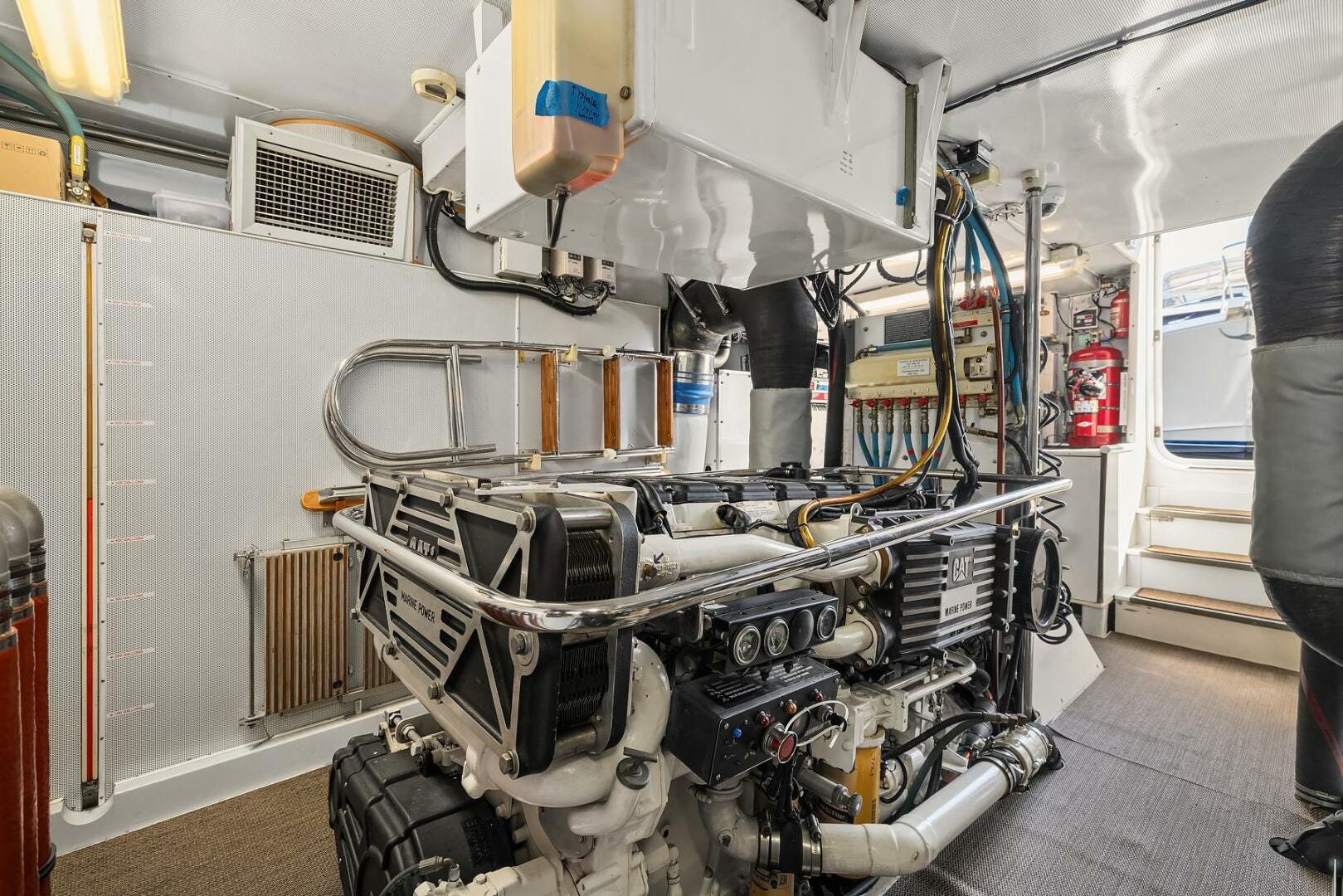
She measures 76 ft 0 in (23.16m) overall, with a 21ft (6.40m) beam and a 5 ft 4 in (1.63m) draft. Her hull is cored fibreglass, she’s US-flagged at 110Gt, and Worth Avenue’s spec sheet lists twin 800hp Caterpillar 3406E diesels, with a 10-knot cruise and a 15-knot maximum. She carries 2,598 US gallons (9,834 litres) of fuel and 400 US gallons (1,514 litres) of water, and sleeps six guests in three staterooms.
She’s lying in Bellevue, Washington, on Lake Washington, listed by Scott Hauck at Worth Avenue Yachts for $995,000. At the European Central Bank’s reference rates for 9 October 2026, that’s roughly £753,000 or around €888,000. A lot of boat for the money.
Got a boat?
Know of a vessel for sale, charter, or otherwise that you would like me to feature in a future dispatch? You can send me a direct message or email me via john@yacht-buoy.com
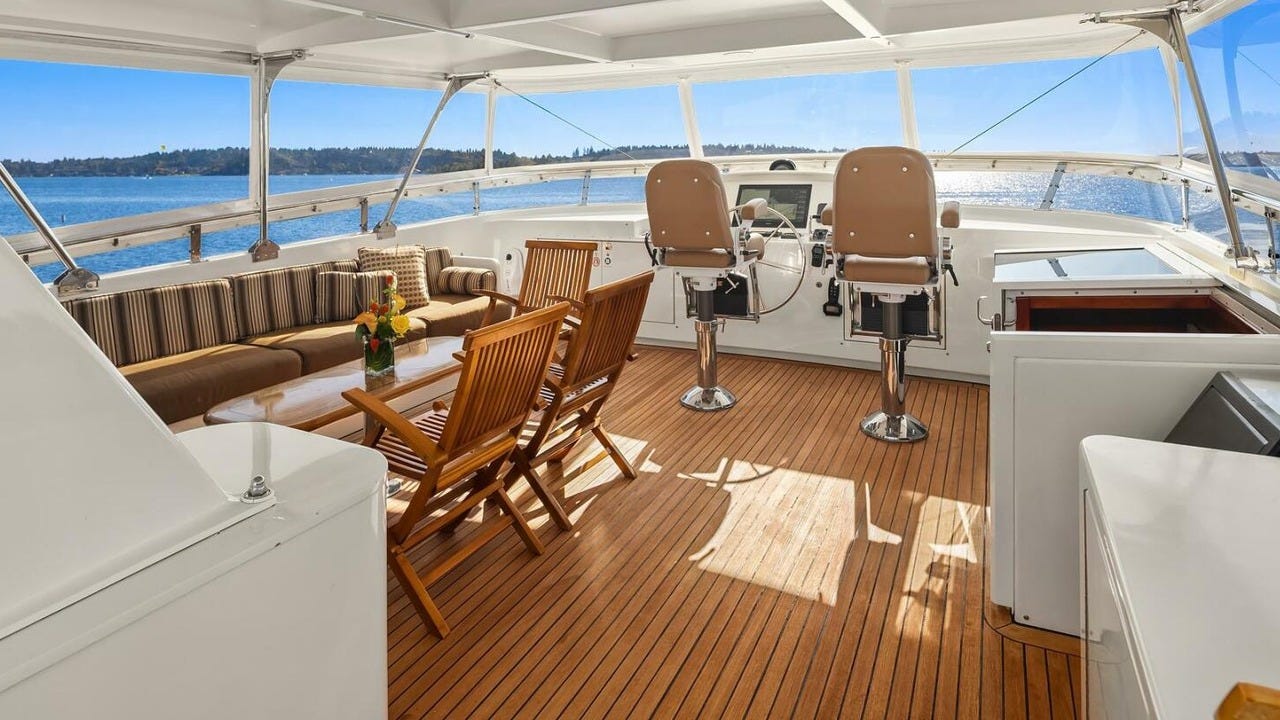
She has an unmistakable broad, white, flush-deck profile, a tall bow rail, and covered side decks running forward to the pilothouse doors. The flybridge sits under a hardtop, and the hydraulic mast and hardtop lower together, reducing her air draft from 29 ft to 19 ft 10 in.
This boat has the naval architecture of a vessel with significant presence on the water. Her deck layout and configuration suggest a boat that can handle rough weather thanks to its no-nonsense profile.
An explorer yacht built around two people
Her first owners were an experienced yachting couple who wanted a sea-kindly hull for extended offshore cruising, with the range to cross the Atlantic without refuelling. Just as important, they wanted to handle her themselves.
That brief shaped almost everything aboard: labour-saving systems, redundancy wherever it’s critical, and simple, reliable systems for everything she needs to run. For her next owner, that means fewer specialist jobs and fewer single points of failure. Because the couple planned to cruise remote waters, they chose components that were available and serviceable worldwide. The owner was on site every day of the build, which Worth Avenue describes as a collaboration between the owners, their architect, two professional surveyors and the builder.
She was engineered to the American Bureau of Shipping’s rules for motor pleasure yachts, the standard that sets how thick a hull must be and how strongly it’s framed for the loads it meets at sea. She was never classed, so there’s no ABS certificate, but the strength was designed in.
Her hull is fibreglass around a Corecell foam core, far stiffer for its weight than solid glass, and Corecell’s maker, Gurit, tests it specifically for slamming, the hammering a hull takes coming off a wave. The foam insulates against cold and noise too. Vinylester outer layers resist osmotic blistering better than ordinary polyester, the keel is solid laminate with no core to crush if she touches bottom, and Kevlar toughens the likeliest impact areas.
Apollonio also drew her for comfort: a hull meant to damp motion, bow sections shaped to resist pitching and Naiad stabilisers for the roll. Her engine room intakes even run up to the top deck, so heavy water can’t find its way below. She was built for open-ocean work, and to be a comfortable home while she does it.
Worth Avenue says she was the smallest Rayburn ever built, by a yard, and that the yard mainly built much larger custom yachts, which helps explain her bigger-boat equipment list.
Across the Atlantic and back
From her launch, the original owners lived aboard full time. Their route took them from Vancouver through the Panama Canal and along the north coast of South America, across the Atlantic to the Mediterranean, back across the Atlantic, then through the Caribbean and the Bahamas, up the US East Coast and on to the Canadian Maritimes.
A couple who weren’t mechanics lived aboard full time and crossed an ocean twice. For anyone who has stood on a pontoon wondering what it would be like to just keep going, that’s quite something.
Two further owners cruised her on the East Coast from 2008 to 2015, before she returned to the Pacific Northwest. She’s been on Lake Washington ever since, and she has been upgraded along the way, including Maretron monitoring in 2023, a new tender in 2022 and a 2020 service of the stabilisers, rudders and propellers.
Life aboard
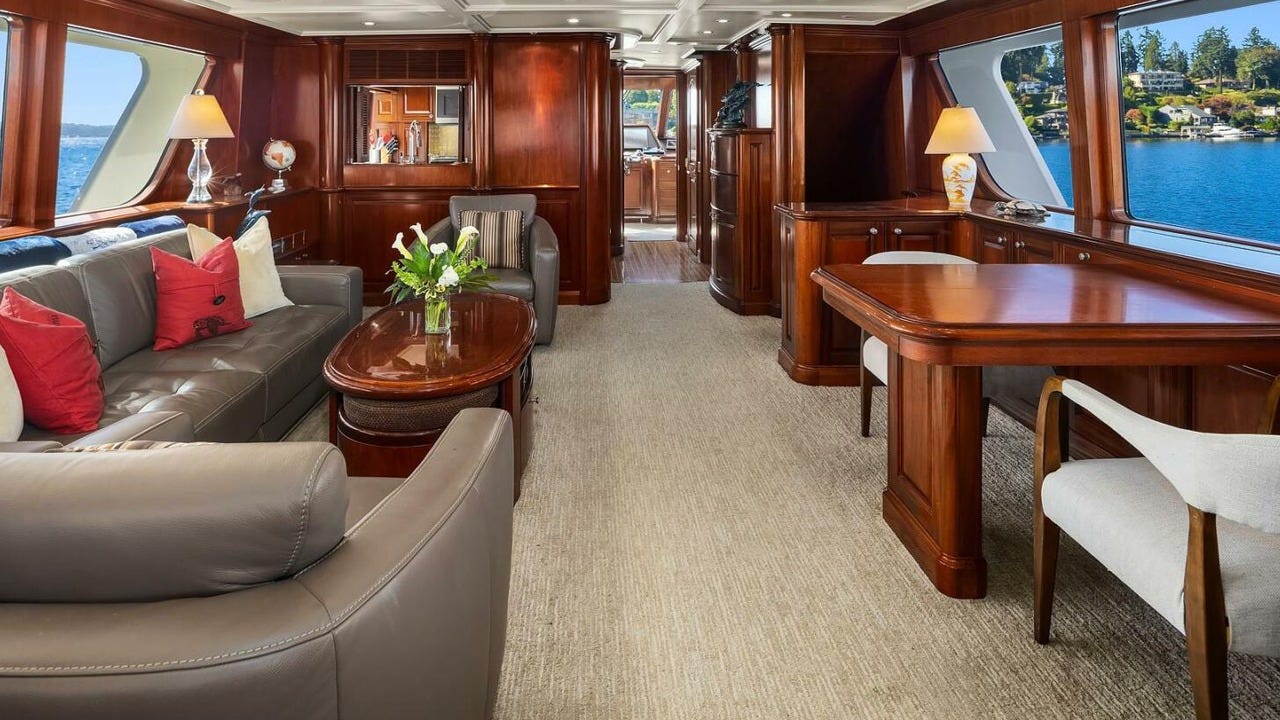
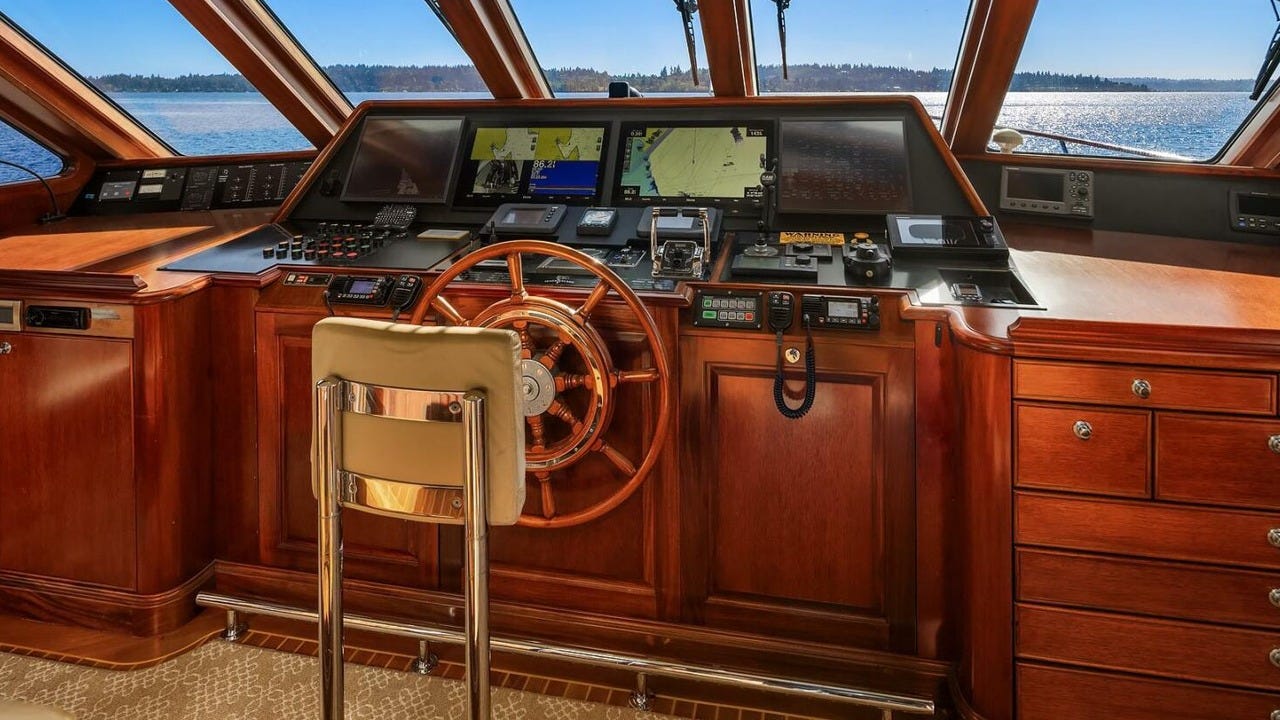
From the aft deck, the salon runs forward under Honduran mahogany joinery, with a dining table that extends to seat five and a pass-through to a U-shaped galley with a dishwasher, trash compactor and ice maker. Beyond the day head, the pilothouse has its own settee and table, with room for two people to pass without disturbing whoever is at the helm, which matters on a long night watch.
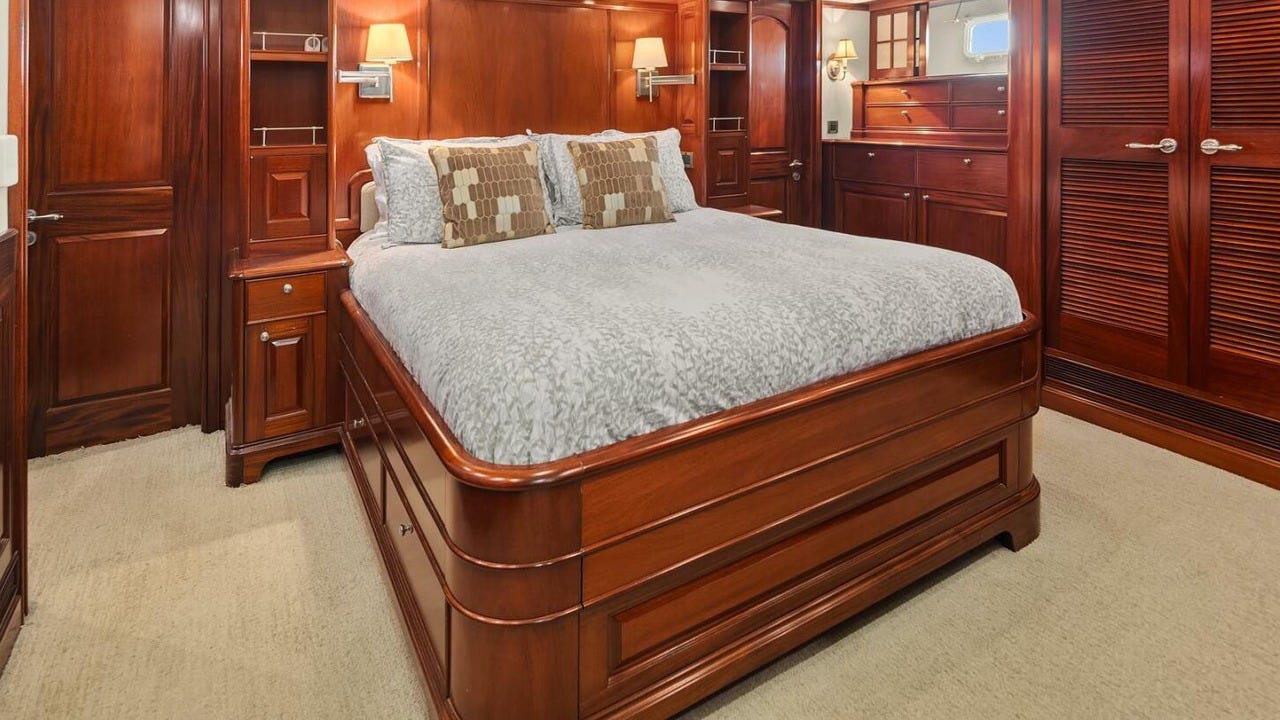
Down a curved stairway, a foyer with a study, desk and library sits between the cabins, beside a laundry with a Miele washer and dryer and a walk-in stainless steel cold store. The full-beam master has a queen berth and “his and hers” heads either side of a walk-in shower. The forward VIP has a queen and its own en suite, and the port guest cabin has over-and-under bunks, also en suite. For a couple living aboard, that’s two guest cabins for visiting family and a study of their own.
Comfort comes from chilled-water air conditioning with reverse-cycle heat, Northern Lights 32kW and 16kW generators, a Victron Quattro inverter/charger, Naiad stabilisers and hydraulic bow and stern thrusters. A 2,000lb Steelhead davit handles the 2022 Highfield 15ft tender with its 90hp Honda.
So how long could you stay out? The Boat Galley suggests 4 to 6 US gallons (15 to 23 litres) per person per day for comfortable, careful cruising. On that basis, her 400-gallon tank would last two people roughly 33 to 50 days, four people 17 to 25 days and six people 11 to 17 days. Her Sea Recovery Aqua Whisper watermaker has a nominal rating of an impressive 1,800 US gallons (about 6,800 litres) a day under the maker’s reference conditions. If it delivered that rate, it would refill the tank in a little over 5 hours, but it was rebuilt in 2023 and hasn’t been used since, so her first long trip will show what it really delivers.
Fuel works the same way. At her listed 8-knot burn of 7.4 gallons an hour, 2,598 gallons is about 351 hours of running, or roughly 14 and a half days non-stop, before any reserve.
If a home afloat appeals on a smaller scale, my look at Nordhavn 47 Happy, a $849,000 home afloat for two makes good companion reading.
The numbers that make the story
Worth Avenue says original invoices put her at $6.9 million in 2001. In September 2025, Yachting Magazine reported her for sale at $1.55 million. Today she’s $995,000: about 14.4 cents on each invoiced dollar, and $555,000, or about 36%, below the 2025 figure. Those are nominal numbers across 25 years, so they show how far her asking price has travelled rather than putting a value on her.
Worth Avenue also lists Cinnabar VI, another 2001 76-footer, at $699,000 in Stuart, Florida. She’s a Grand Harbour with MTU engines and a 19ft beam, so builder, machinery and coast all differ, and I couldn’t find a like-for-like long-range 76-footer on the same broker’s books. The more telling comparison is Jade Panama against herself. At 8 knots, her fuel table gives 2,811 nautical miles on full tanks; at 10.6 knots, 1,288. Bring her down to 6.9 knots and the same table gives 3,588 nautical miles.
For another big boat at a surprising price, see A 91ft steel explorer yacht you can actually afford?
This article continues below, in “The Wardroom”, because my premium subscribers keep both the YouTube channel and this publication going. There are no adverts here, and I choose every boat I feature for its merits. So whether you’re already a premium subscriber or you’re about to become one, a massive thank you!
In the premium section, I cover:
- A year around Seattle: a published berth rate for a 76-footer, and her fuel bill at 50, 100 and 200 engine hours.
- What 6,600 hours on the Caterpillars tells a buyer, and the three things I’d ask for.
- Her fuel table as a planning tool: reserve-adjusted range and the fuel cost per mile at 8, 9 and 10.6 knots.
- Can a couple still run her without crew? What was built in for it, and what her MARAD waiver does and doesn’t allow.
- My honest assessment: who she suits and what she asks of an owner.
A year around Seattle
What do a berth and fuel come to for a 76ft yacht on Lake Washington?…[article continues below]
