

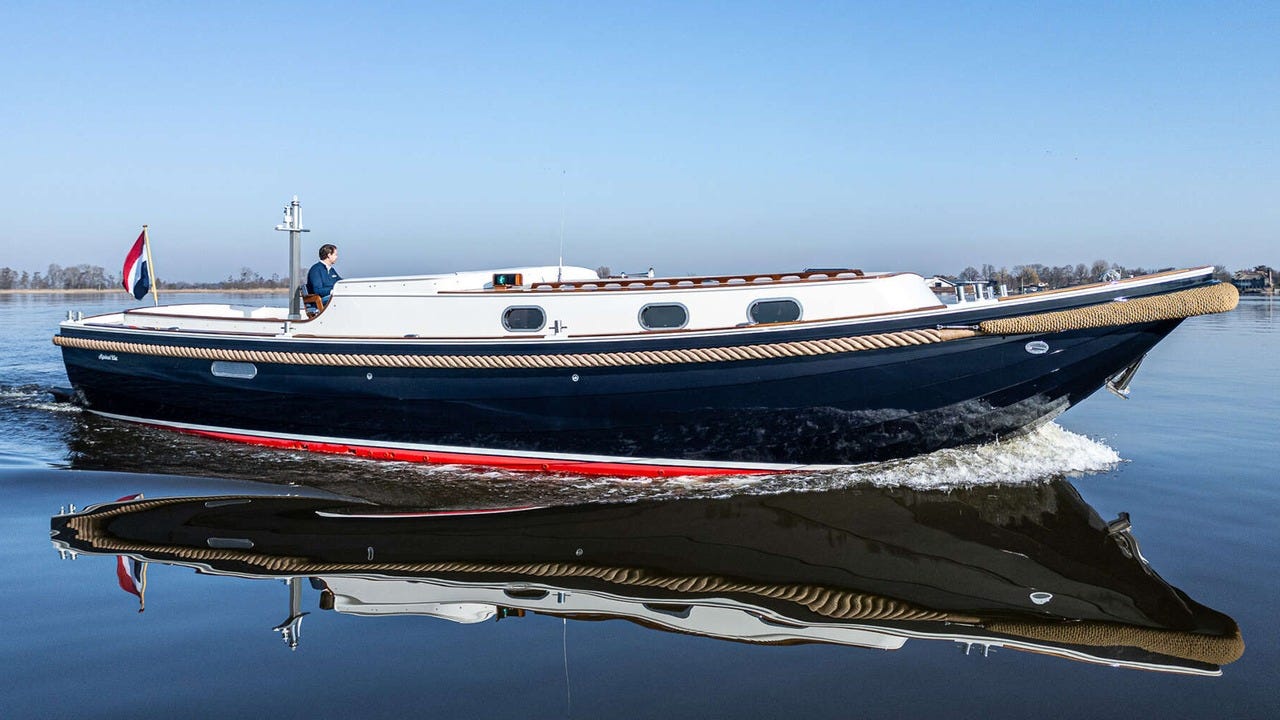
The Rijnlandvlet 1300 OC Hybrid arrived at De Valk’s covered sales marina in Loosdrecht in 2024, having been used for precisely one sea trial and one photoshoot. She has never turned a passage mile in anger. She is, by any reasonable definition, brand new, asking €595,000 VAT paid.
What makes her interesting is not her price, though the price is interesting. It is what sits beneath her steel deck: a full hybrid diesel-electric drivetrain, a 48-volt lithium battery bank with 37.2 kilowatt-hours of stored energy, and a Belmarine EM 220 electric motor on the same shaft as her Vetus Deutz diesel. She can ghost through a canal city making no more noise than a rowing boat. She can then fire up the diesel and cover 1,085 nautical miles before the fuel runs out. That is an unusual combination in a 13.5-metre boat at any price.
Check out the boat tour video that I filmed on board this intriguing boat, and then come back to this article.
The Vessel
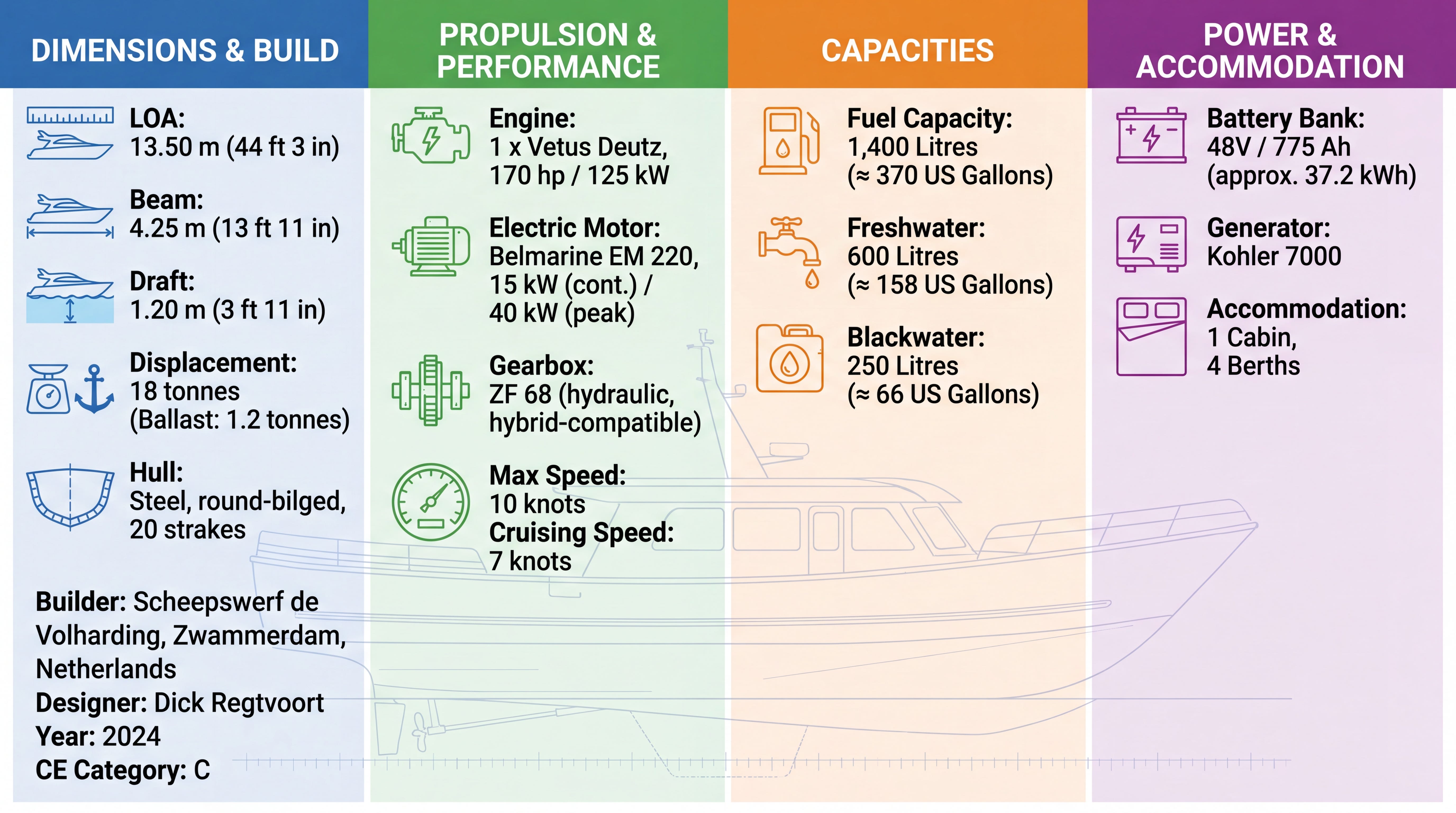
The Rijnlandvlet 1300 OC Hybrid is 13.50 metres on the waterline, 4.25 metres wide, and draws just 1.20 metres. She displaces 18 tonnes. Her hull is round-bilged steel, built in 20 strakes, finished in blue. The superstructure, deck, and cockpit are also steel; this is not a vessel that reverts to aluminium or GRP above the waterline, with teak laid over the deck and superstructure. The mast lowers hydraulically, which matters in the Netherlands, where bridges arrive at a rate that would exhaust the patience of anyone with a fixed rig.
She is CE Category C. That rating covers inshore and sheltered coastal waters in conditions up to Force 6, enough for the North Sea coast hugged close, the Mediterranean in summer, and every canal, river, and lake in Western Europe. She is not an ocean crosser. She is, instead, a vessel built for the world where most European owners actually use their boats: the extraordinary inland waterway network that connects the Netherlands, Belgium, Germany, France, and beyond.
- Asking price: €595,000 VAT paid
- Lying: Loosdrecht, Netherlands
- Broker: De Valk Loosdrecht
Range: Diesel, Maximum Speed, and Electric Only
The range question is one of the most important things a buyer asks about any motor yacht, and on this one it comes in three separate answers because she has three distinct modes of propulsion.
At cruising speed of 7 knots, with the Vetus Deutz diesel running, she burns approximately 8 to 10 litres per hour. On a 1,400-litre tank, that works out to roughly 155 hours of endurance and a passage range of approximately 1,085 nautical miles. That is Rotterdam to Gibraltar without a fuel stop if the conditions allow, or a summer of continuous cruising on the French canals without ever thinking about the gauge.
At maximum speed (10 knots), the engine works harder, consuming around 18 to 20 litres per hour. Range drops to approximately 740 nautical miles, still a very respectable figure for a vessel of this type.
In pure electric mode, the picture is different in character.
The Belmarine EM 220 draws from the 48-volt, 775-amp-hour battery bank, which holds approximately 37.2 kilowatt-hours of energy. At 4 to 5 knots, a displacement hull of this size needs only around 3 to 4 kilowatts at the prop shaft. That gives between 8 and 10 hours of electric-only running, and a range of approximately 40 to 45 nautical miles in complete silence. For a day’s passage through the Amsterdam canals, where zero-emission zones are already becoming the norm, that is more than enough. You leave the marina on batteries, transit the city, pick up the diesel when you reach open water, and arrive without having contributed a gram of exhaust to the canal air.
The Builder and Designer
She comes from Scheepswerf de Volharding, a Dutch shipyard that has been building steel vessels continuously since around 1900. The yard introduced the Rijnlandvlet type in 1987, and the hull form has changed very little since. That is not conservatism for its own sake. The yard’s position is that a round-bilged, moderate-displacement hull optimised for 5 to 8 knots in sheltered water does not need reinventing; it needs refining. Their signature construction method, chain-welding applied to both sides of every seam below the waterline, has been unchanged since day one. A Rijnlandvlet built to this standard is expected to give 30 to 40 years of hard service before requiring any structural attention.
The designer is Dick Regtvoort, and his role is unusual: he is the in-house designer and director of both the shipyard and Rijnland Yachts, meaning the design, the construction standards, and the decision about what gets built next are all one person’s responsibility. That kind of continuity is rare in modern boatbuilding. His philosophy comes down to one principle: fitness for purpose in the European inland waterway environment. Shallow draft. Low air draft. Round-bilged for sea-kindliness. Interiors that prioritise habitable volume over aesthetic drama. The 1300 OC Hybrid is where that philosophy meets a 2024 drivetrain.
In the Wardroom below, I go into considerably more depth on both: the full history of the yard from its commercial origins through to the leisure transition, and the specific construction techniques that define why a Rijnlandvlet holds its value the way it does.
This article continues below, in “The Wardroom”
In the premium section, I cover:
- The builder in detail: Scheepswerf de Volharding’s full history from 1900 to today, their distinctive construction methods, and what their reputation actually means for a buyer evaluating this vessel
- Dick Regtvoort and the Rijnlandvlet type: the design philosophy behind the 1300 OC, and why this hull form has remained essentially unchanged since 1987
- The hybrid drive explained: how the Belmarine EM 220 integrates with the ZF 68 gearbox and what it means in practice for maintenance, fuel savings, and operation
- Shipping costs: what it would realistically cost to get her to the US East Coast, the US West Coast, and Australia, and why CE Category C makes this a more nuanced conversation than it first appears
- My honest assessment of the €595,000 asking price: how she compares to non-hybrid Rijnlandvletten, to German and Belgian alternatives, and whether the premium for the hybrid package is justified
The Wardroom
The Builder: Scheepswerf de Volharding..
Scheepswerf de Volharding has been building steel vessels in the Netherlands since around 1900. The yard traces its current character to the 1920s, when Auke van der Werff, one of five brothers from Warga, purchased an existing timber shipbuilding facility and converted it to steel construction. The name, which translates roughly as “shipyard of perseverance,” has proved apt. The yard has been continuous for over a century.
