

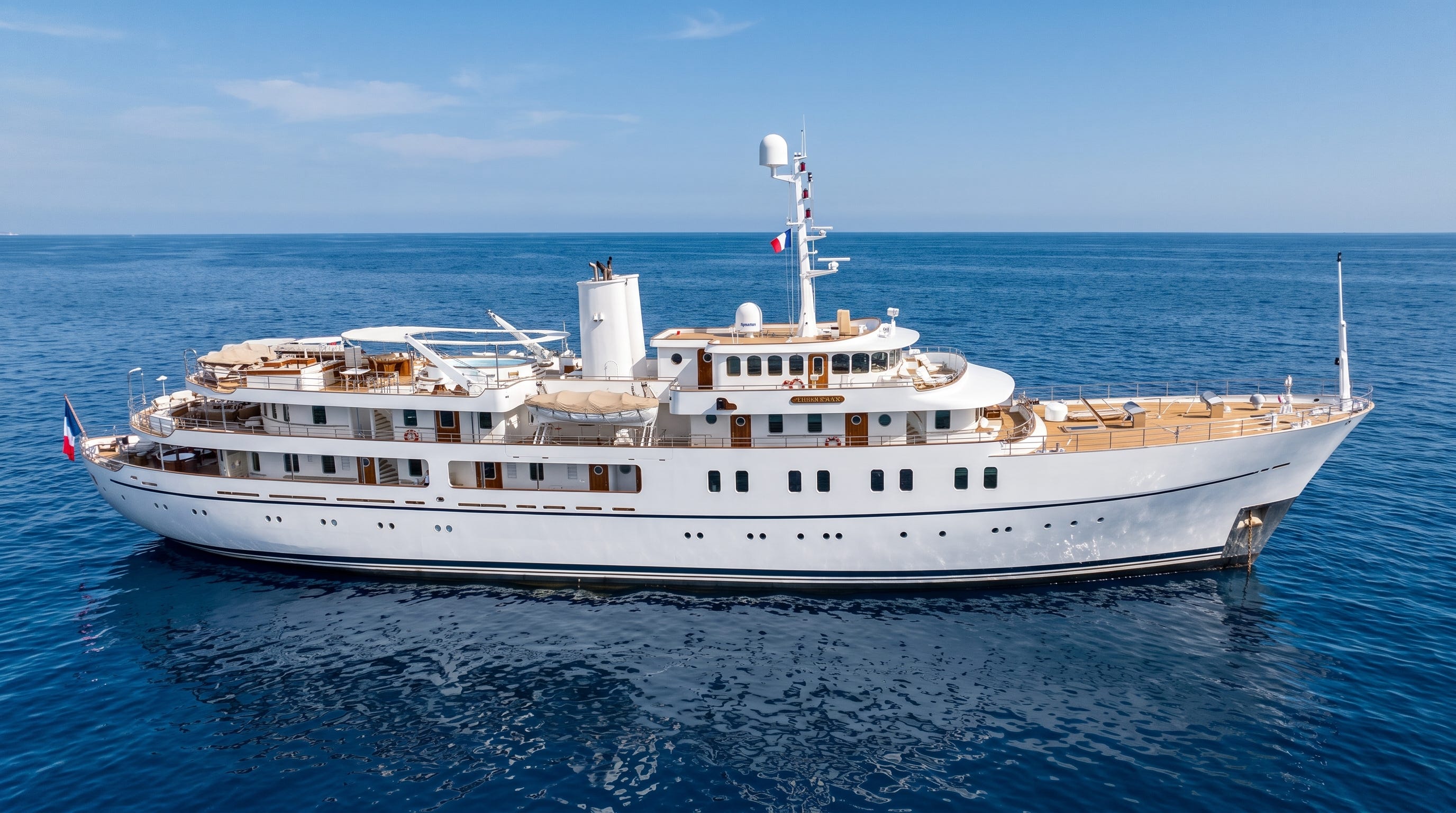
Some of you will have seen my tour of Sherakhan already. I filmed it 2 years ago, a full 30-minute walkthrough of her, and it remains one of my favourite videos I’ve made. But roughly 70,000 of you have joined my YouTube channel since then, and I would guess most of you haven’t seen it. So, I wanted to give you the background on this boat, because her story deserves more than a quick caption (if you have not seen it yet, then you can watch my latest video HERE).
I’ve known her captain, Kevin, for a while now, which is a nice thing about doing this job long enough. He had me, my wife and our two kids on board for an afternoon last year, Jack was 7 at the time, Freya was 4.
We weren’t paying charter guests, obviously, just a family being shown around, but the level of care we got was something else entirely. I still think about it now. Jack and Freya spent most of the afternoon tearing round the decks with the captain’s own son, three kids running wild on a 70-metre yacht like it was the best playground on earth, while I sat down to lunch with Kevin and my wife, Nicola, on the aft deck, a full sit-down meal cooked by the onboard chef, the sun out, nowhere else either of us needed to be.
In four decades of being on and around boats, that afternoon still stands out as one of the best of the lot. If that’s the welcome a family gets for a few hours with no money changing hands, I can completely understand why one set of charter guests booked a week and ended up staying for seven.
Here’s the dream first, because that’s usually where I start. You step aboard a 70-metre motor yacht with a genuine 20m saloon, double height, a glass-bottomed spa pool set into the ceiling above you, two sweeping staircases either side leading up to a minstrel’s gallery with a bar and a dancefloor.
You climb up on to a circular observation lounge built around the funnel, 20 metres above the water, and watch the world go paston all sides. You have a library stocked with first editions. You have a Balinese-style spa with a sauna and a masseuse. Nineteen crew are looking after 26 of you, and somewhere in your head you are trying to work out how a boat can feel this much like a genuine traditional steel motor yacht and this comfortable at the same time.
That tension is exactly the point. Sherakhan looks like she has always been a yacht. She has not. For 45 years she was something else entirely.
From Training Ship to Superyacht
She was built and launched in 1966 by A. Vuyk & Zonen, a Rotterdam-area shipyard at Capelle aan den IJssel that had been building solid, unglamorous working vessels since 1872. Her name was Prinses Margriet, and her job was training cadets for the Dutch merchant navy, operated out of Terschelling by the Willem Barentsz Maritime Institute. For four and a half decades she took young Dutch sailors out into the North Sea and the Atlantic and taught them their seafaring trade on a genuinely tough working hull.
That hull is the whole story. When Jan Verkerk, the Dutch businessman who would go on to buy her, had her surveyed in July 2002, the plating came back at 30mm thick. For context, a modern superyacht hull typically runs around 8mm. After 45 years of hard commercial service in the North Sea, Prinses Margriet’s steel had corroded by only a single millimetre. That is an extraordinary result for a working hull of that age, and it is precisely why Verkerk saw potential where most people would have seen a retired training vessel heading for scrap.
Verkerk knew what he was looking at. He had already converted M/Y Jaguar into an early charter success in the 1990s, and he would go on to do the same, more dramatically, with a former Soviet icebreaker that became the 77-metre Legend (sold to Eric and Wendy Schmidt in 2020). Prinses Margriet became his next project, and arguably his signature one.
The conversion took 3 years, from 2002 to 2005, working with naval architects KMC and KHMB Enkhuizen and interior designer Claudia Rijntjes. The scale of what they did is worth spelling out. The original steel superstructure, roughly 200 tonnes of it, came off entirely. In its place went 60 tonnes of aluminium, reshaped to echo the lines of a 1936 classic motor yacht rather than the boxy, top-heavy profile of a 1960s training ship. Verkerk himself talked about wanting to avoid the “clumpy” look that so many vessel conversions end up with. The steel hull below the waterline, that 3cm of proven plate, stayed exactly as it was.
The propulsion tells you something about Verkerk’s philosophy too. Rather than fitting twin engines for redundancy, as some modern explorer yachts do, he kept her on a single engine, a Caterpillar 3512B DI-TA producing 1,380hp, giving her a cruising speed of 11 knots and a range of around 3,500 nautical miles. Four decades of Dutch cadets had trained on single-engine operation. Verkerk’s reasoning was that if it had worked for the navy for that long, it did not need changing for a charter yacht either.
She relaunched, and took her first charter guests, on 23 June 2005. And the name that went on her stern was Sherakhan, after Shere Khan, the tiger from The Jungle Book. Verkerk’s daughter had been watching the Disney film on repeat during the conversion, and the name stuck. It is a heartwarming story for a boat that now has a tiger painting hanging in her main salon and a library named after her.
What She Is Today
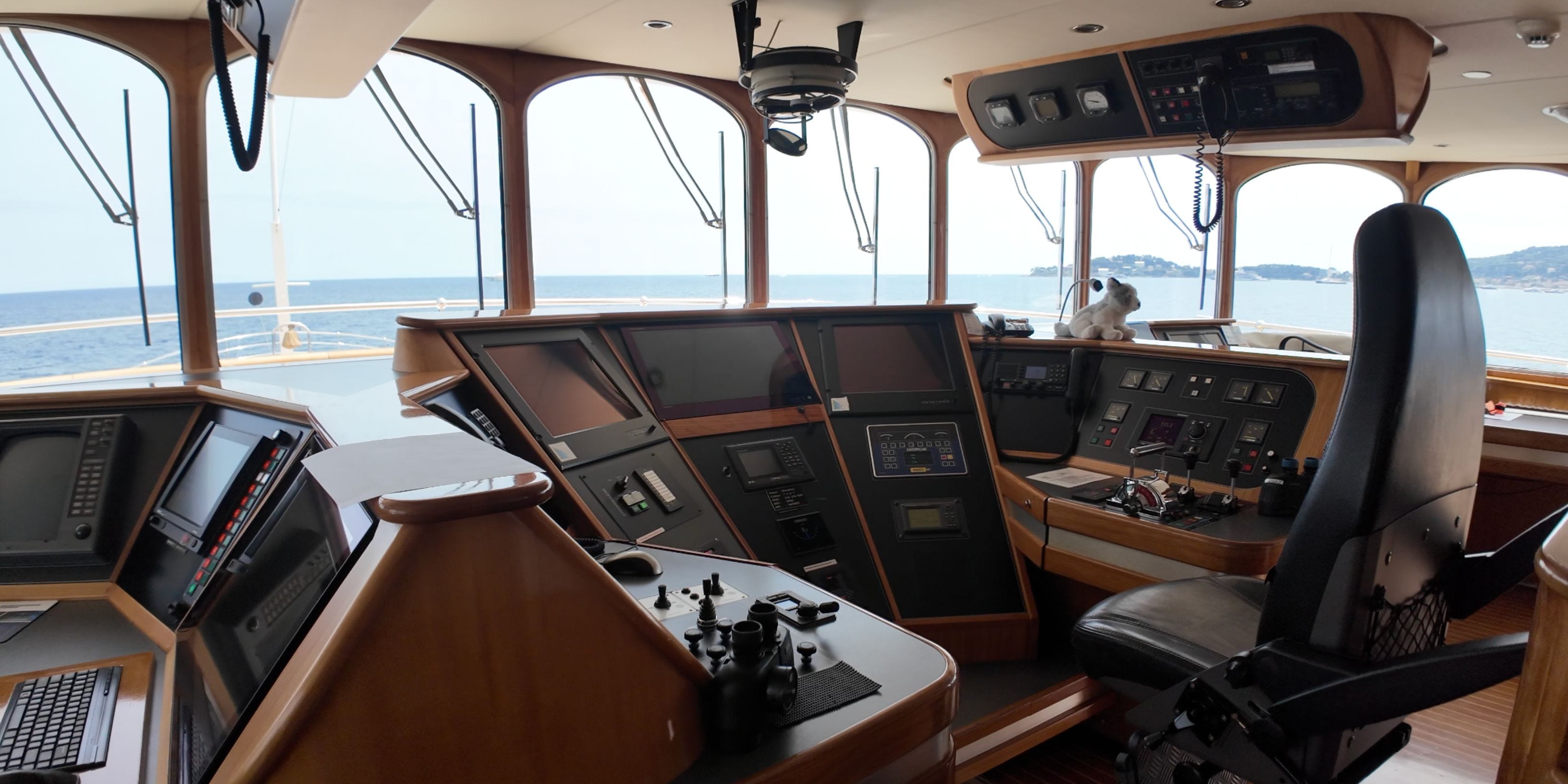
Sherakhan has had two significant refits since her 2005 relaunch. The first, completed at Icon Yachts in December 2017, changed her look considerably: the hull went from navy blue to brilliant white, and the interior moved from the darker, heavier classic palette of her early years to a lighter, more contemporary white scheme. Verkerk worked closely with his long-serving hotel manager, Manon de Wit, on that project, and by all accounts it worked. Her first charter clients after the refit extended their week to seven.
The second refit, in 2022, added a fitness gym and expanded the Balinese-themed spa with a second jacuzzi, a dedicated massage room, and sauna upgrades. Between the two, she has moved from “impressive classic conversion” to “genuine wellness-focused expedition yacht” without losing the character that made her interesting in the first place.
She now sleeps up to 26 guests across 13 cabins, including a 50 square metre master suite forward with its own study, and carries a crew of 19. At 1,945 gross tons and 69.65 metres, she is a genuinely large vessel, and her cruising résumé reflects it: Mediterranean summers, Caribbean and Central American winters, and expeditions to the Antarctic in December and January, which is not a sentence you can write about most charter yachts of any size.
If Sherakhan sounds like the right boat for your group, get in touch with me directly and I will handle the introduction from there. CLICK HERE to make an enquiry.
This article continues below, in “The Wardroom”
In the premium section, I cover:
- The full weekly cost of chartering Sherakhan: the base rate, APA, and gratuity expectations, broken down to a real total
- Jan Verkerk’s conversion philosophy across his fleet: what Sherakhan and Legend actually have in common, and why he keeps choosing overlooked, oversized hulls
- The steel hull at 60 years old: what that original 3cm plate means for her long-term future, and how a vessel like this ages compared to modern explorer builds
- My honest assessment of the price: how $595,000 a week actually compares against the rest of the expedition charter fleet
The Real Cost of a Week Aboard
The headline rate for Sherakhan is $595,000 per week (some brokers quote the equivalent figure in euros, depending on which agency you book through). That is the base MYBA charter fee. It is not the number you actually pay.
