Starting Bid €250,000, Reserve Applies: TYR, a Brand-New Aluminium Explorer Rated for the Open Ocean That Folds Down to 3.4 m
She was listed at €1,550,000, VAT unpaid. Now her builder is selling her at auction in December, with a reserve. I look at the yard, her designer, her Steyr engines and what she costs to run.

In the summer of 2021, a Korvet carrying an extra 2,000 litres of fuel left Horta in the Azores and didn’t stop until she reached Bermuda, roughly 1,800 nautical miles and about nine days later. She was a long-range version of the boat I want to show you today.
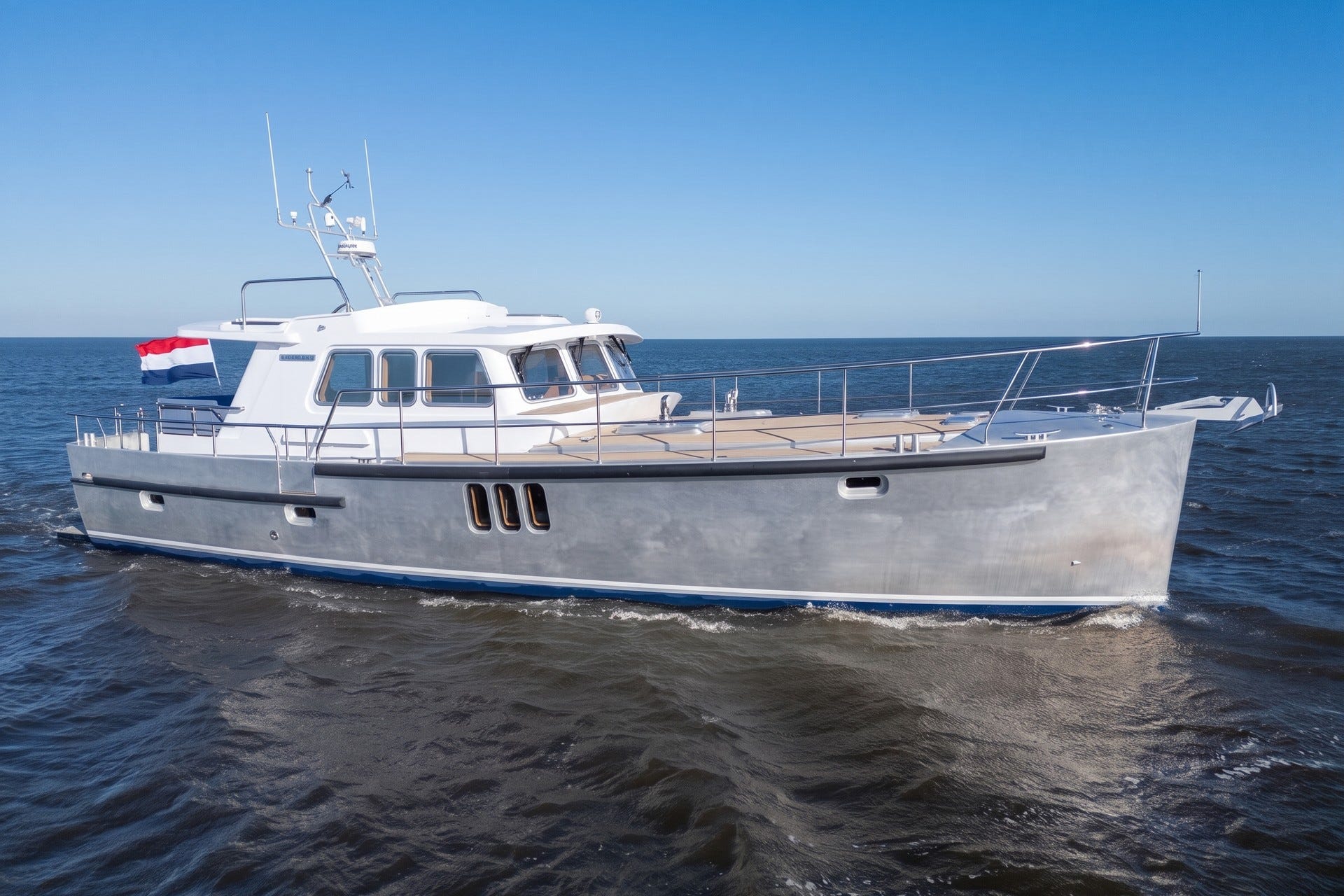
TYR is a stunning brand-new Korvet 14 CLR: 14.6 metres (48 ft) of aluminium, rated CE Category A, with a range of around 1,700 nautical miles at 8 knots. And yet, with her mast folded down, she stands about 3.4 metres high, per her spec sheet. She was listed at €1,550,000 (about £1.29 million or $1.7 million), with VAT not paid. Now she’s going to an online auction (link to auction below) from 21st to 28th December, with a starting bid of €250,000 and a reserve that hasn’t been published, so that opening figure is where the bidding starts, not what she’ll sell for.
Her original owner is no longer able to take her on, so her builder, Deep Water Yachts, has finished her and is now selling her on his behalf. She has fewer than 40 hours on her twin engines.
I went aboard her in Sneek on 12th November, on the first day of my filming trip to the Netherlands. When I asked my premium subscribers which boats I should film, a few of you voted for her and sent me questions, and I’ve answered those in The Wardroom below.
Photos courtesy of her builder and the listing broker.
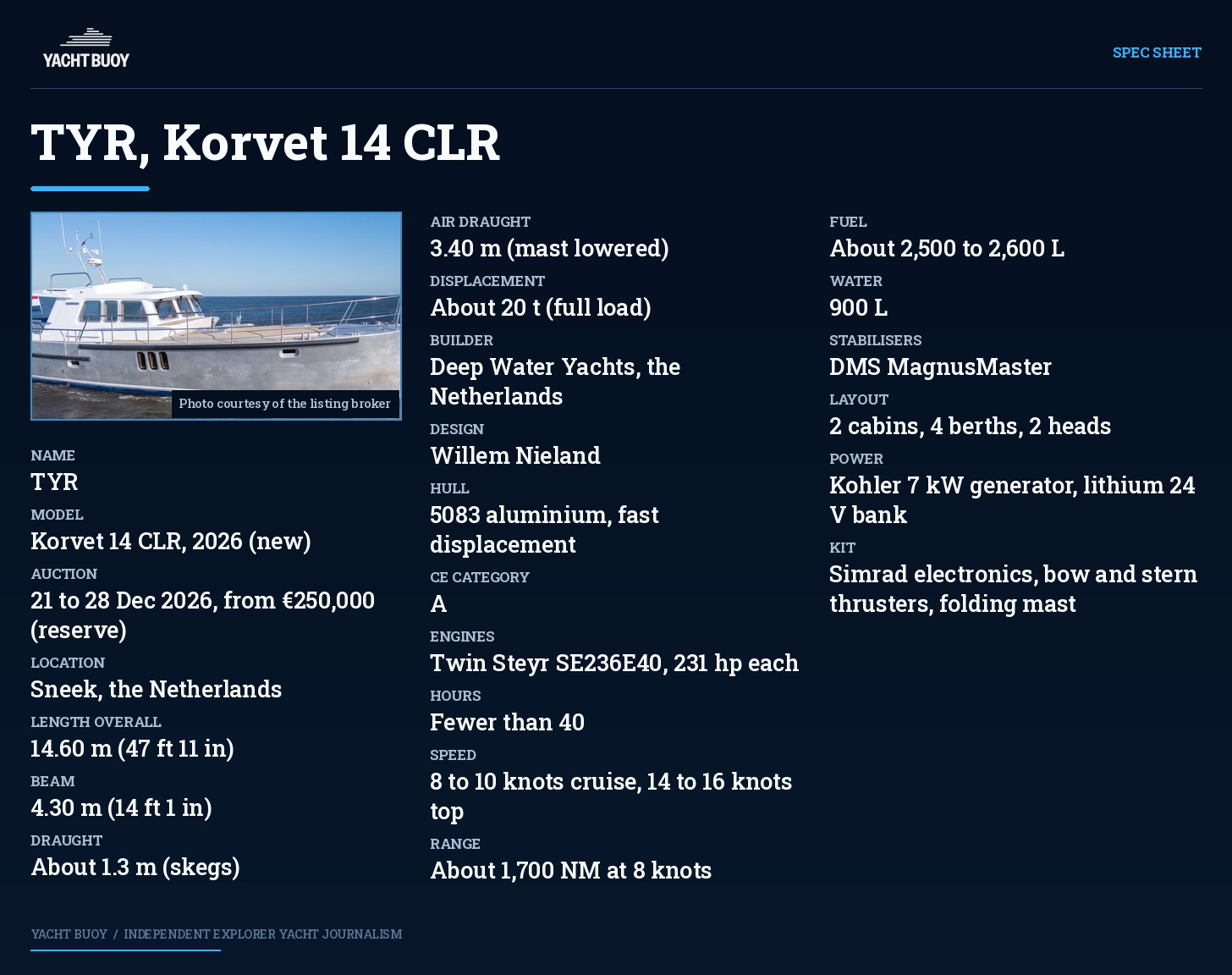
Her full listing, with photos and the complete specification, is on my website: see her listing. You’ll find my other hand-picked explorer yachts for sale there too.
The boat her builder wanted for himself
Deep Water Yachts started with one man’s vision. Peter Bost served in the Netherlands Marine Corps, then logged thousands of miles on a fibreglass boat between Belgium and the French Riviera. When he went looking for something tougher, he couldn’t find the boat he wanted, so he wrote his own brief and took it to the Dutch designer Willem Nieland.
The brief was simple to say and hard to build: low maintenance, strong, seaworthy, shallow enough to reach the places big boats can’t, self-sufficient for long spells at anchor, and able to take the ground. The first Korvet 14 CLR was built for Peter and a partner. He was so pleased with the craftsmen who built her that he founded Deep Water Yachts, around 2015, to bring the boat to market. As he put it to a boating magazine (in translation), “We ordered a displacement boat but got a fast one.”
The company works as an alliance of Dutch specialists rather than one big shed. The builder names Shipyard Rotterdam as its hull builder, with the joinery from a cabinetmaker in Hardinxveld-Giessendam, and the stainless, electronics and engineering from their own partner firms. Each boat takes about a year to build once her owner has signed off the specification, and they’re built in small numbers. The motto is “Form follows function”, and the Korvet 14 was named the HISWA Motorboat of the Year in 2015.
CLR stands for Compact Long Range, and TYR is the smallest of three current models. The Korvet 16 CLR stretches the same idea to 16.2 metres, with around 3,300 nautical miles at 8 knots. The flagship Korvet 18 LR is just under 19 metres and good for around 4,400 nautical miles. In America they’re sold as the Korvet 50, 54 and 62, and the 50 comes with US-standard shore power and appliances.
Willem Nieland, and that “sailing yacht” bow
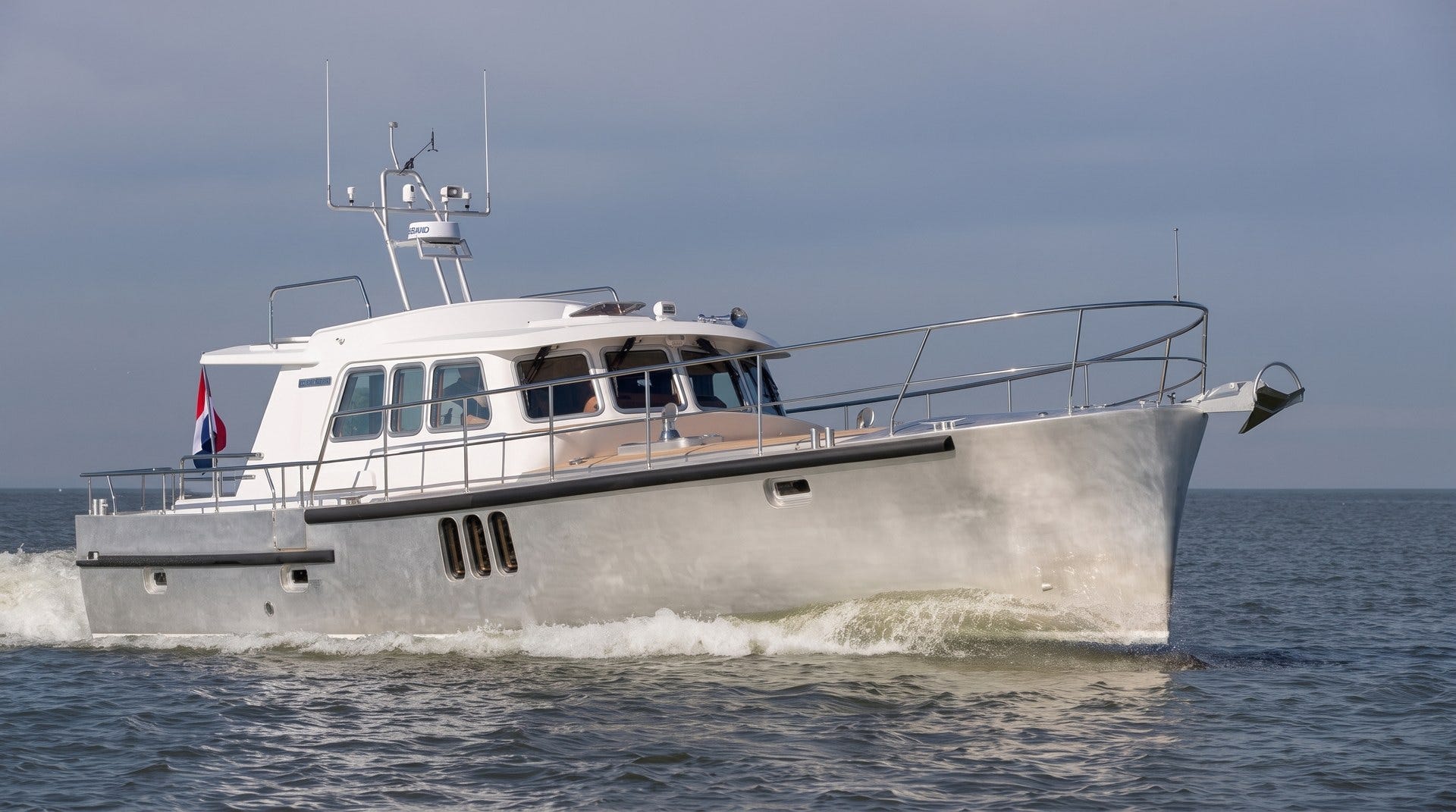
Willem Nieland was born in 1956 and has spent around 35 years designing boats. He made his name with the Pilot 44, a motor boat for people coming over from sail, and he’s also drawn the Globemaster range of aluminium sailing yachts. His motor boats tend to borrow from working boats, and the Korvet is a good example: above the waterline she has the stance of a classic American trawler, while below it she’s closer to a sailing boat.
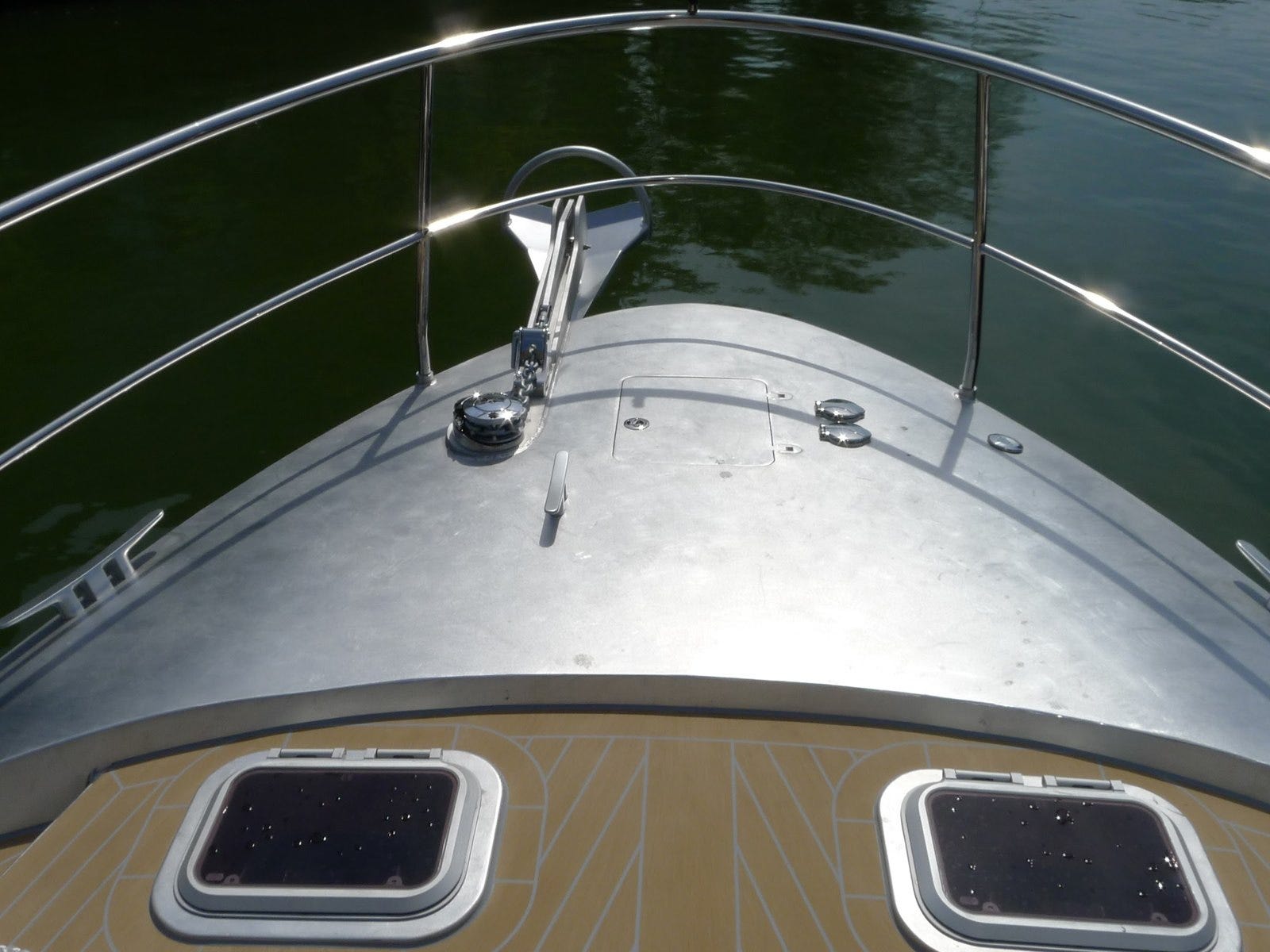
That’s the “sailing yacht” bow I talk about in the video that I have just published on my YouTube channel. She has a plumb stem with a small wave-piercing bulb, a round-bilge hull with a single knuckle running back into a nearly flat aft bottom, and skegs that protect her running gear, so she can take the ground on a falling tide.
Why 20 tonnes does 10 knots
A traditional displacement boat hits a wall at what’s called hull speed. If her waterline is close to her full 48 ft length, that works out at roughly 9.3 knots, and pushing past it takes a lot more power for very little extra speed. TYR’s builder calls her hull “fast displacement”: long, slim and light for her size, at about 17 tonnes empty and 20 tonnes loaded, so she can run a little past that wall without fighting it.
She cruises at around 10 knots, and her listing puts the fuel burn at that speed at about 18 litres an hour. At 10 knots her builder gives her about 1,360 nautical miles. Ease back to a respectable 8 knots and that stretches to about 1,700, so 2 knots slower buys you roughly 340 more nautical miles. Her spec sheet puts her top speed above 14 knots, and the builder’s own figure for the model is 16.
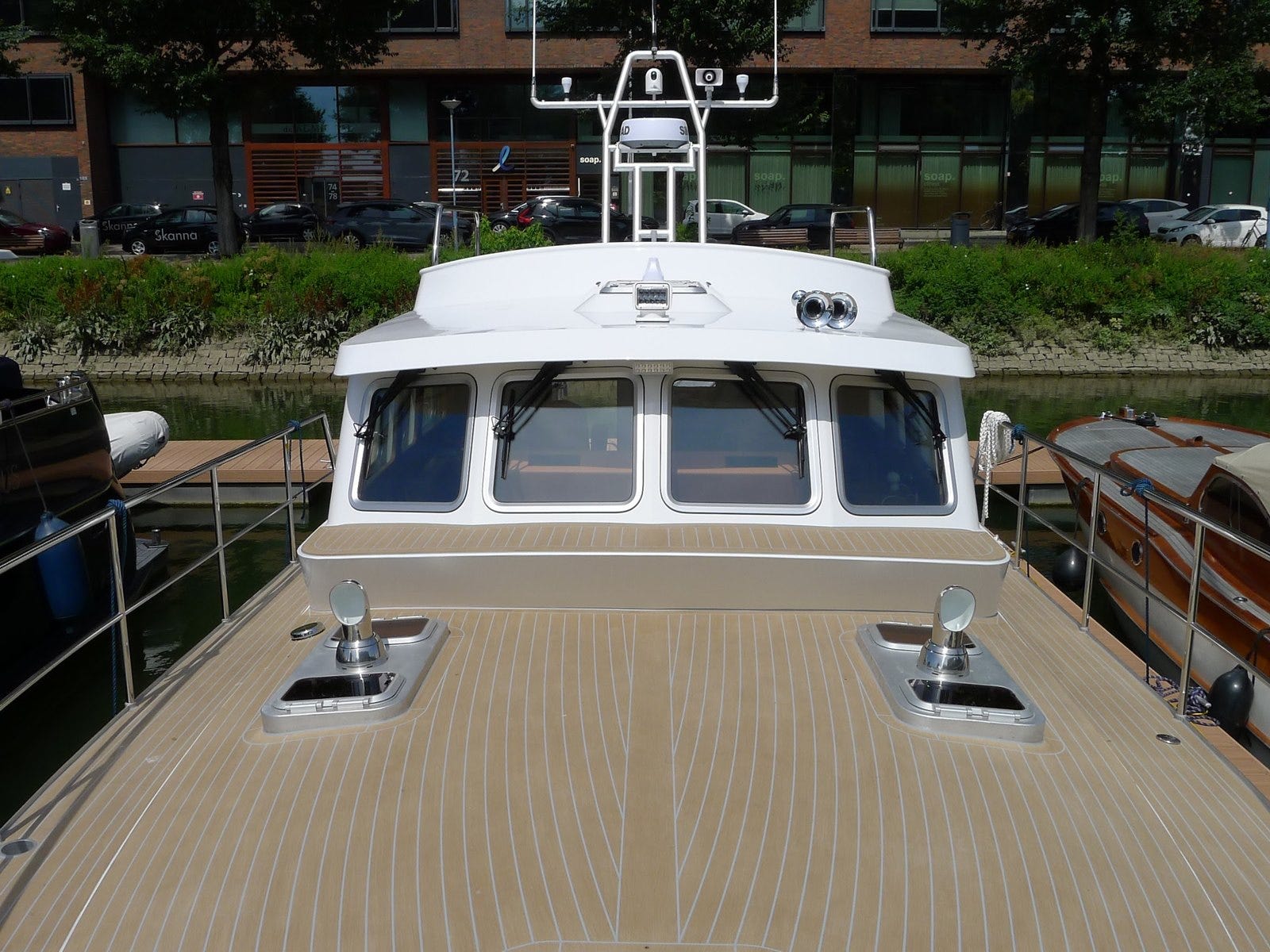
Her hull is bare aluminium, sanded rather than painted, with antifouling below the waterline, so there’s no topside paint to chip, fade or touch up. Right up in the bow there’s a heavy crash bulkhead, plus two more watertight bulkheads behind it. She draws about 1.25 to 1.3 metres at her skegs and only 0.75 metres under the hull itself, and her mast folds electrically, which takes her down to about 3.4 metres. In other words, she’s built for canals and inland waterways, and still rated for the open ocean.
The nine-day run to Bermuda
That Atlantic passage was made by Callisto, a Korvet delivered to the Bahamas. She was set up as a “50 XLR”, with about 2,000 litres of extra fuel built into the hull, for 4,600 litres in all. She left Rotterdam, called at Brighton and the Azores, then ran the 1,800 or so nautical miles from Horta to Bermuda in about nine days, averaging roughly 8 to 9 knots, before carrying on to Nassau. Peter Bost says she arrived in Bermuda with about 700 litres to spare.
TYR carries the standard tank of about 2,500 to 2,600 litres, so a leg like that would need extra fuel. What Callisto shows is what this hull design has done once she’s out there.
Life aboard
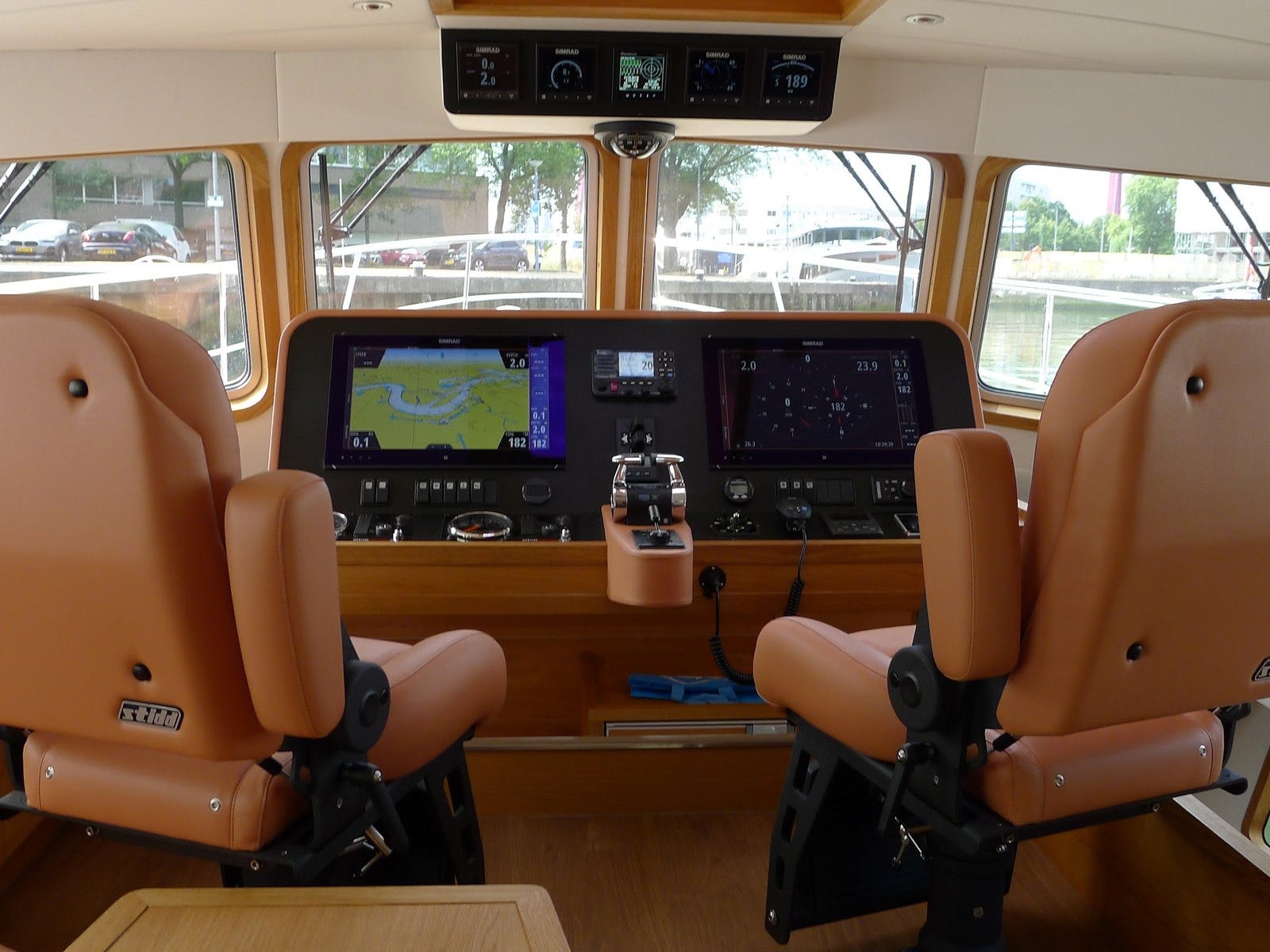
You step up from the saloon into a raised pilothouse that seems to float above the living space, with a dinette alongside and two STIDD helm chairs facing a pair of 19-inch Simrad screens. Steering is by autopilot and a Simrad follow-up joystick, and there’s a night-vision camera for arriving somewhere after dark.
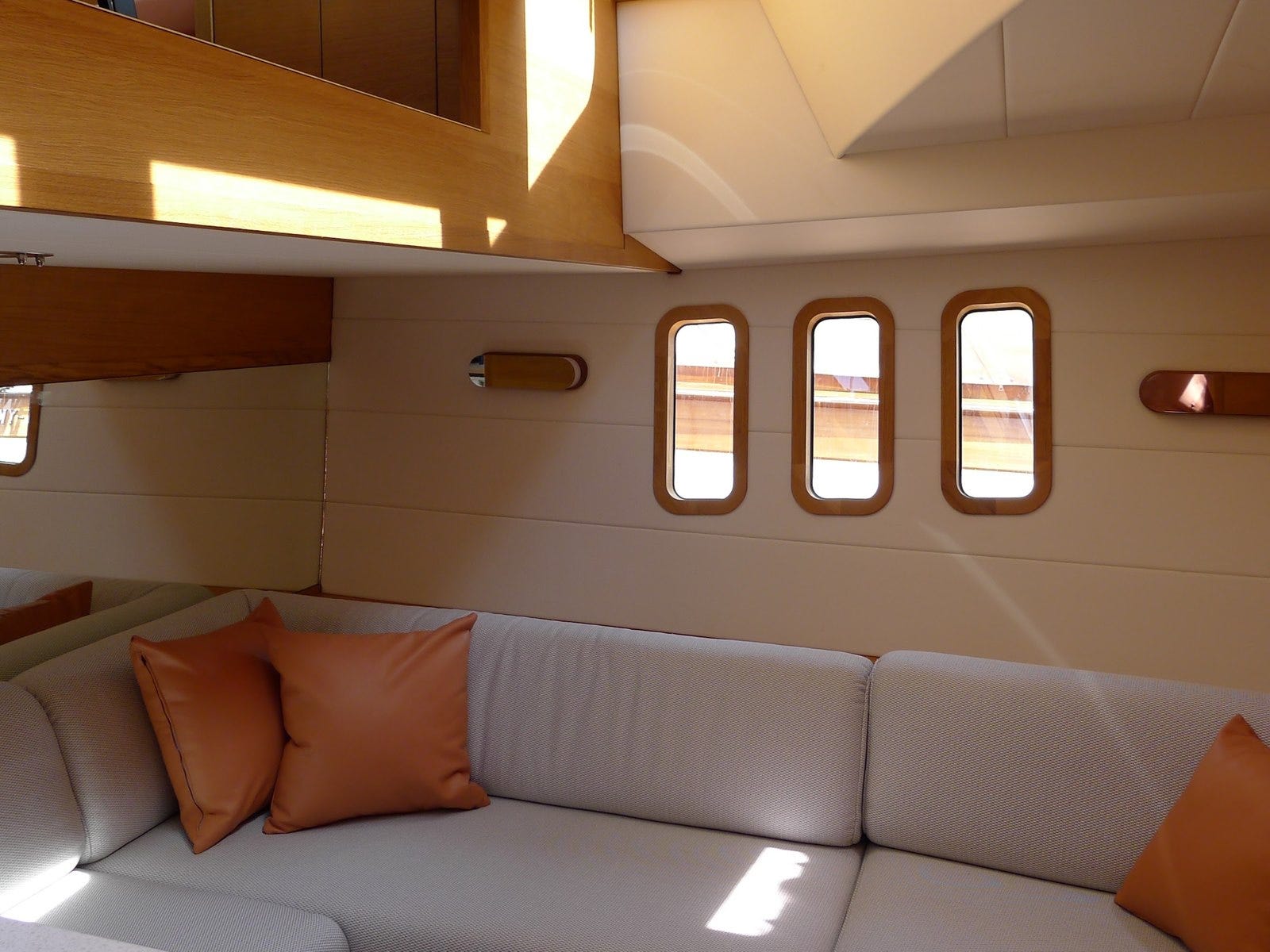
Down in the saloon there’s a U-shaped settee under the vertical windows, and the galley has a three-zone induction hob, an oven, a fridge-freezer, a compact dishwasher and a washer-dryer. The joinery throughout is light oak.
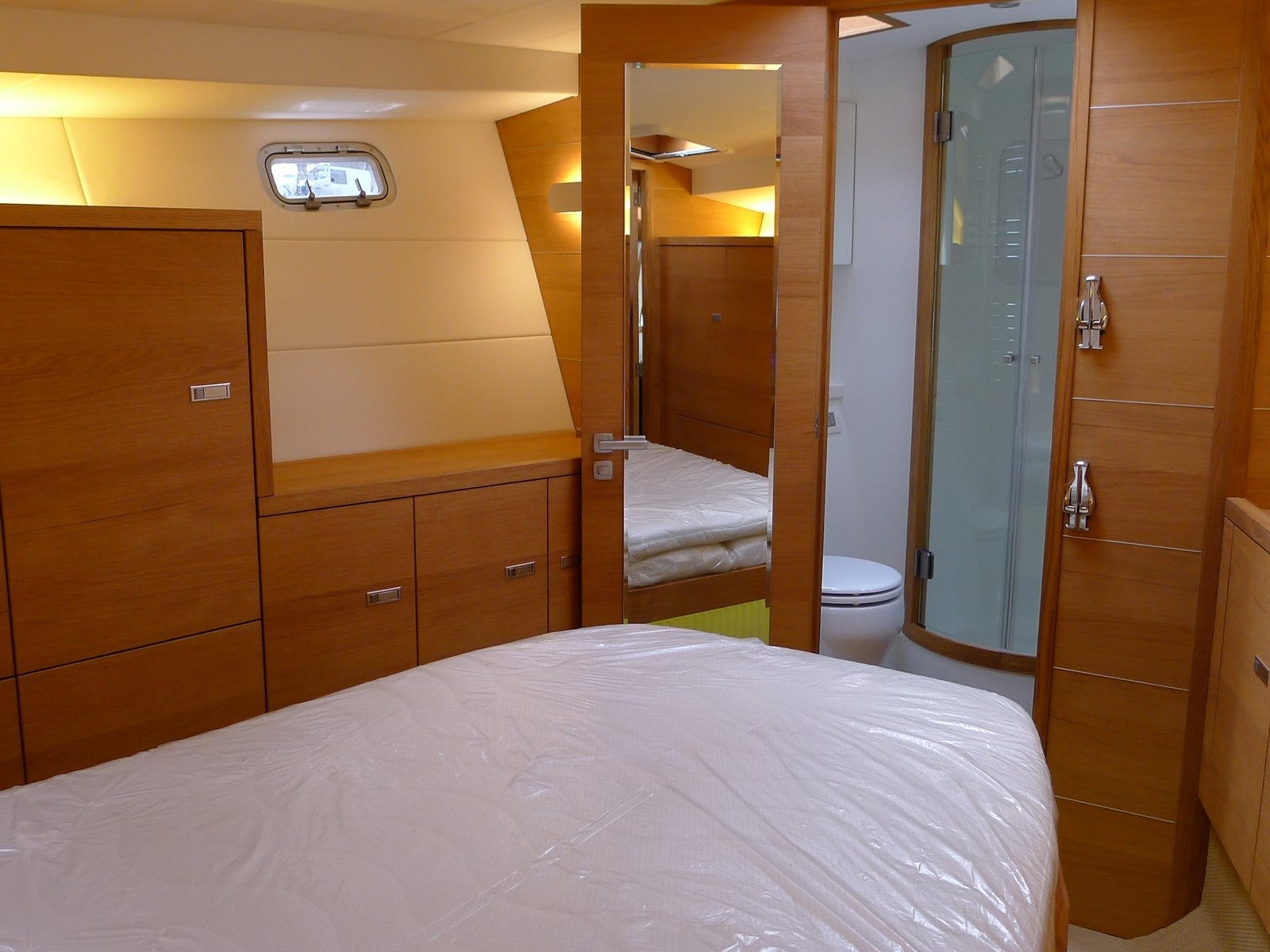
The owner’s cabin is forward, and here’s a neat Nieland touch: the en suite sits right up in the narrow forepeak, so the bed can sit where the hull is widest. The guest cabin has two single berths, and there are two heads in all.
She’s set up for every season. There’s 15 kW of central heating with radiators, 36,000 BTU of air conditioning, a 460 Ah lithium bank at 24 volts, two 3,500 W inverter-chargers and a 7 kW Kohler generator, so you’re not tied to a marina for power.
What powers her, how the auction works, what she costs to run, and what it would take to get her to the UK or America are all below, in the premium section, along with the answers to your questions.
This article continues below, in “The Wardroom”
A quick thank you to everyone in The Wardroom, existing and new alike: your support keeps both the YouTube channel and this newsletter advert-free and independent, and lets me keep writing about and filming boats like TYR.
In the premium section, I cover:
Your questions answered: why 20% UK import VAT doesn’t mean paying VAT twice, what her 3.4 m air draft means for the Great Loop, and how to check an aluminium hull for corrosion you can’t see
Twin 231 hp Steyr SE236E40s: the Austrian monoblock diesels most owners have never heard of, and the takeover now under way at Steyr
Stabilisers that work from 3 to 12 knots, and why they won’t help at anchor
About €28 an hour at 8 knots: fuel, berths, insurance and a rough annual budget
A 12.5% fee plus VAT: how the auction works, and what a €400,000 hammer price really costs a Dutch buyer
Likely about 10% US duty, a 50 Hz generator and a rough shipping estimate: what getting her to America involves
My honest assessment: who she suits
You asked, I found out
As ever, I’ve done the research, so you don’t have to…
