

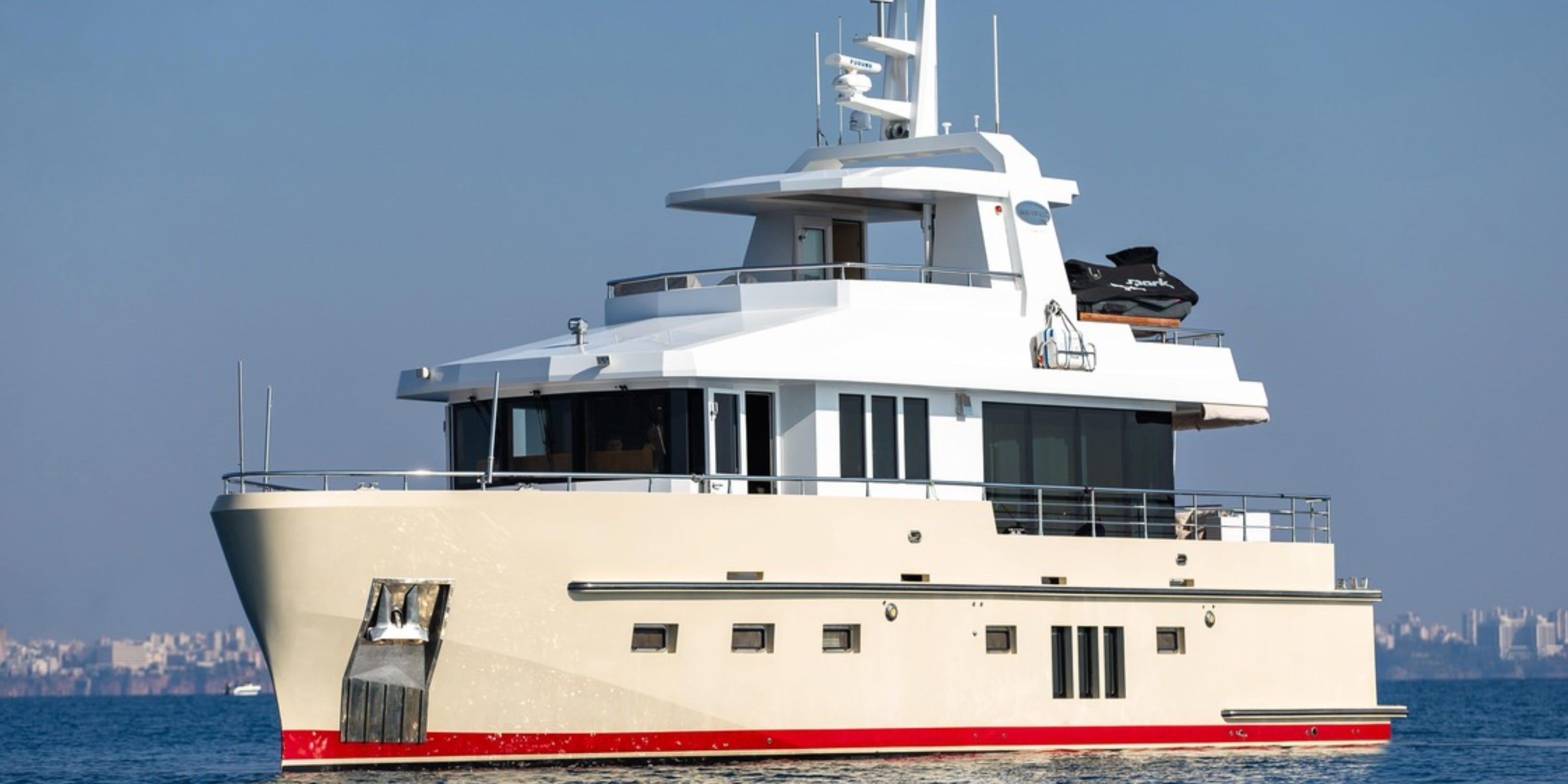
Although I’ve featured quite a few Bering Yachts on my YouTube channel, I’ve never been aboard M/Y ‘Dzam’, but I already know two things I love about her: her seakeeping and her range. She’s a 2012 Bering 60, a steel explorer weighing 97 tonnes at full load, with a full-displacement hull and tankage for 8,700 litres of diesel. That’s the recipe for a steady, purposeful explorer in a seaway, and a tank that size means you don’t have to think about the next fuel dock every couple of days.
She’s also currently for sale with the very yard that built her. Bering Yachts is offering Dzam themselves from Antalya, on Turkey’s south coast, at $1,100,000 (link below), roughly €981,000 or £830,000 at the European Central Bank’s reference rates of 15 October 2026. That’s a lot of steel and range for the money, and it raises the question I’ll come back to: how would you pay for a boat like her?
Dzam belongs to Bering’s Exploration series, built for long-range cruising with more contemporary styling. She measures 18.3m (60ft) overall, 17.2m on the waterline, 5.7m in beam, and draws 1.8m. Her hull is steel, and she is rated CE Category A. Bering lists her twin Cummins QSB5.9 diesels at 225hp each at 1,700rpm, both continuous-duty rated, with 2,623 hours on the port engine and 2,616 on the starboard, turning five-blade propellers. She cruises at 7.5 knots, tops out at 9.5 and has a listed range of 3,000+ nautical miles at cruising speed.
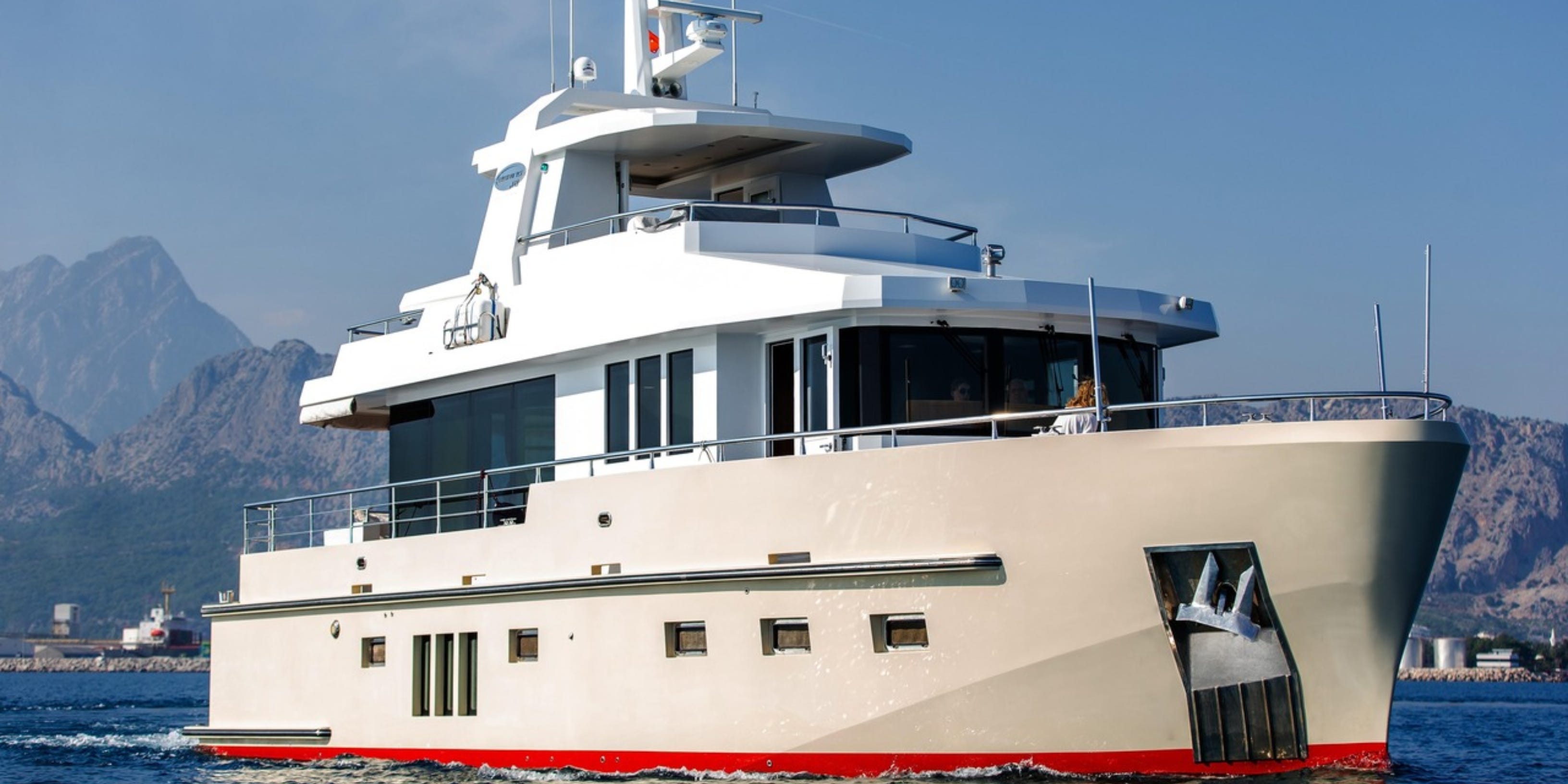
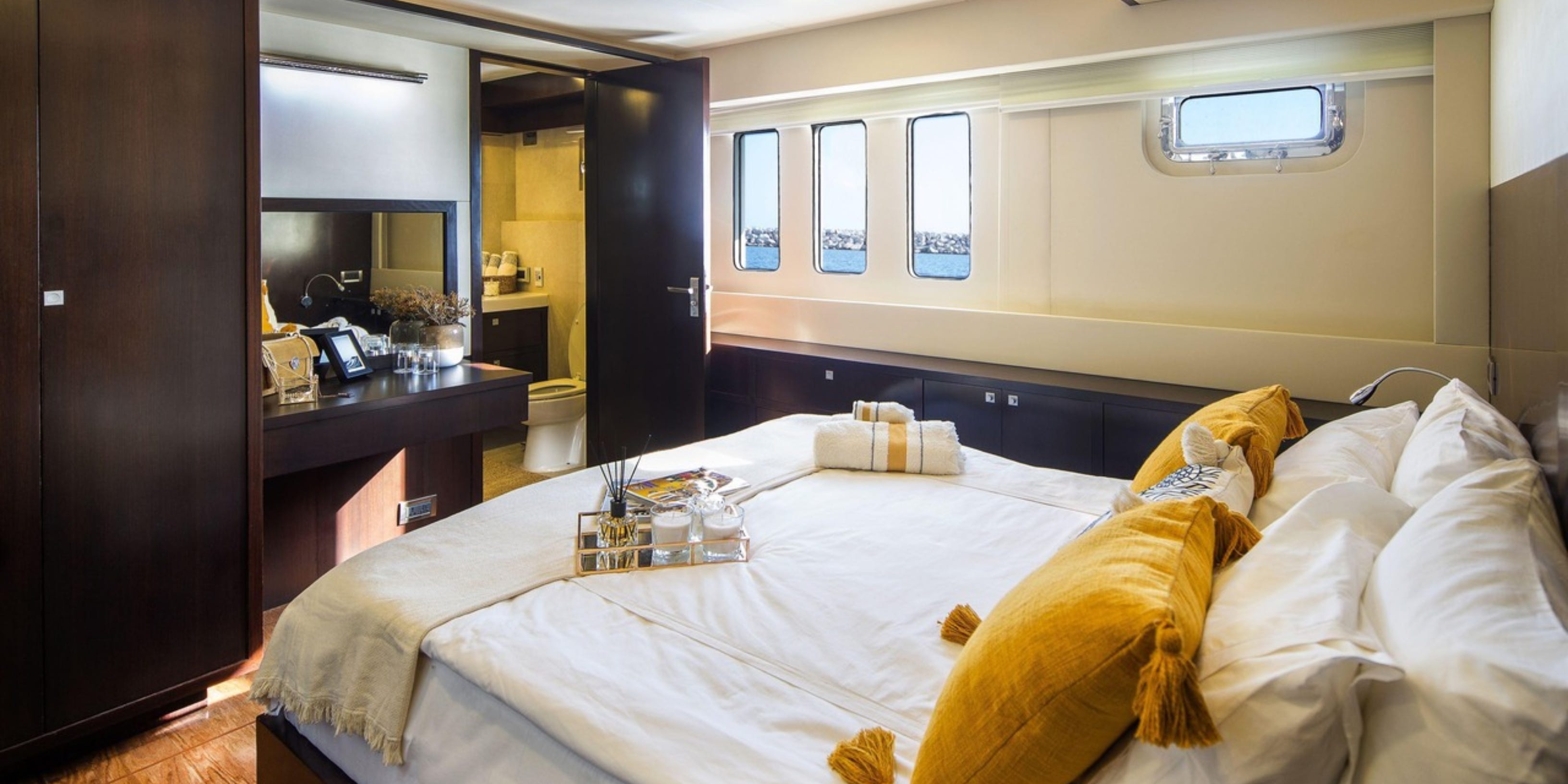
Inside, she has two staterooms, a crew cabin, two heads, a Seakeeper gyro stabiliser, bow and stern thrusters, a watermaker, and a generator. She looks the part, too, with a tall bow, high, squared-off topsides above a red boot stripe, big dark saloon windows and a flybridge with generous seating.
Why I love her seakeeping
Weight is the starting point. At 97 tonnes, Dzam carries a lot of mass for a 60-footer, and her full-displacement hull keeps it down in the water rather than lifting onto the surface. That inertia keeps her from being thrown about by every short wave, and a boat like this one tends to move more slowly and predictably.
The Seakeeper adds to that. A gyro stabiliser uses a spinning flywheel to resist rolling, and it works at anchor as well as under way, which is lovely when a swell finds its way into an anchorage just as dinner goes on the table. It tames roll rather than every kind of motion.
Her CE Category A rating is the open-sea design category under the EU’s Recreational Craft Directive, intended for voyages where the wind may exceed force 8 and significant wave heights reach 4m or more, abnormal conditions excluded.
And her range
That listed range is Bering’s figure, and real results depend on weather, sea state, loading and how she’s run. The principle is simple, though: a displacement hull at a gentle speed needs relatively little power, and Dzam carries 8,700 litres to feed it. At 7.5 knots, 3,000 nautical miles is 400 hours of running, which is nearly 17 days non-stop. That means fewer fuel stops, the freedom to fill up where the diesel is good, and planning longer passages instead of hopping between marinas. I love that about her.
What “continuous duty” really means
Marine diesels aren’t sold with a single power figure. Cummins publishes ratings tying power and rpm to how hard and how often an engine works, and lists its QSB5.9 family at several outputs and speeds, each matched to a duty.
At one end is Continuous Duty, which Cummins intends for continuous-use applications with a 70% to 90% load factor, typical of ocean-going displacement vessels. At the other is High Output, for recreational boats used infrequently with variable loads, typically a 10% to 30% load factor, with full power limited to 1 hour in every 8. One is set up to run steadily all day, every day, and the other for short sprints with plenty of easy running in between.
Bering’s continuous-duty rating for Dzam’s engines, at 225hp and 1,700rpm, matches the use she was designed for: long passages at a steady cruising rpm, hour after hour. That also explains why a 97-tonne explorer doesn’t need loads more horsepower. Almost all of her 60ft sits in the water, and a full-displacement hull pushes water aside rather than climbing over it, so beyond a speed set largely by her waterline length, extra power mostly makes a bigger wave and burns more fuel.
Her hour meters average a little under 190 hours a year over 14 years. Hours alone say nothing about condition either way; they’re a planning figure, and I’d ask to see the engines’ service records alongside them.
Life aboard
Two staterooms and a crew cabin is a layout I like on a boat like this: space for the owners, a cabin for friends or family, and somewhere for a hired skipper on a long delivery or an extra berth when she’s full. Two heads keep mornings civilised with guests aboard.
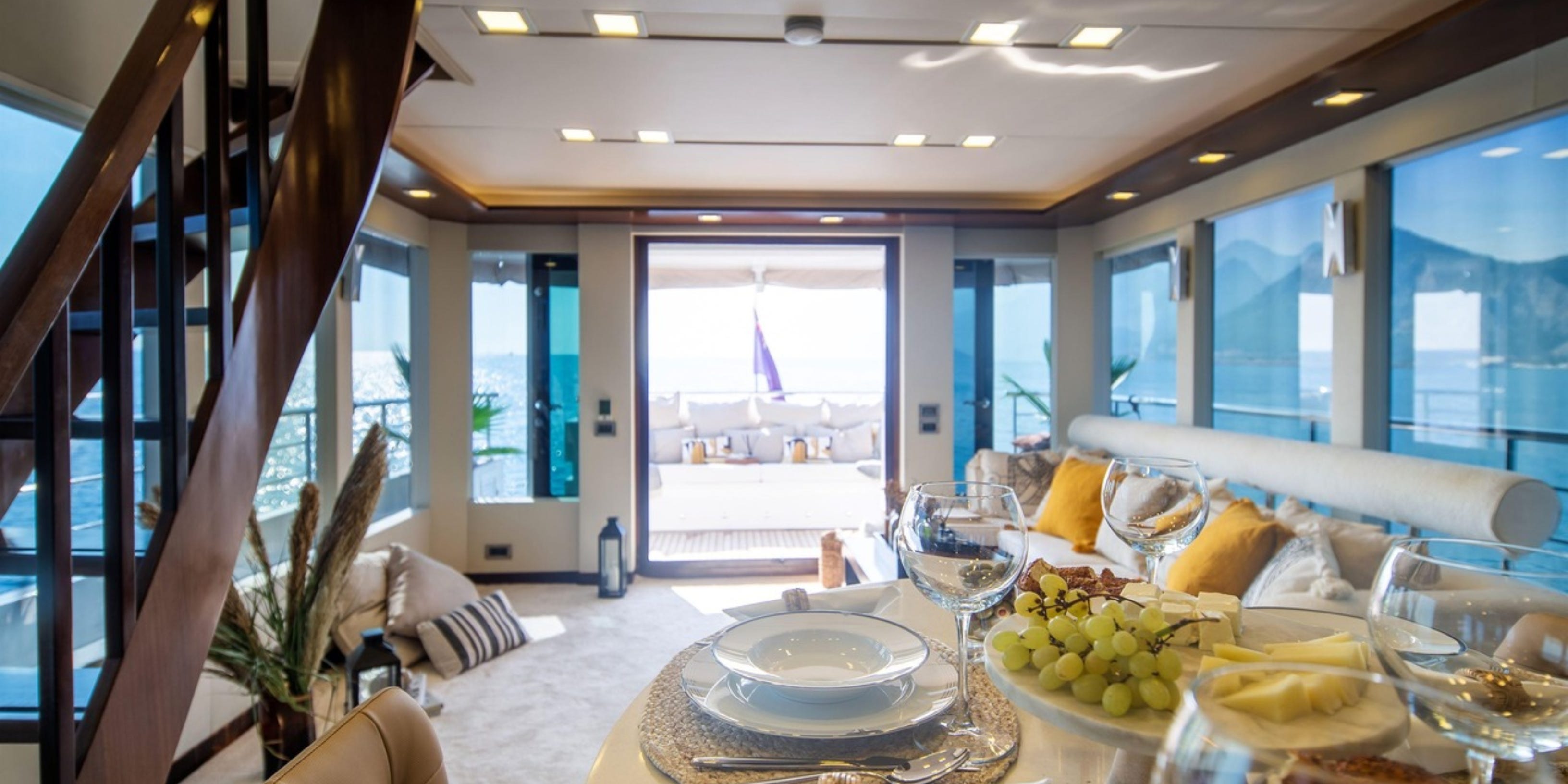
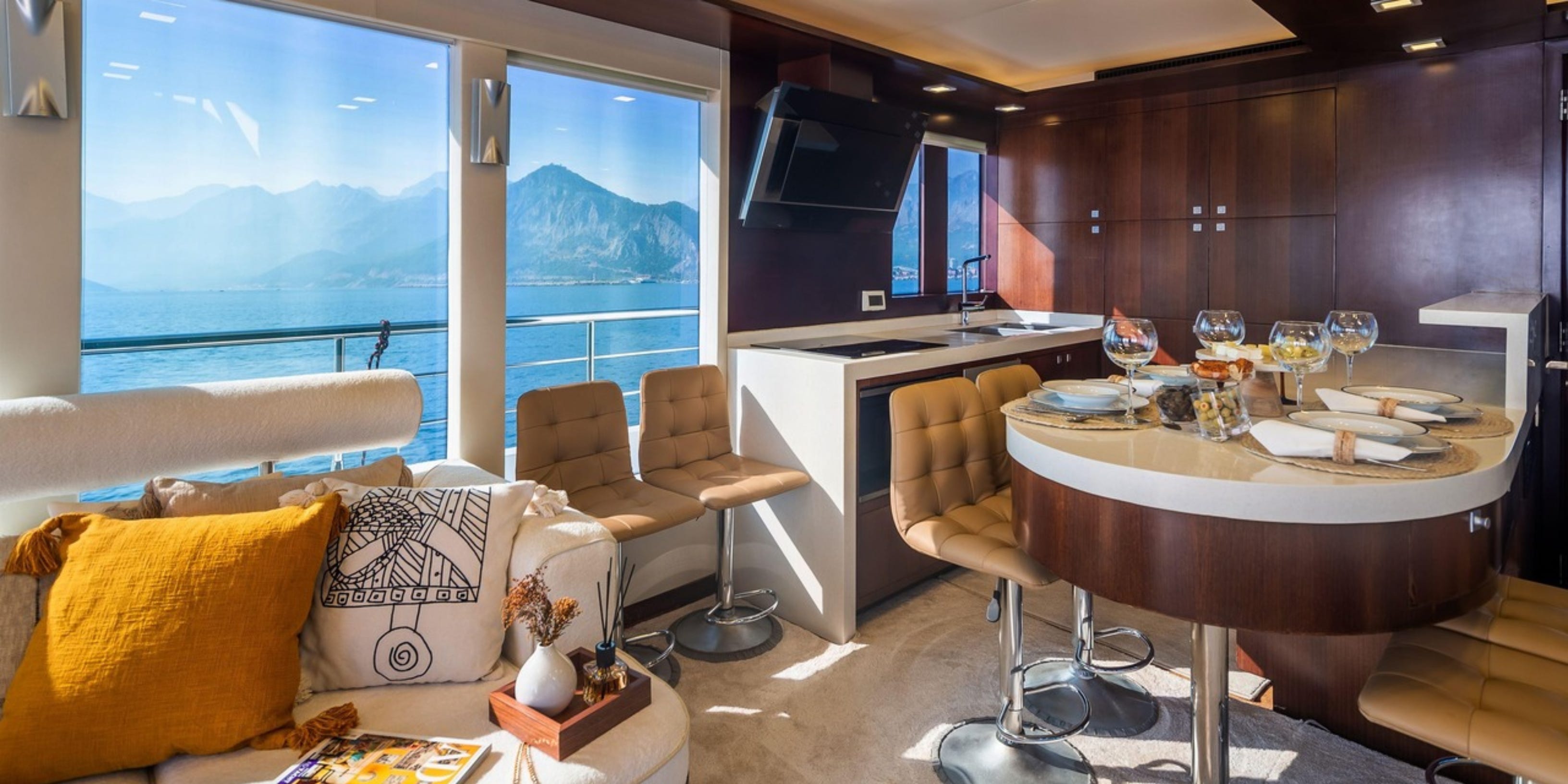
The saloon is wide and light, with big windows, pale upholstery and dark joinery, and the galley shares its space with the dinette, so whoever’s cooking isn’t shut away. It has a dishwasher, fridge, deep freezer, and microwave, plus a washing machine and air conditioning. On a boat with this much range, the deep freezer helps when you’re far from the shops, and laundry aboard means clean sheets needn’t wait for the next marina.
Her 3,785 litres of fresh water are easier to picture using the World Health Organization’s figure of about 50 litres per person per day for a home with an intermediate level of water access. It’s an illustration, not a yacht consumption figure, but on that basis a full tank would last about 38 days for two people or 19 days for four, with nothing held back. The watermaker can top it up whilst conditions and the source water allow.
Bering Yachts, the yard selling her
Bering’s story began in 2007 with a 50ft all-metal boat built in Foshan, China. Today the company has shipbuilding facilities in Antalya, Türkiye, and Burgas, Bulgaria, and its model pages run from this 60 up to a 165, alongside a family of expedition catamarans. I’ve written about the yard before, including the Bering 88 sea trials. Most of the time, a pre-owned explorer changes hands through a brokerage, so it’s unusual, but not unheard of, to find one offered by her builder.
How she compares
When I wrote about the Bering 76 ‘Lemanja’, launched in 2022, she weighed 148 tonnes and carried 22,700 litres of fuel, with twin 404hp Cummins QSL9s, three guest cabins plus crew and a claimed 4,000 nautical miles at 8 knots. Dzam is a more compact version of the same idea, with about two-thirds of the weight, under 40% of the fuel, and a layout for a couple with guests.
Bering is also selling a 2022 Bering 70, ‘Levanna’, from Antalya, displayed on YachtWorld at $3,138,208 on 19 October 2026 (a converted figure that can vary). She’s 73.5ft and 10 years newer, with four guest cabins, four heads and twin 200hp John Deere engines, yet she’s listed with 2,076 US gallons of fuel to Dzam’s 2,300. Levanna suits a bigger group, whilst Dzam puts Bering’s long-range thinking into a more compact package for roughly a third of the money.
Which brings me back to how a buyer could finance a boat like her.
This article continues below, in “The Wardroom”
A big thank you to every premium subscriber, whether you’ve been here for years or joined this week. You keep both the YouTube channel and this publication going, advert-free, and make it possible for me to keep writing about and filming boats like Dzam.
In the premium section, I cover:
- How a buyer could finance a boat like her, with a worked deposit and loan example on her $1.1m price
- What lenders look for in a 14-year-old yacht lying in Turkey, including age limits, living aboard and the UK and US differences
- The money beyond the price: survey, getting her out of Antalya, import VAT and duty, fuel, berthing and her range with a reserve
- My honest assessment: who she suits, what she asks of an owner and what I’d ask for as a buyer’s rep
How you could finance a boat like her
Whether a lender will finance her is each lender’s call, and her age, location, and where she’ll live next all shape the answer. I’ve done the research, so you don’t have to…[article continues below]
