If you subscribe to this newsletter (rather than being forwarded this article by a friend), then you will already know that I have written about loads of Dutch steel motor yachts. Each time I see a new listing for a boat that looks like a working vessel, I always tend to ask the same question: is this a conversion or a purpose-built private vessel, with commercial lines?
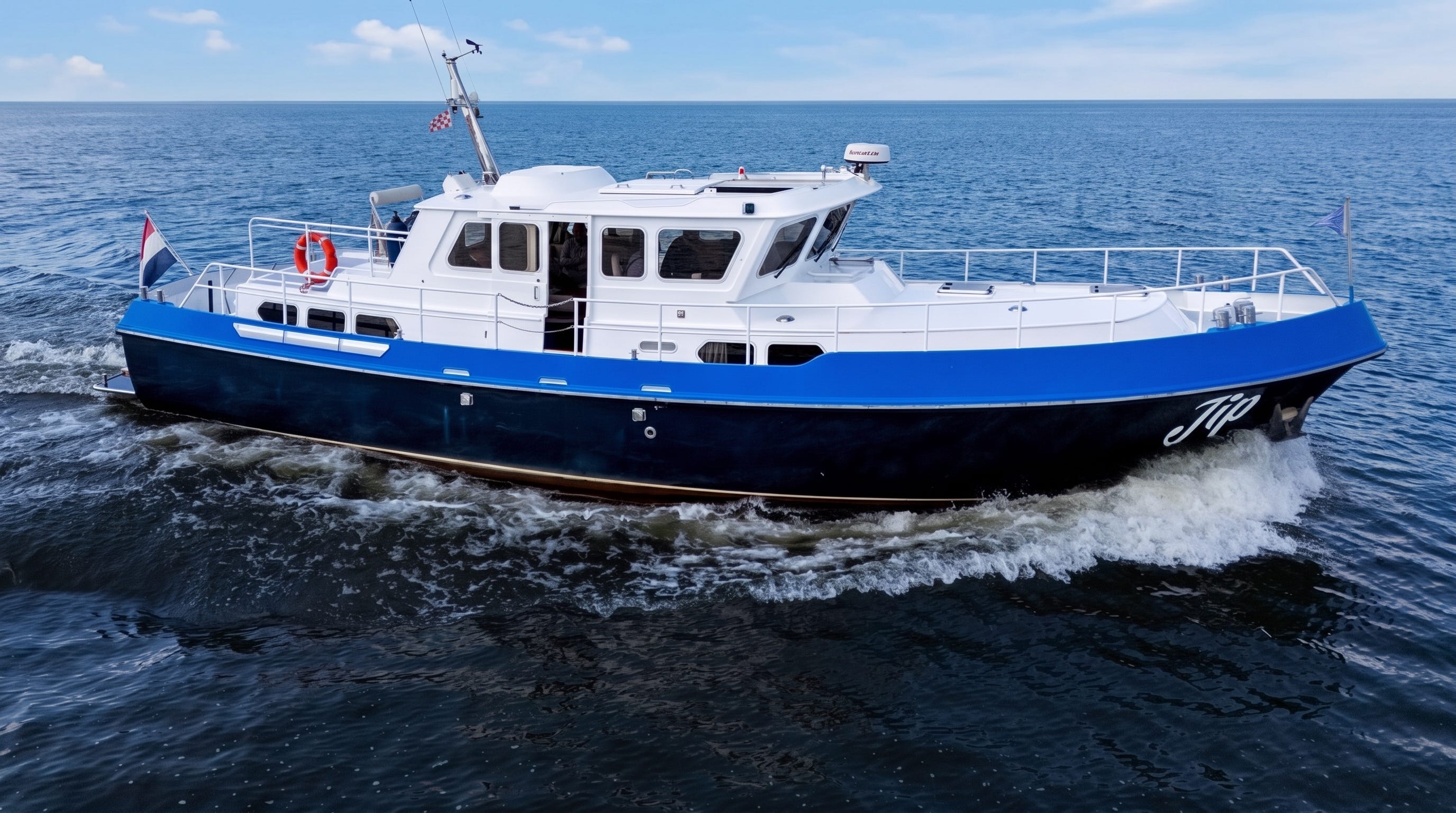
‘Jip’, the boat featured in this write-up, is the second kind, and it is the sort of vessel that I absolutely love. And, judging by the feedback that I get from my followers, these purpose-built commercial-looking boats are becoming even more popular.
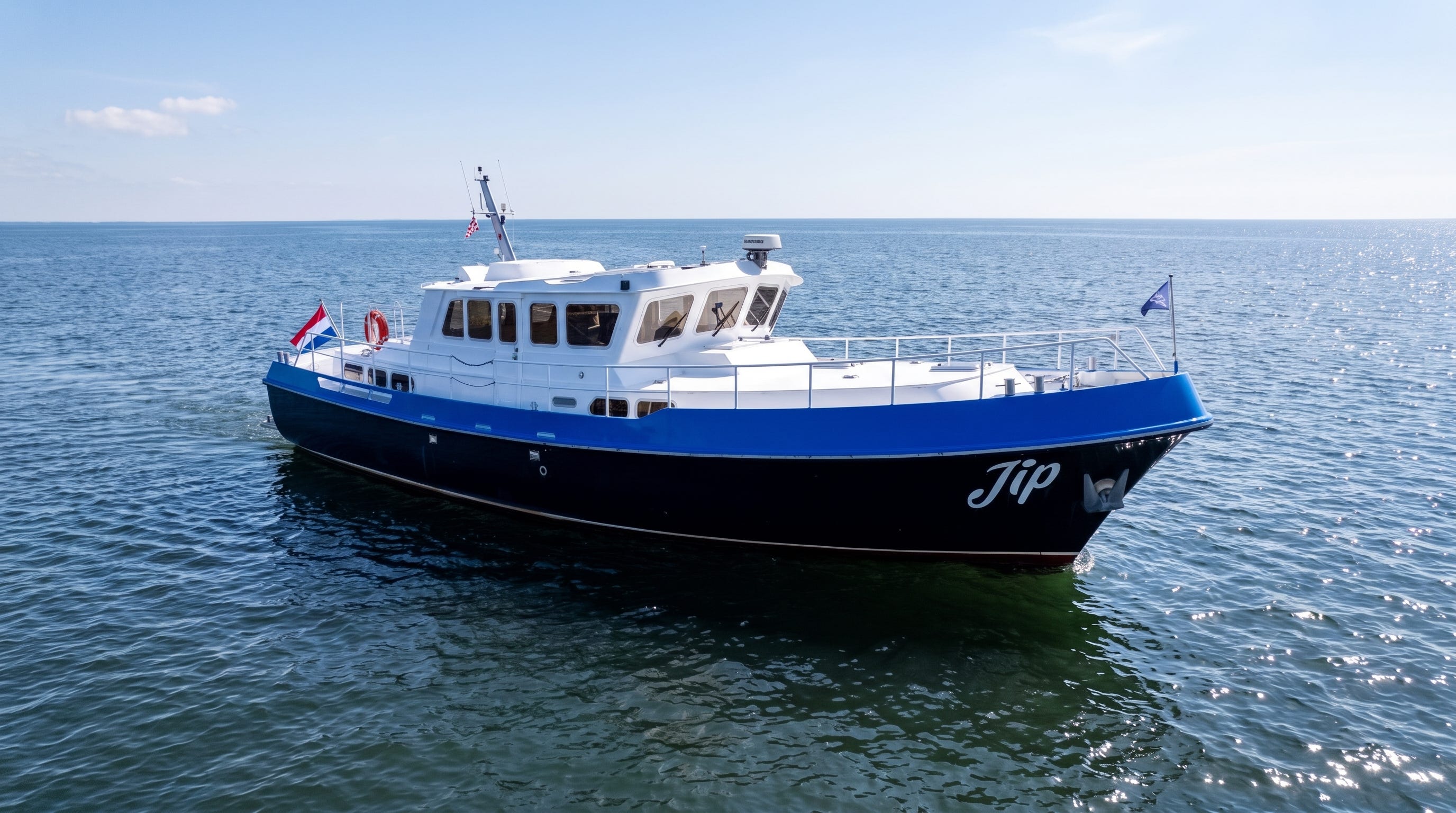
She is a Noorderlicht 50 Spiegelkotter and was built in 2005 to a design by the well-known Dutch naval architect, Willem Nieland. And have exchanged many messages with Willem over the last few years about lots of his designs, and, judging by what he has got on his drawing board, more and more boat owners are embracing his unique design philosophy.
At the time of writing this piece, ‘Jip’ is currently listed for sale in the Netherlands for €235,000, VAT paid.
If you are unfamiliar with the name ‘Spiegelkotter’, then let me break it down for you. “Spiegel” is Dutch for mirror, which in this case I believe refers to the flat transom that has defined Dutch coastal and inland cargo Kotters for centuries.
“Kotter” is the Dutch word for this working-boat type and has always been used for fishing or coastal bulk carriers operating around the Dutch coast and through the IJsselmeer and Wadden Sea.
The mirror stern goes back further in time, originating in the 18th-century spiegeljacht, which was a private pleasure yacht often acquired by well-off Dutch citizens who wanted an enclosed cabin, but without the wait or cost of a larger vessel.
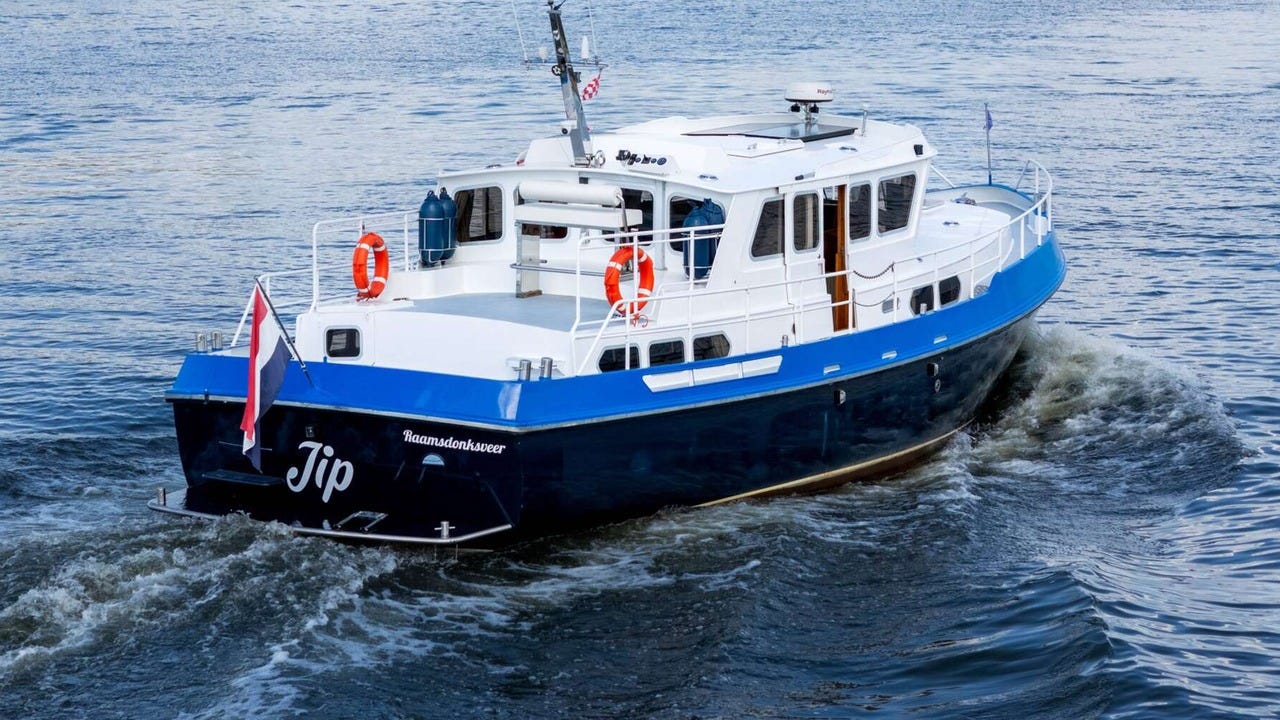
The flat transom allowed designers and builders to fit a spacious ‘pavilion’ at the stern, and the full-beam owner’s cabin behind a vertical mirror (you will often see these in the walkthrough videos on my YouTube channel) is what today’s modern version of the spiegelkotter is still renowned for. It is one of the oldest ideas in Dutch yacht design, and it has never really gone out of fashion.
Despite her lines, ‘Jip’ was never a former worker boat, forced into retirement and then converted into a private motor yacht. She was purpose-built new, in steel, with an LOA of 14.99 metres. Willem drew her with those traditional lines because that is still what a lot of European and, increasingly, North American, buyers want.
The owner who commissioned her build decided that the round-bilged, steel hull with the mirror stern was still the best design choice for their cruising needs. However, I would guess that nostalgia also played a big part in her design philosophy.
Her steel hull was expertly welded by a small yard called ‘KBS’ in Koudekerk aan den Rijn, South Holland. When I looked online, I could not find a website for KBS, which is not really that unusual for a small Dutch boatbuilder where most of their work is from word of mouth or existing clients.
Many of these build projects start their lives as a casco, a bare welded hull, and then get finished by another yard.
In Jip’s case, that ‘another yard’ was her owner. A former listing described the work that was carried out on the boat as “afwerking in eigen beheer”, which Google Translate informs me means ‘fit-out managed in-house’. That owner clearly knew exactly what they were doing.
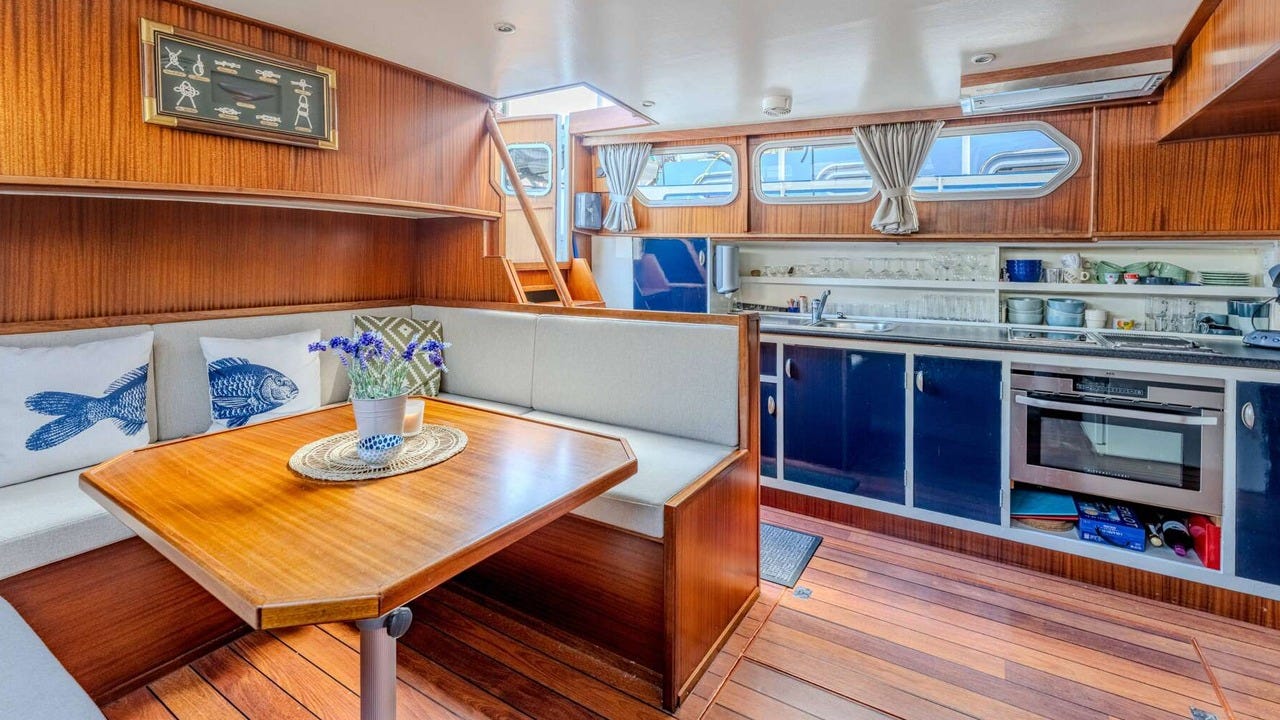
‘Jip’ is fitted with Corian worktops in her galley, Miele appliances and a full Raymarine nav suite. I have never met so many people in a relatively small country who understand boat building better than the Dutch. For many Dutch people, boatbuilding is a part of their DNA.
Willem has been drawing and designing boats for over 30 years, spanning aluminium expedition vessels under the ‘Globemaster’ name (I have featured two on my channel, M/Y ‘Borr’ and M/Y ‘Yeti’ - both now sold). Willem has also collaborated with an Antwerp-based design studio on a boat called ‘Firmship 42’.
I do not think that Willem would mind me saying that the spiegelkotter is very close to his nautical heart. He still sells a current version of this concept designed (in his own words) so that an owner can safely choose the ‘more adventurous’ waterways.
Indeed, Jip is an earlier take on that very idea. Slightly beamier and with a deeper draft than his current design, and single-engined (many of his newer boats run twin engines).
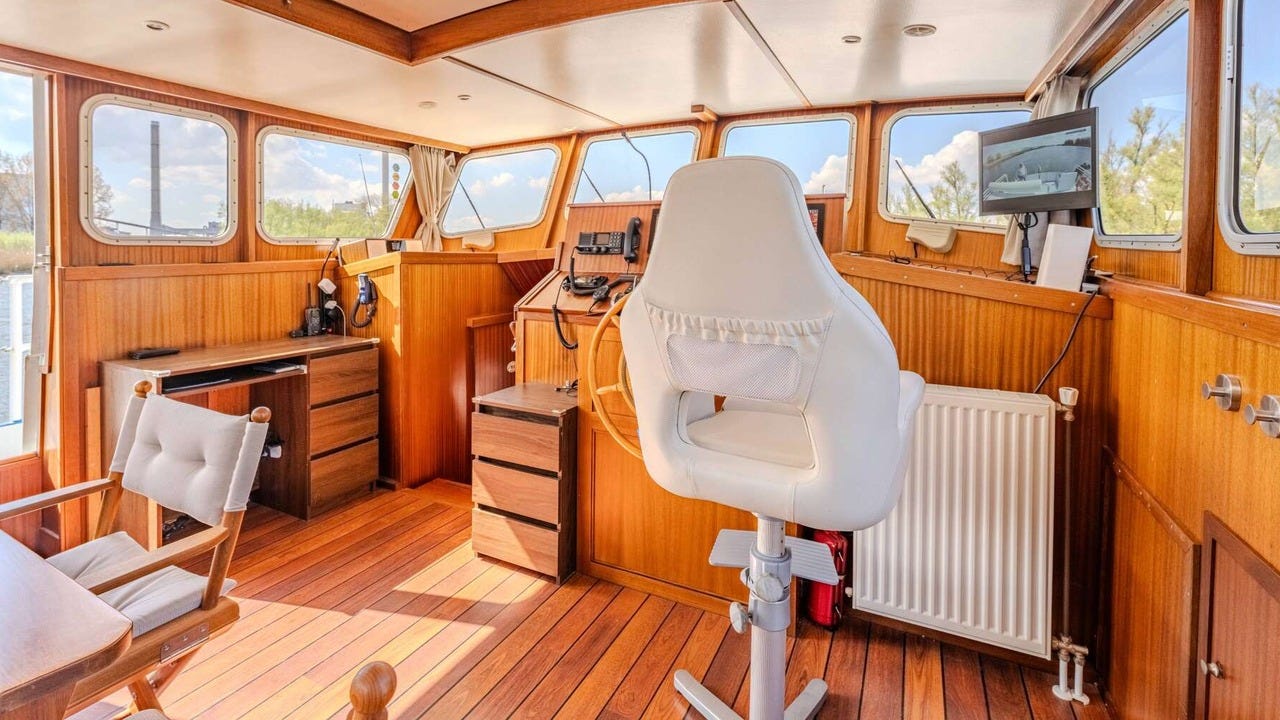
I had a look on the internet and found that Jip is not the only Noorderlicht out there. The first hull off this design, Brandaris, was built in 2002 by a different yard, Jachtbouw Noorderwind in Stadskanaal, and has since had a full refit.
She is also currently listed for sale, through a different Dutch broker, at €325k, so nearly €100k more than what Jip is asking for. I will come back to what that difference buys you, because it is perhaps the most useful number in this whole story.
Jip has a paper trail that almost went off the radar. Back in Feb 2021, a Dutch brokerage called Kempers Watersport listed what is, spec for spec, the same boat. Built in 2005, the same DAF 1160 engine at 158hp, the same Mastervolt Whisper 6000 generator, the same two-cabin, six berth configuration.
Dutch boating site BootAanBoot also featured her as their “Video of the Week” in the same month and praised her as a fantastic family boat. They echoed the sentiment that the engine is well known for its great reliability and very long service life.
From what I could see, that listing is gone now, along with any reference to the price that she carried at the time. The only reason I am sharing this with you is that the text did actually survive in a search engine’s cached index in the form of a few sentences in Dutch, describing a boat that, on paper at least, no longer exists.
Somewhere around 2021, she evidently found a buyer and is now back on the market (link to broker’s website can be found below).
But what does that shallow, mirror-sterned hull buy an owner? Here is a useful number: a draft of just 1.3 metres...
Most steel yachts of this size typically draw between 1.4 and 1.8 metres. When you combine that with a minimum air draft of 3.2 metres, which is achieved by lowering her mast electrically, then you will find that this boat can get into places many of her contemporaries cannot.
The provincial Dutch canal network, the wide but shallow IJsselmeer and, with some careful tidal planning, the Frisian harbours of the Wadden Sea all become viable options for this boat when it comes to planning an itinerary.
Below her decks, she sleeps a total of six people across two cabins. The owner’s cabin has an en-suite bathroom and a full-size double bed. The guest cabin has a double plus a stacked bunk, so you are getting a clever layout that works well for when the family or friends come and stay on board.
As mentioned before, the galley has a Corian worktop and a Miele fridge/freezer. Hot water runs off a 220V system, and the electrical installation spans 12V, 24V and 220V throughout.
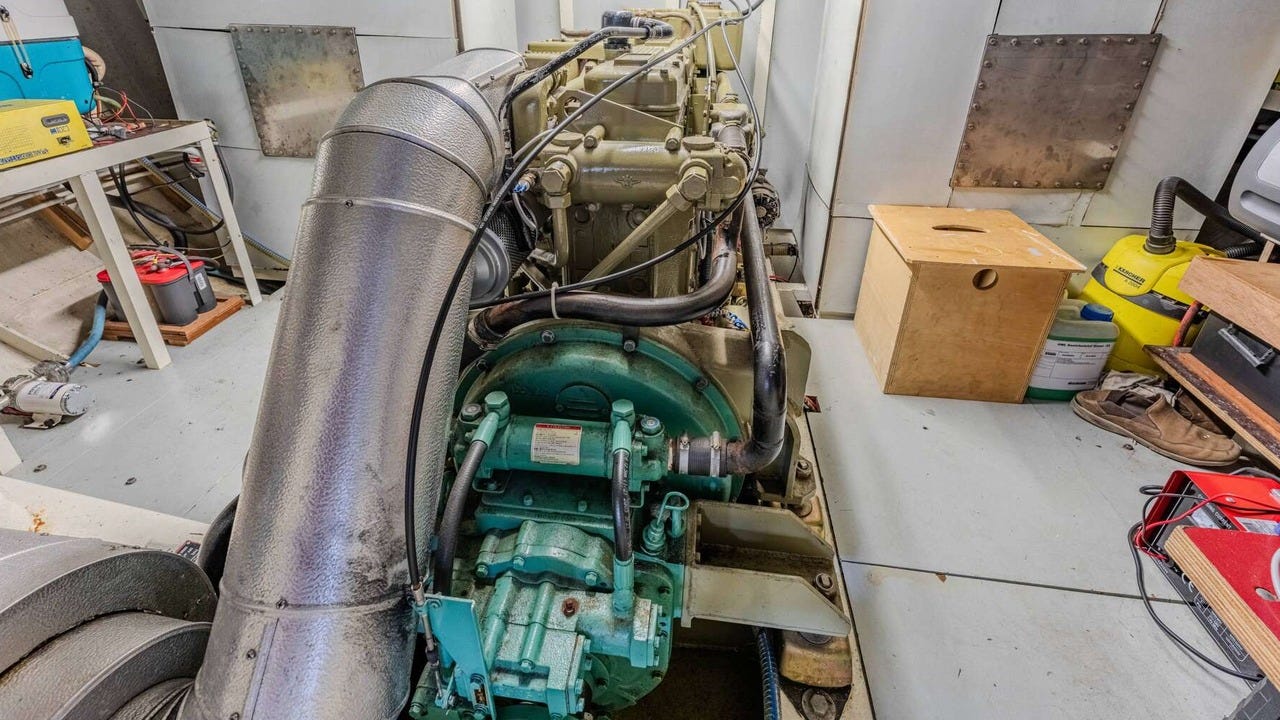
Power comes from a single DAF DK1160 MG diesel (158hp/1116.29kW) driving a fixed prop through a stainless steel shaft on hydraulic steering. The DAF 1160 family of engines has a good reputation. They began life as a Leyland design that DAF developed and enlarged under the licence, and the same 11.6 litre six-cylinder block powered DAF’s own trucks and buses through the 1970s, 80s and 90s before they were marinised.
A heavy and robust industrial truck engine of which tens of thousands were built means that they are still very much understood by both owners and marine mechanics who still work on them decades later. Many specialists in the Netherlands still stock parts and recondition units for this family of engines today, alongside an owner-run barge association that still hosts the full factory manual completely free of charge.
This boat also carries a Mastervolt Whisper 600 generator, a Victrom Qauttro inverter-charger and battery monitor and solar panels. So, a sensible spec for a boat that was built to be used a lot.
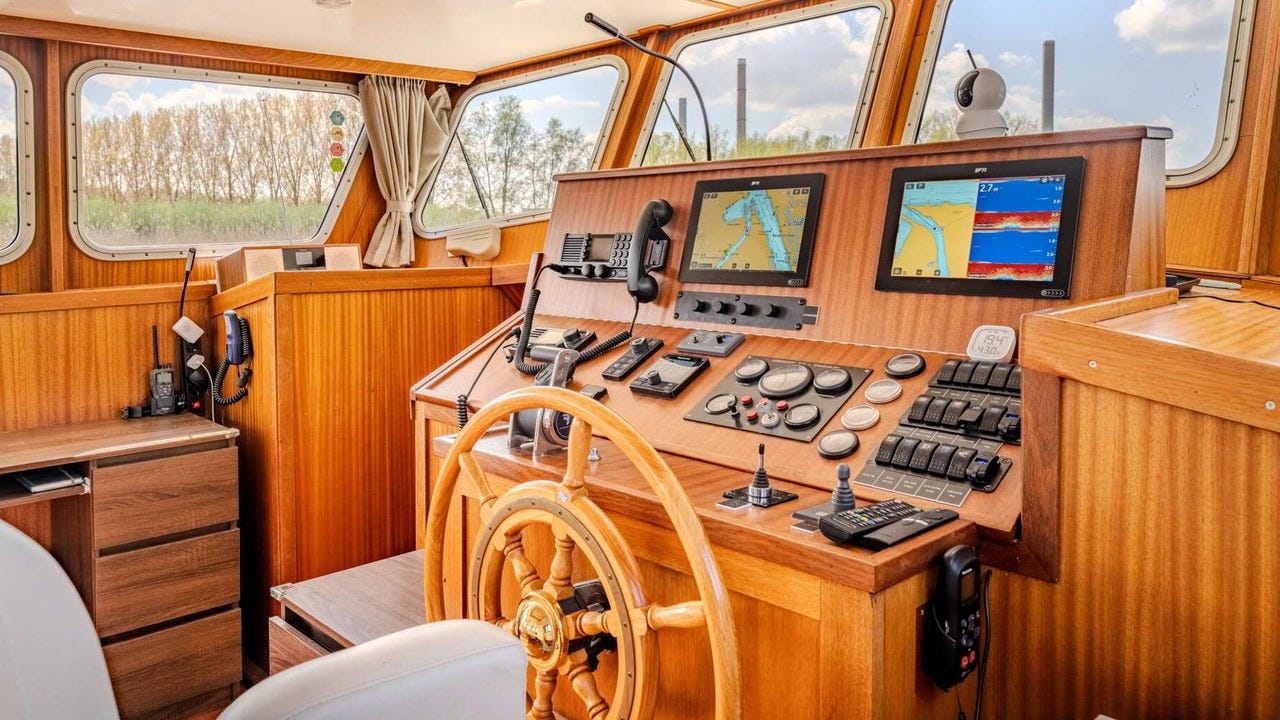
Her digital nav suite comprises a full Raymarine suite, backed by dual VHF sets and an AIS transceiver. But for me, the beauty and functionality of this boat comes with her naval architecture and trawler-style lines. Those are what drew my eye to this boat, along with her very reasonable asking price.
This article continues below, in “The Wardroom”, which is the premium section of this newsletter. It is thanks to my premium subscribers that I can travel around filming boats for my YouTube channel. So, if you do become a premium subscriber, then you are very much a part of the Yacht Buoy network.
In the premium section, I cover:
- The €90,000 question: what actually separates Jip from her professionally built, refitted sister ship Brandaris, and whether the gap is money well saved or money you will end up spending anyway
- The owner-completion risk: what “afwerking in eigen beheer” really means for a buyer doing due diligence, and the survey questions I personally would be asking.
- The DAF 1160’s real-world running costs: parts availability, what a truck-derived marine block actually costs to keep alive in Europe today, and where that leaves you against a more common marine-specific diesel
- My honest assessment of the €235,000 asking price: how it stacks up against three comparable Spiegelkotters currently on the Dutch market.
- Range & Speed assessment: Based on what we know about this boat, I work out her estimated range, cruising speed and top speed