

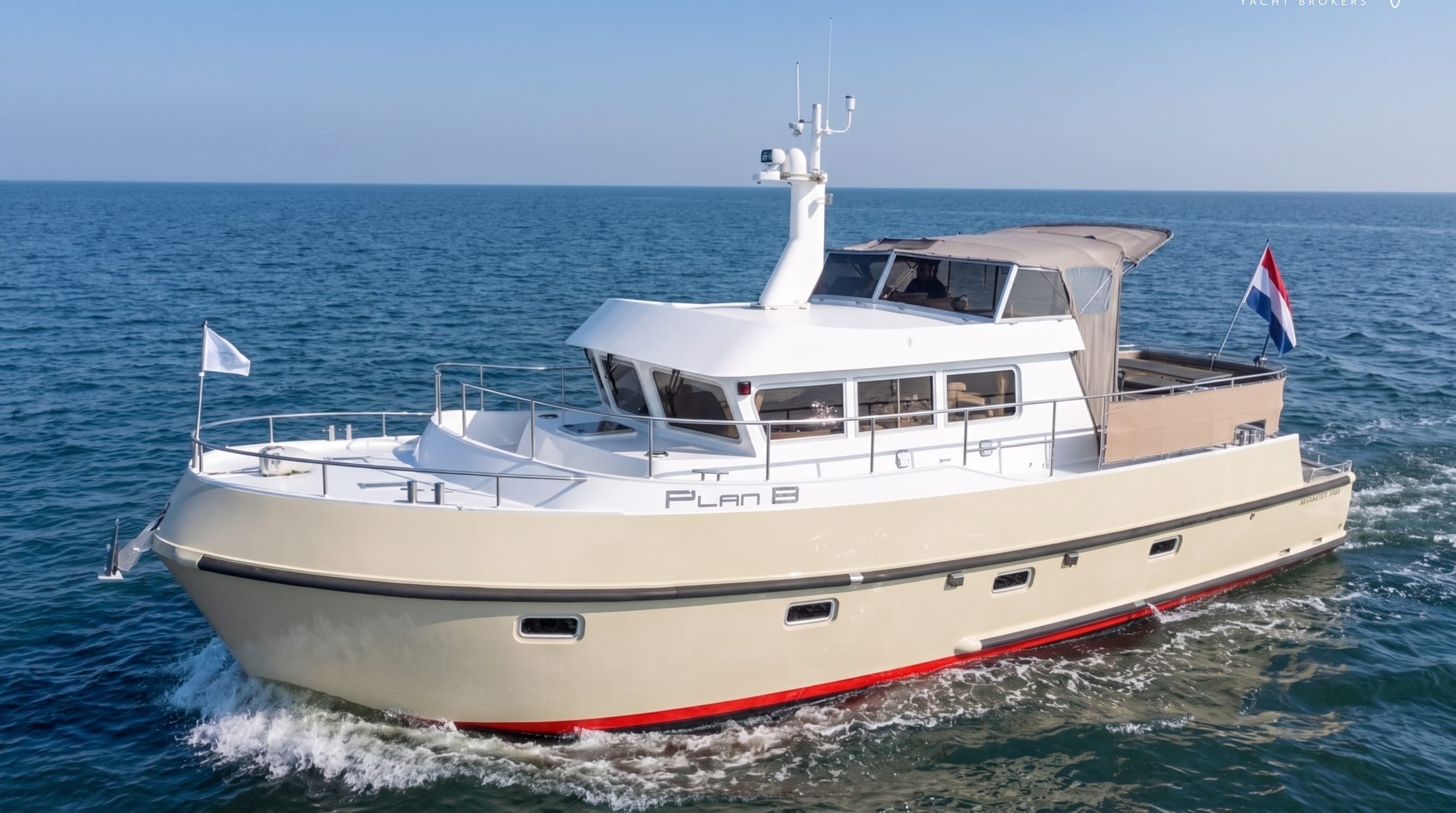
I get contacted by designers and builders fairly often once a video goes out, usually a friendly note or a correction on some detail. This time was a bit different. A man called Jos van den Enden got in touch and told me he designed this exact boat.
He runs Azza Yachting BV, a Dutch maritime design and development business with an impressive track record. He says this particular trawler was his own special design, built at a shipyard he ran himself and created to see how much extra usable living space he could design into a hull of this size, and that only three of them were ever built, this being the enlarged version.
She’s a genuinely good looking trawler-style motor yacht in her own right, which is exactly why that email pulled me back to her for a second, much deeper pass.
I don’t live in the US or Australia myself (I live in London), but a huge number of you do, and after nearly every trawler video I get asked the same question: could I actually bring one of these home? So alongside the designer’s story and every technical system aboard, this piece includes real numbers on what it would cost to ship her to either country.
If you have not seen the full boat tour video yet, then I have added it below.
The Boat Herself
This is the Ebyca Trawler 1300, currently named ‘Plan B’, built in 2011, lying in Drimmelen with Sterkenburg Yacht Brokers (link below). At 13.00 metres long with a 4.10 metre beam and a genuinely shallow 1.05 metre draught, she is the smallest boat I filmed on that trip, and in some ways the most quietly clever.
She is a multi-chine steel trawler, which in plain English means her hull is built from several flat panels welded together at angles, rather than one continuously curved shape.
Dutch trawler-style yards have leaned on this hull form for decades, and it earns its place on genuine seakeeping merit rather than just tradition. The flat panels give her strong initial stability, so she sits steady and doesn’t roll around alarmingly at rest, at anchor, or alongside, which matters enormously if you’re aboard her for anything longer than a weekend.
The hard chines also act a bit like built-in spray rails, helping to knock down and deflect spray forward rather than letting it climb the topsides in a head sea. And because the hull is built from flat panels rather than continuously curved plate, she is a genuinely straightforward hull to survey and maintain over her life.
What amazed me stepping aboard was how much boat she gives you for 13 metres.
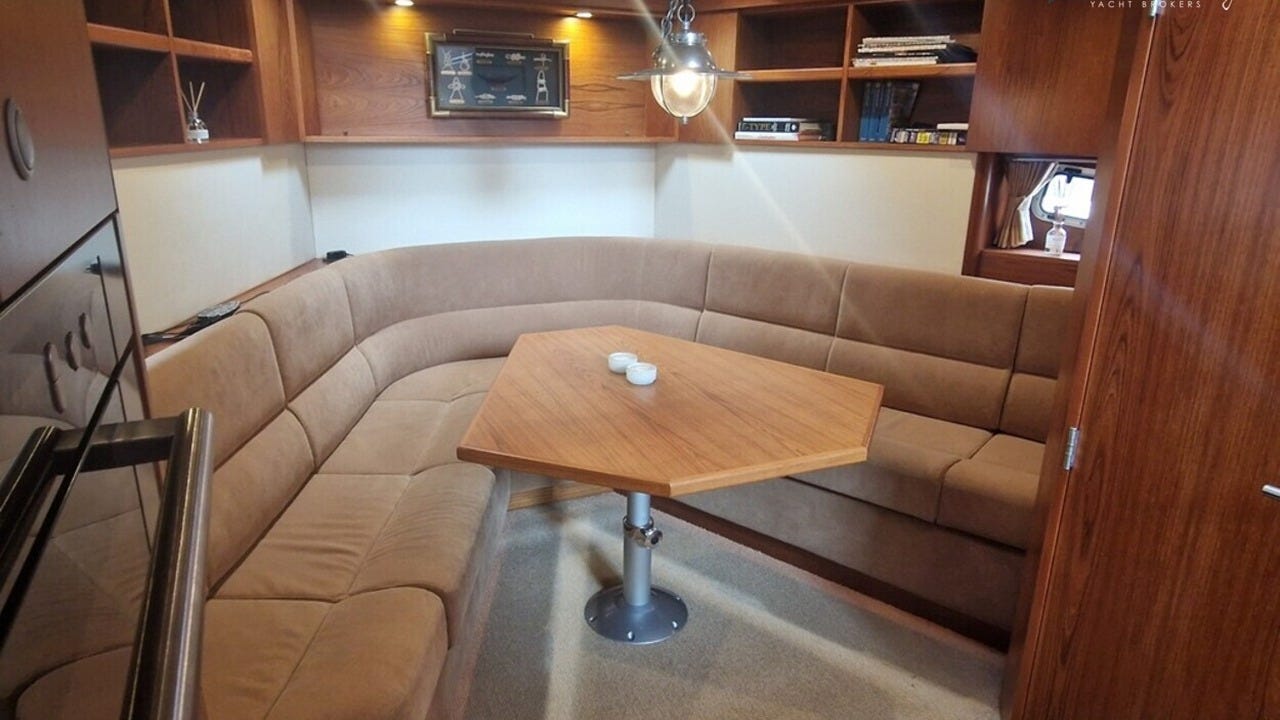
A spacious saloon, a genuinely lovely owner’s cabin, a second guest cabin with bunk beds for five berths across two cabins in total, and a second helm station out on the aft deck with an open cockpit, the kind of set-up that lets you handle her from outside when you are coming alongside rather than craning your neck out of a window.
The interior throughout is finished in teak, which gives her a warmth that a lot of modern production boats simply don’t have.
On deck and at the helm, she carries a genuinely sensible navigation and safety package for a boat this size: Simrad log and depth gauge, an AP24 autopilot, VHF, a compass, plus a Raymarine GPS and plotter.
Manoeuvring is handled by electric bow and stern thrusters, both operable by wireless remote control, and the anchor comes up on an electric winch.
Below decks she carries 1,100 litres of fuel, 900 litres of fresh water, and a single WC and shower. A cockpit cover is fitted for the aft deck, and the comfort list runs to a stereo, TV, cooker, oven, microwave, freezer, a fully fitted galley and dinette, a pressurised water system with warm water on demand, and a swimming platform with ladder.
Her underwater hull was treated again this spring, in 2026, which tells you the current owner is keeping her ready to go rather than letting maintenance slide while she sits on the market.
Displacement sits at 17,000kg, headroom at 195cm, and she draws just 1.05 metres, shallow enough for canals and drying creeks that would ground plenty of bigger boats outright.
And here is the thing Jos van den Enden wanted me to understand: this is not a standard production hull. It is a special design, and there are only three of them in the entire world.
This deep dive article continues below, in “The Wardroom”
In the premium section, I cover:
- Every technical system aboard: the VW diesel, ZF and Python drivetrain, Victron electrical system, and Webasto heating, verified against manufacturer specifications
- Her genuine liveaboard credentials: what actually makes a 13-metre trawler workable as a full-time home
- What Jos van den Enden is doing now: his current shipyards, his son’s involvement, and the design lineage this hull sits inside
- What it would actually cost to ship her to the US or Australia: real transport methods, real freight quotes, and the import duty nobody mentions until you are already committed
- The real annual cost of owning her: fuel, berthing, insurance, and engine maintenance on a single VW diesel
- My honest assessment of €269,000: what she is actually worth against the wider Dutch trawler market
Every System Aboard, Checked Against the Manufacturer
A genuine deep dive means going beyond the spec sheet, so every system below has been checked against the manufacturer’s own current specifications.
