

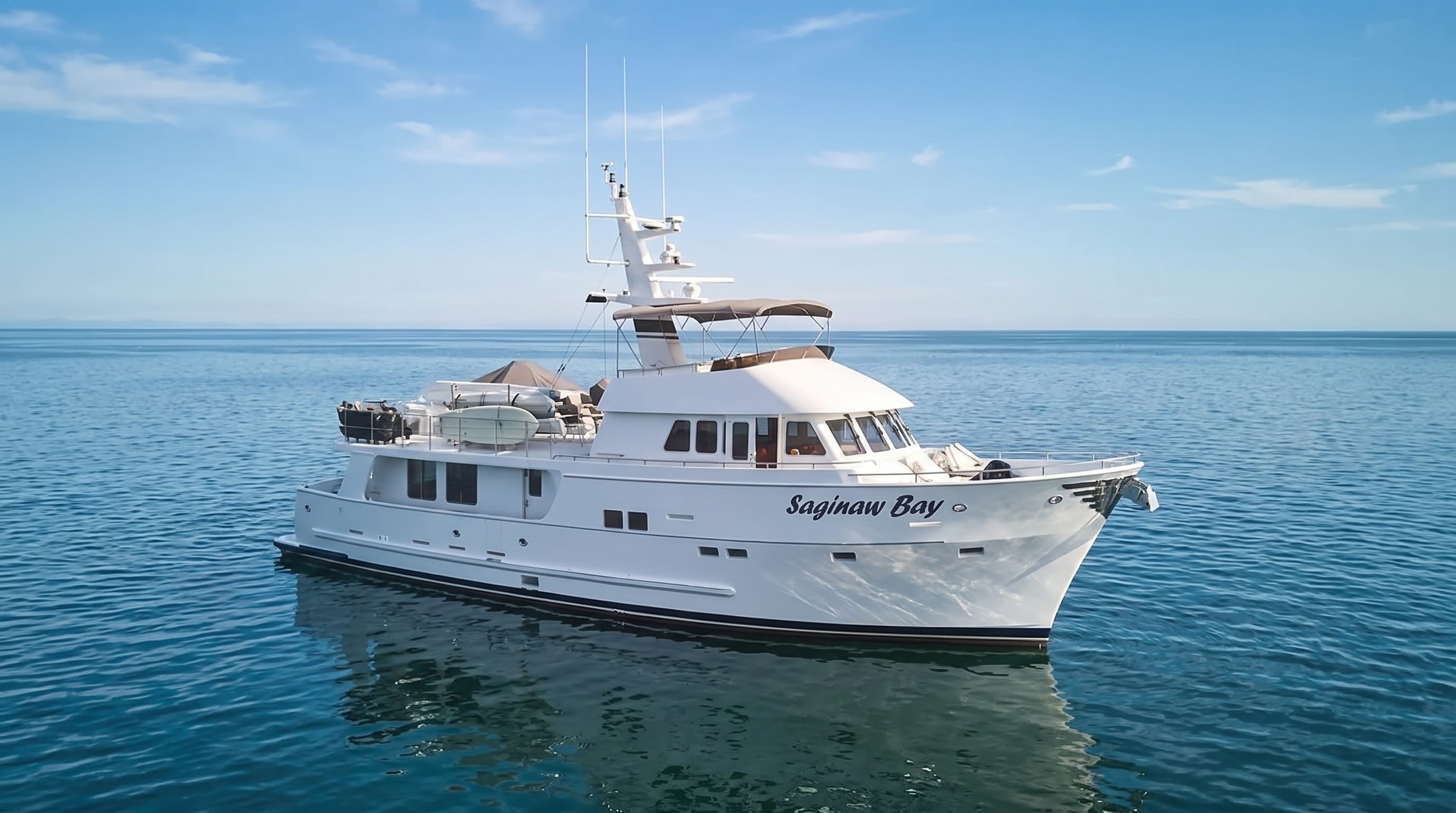
I want to start this particular article with an important number that will mean something to anyone who has spent time around this category of boat: 75-04.
That is Saginaw Bay’s yard number, and it tells you two things immediately. First, that she was the 4th hull built to this exact specification of the Northern Marine 75. Second, and more interesting, that according to the boat’s own listing, only 4 hulls were ever built to it. An 18.5-foot beam, lower freeboard than the larger 75s that followed her down the ways. Owners of these particular hulls, and Northern Marine itself, regard them as perhaps the best boats the yard ever produced.
For reasons which I am sure you will understand, that is not the kind of claim I take at face value. But by the time you have read the rest of this piece, you will understand why it holds up…
The Vessel
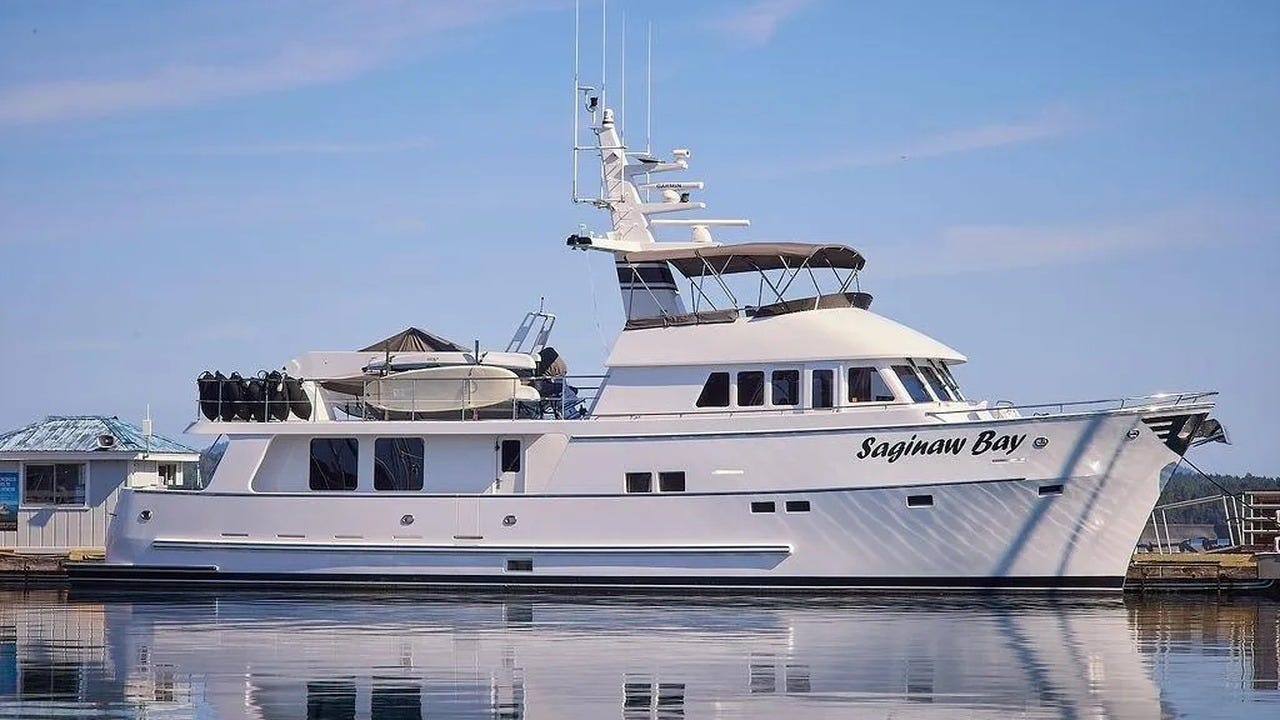
Saginaw Bay is a 2000 Northern Marine 75, 75 feet and 4 inches LOA, with an 18.5-foot beam and a 7-foot maximum draught. She is asking $3,199,000, listed with LC8 Marine (link below), and currently based in Seattle, Washington, on a 100-foot slip.
She is a one-owner boat for 22 years. Built in Anacortes, Washington, and delivered to her first owners in 2000, she stayed in their hands until a private sale to her second owner in 2022, who has since completed a comprehensive electronics, networking, and systems modernisation with the stated intention of taking her worldwide.
Her hull is moulded fibreglass, built to comply with or exceed ABS rules, in a full displacement form with a bulbous bow. Of course, that bow shape is not decorative. On a full displacement hull, a well-designed bulbous bow reduces wave-making resistance at the vessel’s natural hull speed, which on an explorer yacht like this translates directly into fuel economy over long passages rather than outright speed. Saginaw Bay cruises at 10 knots at 1,600 RPM, which is exactly what a 75-foot full displacement hull of this configuration should be doing.
Propulsion comes from a single Lugger L6140AL2 diesel, rated at 700 horsepower, showing 3,156 hours. However, this is not the engine she was built with. Her first owners, a Seattle family who had her constructed from the outset and cared for her meticulously, replaced the original build engine a few years into ownership with the higher-output commercial-duty Lugger currently installed. There was, by all accounts, nothing wrong with the stock installation. They simply wanted more power and performance once they had lived aboard her for a while and understood what they wanted from the boat. That is worth noting for what it says about the kind of ownership Saginaw Bay has had: an owner who upgraded a working system rather than merely maintained it, and who kept the same hands-on boat manager and captain involved throughout construction, maintenance, and the eventual repower.
Backing that single main engine is an ABT Get Home Drive, running off either of two 20kW Northern Lights generators via hydraulic power take-off pumps. On a single-engine boat, this is precisely the kind of redundancy that matters. A pure single-engine configuration with no independent backup propulsion is a genuine consideration for anyone planning serious offshore and transoceanic passages. A single main engine paired with a hydraulic get-home drive that can run off either generator is a materially different proposition, because it means a main engine failure does not strand the vessel, it simply slows her down while she motors along on backup power.
Fuel capacity runs to 4,396 gallons across a day tank and 4 wing and lazarette tanks, giving a quoted range approaching 4,600 nautical miles. Fresh water capacity sits at 1,436 gallons, and the boat carries a 70-gallon-per-hour Sea Recovery watermaker in the lazarette with remote monitoring, which matters considerably for genuine long-range independence rather than range on paper alone.
The Builder
Here is where Saginaw Bay’s story gets more interesting because Northern Marine’s own history is a genuinely remarkable one, and it is worth understanding before you evaluate any Northern Marine hull, this one included.
Northern Marine was founded in 1995 by Richard “Bud” LeMieux, in Anacortes, Washington. LeMieux did not arrive at explorer yacht building from a design school or a marketing background. He spent more than 20 years building commercial fishing vessels and small workboats at Delta Marine in Seattle before starting his own yard, and that commercial pedigree is baked into everything Northern Marine subsequently built. The yard’s first vessel, Spirit of Zopilote, a 62-foot long range cruiser, was completed in 1997 for the well-known television producer Bruce Kessler, and it set the template: seaworthy, over-engineered by recreational standards, and designed for an owner-operator couple rather than a full-time professional crew.
Over the following decade, Northern Marine built roughly 28 explorer yachts ranging from 35 to 152 feet, including the 152-foot megayacht Lia Fail (later renamed Sorcha), a genuinely world-class example of the yard’s capability at the top end. In 2007, the 80-foot trawler Julianne won Showboats International’s award for Best Full Displacement Motor Yacht Under 45 Metres, built specifically for owners who wanted a boat they could run themselves as a captain-and-wife team rather than a boat that needed professional crew to operate. Throughout this period, Northern Marine was also one of the first North American yacht builders to adopt resin-infusion composite construction, a technique that improves the strength-to-weight ratio of a fibreglass hull and superstructure, ahead of most of its competitors.
Then came the difficult years. The 2007-2009 recession hit the yard hard, as it hit most American builders of this type, and Northern Marine passed through a succession of ownership changes. In 2011, a former Northern Marine employee assembled a team that licensed the brand and resumed building, but a launch incident involving a 90-foot hull, unrelated to the design or construction quality of the vessel itself, slowed the yard’s post-recession recovery further. In 2015, a Northern Marine customer named Jay Bernstein, who had a 57-footer under construction at the yard at the time, acquired a controlling interest in the company. Bernstein’s own boat, Agave, launched in early 2017, and he set about steering the yard forward with renewed investment.
Got a boat?
Know of a vessel, for sale, charter, or otherwise, that you would like me to feature in a future dispatch? You can send me a direct message or email me via john@yacht-buoy.com
Then, in November 2018, misfortune struck again. Bernstein died in a mountain biking accident.
That could easily have been the end of the story. It was not. Northern Marine’s core team, the highly skilled craftsmen and the design, engineering, and project management staff who had stayed through every ownership change, remained intact throughout. When the opportunity arose to acquire the yard’s assets, Peter Whiting, managing partner of Seattle Yachts, did not hesitate. Whiting was already an established trawler yacht builder and broker in Anacortes through the Northwest line, well acquainted with the Northern Marine team and their work, and he understood exactly what a small semi-custom shipyard offers buyers that a large production builder cannot. Seattle Yachts acquired the brand, the intellectual property, the existing tooling for several hull and superstructure sizes, the yard facility itself, and two hulls already in progress.
That acquisition holds today. Northern Marine currently builds three model lines: the 57 Raised Pilothouse, the 64 Raised Pilothouse, and the 70 Expedition Yacht, available in either forward or aft pilothouse configurations. All three sit within what the company itself, and the wider market, regards as its genuine sweet spot: domestically built, full displacement expedition yachts between 50 and 90 feet. Over more than forty builds across three decades and three separate ownership eras, Northern Marine has weathered a recession, a launch incident, and the tragic death of an owner who believed in the yard, and it is still building boats in the same Anacortes yard today.
Saginaw Bay comes from the earlier era of that story, the period when a small, commercially minded yard built boats to individual owner specifications rather than a fixed model line, before the current 57/64/70 range settled into place. Given that only 4 hulls were built to her exact specification, and that both owners and the yard itself regard those particular hulls as among the best Northern Marine ever produced, she represents a genuinely narrow window into the yard’s original, most hands-on production period.
Life Aboard and Recent Investment
Saginaw Bay has spent her ‘working’ life predominantly as a Pacific Northwest cruiser, based out of Seattle, and the November 2025 survey confirms her as being in excellent condition with all maintenance current.
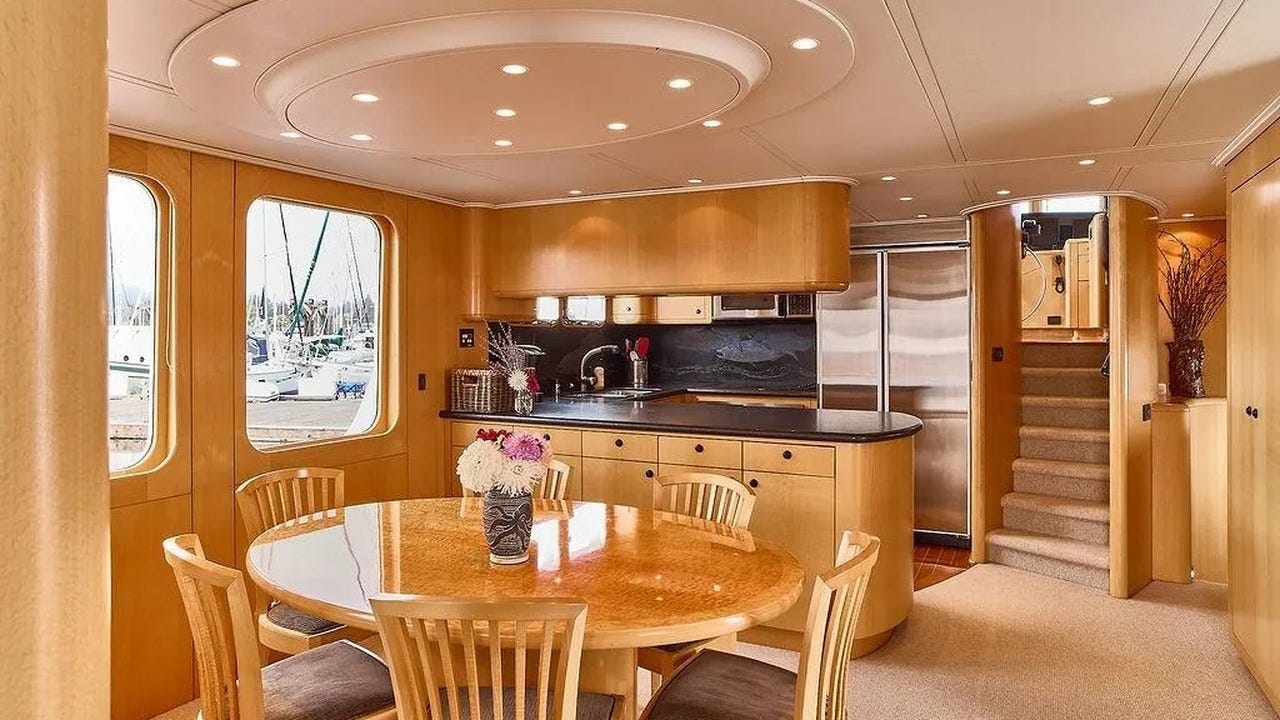
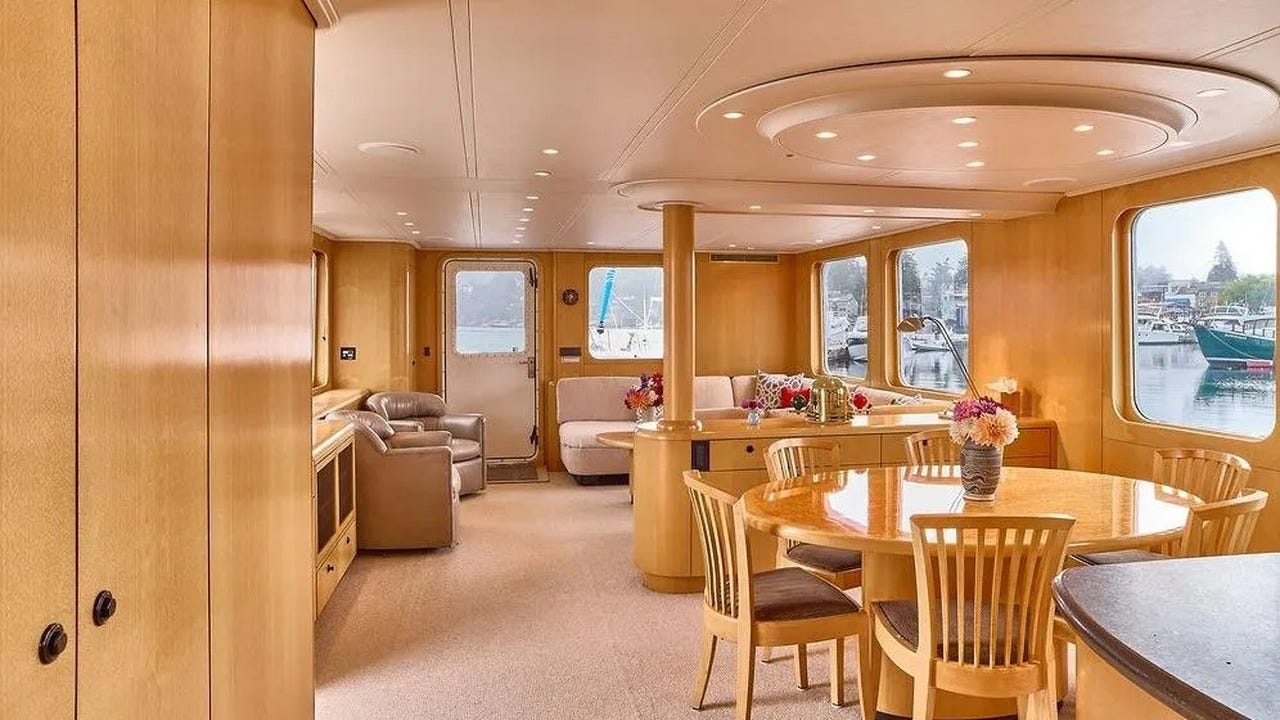
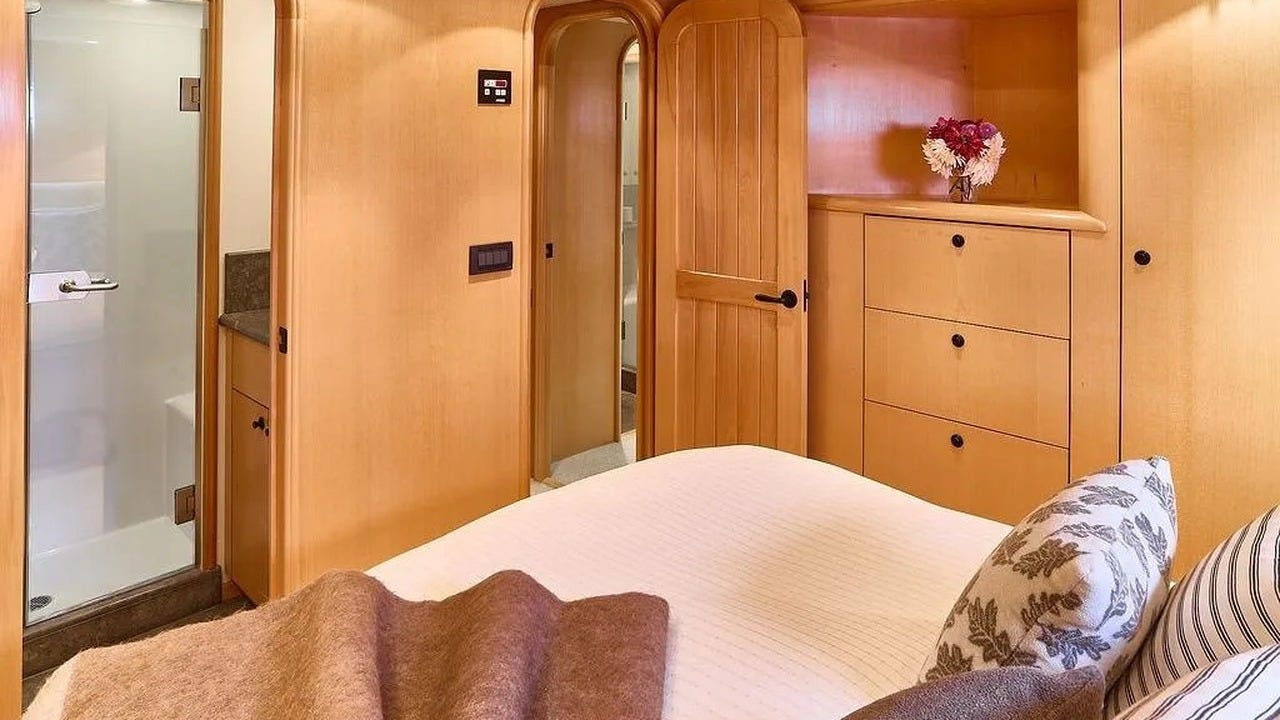
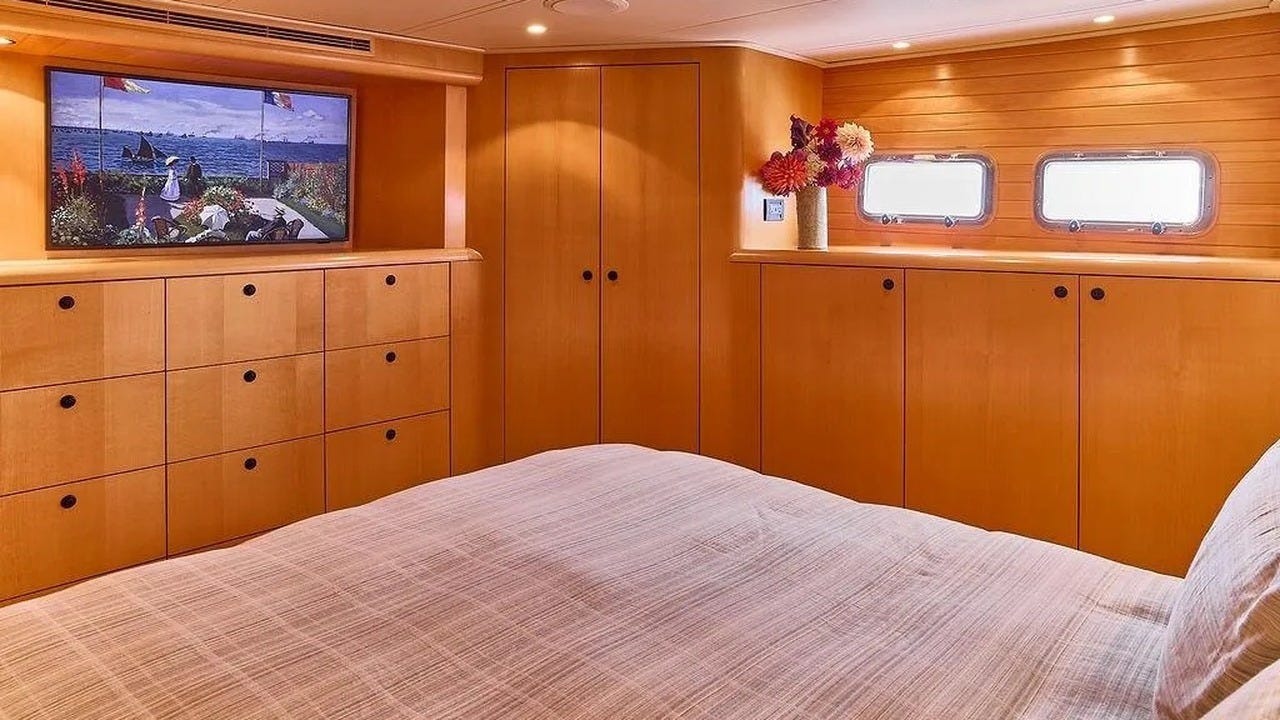
She carries 4 staterooms and 4 full bathrooms, plus a fifth half bathroom in the cockpit, laid out across a portside flushdeck design that opens up the interior living space without sacrificing the operational deck access that a working expedition boat needs. The saloon combines a U-shaped seating arrangement with an 8-person dining table, a large kitchen with dark honed granite counters, and full-height storage. All 4 staterooms are finished with bookmatched cherry joinery, and the owner’s suite sits on its own private level directly below the pilothouse.
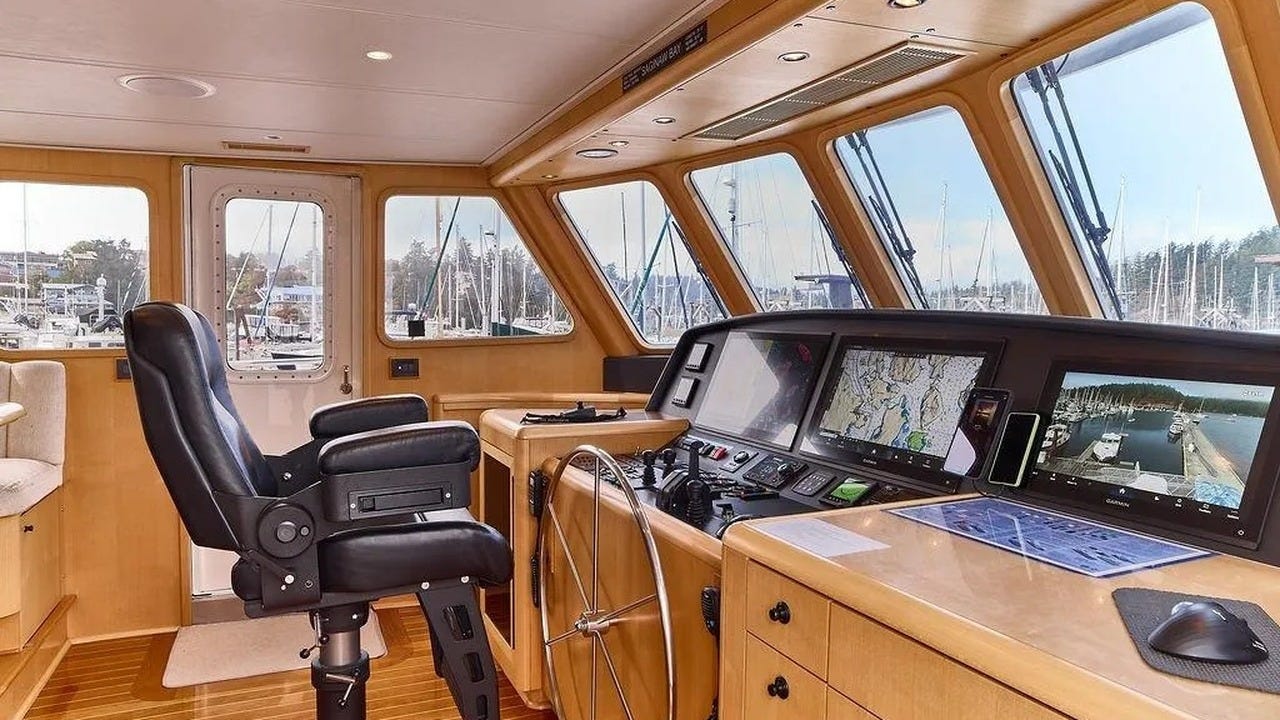
The current owner’s 2024-2025 refit is comprehensive rather than cosmetic. Navigation electronics were fully replaced with Garmin 9000 series 4K displays and Maretron monitoring throughout the vessel, Marine Starlink was installed, new fuel lines were run from every tank to the central engine room manifold, and a new dripless shaft seal was fitted. The stabilisers were serviced in September 2025, alongside a full bottom paint and Propspeed application. This is the kind of refit that addresses the unglamorous, structural side of ownership rather than simply the visible finishes, and it matters more to a serious buyer than a fresh coat of varnish ever will.
That large aft boat deck, distinctive for a 75-foot expedition yacht, carries a 3,000-pound crane capable of rotating 358 degrees to launch to port, starboard, or the stern swim platform. It currently holds a new Highfield Sport 560 tender with a Honda 100 horsepower engine, alongside space for a second tender or a full collection of kayaks, paddleboards, and bikes. For an owner who wants genuine flexibility in how they use a boat this size, rather than a fixed single-tender arrangement, that is a meaningful practical advantage most 75-foot yachts simply do not offer.
Taken together, what you are looking at with Saginaw Bay is a rare-specification hull from a builder with a genuinely remarkable survival story, kept by a single family for 22 years, repowered deliberately rather than out of necessity, and brought fully current by a second owner with serious long-range intentions before a change in personal circumstances put her back on the market.
There is more to say about what actually owning her costs, and it is not all straightforward.
This article continues below, in “The Wardroom”
In the premium section, I cover:
- The single-engine, twin-generator redundancy question: what the ABT Get Home Drive genuinely buys you against a true twin-engine layout, and what I would want confirmed before survey
- Servicing a Lugger L6140AL2: parts availability, typical service intervals, and what commercial-duty diesel support actually looks like on the US West Coast
- What $3.2 million actually buys against the current market: how Saginaw Bay compares to a new Northern Marine 70, and to comparable pre-owned Nordhavn and Selene tonnage in this size and price bracket
- My honest assessment of the price: whether the rarity of this specification, and the scale of the recent refit, genuinely justifies the asking figure
The Wardroom
The Single-Engine, Twin-Generator Redundancy Question
