

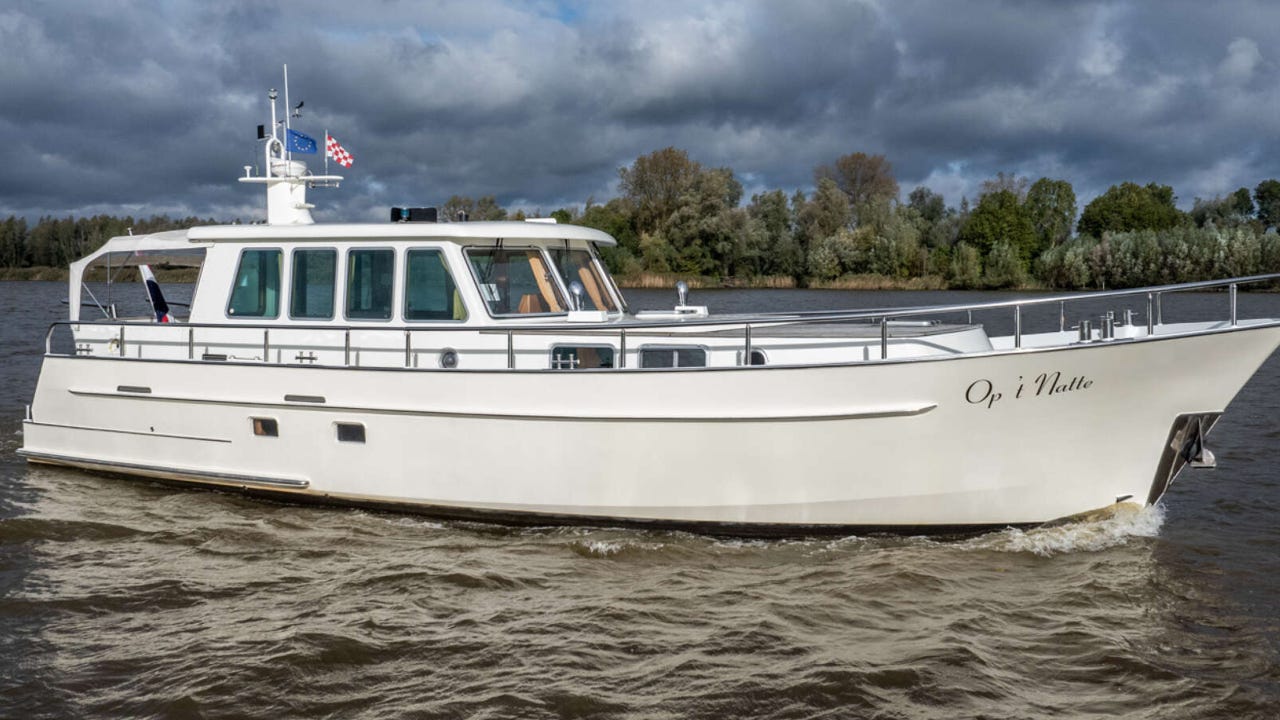
Not many people would associate an asking price of €349k with a Vripack-designed steel motor yacht. Mainly because that figure sits roughly €300k below what comparable Dutch-built vessels generally go for in the European brokerage market. The reason? This vessel was built at Stentor Yachts in Romania, meaning labour costs were lower. Still, the Vripack design integrity that comes with one of the most respected naval architect names was maintained.
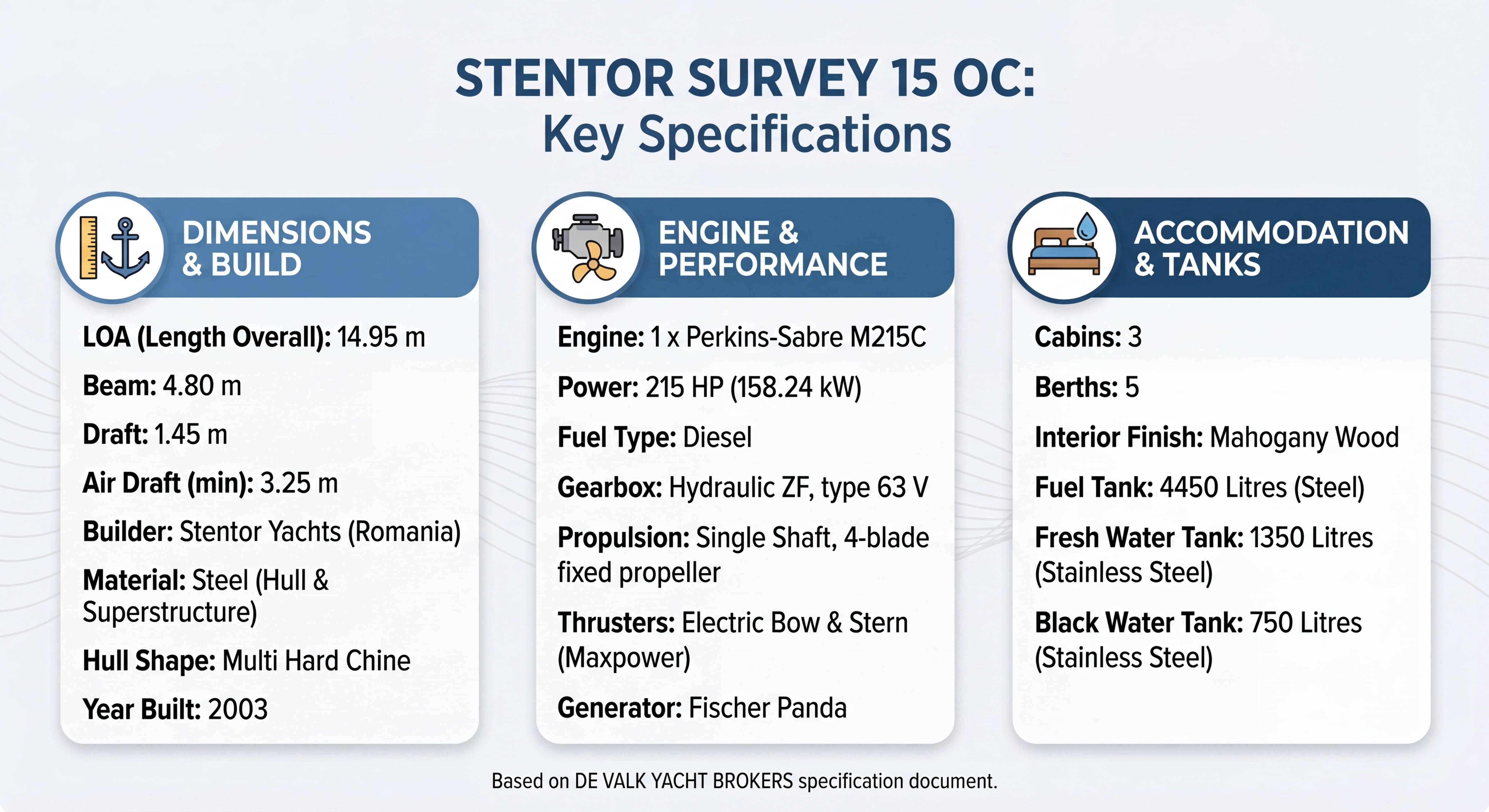
The boat in the spotlight here is a Vripack Survey 15 OC that was built to Vripack’s exact specifications and, at the time of writing, is listed for sale with De Valk Altena (NL). The last time I checked, her asking price was €349k. She has an LOA of 14.95 metres, with a beam of 4.8 metres and offers genuine offshore capability thanks to her CE Category ‘A’ rating. As with most steel displacement motor yachts, her passagemaking credentials mean that an owner can enjoy long-distance cruising without having to navigate around the usual storms which gather off the coast.
For a buyer who is trying to find Vripack pedigree but who has a budget under €400k, then this boat represents excellent value for money and is worth a closer look. Knowing whether that value translates into cost-efficient ownership means we need to look beyond the asking price to what you actually get for €349k, what her operating costs look like and how Romanian boat building compares to Dutch.
Vripack Naval Architects has operated since 1961, producing over 900 designs spanning motor yachts, sailing yachts and commercial vessels. The firm built its reputation on steel and aluminium trawler-style motor yachts that prioritise seaworthiness, fuel efficiency and long-range capability over styling trends. Vripack designs are recognisable through their displacement hull forms, practical deck layouts and proportions that favour seakeeping over interior volume maximisation. Those characteristics make Vripack yachts particularly popular among owners planning extended offshore passages rather than coastal hopping between marinas.
The Survey 15 designation reflects the vessel’s intended role. Survey yachts evolved from commercial survey and patrol vessels, designed to operate continuously in offshore conditions whilst providing stable working platforms. Applied to recreational yachts, the survey designation typically indicates a vessel built to commercial standards with offshore capability as the primary design criterion. The “OC” suffix denotes “open cockpit”, distinguishing this layout from fully enclosed variants.
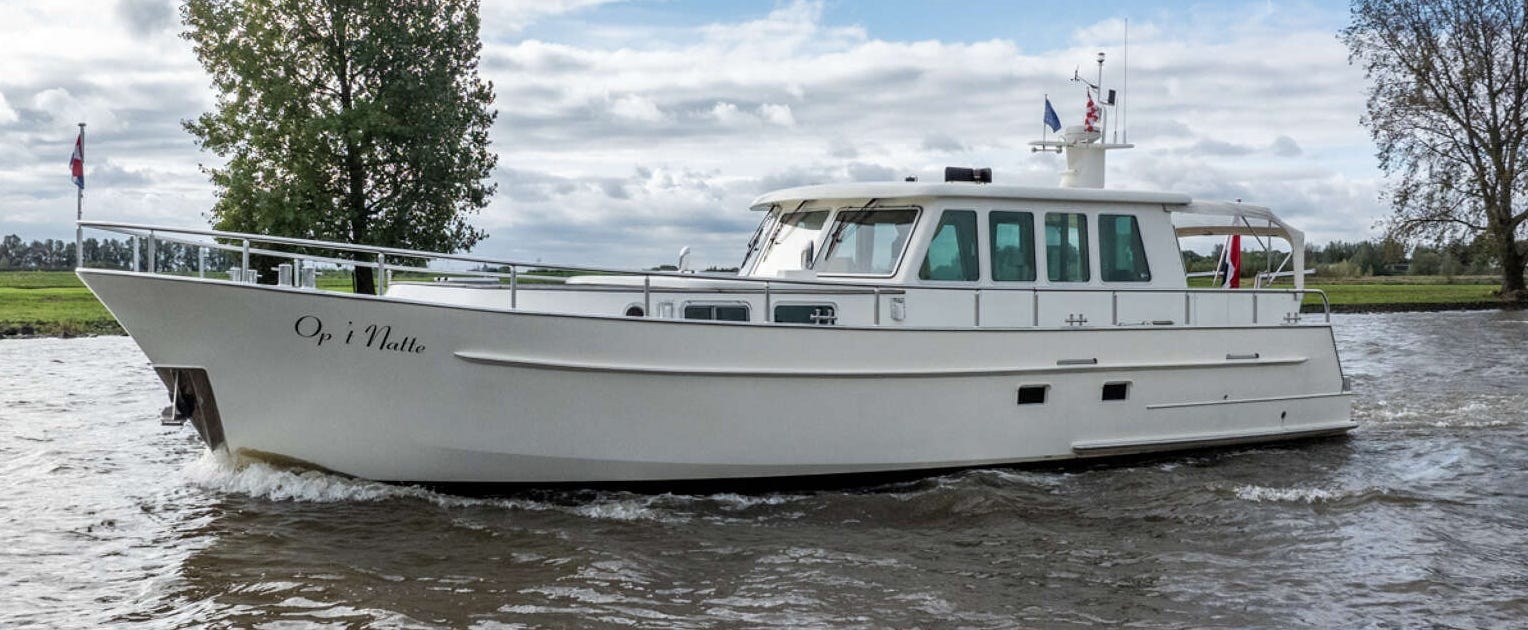
The hull construction follows traditional steel displacement principles. The hull plating measures 5 millimetres thick, the superstructure 4 millimetres, and deck plating 4 millimetres. Those thicknesses sit comfortably within standard practice for steel yachts of this size, providing adequate strength for offshore work whilst avoiding unnecessary weight that would compromise efficiency. The hull form employs a multi-chine configuration, creating defined angles between the bottom and topsides that improve stability and reduce rolling motion in beam seas.
Displacement totals 30 tonnes, which produces a displacement-to-length ratio favourable for fuel efficiency at cruising speeds. The relatively shallow 1.45-metre draft opens access to anchorages and harbours that deeper-draft vessels cannot reach, though it sacrifices some directional stability in crosswinds compared to vessels with longer keels. Cast iron ballast totalling approximately 1.2 tonnes sits low in the hull, contributing to stability and reducing rolling tendency.
The propulsion system centres on a single Perkins-Sabre M215C diesel producing 215 horsepower. Perkins engines carry a strong reputation for reliability and serviceability, with parts availability through Perkins’ extensive dealer network. The Sabre marinisation package includes heat exchangers, exhaust systems and cooling infrastructure designed specifically for continuous marine operation. Fuel capacity totals 4,450 litres across main tanks, with an additional 100-litre day tank providing filtered fuel to the engine whilst protecting against contamination in the main supply.
At typical cruising speeds of 8 to 9 knots, fuel consumption approximates 22 to 28 litres per hour. Over a 1,000-nautical-mile passage, that translates to roughly 2,500 to 3,200 litres consumed, providing comfortable range with reserves. The single-engine configuration reduces mechanical complexity and ongoing maintenance costs compared to twin installations, though it eliminates redundancy. For owners comfortable with thorough preventative maintenance and carrying spares for critical components, single-engine platforms offer practical reliability. For owners prioritising absolute redundancy, twin engines remain preferable despite higher operating costs.
Freshwater capacity reaches 1,350 litres, sufficient for extended periods away from shore facilities. The blackwater holding tank provides 750 litres capacity, meeting requirements for operation in restricted discharge zones. All tanks employ stainless steel construction, eliminating the corrosion concerns associated with mild steel tankage and providing long service life with minimal maintenance.
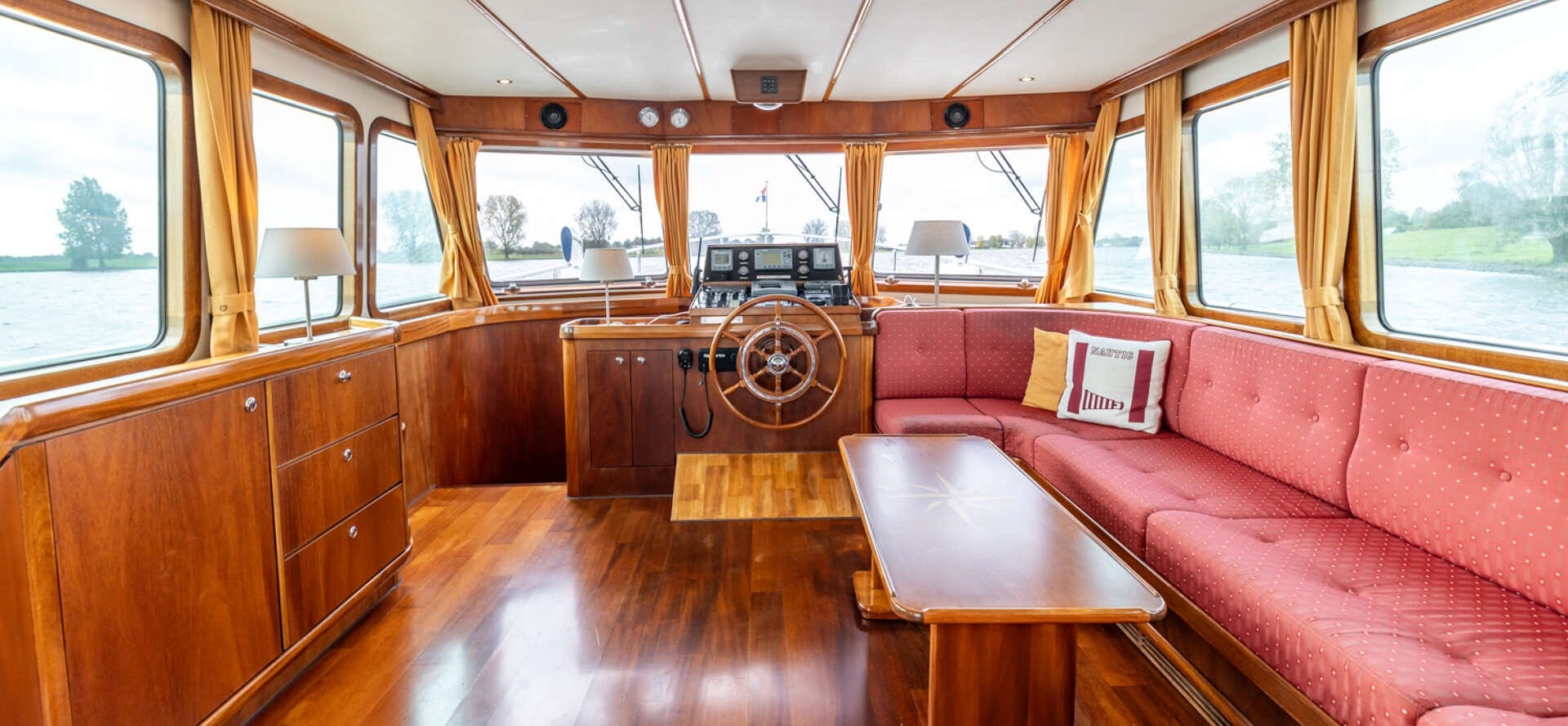
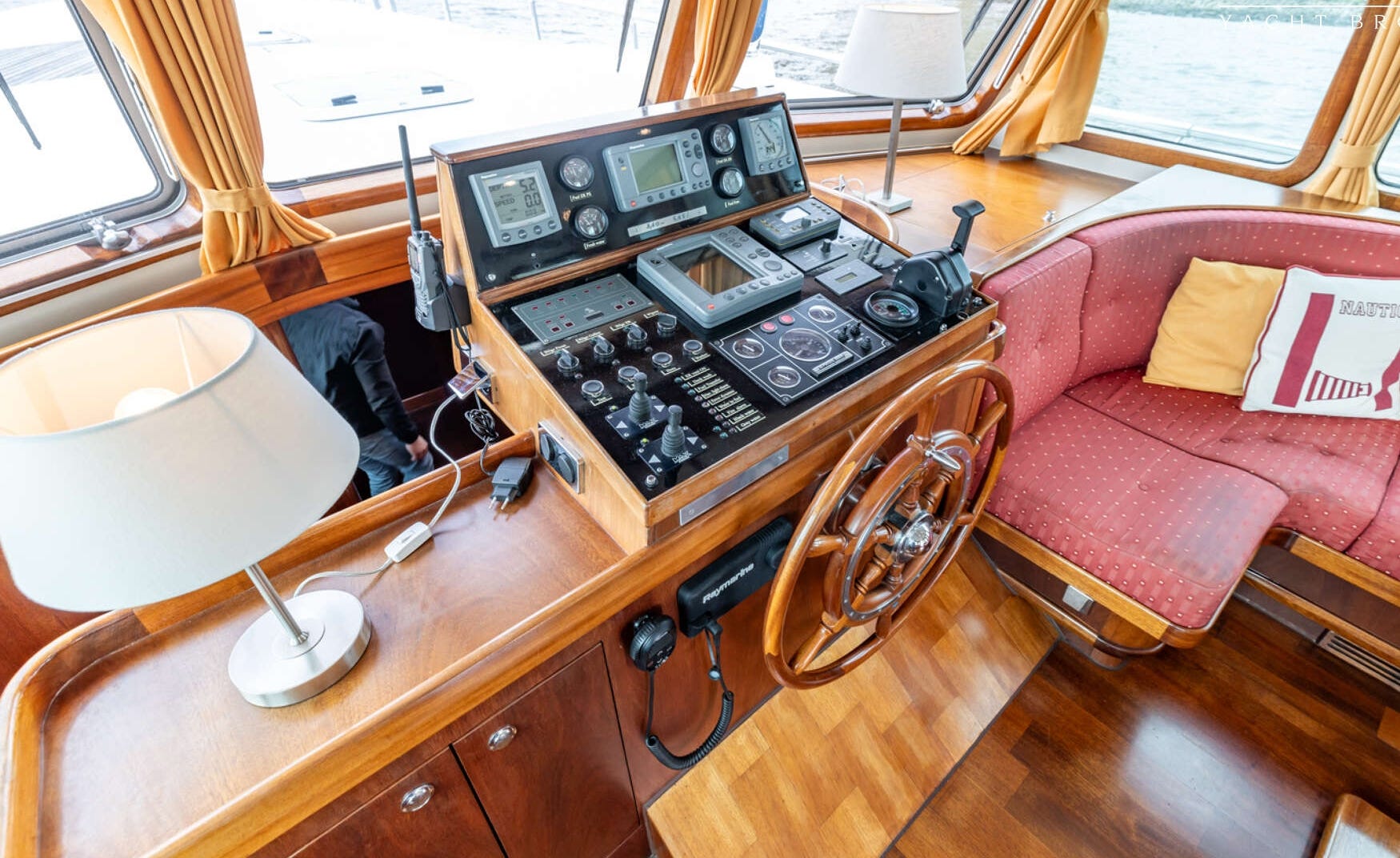
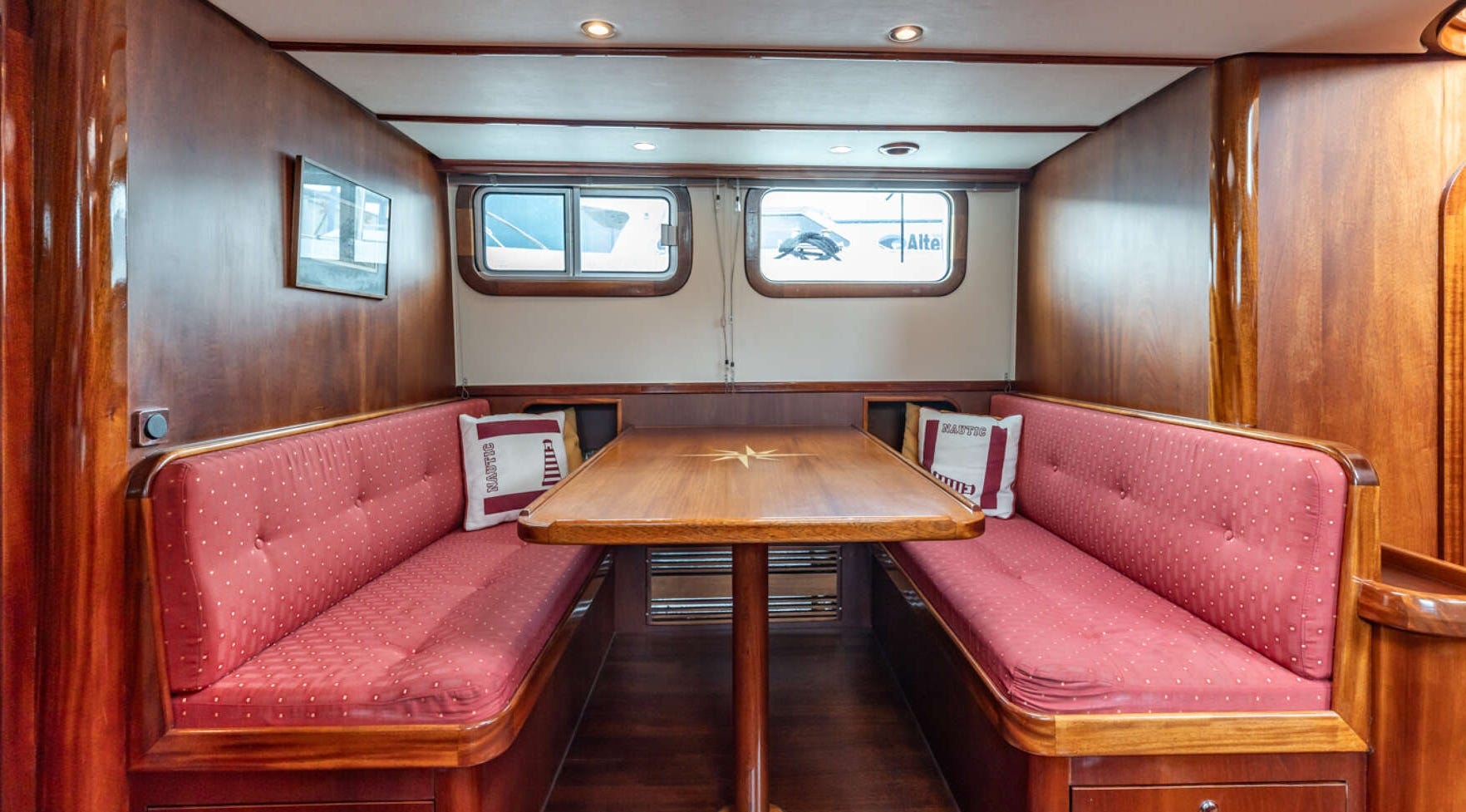
The accommodation layout reflects the vessel’s focus on practical liveaboard capability rather than guest entertainment. Three cabins provide sleeping for five, with the owner’s cabin occupying a midships location and featuring en-suite bathroom facilities including electric toilet. Two guest cabins forward offer double and single berths with shared head access. The saloon combines a navigation station, dining area and galley on the main deck level, creating an open living space with excellent visibility through large windows that wrap around the superstructure.
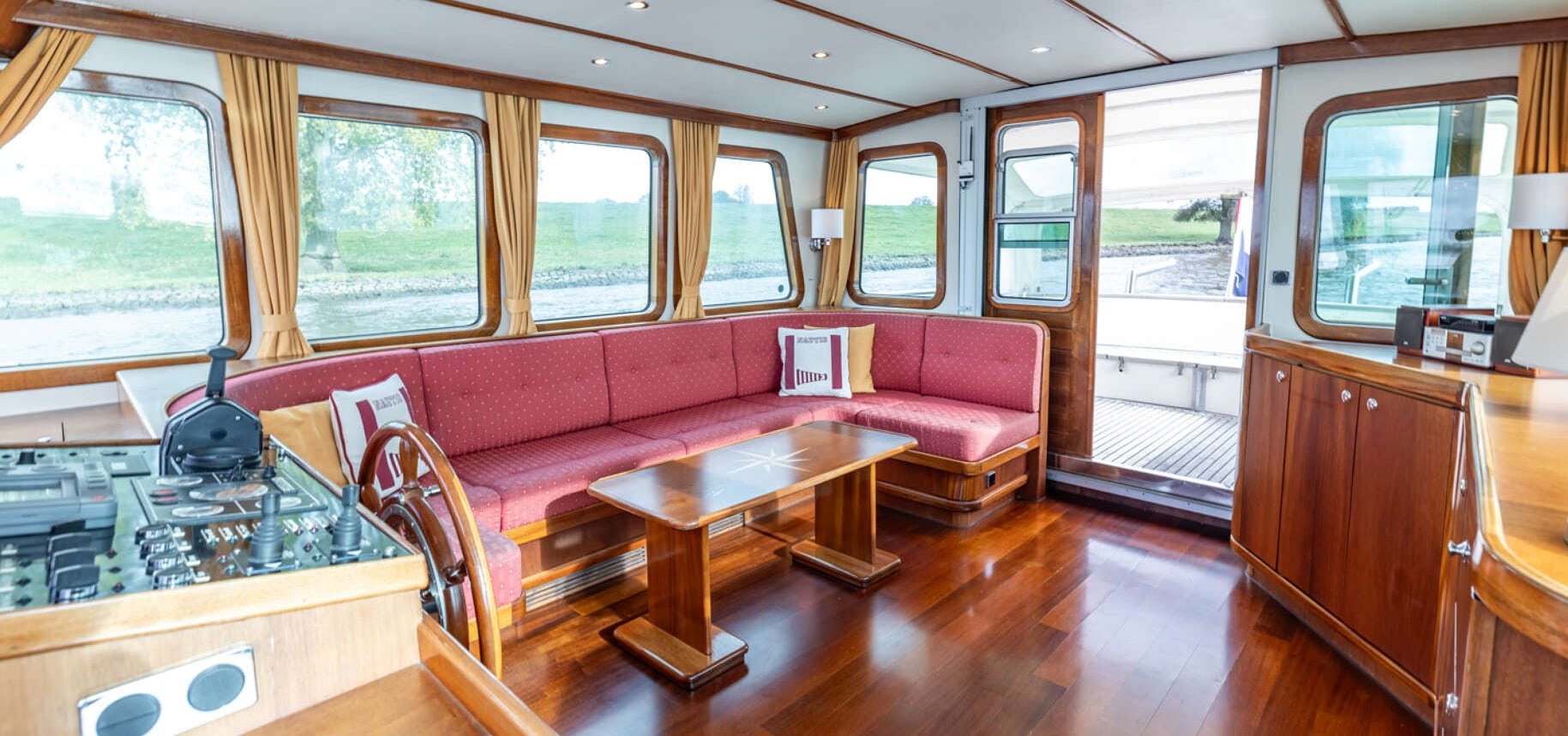
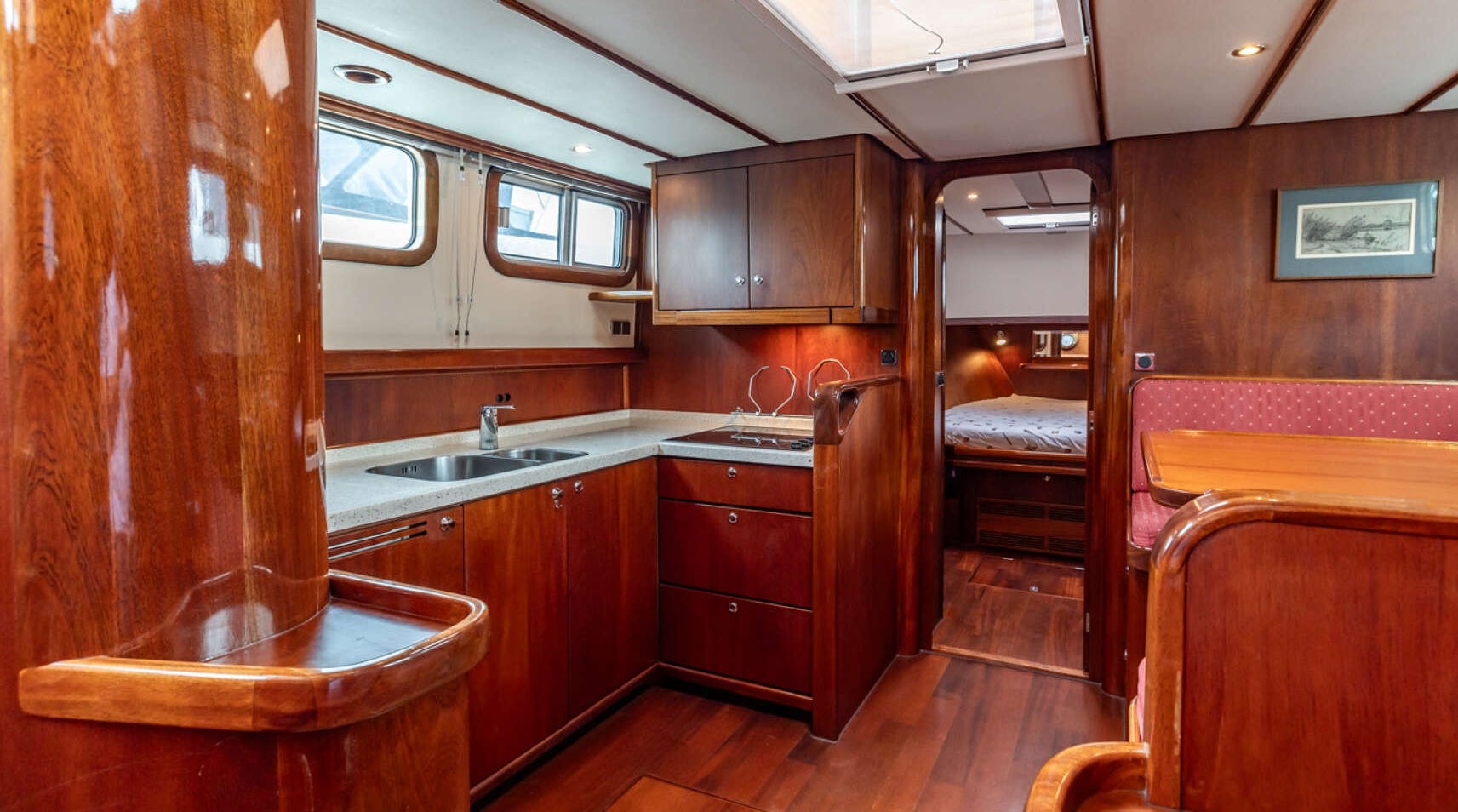
The galley equipment includes an electric cooker, combination microwave and oven, refrigerator, freezer and Corian countertops. Electrical equipment suggests shore power dependency or extended generator running for cooking and refrigeration, which affects fuel budgets for owners spending significant time at anchor. The central heating system employs a Kabola B8 boiler, providing climate control during cooler months without requiring continuous engine operation.
The CE-A certification merits particular attention because it defines the vessel’s intended operating envelope. CE (Conformité Européenne) certification categories range from Category D (sheltered waters) through Category C (coastal), Category B (offshore) to Category A (ocean). Category A certification requires the vessel to withstand wind forces to Force 8 (34 to 40 knots) and significant wave heights exceeding 4 metres. Achieving Category A involves structural calculations, stability testing, watertight integrity verification and safety equipment standards that exceed requirements for lower categories.
For buyers, CE-A certification provides several practical advantages. Insurance underwriters typically offer better terms and broader coverage for Category A vessels operating offshore compared to Category C vessels venturing beyond their design limits. Resale values tend to hold better for Category A platforms because they appeal to serious cruisers rather than only coastal operators. The certification also signals that the vessel was designed and built with offshore capability as a primary consideration rather than an afterthought.
Stentor Yachts constructed this vessel at their facility in Romania. The decision to build outside the Netherlands reflects economic realities within European yacht construction. Romanian labour rates typically run 30 to 40% below Dutch rates, producing cost savings on labour-intensive steel construction. However, labour cost differences do not automatically translate to quality differences. The critical factor is whether the yard possesses the skills, equipment and quality control processes necessary to execute complex marine construction to specification.
Stentor Yachts operates with modern fabrication equipment, experienced welders and established relationships with European suppliers of marine systems. Romanian yards have supplied vessels to commercial operators, government agencies and private owners across Europe for decades, demonstrating technical capability that meets demanding standards. The quality of any build ultimately depends on the specific yard’s practices, the rigour of owner oversight during construction, and whether proper survey and sea trial protocols were followed before delivery.
For this vessel specifically, buyers should verify construction quality through comprehensive pre-purchase survey rather than assuming either superior or inferior quality based solely on build location. Steel construction allows relatively straightforward assessment through ultrasonic thickness testing of hull plating, inspection of weld quality and evaluation of through-hull installations. A qualified marine surveyor can determine within hours whether the vessel was constructed competently or exhibits deficiencies requiring remediation.
The €349,000 asking price requires context to assess whether it represents genuine value or merely reflects average market positioning. Comparable Vripack-designed steel motor yachts built in Dutch yards typically command €550,000 to €700,000 for vessels of similar age and specification. A 2007-built Vripack 1500 (15 metres) sold recently for €695,000. A newer Vripack 1600 (16 metres) asks €850,000. Both vessels share similar design philosophy, steel construction and Vripack pedigree. The €300,000 difference between this vessel and Dutch-built comparables reflects labour cost savings rather than specification compromises.
However, that comparison assumes similar condition, maintenance history and systems functionality. A €349,000 vessel requiring €100,000 in deferred maintenance or systems upgrades becomes effectively a €499,000 purchase. Buyers must therefore assess the vessel’s actual condition through survey before concluding that the price represents value. The specification sheet indicates recent window replacement (2024), suggesting some ongoing maintenance investment, but comprehensive survey remains essential to identify any hidden costs.
The VAT-paid status holds significant value for European buyers. VAT on a €349,000 vessel approximates €95,760 at typical EU rates. Purchasing a VAT-unpaid vessel and subsequently importing into EU waters triggers that liability, effectively raising the acquisition cost to €494,760. This vessel’s VAT-paid status eliminates that concern, providing immediate freedom to operate throughout European waters without tax complications.
Understanding what €349,000 delivers requires examining the full ownership proposition. Below the paywall, I break down the annual operating budget for a steel yacht of this size, the specific maintenance requirements that steel construction imposes, what the Perkins-Sabre M215C demands in service costs, and who, in my humble opinion, should consider this vessel versus alternatives in the same price range.
The Steel Hull Reality
What Maintaining 30 Tonnes of Steel Actually Requires
Steel yacht ownership revolves around managing corrosion through consistent maintenance rather than attempting to prevent it entirely. Steel exposed to marine environments will corrode without protection. Responsible ownership involves maintaining coating systems, galvanic protection and regular inspection cycles that keep corrosion at acceptable levels whilst avoiding the expense of major remediation.
