

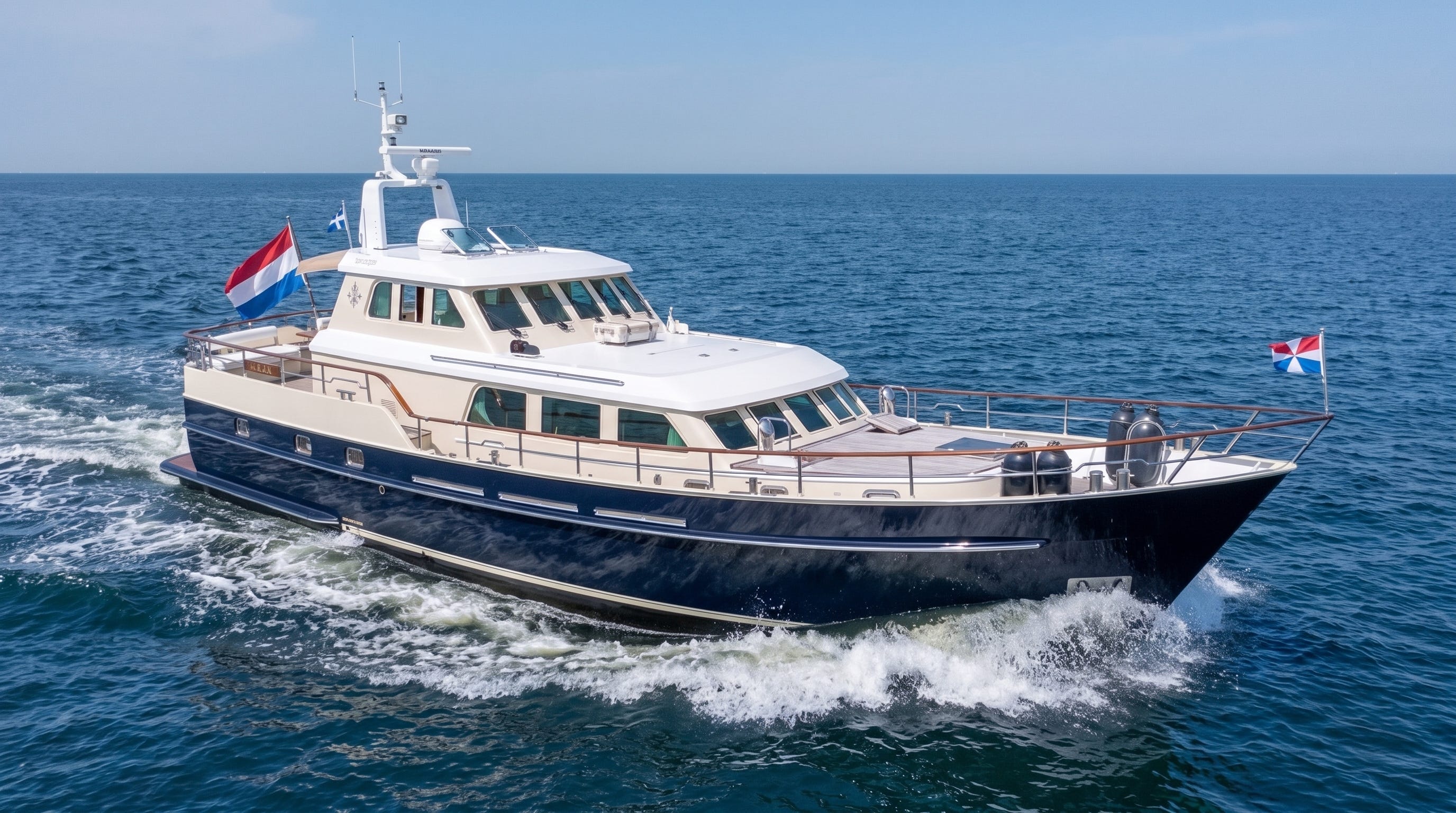
4,995 hours. That is what is showing on both engines of the boat you just watched me walk through, following my recent visit to the Netherlands, and she was built in 2002. Do the maths and that works out at a little over 200 hours a year, which is low usage for an explorer style motor yacht of this age, and it is worth understanding exactly why before we go any further.
This is Valerie, a Pieter Beeldsnijder PB55: 18.40 metres of round-bilged Dutch steel, CE Category A rated, with just one owner from new. She has spent every single winter of her life in a heated shed, and now, for the first time ever, she is for sale, through Sterkenburg Yacht Brokers in Drimmelen, at EUR 569,000 (link to listing below).
A Round-Bilged Hull, Built by Someone Who Knew What He Was Doing
Pieter Beeldsnijder was one of the most respected names in Dutch yacht design, a career that ran nearly 60 years and touched more than 2,500 vessels before he passed away in 2016. He trained at Royal Huisman and Feadship, two of the most serious yards in the business, and went on to design superyacht interiors that picked up ShowBoats International and World Superyacht Awards. His PB-series kotters are a smaller, more personal thread in that career: round-bilged Dutch motor yachts built for genuine sailing characteristics and a timeless look, rather than headline speed.
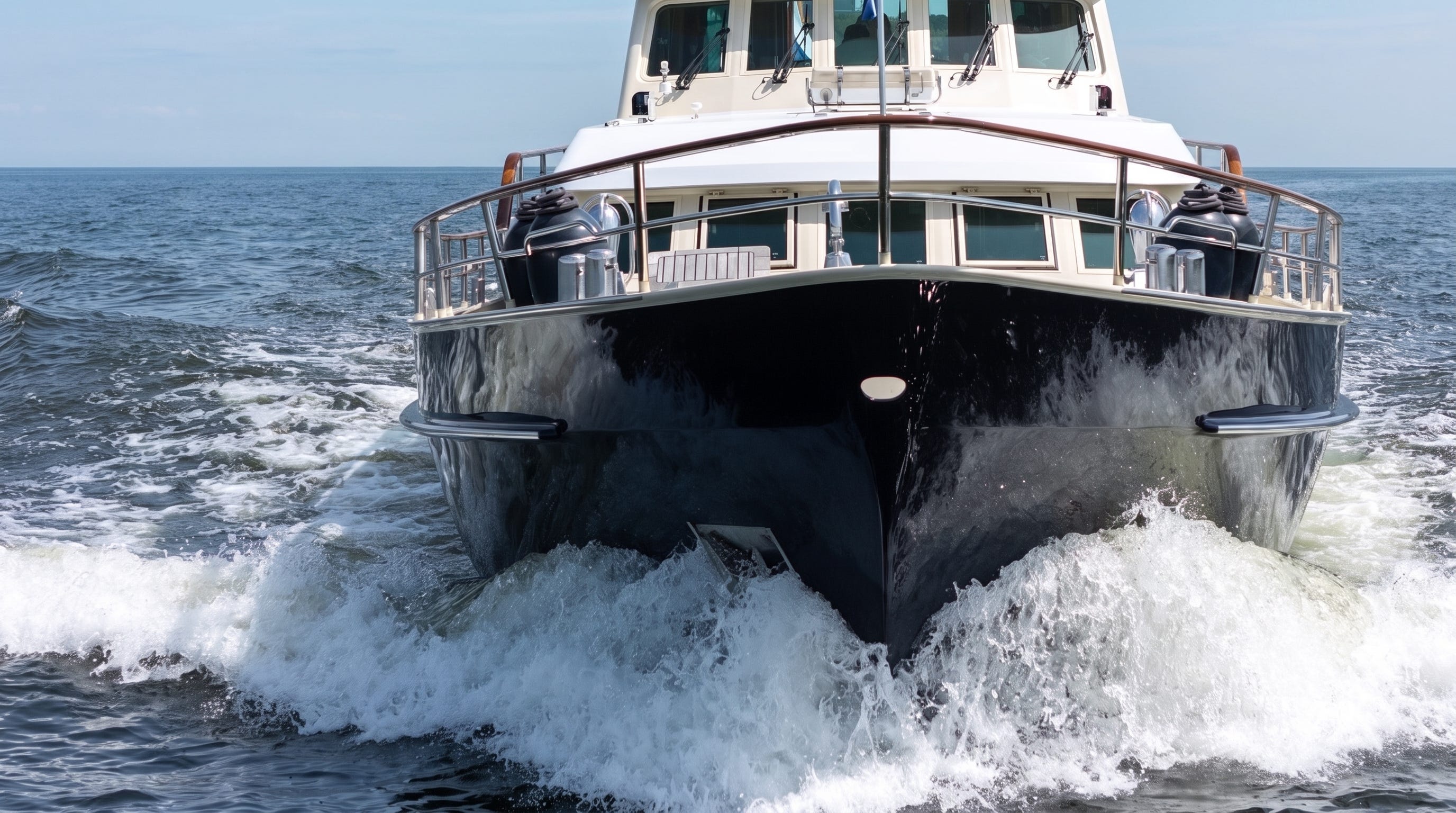
That round bilge is the detail that helps set her apart from a lot of what you will see in this size bracket. Instead of the flat, welded panels of a multi-chine hull, a rondspant hull is rolled and formed into one continuous curve from keel to sheer. It is a genuinely harder job in the yard, and it shows in the way she carries herself: a smoother hull form and a gentler motion when the sea state gets confused, rather than the harder, more abrupt roll a chined hull can give you.
She was built by T&T Yachting in Zevenbergen, a solid regional Dutch yard with a track record in custom steel motor yachts through this size range, working alongside Drinkwaard for the interior joinery: cherry wood throughout, warm, traditional, and finished to a genuinely high standard.
Twin Ivecos, and Why 4,995 Hours in 24 Years Is the Real Headline
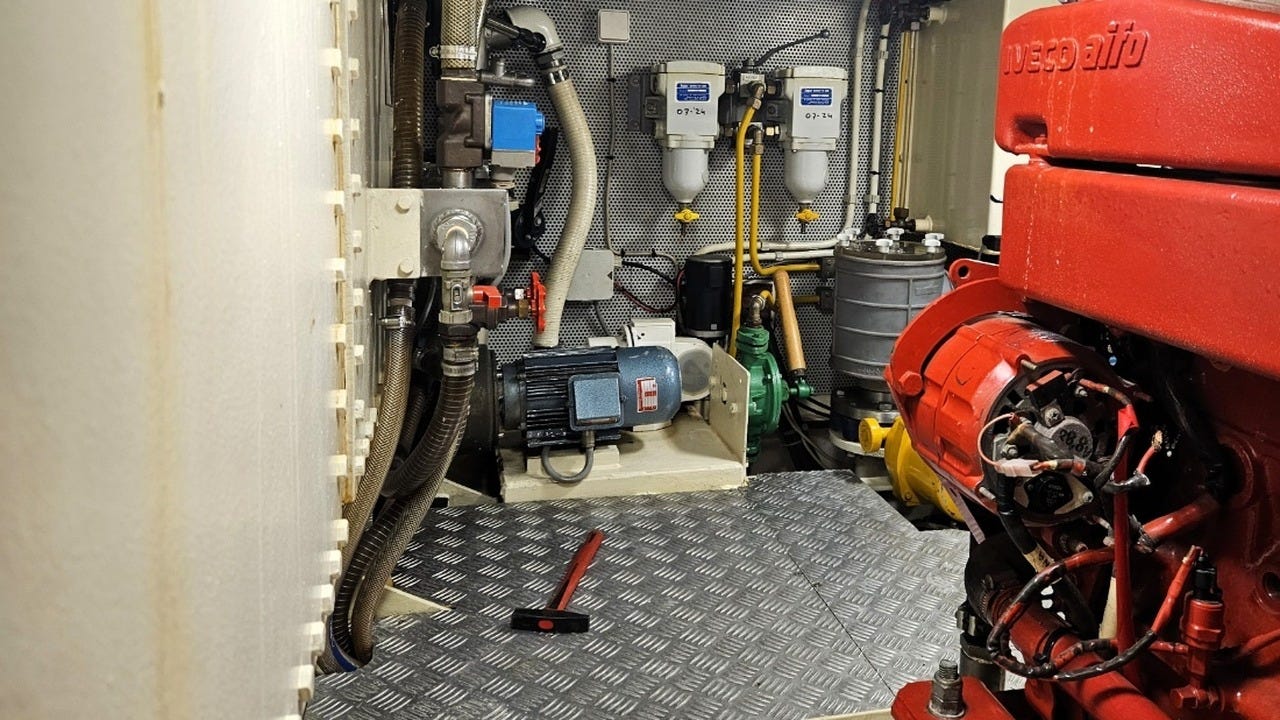
These are her original engines: twin Iveco AIFO 8065 M12 diesels, producing 120 horsepower apiece, 240 horsepower combined in a 48-tonne yacht. That is a genuinely conservative power-to-weight ratio for a hull this size, and it is a deliberate one: this is a boat built around efficient, low-revving displacement cruising at 8 knots, the same philosophy that underpins the long-range explorer yachts a lot of you will already know from this channel, just applied here to European coastal and inland waters rather than open-ocean passages.
The AIFO 8065 M12 is drawn from Iveco’s industrial engine family, a straightforward, well-proven unit rather than anything highly stressed or exotic, and it has a genuinely good reputation and strong parts availability across Europe and North America. Drive is through conventional shafts: simple, proven, and exactly what you would expect on a boat built for reliable, unfussy cruising.
What actually matters here is the 4,995 hours. Across 24 years, that works out at barely over 200 hours a year, a genuinely low-usage boat, and it tells you a story about how she has been kept. A single, careful owner who commissioned her from new, wintered her every year in a heated shed, and clearly used her rather than neglected her, but never hammered her either. That combination, low hours plus documented, careful storage, is about as good a starting position as you will find for a 24-year-old steel motor yacht.
Why Her Fuel Tanks Are Smaller Than You Might Expect
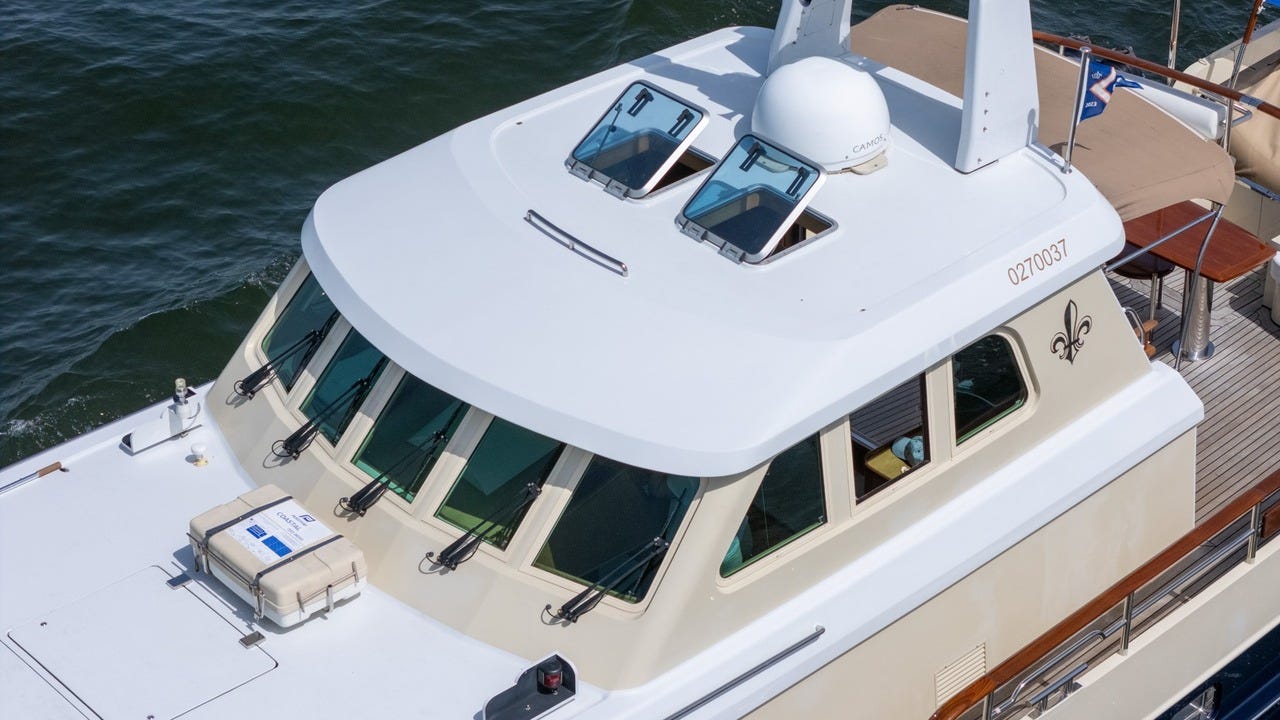
Here is something worth understanding in full, because it is the question I imagine a fair few of you asked while watching the yacht tour: why does an 18.4 metre, 48-tonne yacht like this carry only 3,130 litres of fuel?
The honest answer is that not every owner commissioning a build like this in 2002 was imagining an Atlantic crossing. At a genuine 8-knot cruise, twin 120hp Ivecos of this type burn somewhere in the region of 10 to 15 litres an hour combined. She has a genuinely useful range for coastal and inland European cruising: the North Sea, the Dutch and Belgian waterways, a passage down to the Mediterranean and back. It simply is not built for ocean crossings, and it was never meant to be.
Compare that with a true ocean-crossing explorer yacht of similar displacement, which typically carries fuel equal to 50 to 70% of her weight rather than the roughly 6% Valerie carries here, often running to 5,000 or even 8,000-plus litres to guarantee genuine transatlantic range. Valerie’s tankage sits closer to what a sensible coastal cruiser needs, which is exactly what her first owner asked for. Smaller tanks are not a shortcoming here; they are evidence of a boat built honestly for the life she was actually going to lead, rather than over-specified for a passage her owner never intended to make.
Worth flagging early for anyone reading this from outside Europe: those same tanks mean Valerie cannot cross an ocean under her own power, so a buyer in the United States, Canada or Australia is looking at professional shipping rather than a self-delivery passage. That is a real cost to factor into the total picture, and I go through what shipping actually runs to each of those three destinations in the Wardroom below.
Comfort, Kept Simple and Kept Working
The rest of the specification reads the same way: sensible, well-chosen, and clearly used rather than just installed and forgotten. Hydraulic bow and stern thrusters, which matters more than it sounds; hydraulic systems are cooled by the fluid running through them, so you can lean on them continuously in a genuinely tight lock or a difficult crosswind without them overheating and needing to rest, unlike an electric thruster. Air conditioning, central heating via a Kabola boiler (a genuine, well-regarded Dutch diesel-heating brand), a built-in dehumidification system, and a central vacuum system, the kind of detail that tells you the original owner thought about comfort at a genuinely granular level rather than ticking a options-list box.
Her electrical system runs on a Mastervolt 24/75 charger and 24/2500 inverter, both mid-range units from one of the most respected names in marine electrical integration, more than sufficient for galley, heating, and cabin systems between shore power connections. Navigation runs on a full Simrad suite (log, depth, wind, GPS, plotter, compass) with a Simrad/Robertson autopilot, Shipmate VHF, radar, and AIS, a genuinely serious navigation and safety package for a boat of this size.
Below decks, three cabins sleep six: a spacious owner’s cabin with its own en-suite, a guest cabin in the bow, and a third cabin with bunks, plus a separate guest toilet. Two WCs and two showers across the boat, double glazing throughout, and a genuinely comprehensive comfort list, washer, dishwasher, full galley, salon and dinette, warm water on demand, a swimming platform and ladder.
At EUR 569,000, and with a single careful owner, a heated winter shed every year of her life, and hours this low for her age, Valerie represents exactly the kind of boat a serious buyer hopes to find and rarely does.
This article continues below, in “The Wardroom”
In the premium section, I cover:
- The full engine and drivetrain picture: what 4,995 hours on an Iveco AIFO 8065 M12 actually means for remaining service life, and what a pre-purchase survey should focus on given her age
- The real annual cost of keeping her: fuel, berthing, insurance, and servicing on a twin-Iveco, 48-tonne steel motor yacht
- What it actually costs to ship her to the USA, Canada or Australia: real shipping figures, import duty differences between the three, and why one route lands dramatically less than the others
- What a single-owner, heated-shed history is genuinely worth: how much weight that provenance should carry with a surveyor and a buyer
- My honest assessment of EUR 569,000: how she compares against the wider Dutch steel motor yacht market right now
