

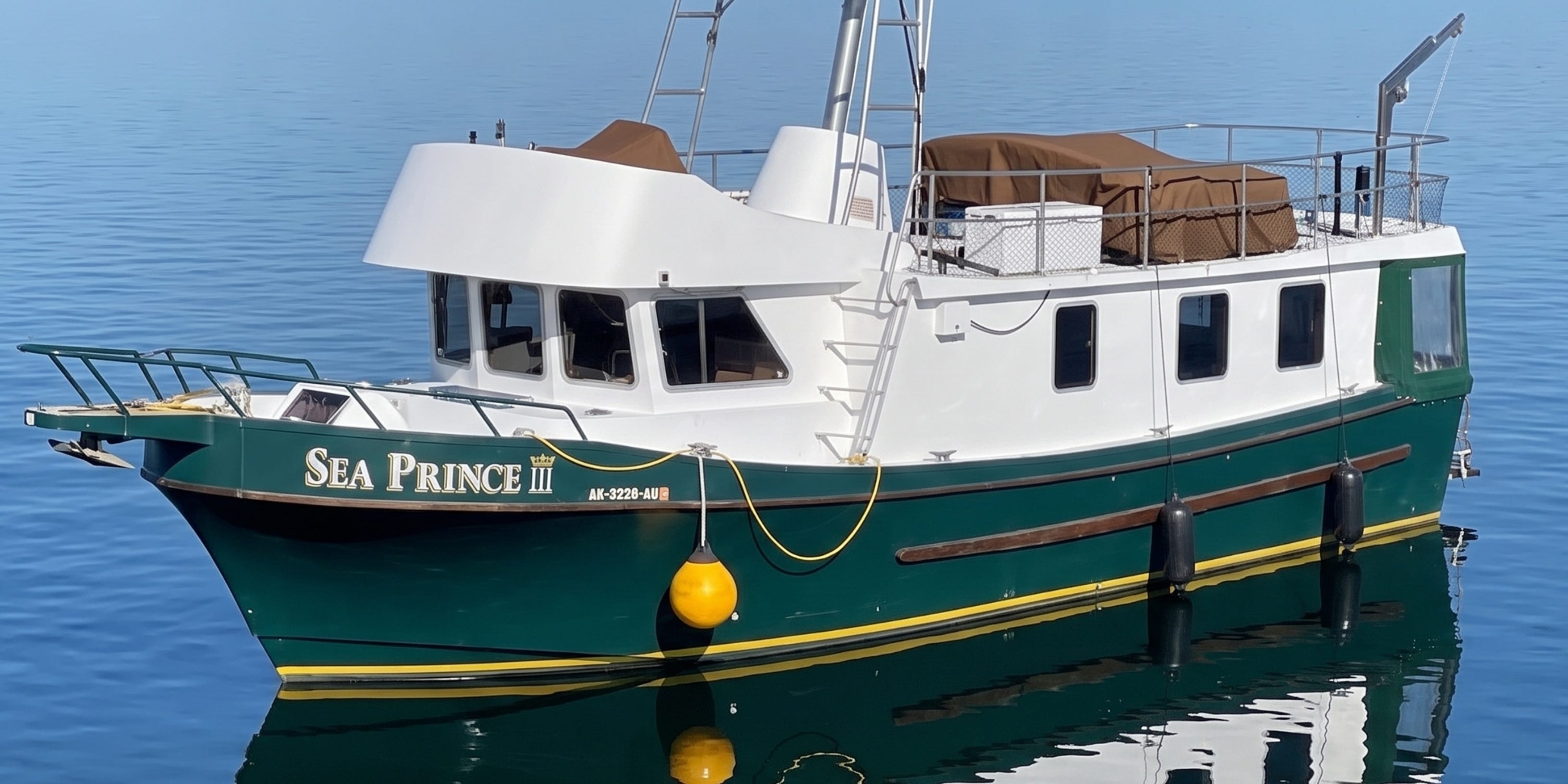
During a recent shift spent scanning the horizon for boats to write about, I found a 42ft trawler dry-moored in Everett, Washington, called Sea Prince III. As of this writing, it’s listed on NW Yachtnet in Seattle for $89,500 (link to broker’s website below). That number buys a finished, heated trawler motor yacht rather than a project, with the broker inviting a full top-to-bottom survey, and she is already in the country where most of you reading this actually live. So, no shipping quote, no import saga and no currency conversion.
You could view and then motor off into the sunset without having to get your passport, assuming (as you are one of my US readers).
She started life in 1986 as a working boat. The broker identifies her as a Deltaga-built Dungeness crab boat, constructed on the Fraser River in British Columbia with a solid, heavily laminated fibreglass hull. Deltaga is documented as a BC builder of fishing vessels, and that is about as far as the public record goes. In 2010, per the listing, she was professionally rebuilt to yacht standard by Nanaimo Shipyards, a long-established commercial yard on Vancouver Island whose everyday work has included ferries, tugs and, of course, fishing boats. That is the kind of yard you want behind a claim like “rebuilt to yacht standard”, and that rebuild file would be high on my document-request list.
Her looks tell the same story from the waterline up. The haul-out photographs show a full, commercial bow with a large bulbous appendage below the waterline, a dark green hull with a yellow boot stripe, and long rubbing strakes with rolling chocks standing proud of the hull sides. Above all that sits a flush-sided, welded aluminium deckhouse that looks more like a purpose-built small ship than the usual production cruiser. Her stern is broad and workboat-like, with a skeg-hung rudder and a well-protected propeller, and the upper deck is a big, flat social space with davits and a control station. She reads as exactly what she is: a working hull given a second life as a private cruiser.
Those underwater details are worth a moment, because you rarely see them on a 42-footer. A bulbous bow is there to reduce wave-making resistance when its shape is matched to the hull’s speed and displacement, which is a naval architect’s way of saying it was drawn to let a slow boat slip along on less fuel. The rolling chocks along her bilges generate damping as the hull rolls, taking the edge off beam seas and rolly anchorages. And the skeg-hung rudder with a protected prop should make a crab-pot line or an uncharted lump far less likely to end your season. None of that is marina queen yacht styling; it is fishing-fleet pragmatism, and exactly what you want underneath a cruising trawler.
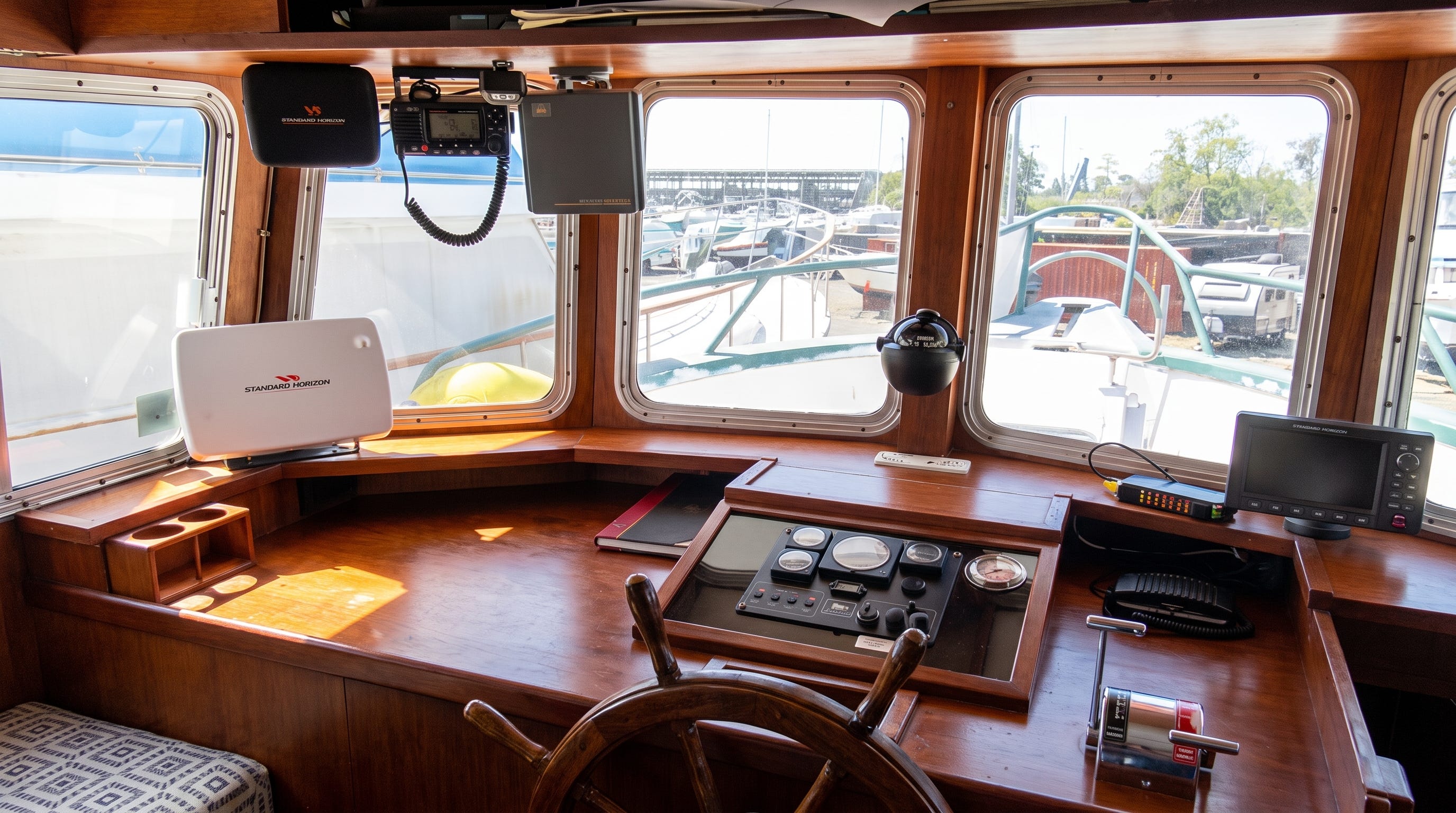
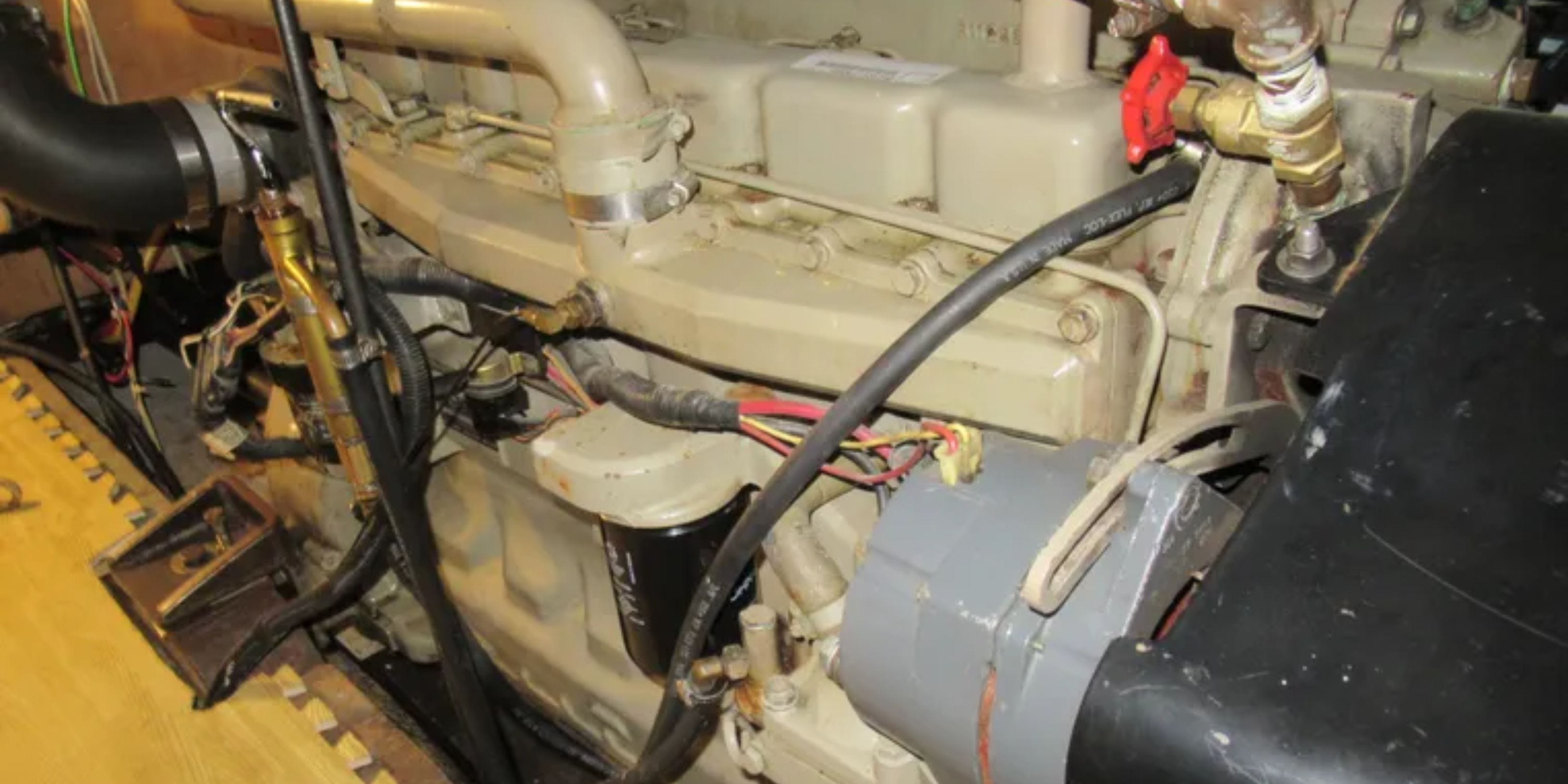
The engine room holds a single John Deere 6068 Turbo, a 6-cylinder diesel used widely in industrial and marine applications, with around 4,400 hours and backed by John Deere’s US dealer and parts network. She swings a 32in bronze propeller through a 3:1 gear, and the 2019 yard bill covered the pulled and balanced shaft, a new stuffing box and new Groco bronze seacocks. The broker’s headline claim is what made my nautical radar ping: 7 knots on 2 US gallons of diesel an hour, from 400 gallons of tankage. I dig into what that actually means for range below.
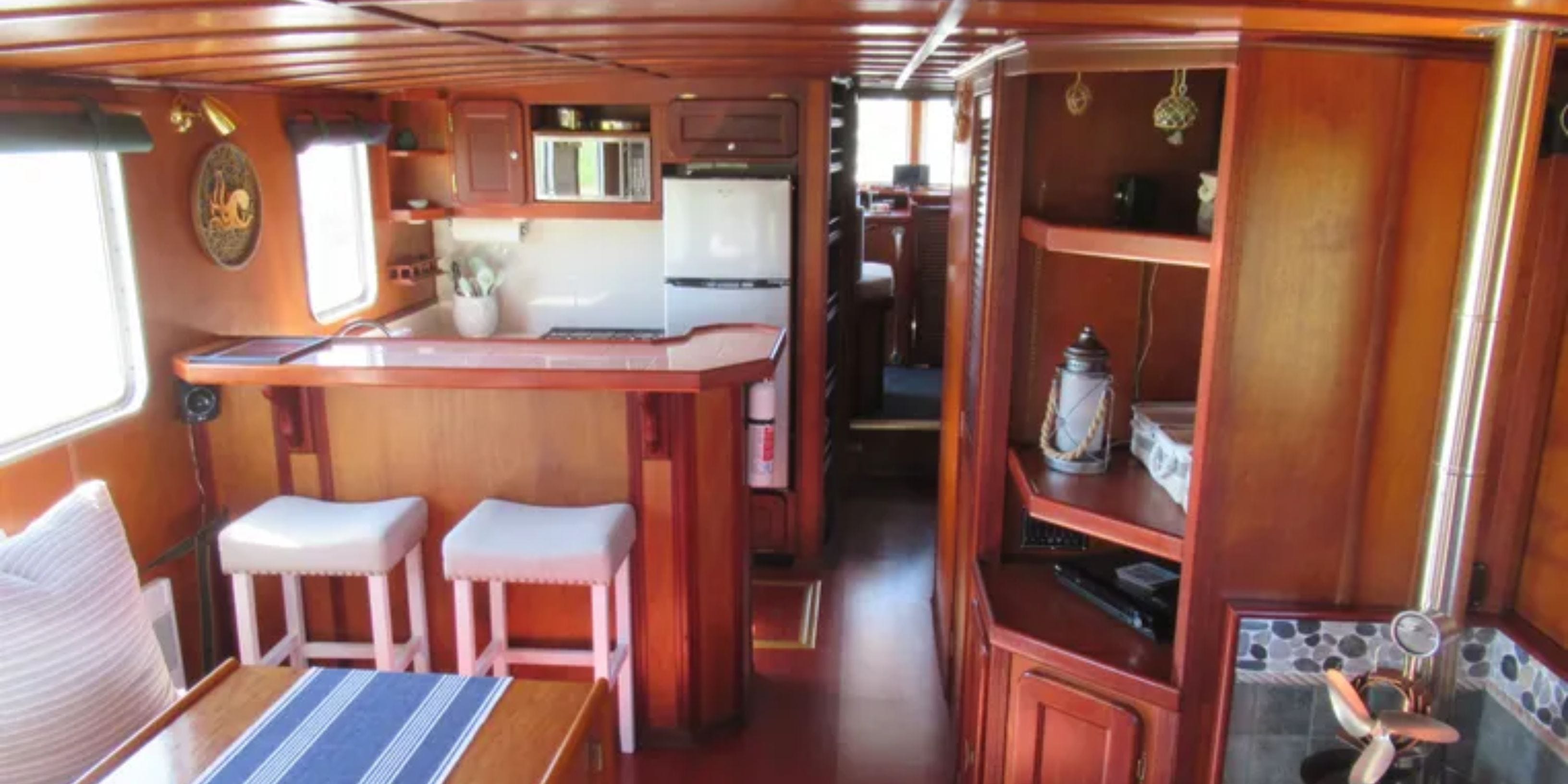
Inside, she is set up for two people to live aboard very comfortably. There is one ensuite queen cabin forward, with convertible settees in the salon and pilothouse, taking total berths to 5. The galley is U-shaped with bar-top seating, the head has a walk-in shower, heating comes from a Dickinson diesel stove plus engine hot water, and the joinery is tropical hardwood with 6’2” of headroom. Recent kit includes AIS from 2024, AGM house batteries from 2020, a Victron isolation transformer from 2021 and a commercial hydraulic drum windlass hauling an 83lb Mantus anchor on 100ft of new chain. A 10ft Highfield RIB with a 9.9hp outboard lives on the swimstep davit.
If you have read my pieces on the 1954 Matton tug conversion or Jezebelle, the $175,001 shrimp trawler, you’ll know I have a genuine soft spot for working boats given second lives. The difference here is that someone else has already done the converting, and the asking price is still in project-boat territory. A very rare combination indeed.
This article continues below, in “The Wardroom”. Thanks to my paying subscribers, I can keep digging into boats like this one. So, if you are a premium subscriber, or you become one today, then I would like to say a massive thank you!
In the premium section below, I cover:
- What 400 gallons actually buys you: the range arithmetic behind the 2 gallons an hour claim.
- The survey that matters: what to check on a 40-year-old solid GRP hull with an aluminium deckhouse and a 2010 rebuild
- What she’d cost to run: Everett moorage, insurance due diligence, a 5-year maintenance budget and the cross-border paperwork
- My honest assessment of the price: what her own broker’s alternative costs, and who should be looking at her
What 400 gallons actually buys you
