

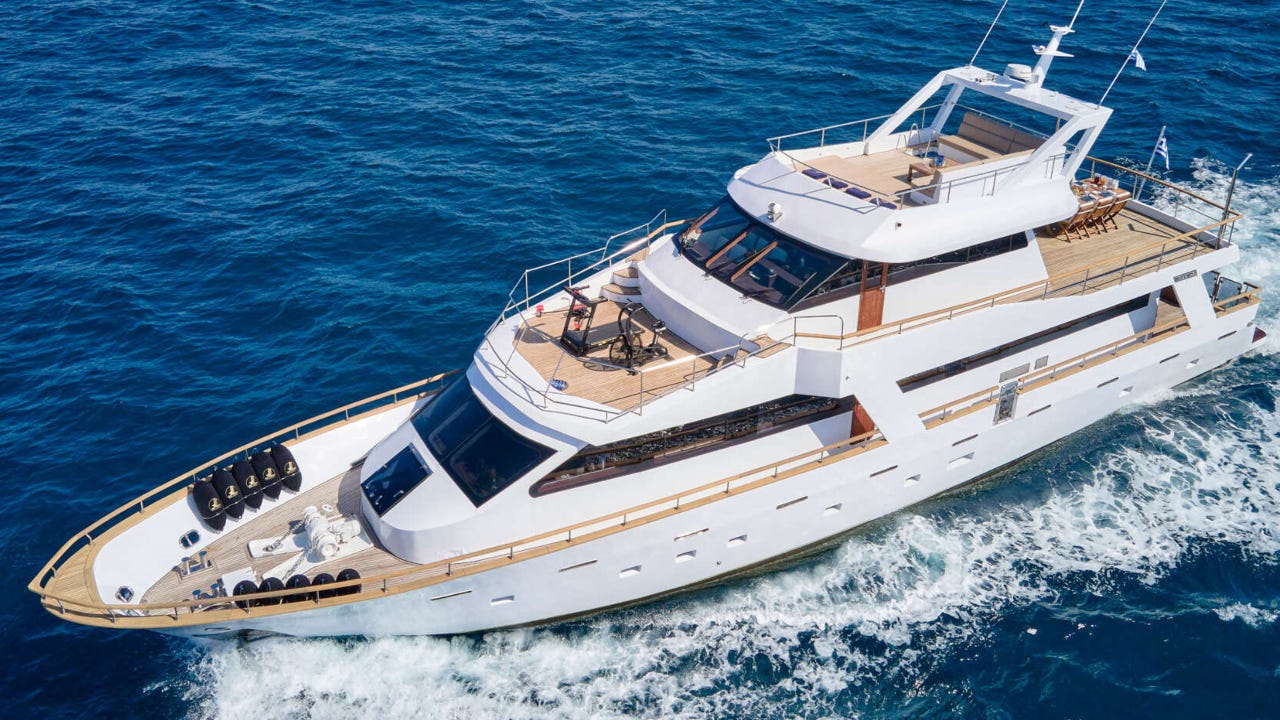
I will be honest with you: before this listing popped up on my radar, I had never heard of Torgem Shipyard. That in itself told me something. In a market where stand-out shipyards dominate the conversation, a 28-metre steel motor yacht from Istanbul priced at €920,000 (listed with De Valk Corfu) has the potential to be either an overlooked gem or something else. I wanted to find out which.
What I found was more interesting than I expected, and more complicated.
A Shipyard You Have Probably Never Heard Of
The name Torgem Shipbuilding Industry and Trade Company does not tend to come up at boat shows. It will not feature in the conversations at your local yacht club, and you are unlikely to see it discussed on the forums. But the story behind the yard is worth knowing before you dismiss the name.
The Torlak family began building wooden boats along the Black Sea in the 1880s. And no’ that is not a typing error. The lineage traces back well over a century, to a craftsman known simply as Mustafa “the Carpenter” Torlak, who established a small boat-building enterprise serving local communities. The business passed through generations, evolving from timber to steel as the industry demanded, and was formally incorporated as Torgem Shipbuilding in 1977.
What followed was a period of rapid growth….
Between 1977 and 1982, Torgem expanded significantly alongside Turkey’s broader shipbuilding industry, gaining experience across commercial vessel construction, repairs, and conversions. In 1983, the shipyard relocated from the historic Golden Horn in the heart of Istanbul to Tuzla Bay, the industrial shipbuilding hub on the eastern edge of the city where many of Turkey’s serious yards operate today.
By the time the Torgem 92 was launched in 1992, the yard had already built dozens of vessels across commercial and private categories. Their record runs to 88 builds in total, accumulating approximately 400,000 deadweight tonnes, with their largest vessel being a 20,000-tonne dry cargo container ship. Today, the enterprise operates internationally as the Tor Group, headquartered here in the United Kingdom, still under the ownership of the founding family now in its fifth generation.
This is not a fly-by-night operation that knocked out a few charter boats in the 1990s.
Torgem was a serious commercial shipyard that turned their hand to yacht construction. That distinction matters when you are looking at a steel hull and wondering what went into it. Turkey’s yacht-building sector has a wide quality variance, from world-class yards that produce superyachts for the most demanding owners to smaller operations where quality control is more variable.
Torgem sits in the credible, mid-tier segment: not a premium pedigree, but a builder with genuine industrial heritage and the kind of longevity that speaks to operational competence.
What She Looks Like, and Why It Matters
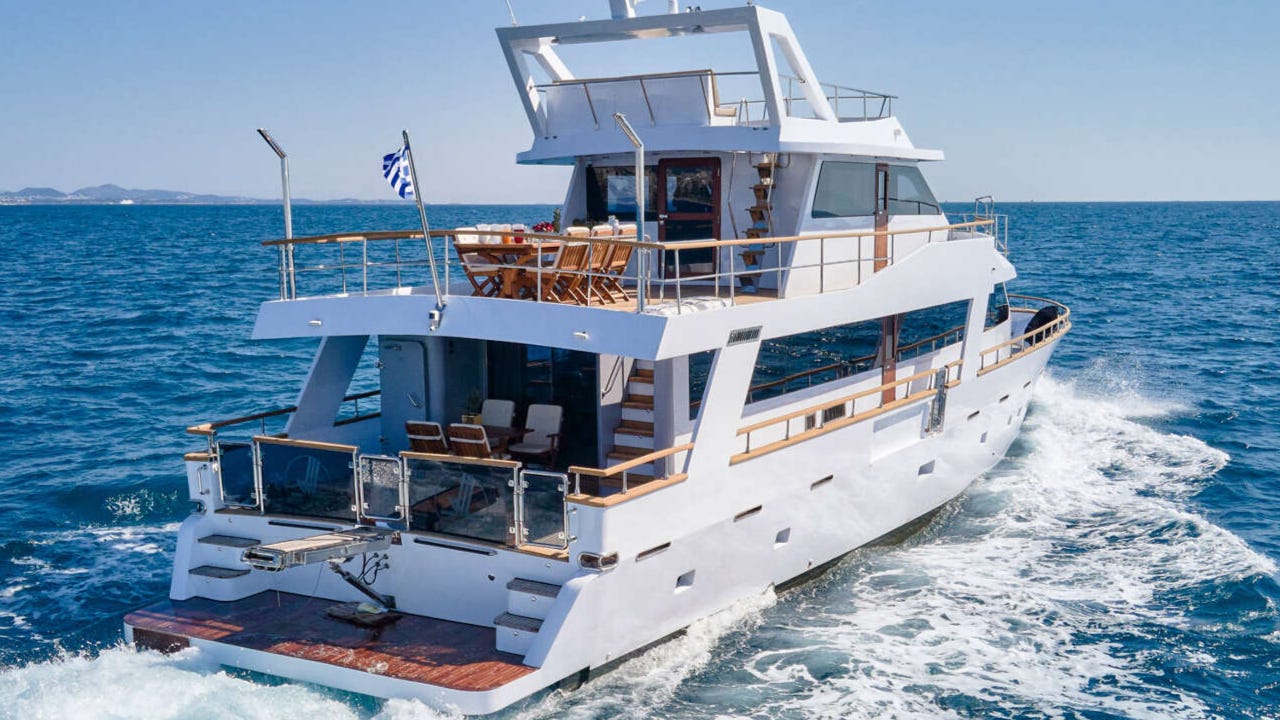
Before we get into the machinery and the numbers, spend a moment with the photographs. The Torgem 92 does not look like a 33-year-old boat. The 2020 refit was comprehensive enough to transform her appearance, and she carries the white-and-teak livery of a modern Mediterranean motor yacht with convincing authority.
There are two design features worth discussing, because they speak directly to how this vessel was originally conceived.
The most distinctive is the forward deck arrangement. Just ahead of the wheelhouse, at the transition between the main deck and the raised superstructure, Torgem built what functions as a sheltered working station at the bow. It is not a Portuguese bridge in the traditional sense, that elevated transverse walkway that allows crew to move forward across the foredeck in heavy weather without being swept overboard.
What Torgem built here is subtly different: the wheelhouse superstructure extends forward and downward, creating a protected working area where crew can manage the anchor windlass and handle bow lines with a degree of shelter that a conventional flat foredeck simply does not provide. The result is a feature that speaks to utility first. Whoever originally specified this yacht had an interest in genuine offshore practicality, not just cosmetics.
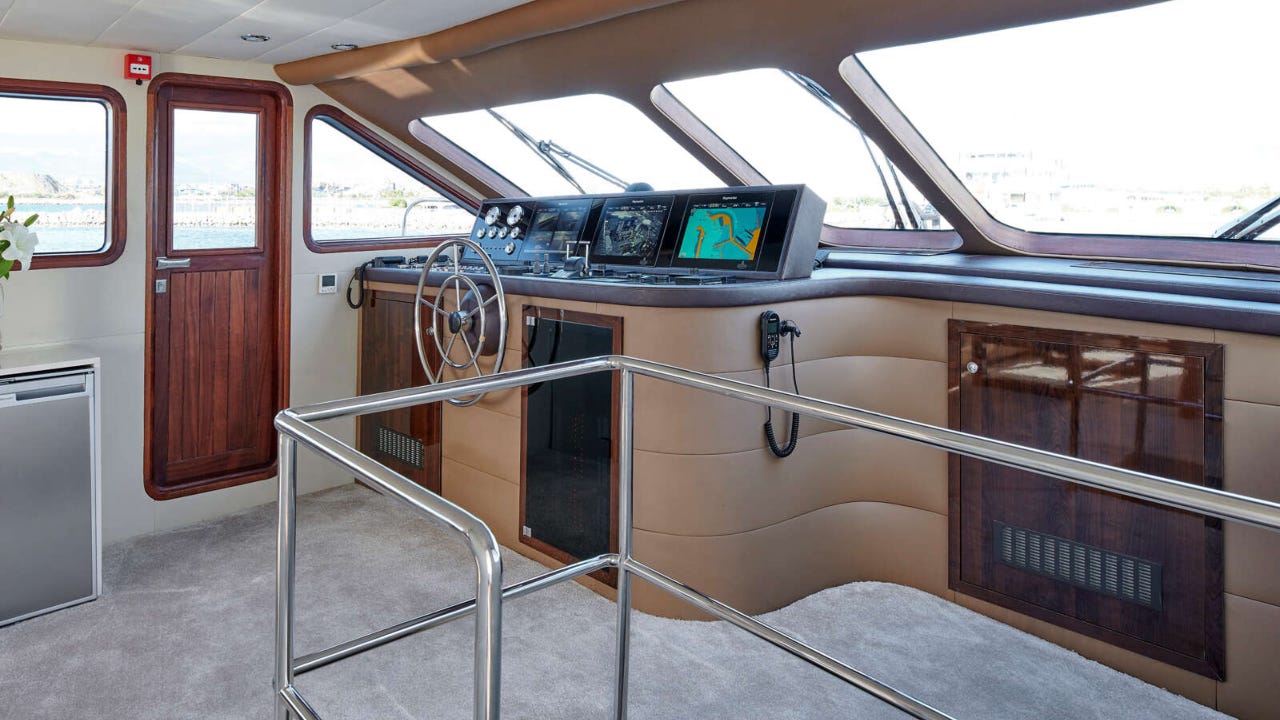
The second notable feature is the glazing on the forward face of the main deck. The windows are large, angled, and panoramic, wrapping around the forward superstructure in a sweep that would have looked progressive in 1992 and still holds up today. From inside the wheelhouse, the forward visibility will be exceptional. In a vessel used across the Mediterranean and Ionian, where the light changes dramatically between seasons and piloting in busy harbours demands full situational awareness, those windows are a practical asset as much as an aesthetic choice.
She carries three deck levels: the main deck with its guest and crew accommodation, the bridge deck housing the wheelhouse with an inside helm position, and the flybridge above for those days when the sun and the sea are too good to be inside. At 28 metres and with a beam of 6 metres, she is a substantial presence in any marina. The 2.20-metre draft is manageable, giving reasonable access to shallower anchorages while providing the stability that serious offshore passages require.
The Engines: Industrial Lineage, Mediterranean-Proven
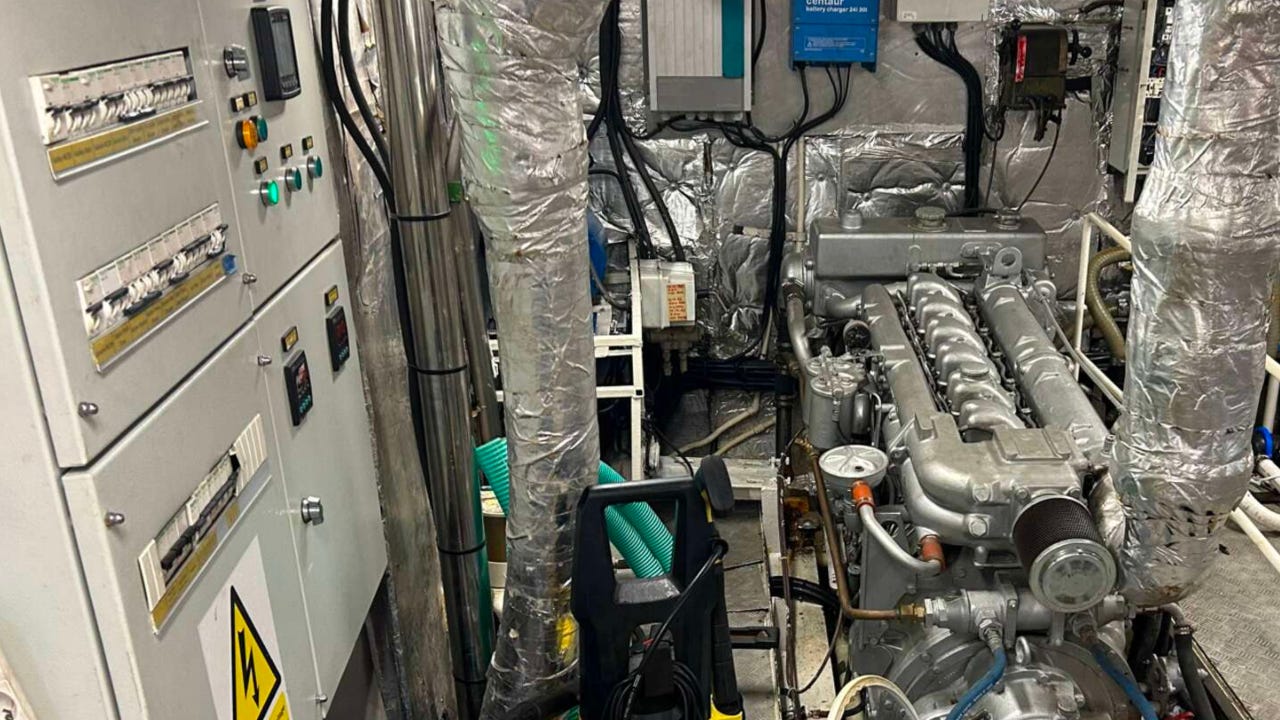
Power comes from twin MAN D2566 ME diesel engines, each producing 250 horsepower. If the designation means nothing to you, it is worth a brief explanation.
The D2566 is a six-cylinder, 11.4-litre turbocharged diesel from MAN’s workhorse D25 engine family, built specifically for marine propulsion. The ME suffix indicates the marinised specification. This is not a cutting-edge engine and it was never intended to be. The D2566 belonged to a generation of marine diesels designed to be mechanically straightforward, so, no common rail injection, no complex electronic management systems, no specialist diagnostics required to maintain them.
The practical implication for an owner in the Greek islands is that a competent marine engineer in Corfu, Athens, or any sizeable harbour in the Ionian will know how to work on these engines. Parts are obtainable throughout the Mediterranean basin through MAN’s dealer network and the independent marine diesel specialists who serve the wider commercial fleet.
MAN engines have built an exceptional reputation in the commercial maritime world. These are engines that have powered fishing vessels, workboats, and coasters through decades of demanding service. In an explorer yacht context, where duty cycles are typically lighter than commercial work, a well-maintained example of the D2566 is a reassuringly predictable proposition.
Both engines received a recorded overhaul in the sixth week of 2023. That is recent enough to be reassuring and old enough that any break-in period is well behind her. On a 1992-build vessel, those 2023 overhaul reports are documents I would request in full, specifically to understand what the overhaul encompassed, whether injectors and turbochargers were addressed, and what the current engine hours are.
Maximum speed is 12 kts with a declared cruising speed of 9 kts. Fuel consumption is listed at 100 litres per hour, a figure that buyers should interpret with appropriate context. That consumption is broadly consistent with what two 250-horsepower marine diesels of this generation will burn at or near cruise throttle settings. With 5,000 litres of fuel capacity aboard, a buyer doing the arithmetic will arrive at a practical range of roughly 400 to 450 nautical miles at 9 knots, assuming a sensible fuel reserve is maintained. For a vessel operating within the Ionian and Aegean, that range is more than adequate for island-hopping passages.
She is not configured as a blue water passage-maker; she is configured as a serious Mediterranean motor yacht, and the numbers reflect that.
Manoeuvring systems include both bow and stern thrusters, a sensible specification for a 28-metre, 6-metre beam vessel navigating the tight berthing situations common to Greek marinas in summer.
Twin ONAN generators provide the vessel’s electrical backbone, a 21.9-kilowatt primary unit and a 17-kilowatt secondary, giving the redundancy that any serious offshore owner should expect. A 150-litre-per-hour watermaker completes the self-sufficiency picture.
Got a boat?
Know of a vessel, for sale, charter, or otherwise, that you would like me to feature in a future dispatch? You can send me a direct message or email me via john@yacht-buoy.com
The Accommodation
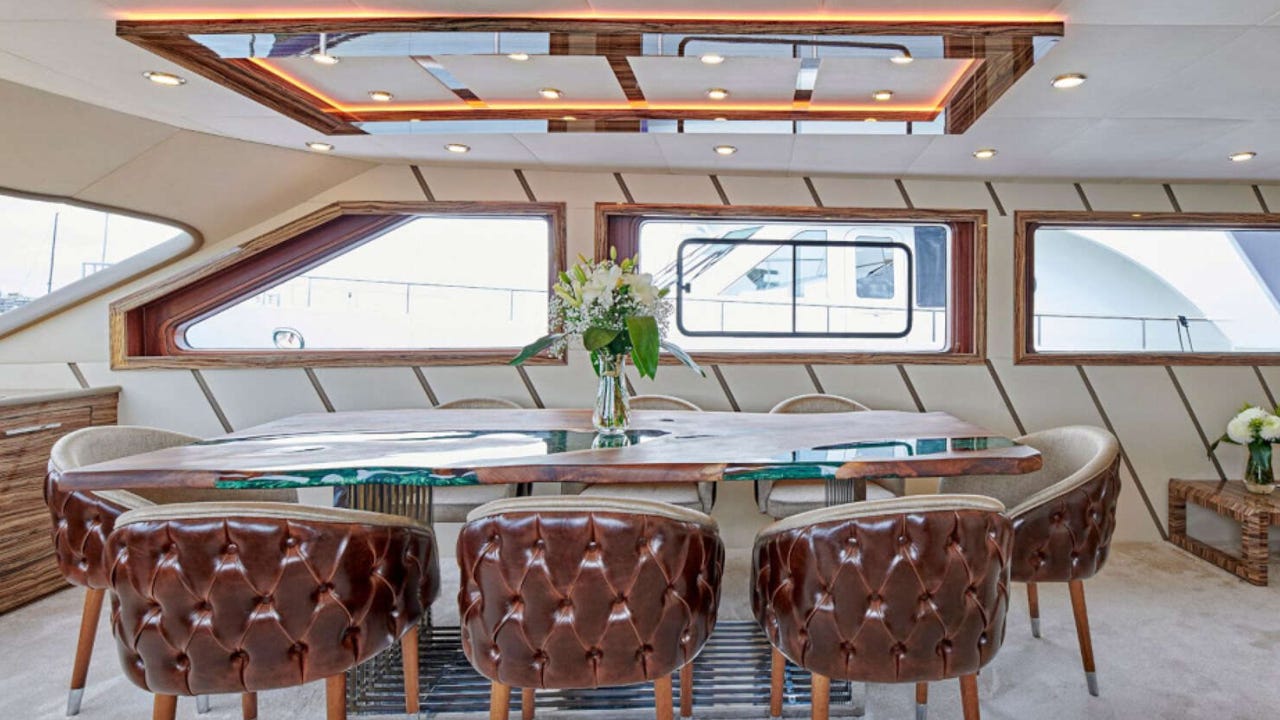
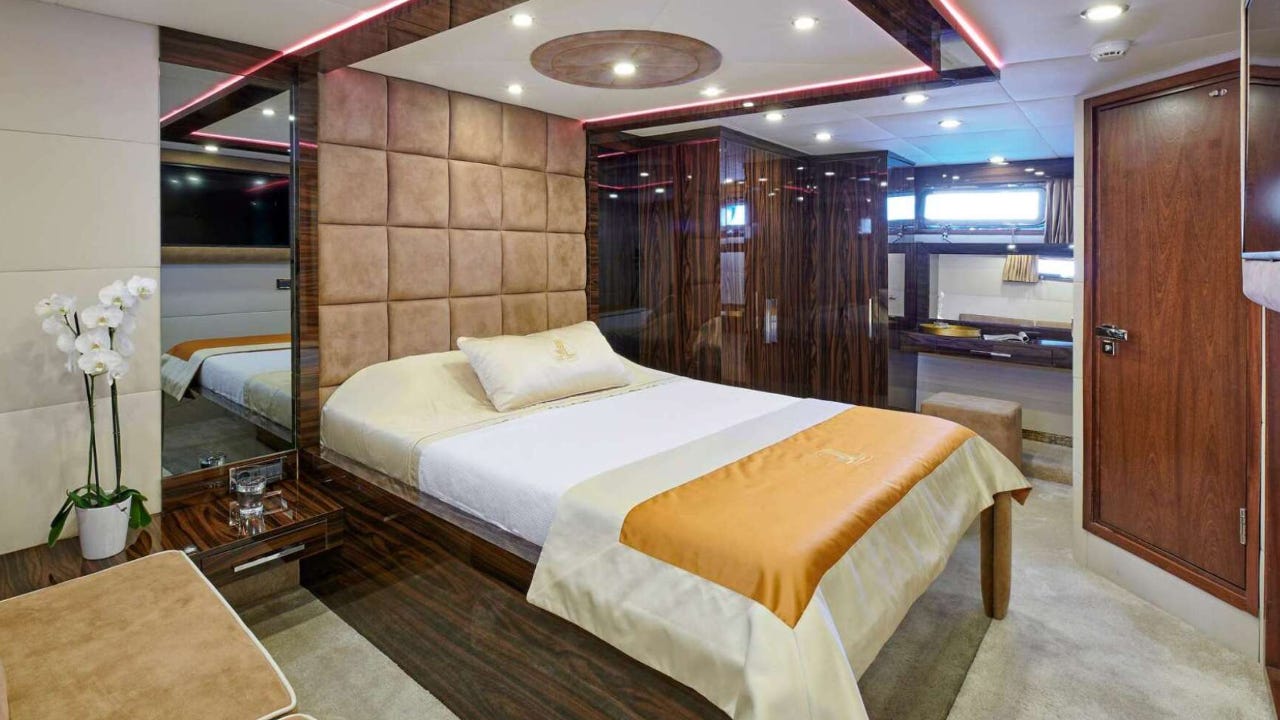
The interior received a complete refit in 2020. Five guest cabins sleep ten, with the owner’s cabin configured around a 160 by 200-centimetre double bed and an en-suite bathroom. The four remaining guest cabins share similar en-suite arrangements. Crew accommodation is entirely separate, with its own cabin, bathroom, and toilet, a configuration that matters both for a private owner planning to run the vessel with professional crew and for charter operators where crew and guest separation is a requirement rather than a preference.
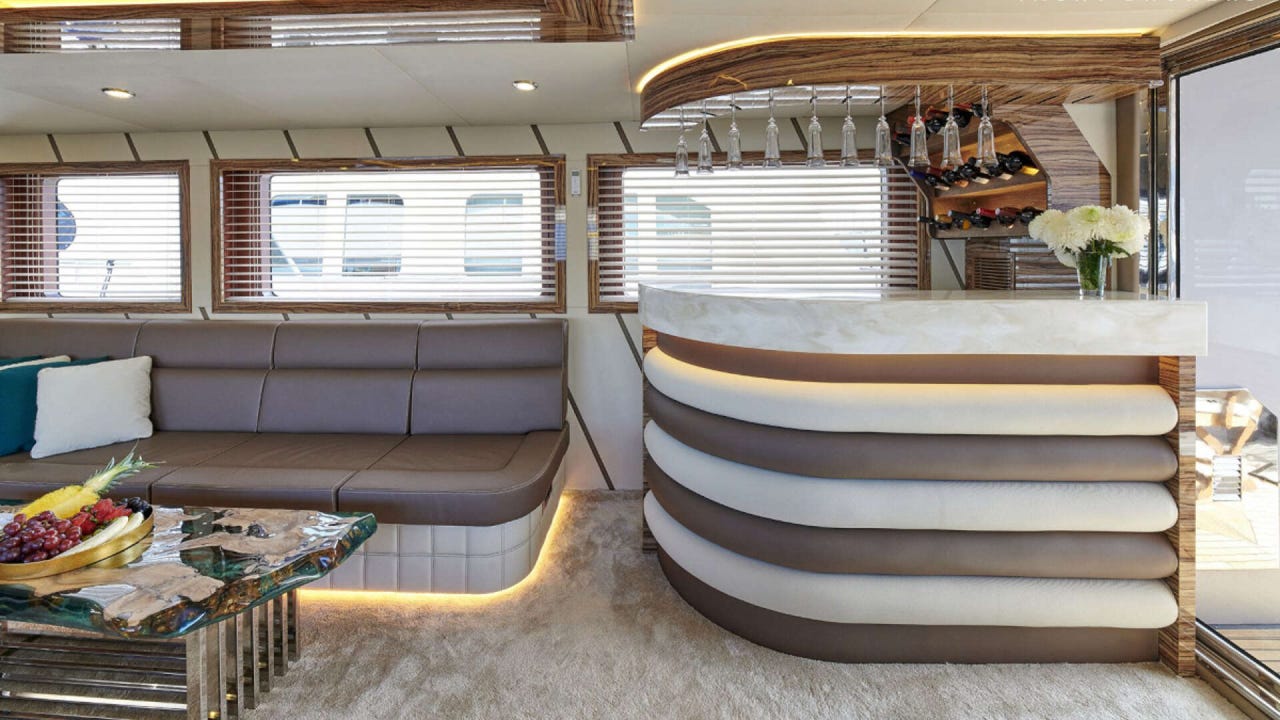
Headroom throughout is 2.05 metres. The galley carries a dishwasher, twin ice makers, a Nespresso machine (very important), and full crockery. Air conditioning runs throughout. Seven televisions and USB charging points in every cabin reflect the 2020 refit priorities. This is charter-ready specification, and the evidence suggests that is precisely how this vessel has been earning her keep. She has operated in the Eastern Mediterranean charter market under the name Wide Liberty, lying in the Corfu area and handled by De Valk’s Corfu office.
For a buyer who intends to offset running costs through charter income, that is a ready-made pathway. The infrastructure, the relationships, the market positioning; they are already in place. Whether that justifies paying a premium or whether the charter wear on a 33-year-old vessel requires deeper scrutiny is a question the survey will need to answer.
The Question a Steel Buyer Should Ask?
A 33-year-old steel hull is either a testament to disciplined maintenance or a reservoir of expensive surprises. The exterior photographs of the Torgem 92 are flattering, and the 2020 refit clearly addressed the cosmetics to a high standard. But a comprehensive refit in 2020 does not automatically mean the hull itself was addressed to the same depth as the interior.
If I were thinking about putting in an offer on this boat, then I would probably be asking questions like: Was the hull taken out of the water during the 2020 refit? Were ultrasonic thickness measurements recorded? Has the vessel been surveyed for structural integrity since? The antifouling was renewed in 2023, which confirms a recent haul-out, but an antifouling application does not constitute a structural hull survey.
A 34-year-old steel vessel is entering the critical inspection phase.
This is where the free preview ends. What follows is the complete ownership picture, and it contains a number that significantly changes the headline figure.*
The Wardroom is Yacht Buoy’s members area. For £75 per year, you get deep dives, financial breakdowns, and the information beyond the listing. If you enjoy finding out more about these boats, it pays for itself on the first piece of intelligence.
The VAT Situation: The Number Behind the Number
The Torgem 92 listing carries a note that deserves careful attention: VAT: Not paid [Article continues below paywall…]
