

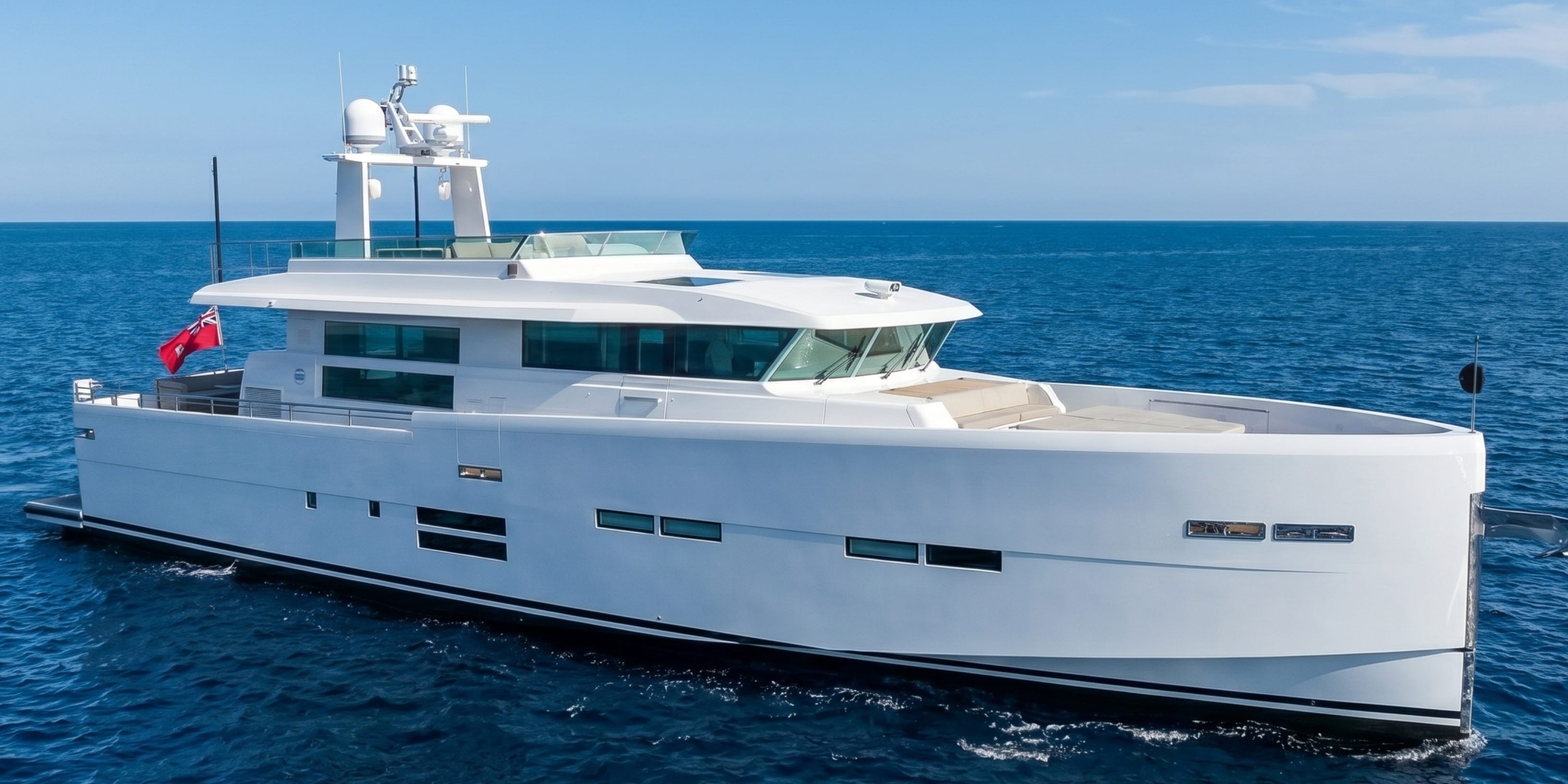
If you have just come from watching the video, you will already know what she looks like in person. But there is a great deal more to this vessel than a camera walkthrough can carry, and that is exactly why this article exists.
The Delta 88 Carbon is not a boat I expected to fall for. My world, as most of you know, leans heavily towards the displacement end of the fleet: expedition trawlers, steel passage-makers, vessels built for long, slow nautical miles in remote water. Speed has never been the primary criterion.
And yet.
There is something about the Delta 88 that is genuinely difficult to dismiss. She is not simply fast. She is efficiently fast, which is a different and more interesting thing. She is not simply modern. She is technically coherent, which is rarer than it sounds. And she is not simply beautiful, though she is certainly that. She has been thought through, from the hull up, with a clarity of purpose that I find hard to argue with.
This article is the companion read to the video. It goes where the camera could not: the engineering decisions behind the carbon superstructure, the yard that builds her, the number of these vessels that have actually been made, and the honest answers to the questions serious buyers might be asking.
The Yard Behind the Boat
Delta Powerboats is a Swedish company, founded in 2003 by a team that included designer Lars Modin and principal owner Lennart Alpstål. They had a combined three decades of boat-building experience behind them and a clear frustration with what the mainstream motor yacht industry was producing: heavy, fuel-hungry GRP vessels that performed modestly and aged quickly.
The early Delta range was modest in scope. Pilothouse boats designed for fast, comfortable island-hopping in the Scandinavian archipelagos. Good work, but not yet the engineering statement the team had in mind.
The watershed moment came in 2010, when Delta did something that had not been done before in production motor yacht building: they began building large vessels entirely from carbon fibre. The Delta 54 IPS became the world’s first serial-produced motor yacht built entirely from the material. The result was a vessel that consumed 40% less fuel than an equivalent GRP design at the same cruise speed.
Motor Boat & Yachting named it their Motor Boat of the Year in 2012. The industry took notice.
The 88 Carbon followed in 2014. It was, and remains, the flagship of the entire Delta range. Motor Boat & Yachting gave it their Motor Yacht of the Year award in 2015. For a yard building low-volume, high-specification vessels, two industry awards in 3 years is an impressive feat.
Today, Delta builds across a range running from smaller displacement trawler-styles up to the 88 Carbon at the top of the performance line. The carbon range alone covers the 48, 54, 60, 72, and 88. The brand markets itself, with some justification, as Scandinavia’s fastest-growing motor boat brand.
Where She Is Actually Built
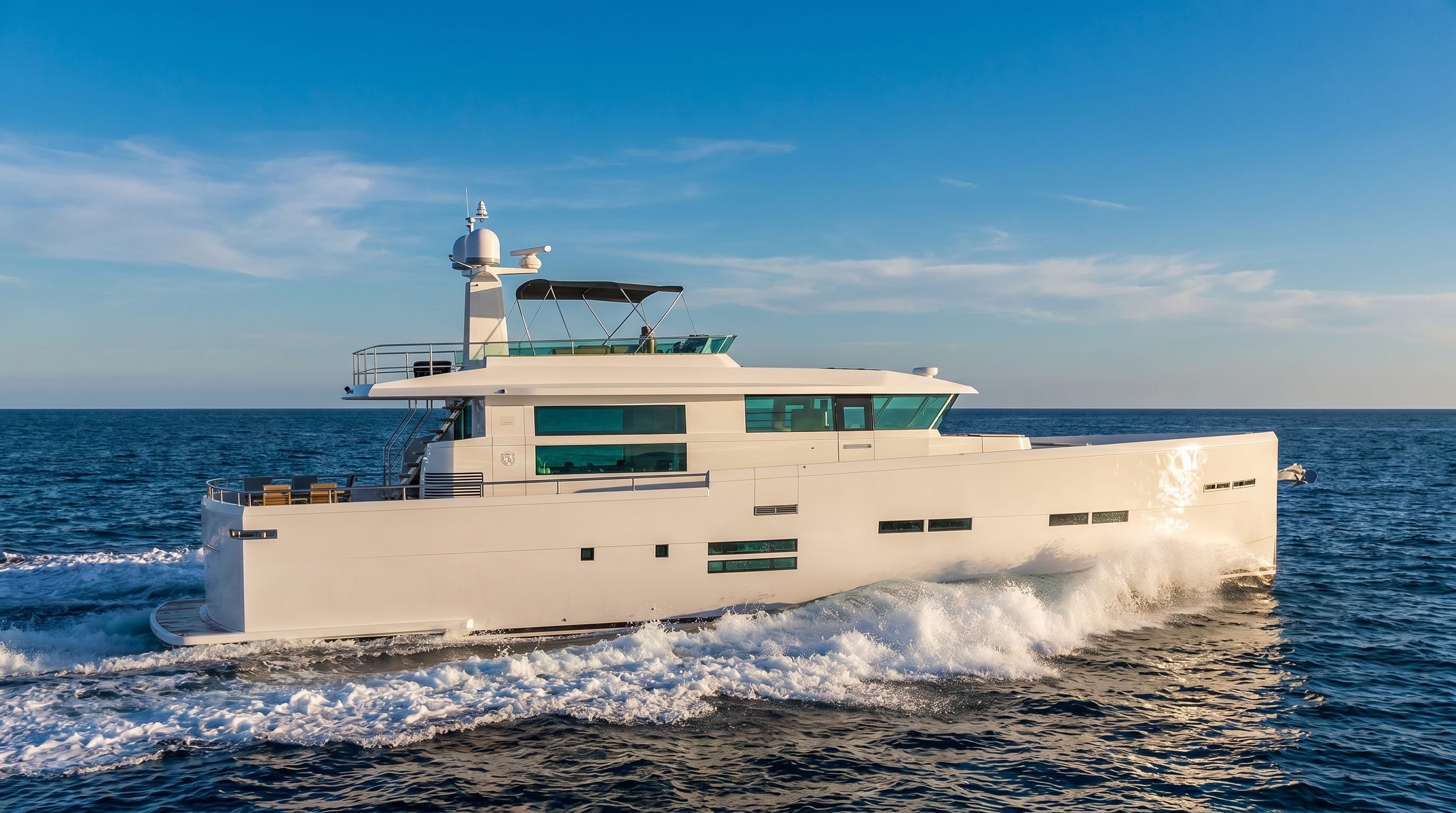
Delta is Swedish in design and philosophy. But the boats are built in Estonia, by a company called Luksusjaht AS, on the island of Saaremaa.
This surprises people. It should not.
Luksusjaht has been in operation since 1995. They are Estonia’s largest manufacturer of luxury yachts and sailboats, with a 15,000 square metre production facility, over 100 employees, and a 2025 turnover of €16 million. They have been running vacuum infusion processes for GRP and carbon fibre since 2006, which is longer than most yards in Europe. In addition to Delta, they build for Arcona Yachts and Dahl Naval, and they operate a subsidiary called MouldTech that produces structural moulds and components for third-party builders.
The choice of Saaremaa is straightforward economics combined with genuine technical capability. Estonian production costs are significantly lower than their Swedish equivalent. The labour is skilled. The yard has the infrastructure: 5-axis CNC milling capability up to 27 metres, in-house mould production, and a supply chain embedded in Northern European composite manufacturing. Delta get the quality they demand at a price that allows them to compete in a market where German and Italian yards have enormous economies of scale advantages.
I mention this not to diminish the vessel, but because it is a question buyers will ask. The answer is: the build quality is good. Luksusjaht’s vacuum infusion work on the Delta carbon range has been producing award-winning results for over a decade. The location is a business decision, not a compromise on craft.
How Many Have Been Built?
This is the question most people want answered first, and the honest answer is: not many.
Delta does not publish production numbers, and the 88 Carbon is not a vessel that appears in yacht registries with reliable frequency. The best available estimate, based on Delta’s own production statements and secondary market activity, is that fewer than 15 to 20 examples of the 88 Carbon have been delivered since the model launched in 2014.
For context: the model has been in production for over a decade. In 10 years, a mainstream GRP yard might produce 300 examples of a comparable vessel. Delta has produced somewhere between 12 and 20. That is not a volume play. It is a craft production approach, and it explains in part why the asking price is what it is.
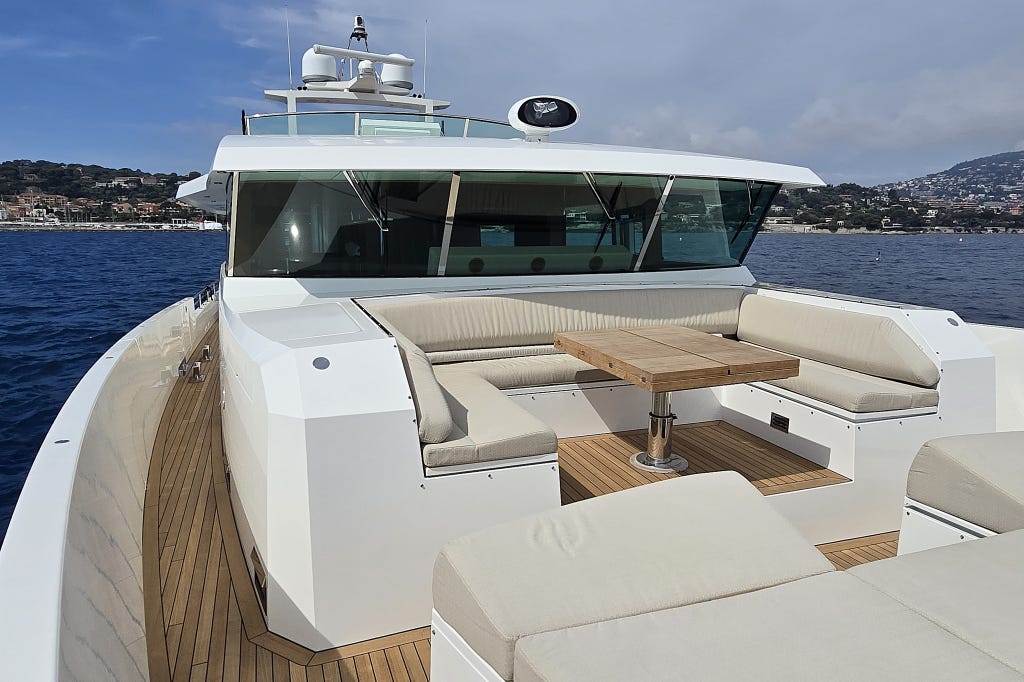
The vessel you have just watched on video is one of a very small number of these boats in existence. It is also one of only a handful currently available on the secondary market. If you are seriously interested, the scarcity is real.
Why Carbon Fibre? What It Actually Means
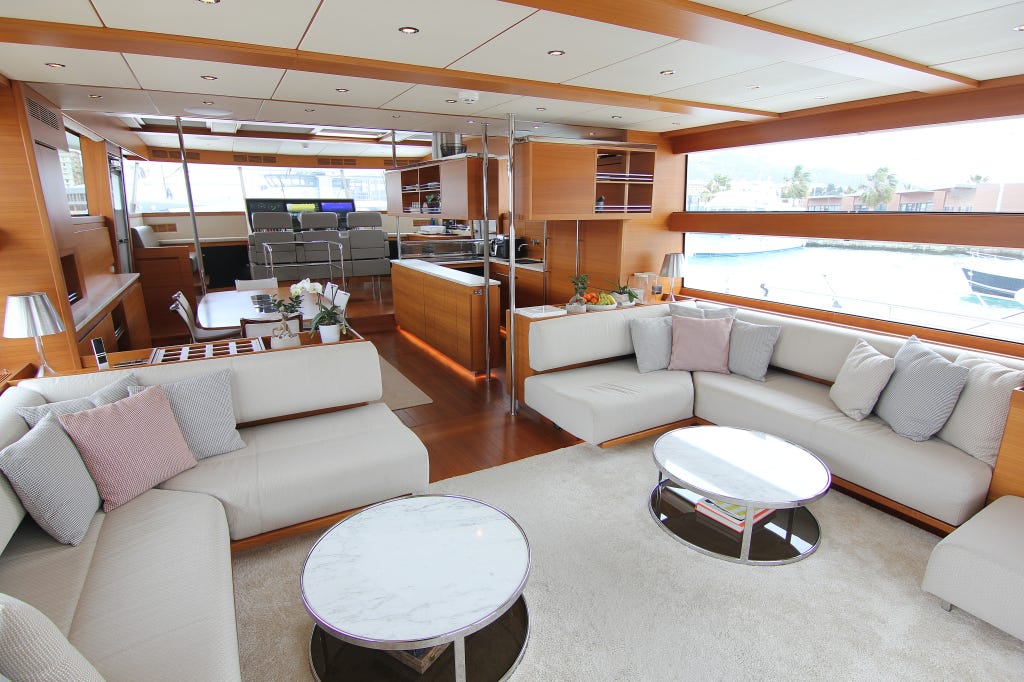
Carbon fibre is used throughout the 88 Carbon. Not just the deck and superstructure, as many buyers assume, but the hull, stringers, and bulkheads as well. Delta’s own specification is explicit: hull, stringers, bulkheads, deck, and superstructure are all constructed from vacuum infused carbon fibre composite, laminated according to Diab Core Infusion Technology. This is not a hybrid arrangement. It is a fully carbon vessel, from the keel up.
The construction method is vacuum infusion. Dry carbon cloth is laid into a mould, then resin is drawn through under vacuum, eliminating the voids and air pockets that weaken traditional wet-layup composites. The result is a material with exceptional strength-to-weight ratio and stiffness. Carbon fibre is approximately 25% lighter than GRP while matching or exceeding it in structural performance.
For a vessel of this size and speed ambition, the weight saving is not a detail. It is the design. A lighter superstructure lowers the centre of gravity, which improves stability. It reduces overall displacement, which allows a smaller, more efficient propulsion package to achieve the same or greater speed. And it reduces fuel consumption at cruise. Delta’s own benchmark is a 40% reduction in fuel consumption versus a comparable GRP vessel at the same cruise speed.
The Diab Core Infusion Technology referenced in Delta’s specification is worth understanding. Diab is a Swedish materials company that produces structural foam cores used in high-performance composite construction. In the infusion process, dry carbon cloth is laid over the foam core in the mould, and resin is drawn through under vacuum. The core provides stiffness and insulation; the carbon skins on each face provide strength. The result is a sandwich construction with exceptional stiffness-to-weight ratio, far superior to single-skin GRP or even single-skin carbon. Every major structural element of the 88 Carbon, hull included, is built this way.
For a vessel expected to cruise at 26 knots and touch 39 knots, that structural coherence is not an aesthetic choice. A hull that flexes absorbs energy and creates noise; a hull that is stiff transmits power to the waterline efficiently and stays quiet. At speed, the difference is felt immediately.
Got a boat?
Know of a vessel, for sale, charter, or otherwise, that you would like me to feature in a future dispatch? You can send me a direct message or email me via john@yacht-buoy.com
Carbon Fibre vs GRP, Steel, and Aluminium
Buyers considering a vessel of this type should understand what carbon fibre means in practice, not just in the brochure.
GRP is cheaper to build, easier to repair, and supported by virtually every boatyard on the planet. If you grind a fender against a dock and chip the gelcoat, any competent yard can fix it with materials from a local chandlery. The downside is weight, and with weight comes reduced speed, higher fuel consumption, and a higher centre of gravity. GRP is a mature technology and an excellent one. But it is not carbon.
Steel is the material of choice for expedition and commercial work because it is indestructible in relative terms, globally serviceable, and forgiving under impact. The disadvantage is weight: a comparable all-steel 26-metre vessel would be significantly heavier than the 88 Carbon, with all that implies for fuel consumption, speed, and performance. Steel also requires ongoing protection below the waterline, with epoxy and antifouling paint as recurring costs throughout the vessel’s life.
Aluminium offers a better strength-to-weight ratio than steel and does not corrode in the same way, but it is expensive, requires specialist welding, and can suffer from electrolytic issues if not properly isolated from dissimilar metals. The builder pool for aluminium is narrower than for steel or GRP.
Carbon fibre excels at weight, stiffness, and performance. The trade-off is cost of repair and the specialist access required to do it properly. This is not a material you can address with a kit from a chandlery. Delamination repair requires vacuum-bag lamination, compatible epoxy, and a technician who knows what they are doing. The repair network, while growing, is thinner than for GRP or steel, and the cost of a significant repair can be substantial.
For the buyer of an 88 Carbon, the maintenance requirement is not a deterrent. It is a known characteristic of the platform, and it should be budgeted for accordingly. What it means in practice: keep the vessel in good yards, inspect the superstructure regularly, and do not let minor impact damage sit unaddressed.
This article continues below, in “The Wardroom”
In the premium section, I cover:
- Carbon fibre maintenance in full: inspection methods, failure modes, what delamination actually costs to repair, and a direct comparison against what the same work would cost in GRP, steel, or aluminium
- The three Volvo Penta IPS-1350 pod drives: how the system works, what the service schedule looks like, what 1,150 hours means for the next owner, and what a drive leg failure costs to rectify
- The Seakeeper 16 and Humphree interceptors: how gyroscopic stabilisation works, what it weighs, how much power it draws, and why this dual-stabilisation package changes the onboard experience at every speed
- Liveaboard credentials: the full picture on the accommodation, Webasto climate control, Dometic watermaker, and Miele galley, with an honest comparison against the Nordhavn 62 and the Northern Marine 69 as a full-time home afloat
- Getting her to North America: the honest Atlantic crossing strategy, why 30-knot passages are not realistic on the northern route, the speed-versus-range trade-off in detail, fuelling stops, crew requirements, and timelines
- Getting her to Australia: the Suez Canal route via the Red Sea and Indian Ocean, what the full transit involves, and what a professional delivery from France to Sydney realistically costs
- My honest assessment of €3,950,000 asking price, as listed by White Whale Yacht Brokers (details below): where this asking price sits against the Sunseeker 88, the Princess Y85, the Ferretti 880, and the Azimut Grande 27M, and what a serious buyer should know before making an approach
