

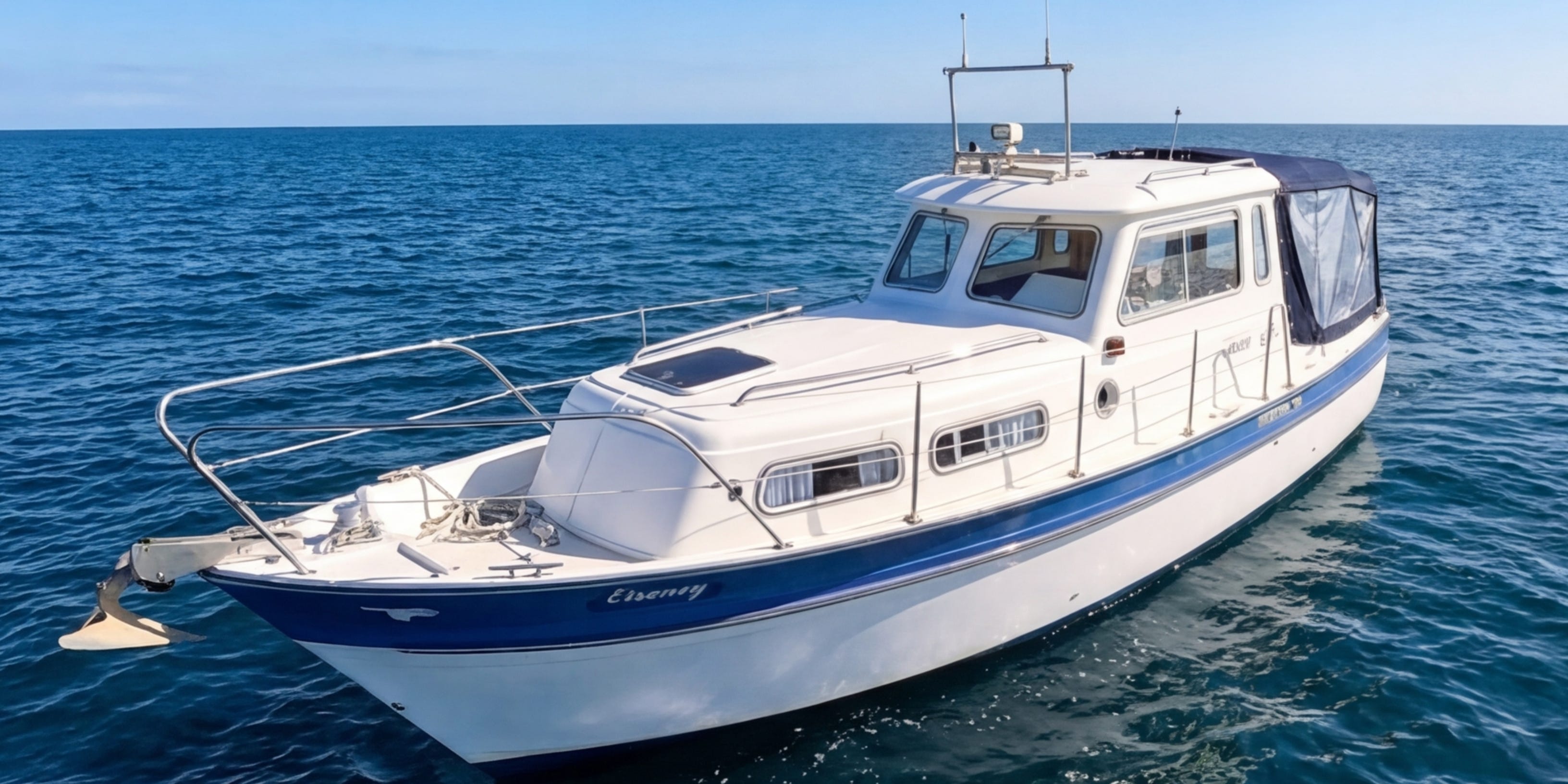
If you’ve watched the Hardy 27 video and clicked through to find out more, welcome. This is exactly the kind of boat that rewards a bit of digging, because what looks like a potential concern on the spec sheet — 2,050 engine hours on a 1994 diesel — turns out to be a very different story once you understand what those numbers actually mean.
The Hardy 27 has been a fixture of UK coastal cruising for decades, and ‘Eireney’ sitting at Burnham Yacht Harbour in Essex is a solid example of why these boats retain both their value and their following. At £34,950, she’s priced where the market expects a well-maintained 1994 example to sit. But price tells you nothing without context. What you really need to know is whether the engine is a concern, what it genuinely costs to run a boat like this, and what a proper survey should be looking for on 30-year-old GRP.
That’s what this piece covers. Let’s start with the number everyone notices first.
The Engine: Why 2,050 Hours Is Actually Good News
The Volvo Penta TAMD31D is one of the most reliable marine diesels ever fitted to a boat this size. It’s a turbocharged four-cylinder unit producing 100hp, designed from the outset for demanding continuous use. The TAMD series has a design life of between 5,000 and 10,000 hours under normal marine service conditions. At 2,050 hours, this engine is somewhere between 20 and 40% through its expected service life. In engine terms, that’s young.
But hours alone don’t tell the whole story. What matters just as much is the pattern of use. The listing notes that 2,050 hours across roughly 30 seasons of ownership works out to approximately 110 hours per year. That’s a weekend cruiser pattern. Regular use, probably May to September, getting out most weekends and maybe a week-long cruise each summer. This is actually the ideal usage profile for a diesel engine. They don’t like sitting unused for months, and they don’t like being thrashed constantly either. Steady, moderate use with proper servicing in between is exactly what keeps these engines going.
The fuel consumption claim in the listing (less than 4 litres per hour at 6 knots) is accurate. Independent data for the TAMD31D shows consumption of around 3.5 to 4.0 litres per hour at typical cruising speeds. That’s genuinely efficient for a 100hp turbo diesel from this era, and it’s one of the reasons these engines became so popular in coastal cruisers.
So the headline is this: 2,050 hours on a TAMD31D is not a red flag. It’s closer to a green one. The engine is well into its working life but nowhere near the end of it, and the usage pattern suggests it’s been looked after rather than worked hard.
That said, an engine with this history deserves a proper look at survey. Not because something is likely to be wrong, but because a £34,950 purchase decision should always be made with full information. Here’s what the survey should specifically cover.
The turbocharger is the first thing to scrutinise. Turbo seals on any 30-year-old engine are worth inspecting carefully; Blue smoke on startup or at idle can indicate seal wear, and a replacement turbo runs to £1,500-2,500 if needed. It’s not a crisis, but it’s worth knowing about before you buy. Cylinder compression is the other critical test. A surveyor with the right equipment can remove all four injectors and check compression across each cylinder, all four should read within 10% of each other. Any significant variance points to piston ring wear or valve condition issues that would need addressing.
The heat exchanger and cooling system are also worth close attention, particularly given the brackish conditions in the Essex waterways. Fresh water cooling systems protect the engine from the worst of it, but zinc anodes in the cooling circuit should show appropriate wear (replace them if they don’t). And at 30 years old, all the rubber hoses and belts should be considered for preventative replacement regardless of condition. Budget £400-600 for that work and consider it insurance rather than repair.
The recent rebuild of the seawater pump is a positive sign. Someone cared enough to do the job properly rather than ignore it. The new batteries in 2024 say the same thing. This is a boat that’s been maintained rather than deferred.
