

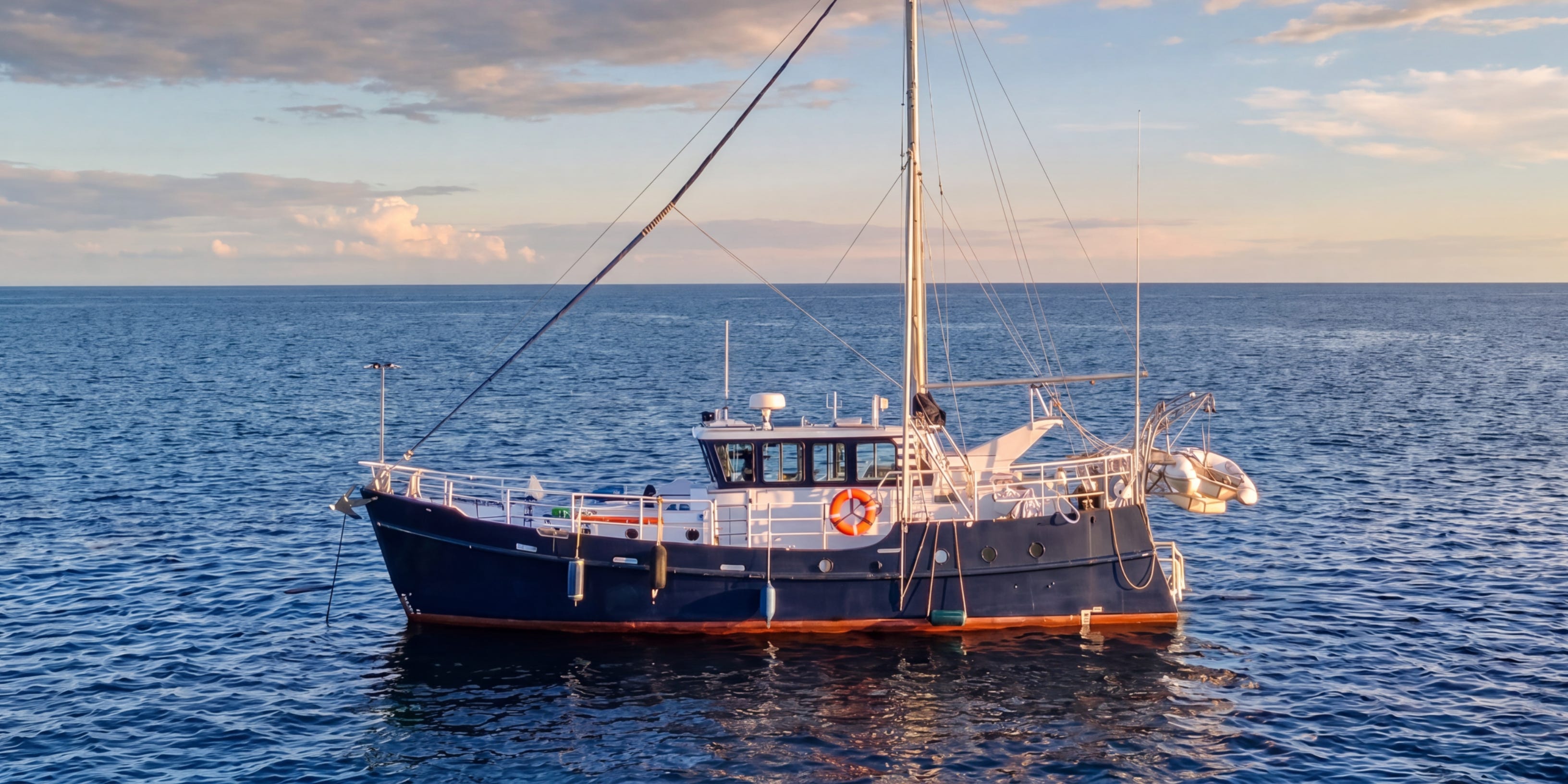
There is a particular kind of listing that stops you mid-scroll. Not because of glossy teak or a gin palace flybridge, but because the story behind the asking price is genuinely interesting. M/Y ‘Peking’ is one of those boats.
She is a Diesel Duck 462, hull number three of a very small production run, built by Seahorse Marine in Zhuhai, China, and commissioned in 2006 to the design of George Buehler. She arrived from the builder after two and a half years of construction and commissioning. Her original owner then spent the next 15 years sailing her in anger - east coast of the United States, the Caribbean, Central America, through the Panama Canal and up the Pacific coast to San Francisco. Eight thousand nautical miles, accumulated slowly and deliberately across a 10.5 years of genuine voyaging.
In 2024, a new owner acquired Peking with a specific goal in mind: the Northwest Passage. He relocated her to Ketchikan, Alaska, the natural staging point for any vessel heading north, and set about preparing her. New lithium battery bank. New solar array. Rebuilt heating system. Advanced navigation equipment. A Dickinson Antarctic diesel stove. He was methodical and thorough, and by all accounts Peking was closer to expedition-ready than she had ever been.
Then, due to unforeseen circumstances, he had to let her go.
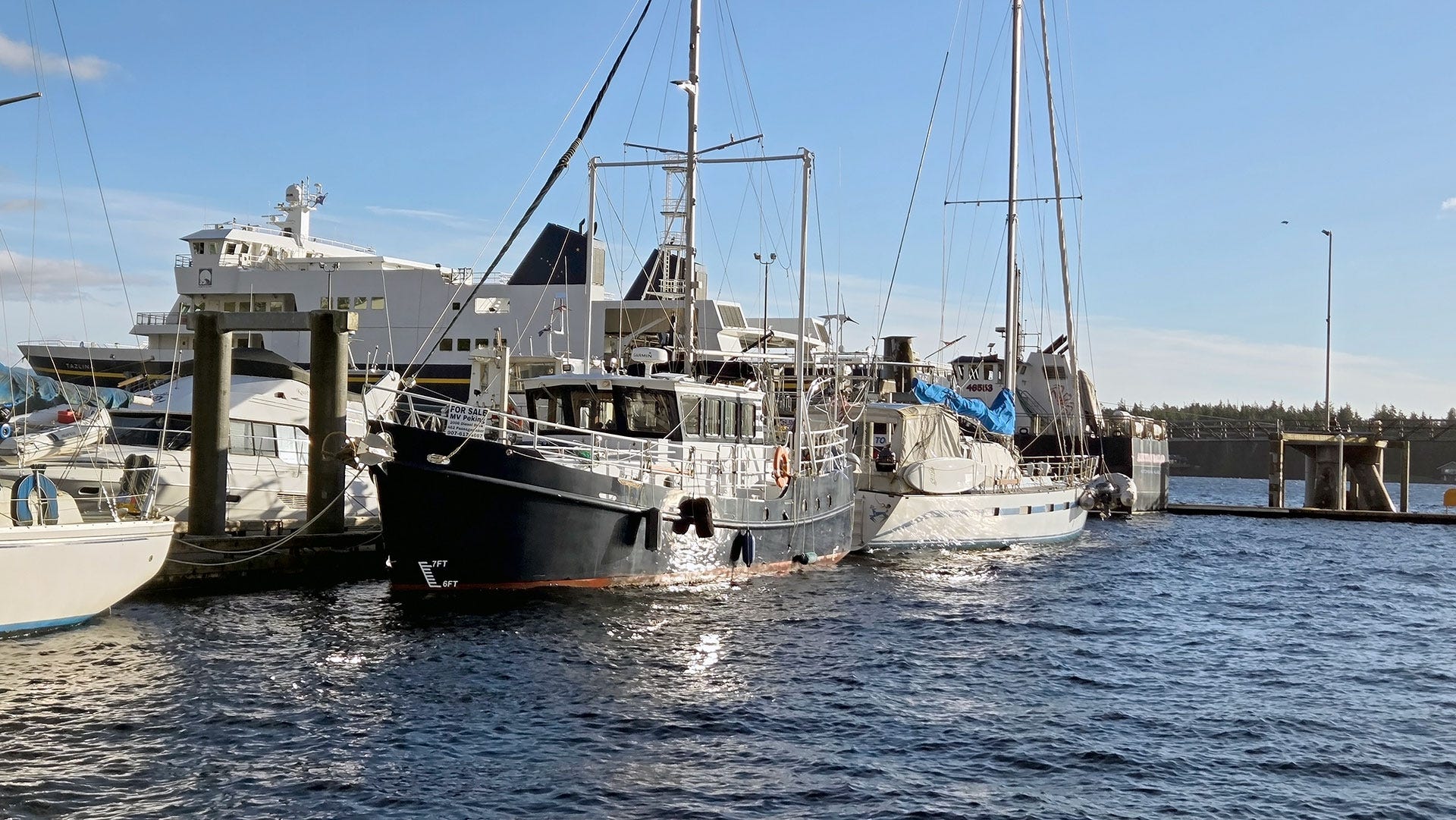
Peking is now listed with JMYS at $420,000, sitting fuelled in Ketchikan, pointed in the right direction.
What Is a Diesel Duck?
George Buehler was an American naval architect whose philosophy ran directly counter to the prevailing fashion for lightweight racing hulls and harbour-to-harbour coastal cruisers. Inspired by the salmon trawlers and fishing boats of the Pacific Northwest, he believed in heavy displacement steel construction, self-sufficiency at sea, and the practical redundancy of a sail-assist trawler over the theoretical elegance of anything faster or flashier. The Diesel Duck series, which grew from a 38-foot design in 1990 through variants up to the 462, was the fullest expression of that thinking. Buehler died in February 2018 at the age of 69, but the designs he left behind remain among the most copied and licensed yacht plans in the world. The 462 was the flagship of the range: his lifetime of accumulated knowledge in a single hull, built to cross oceans.
Peking won the People’s Choice Award at TrawlerFest in 2007, voted by actual cruisers and serious buyers, not a panel of judges. That is not a niche commendation. It is the trawler community telling you, in a single data point, that this is a boat they want.
The Numbers That Matter
At 50ft on the waterline, Peking displaces 80,000 pounds - 36 tonnes of steel, lead ballast, and purpose. Her beam is just under 15 feet, her draft 6 feet. These are not fashionable numbers. This is not a boat designed for marina living or Mediterranean anchorages. She is a displacement hull built to move across open water at a steady 5.5 knots, consuming fuel at a rate that makes most passage-makers look profligate.
The headline figure is her fuel capacity: 2,000 gallons across six steel tanks. At her published cruise consumption of just ONE gallon per hour, that translates to 2,000 hours of motoring range. The manufacturer’s stated figure is the more conservative 7,000 miles, accounting for reserves and a sensible margin. Either way, this is a boat that can cross oceans without refuelling.
Her ketch rig adds another dimension. Main and mizzen with roller furling sails on painted aluminium spars are not here for performance sailing. They are here to silence the engine offshore, extend range in favourable conditions, and provide genuine emergency propulsion should the John Deere ever require attention at sea.
Paravane outriggers with steel stabiliser fish complete the picture; a proven, low-maintenance stabilisation system that delivers a 50 to 70% reduction in roll motion in beam seas and swell conditions where active stabilisers would cost 10x as much to install. The combination of a well-formed displacement hull, paravanes, and sail plan makes Peking exceptionally comfortable in a seaway. That is not a trivial thing on a long passage.
This is a vessel designed around the assumption that somewhere, at some point, things will go wrong. Every primary system has a backup. That is not pessimism; that is expedition thinking.
Peking in the Water
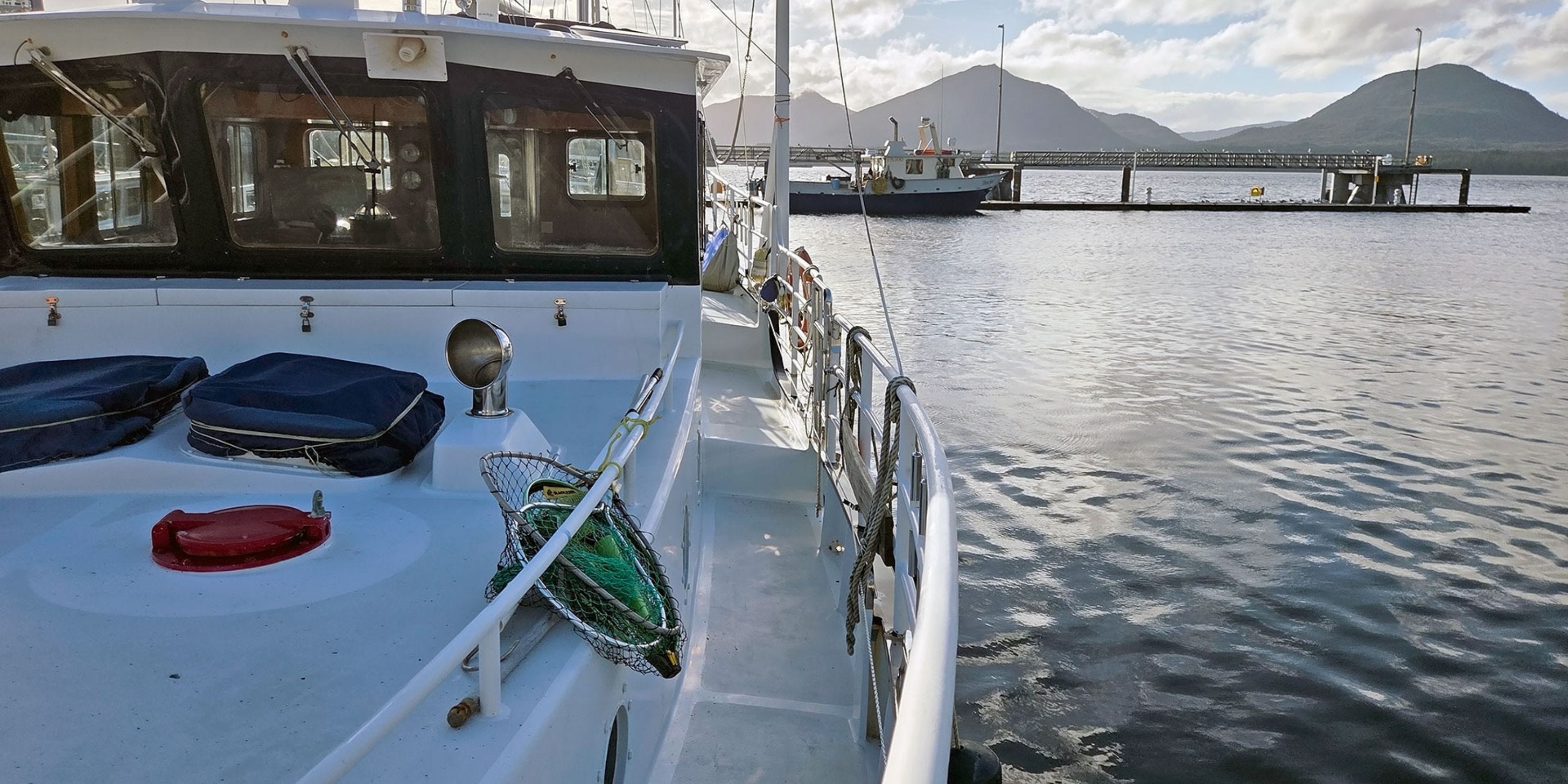
Walk-around decks, bordered by high steel bulwarks and robust railings, are an underrated feature on any offshore vessel. In serious weather, the ability to move safely around the deck without clipping on at every step matters considerably. The watertight bow bulkhead (secured with commercial ship-quality dogged-down hatches) and the four commercial aluminium dogged doors that create watertight compartments throughout the interior reinforce that this hull was built to the working end of the recreational trawler spectrum.
Forward, the ground tackle system is professional grade: a Muir Cheetah electric horizontal windlass with a primary Rocna-type anchor at 45kg on 300 feet of 3/8-inch chain, and a secondary CQR-type at 20kg as backup. In Alaskan or Arctic waters, where holding ground can be uncertain and conditions change rapidly, having a second anchor system properly rigged and ready is not a luxury.
The tender (a ten-foot AB aluminium RIB with a 15hp Yamaha outboard) sits on custom stainless steel stern davits. A Lewmar electric bow thruster handles close-quarters manoeuvring.
Got a boat?
Know of a vessel, for sale, charter, or otherwise, that you would like me to feature in a future dispatch? You can send me a direct message or email me via john@yacht-buoy.com
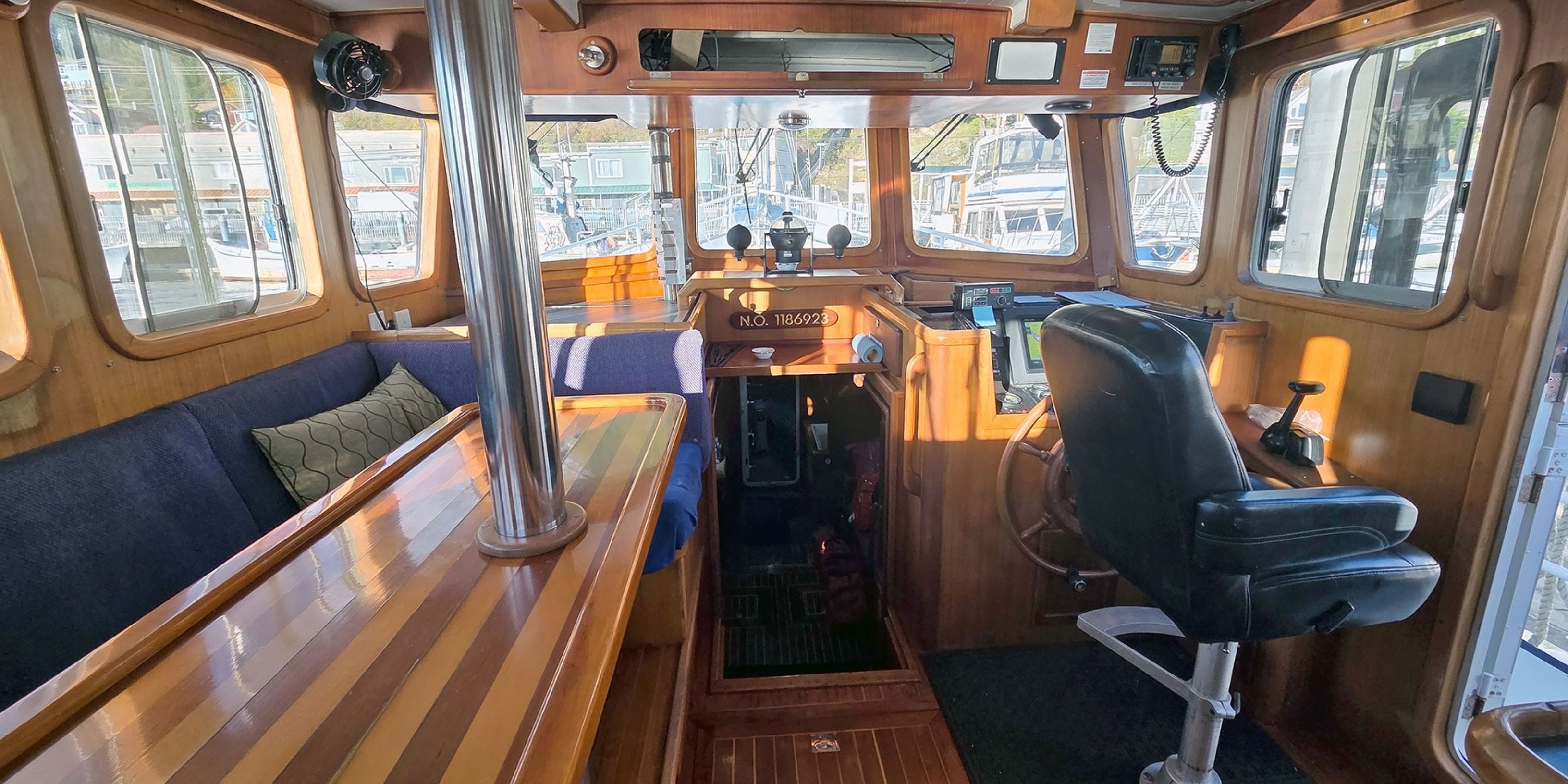
The Pilothouse and Interior
The raised pilothouse is the operational heart of Peking. Panoramic visibility in all directions through large opening windows, a chart table to starboard, and a U-shaped settee to port that converts to a single berth. The helm station carries a new Garmin MFD navigation system, installed in 2024 as part of the current owner’s expedition preparation. Access from both the aft cockpit and the starboard side deck.
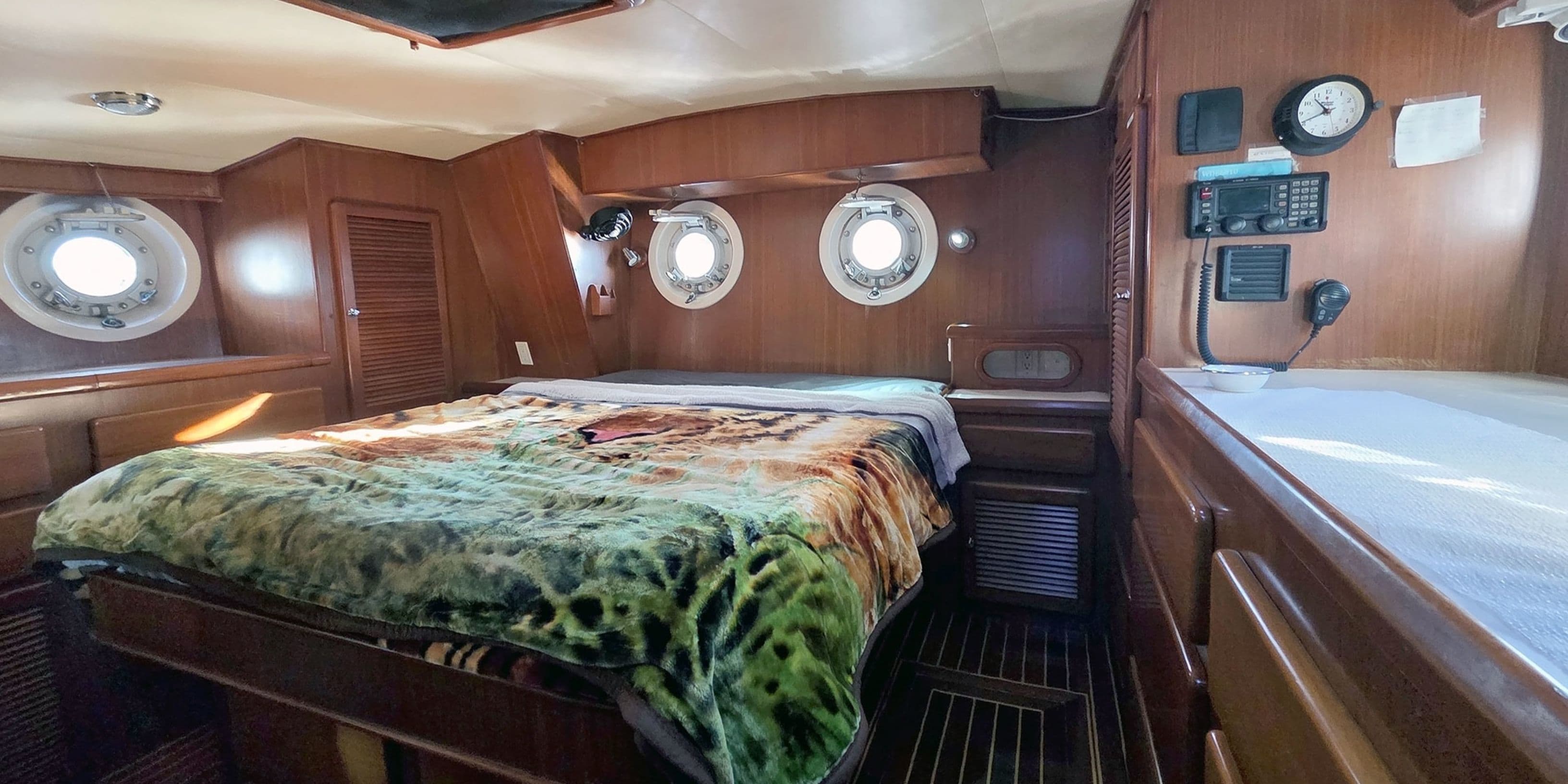
Below decks, the layout is a practical two-stateroom, two-head configuration. The owner’s cabin sits aft of the engine room with a queen-sized berth, en-suite head and shower, and hanging lockers both sides. The guest stateroom forward has twin bunk beds to starboard with a privacy curtain. Two Tecma freshwater toilets, two stand-up showers.
The galley runs along the port side of the saloon: Force 10 propane range and oven, Norcold refrigerator/freezer, Isotherm top-load freezer with holding plate, double basin sink, and granite countertops. Interior woodwork is teak and holly throughout, with granite in both heads. This is not the spartan fit-out of a working boat.
The engine room deserves specific mention. Six-foot ceilings and full walk-around access to the engine, generator, and workbench. On a 50ft boat this is not a given. Access without contortion means maintenance is attended to rather than deferred, which over the life of a vessel matters more than any single specification.
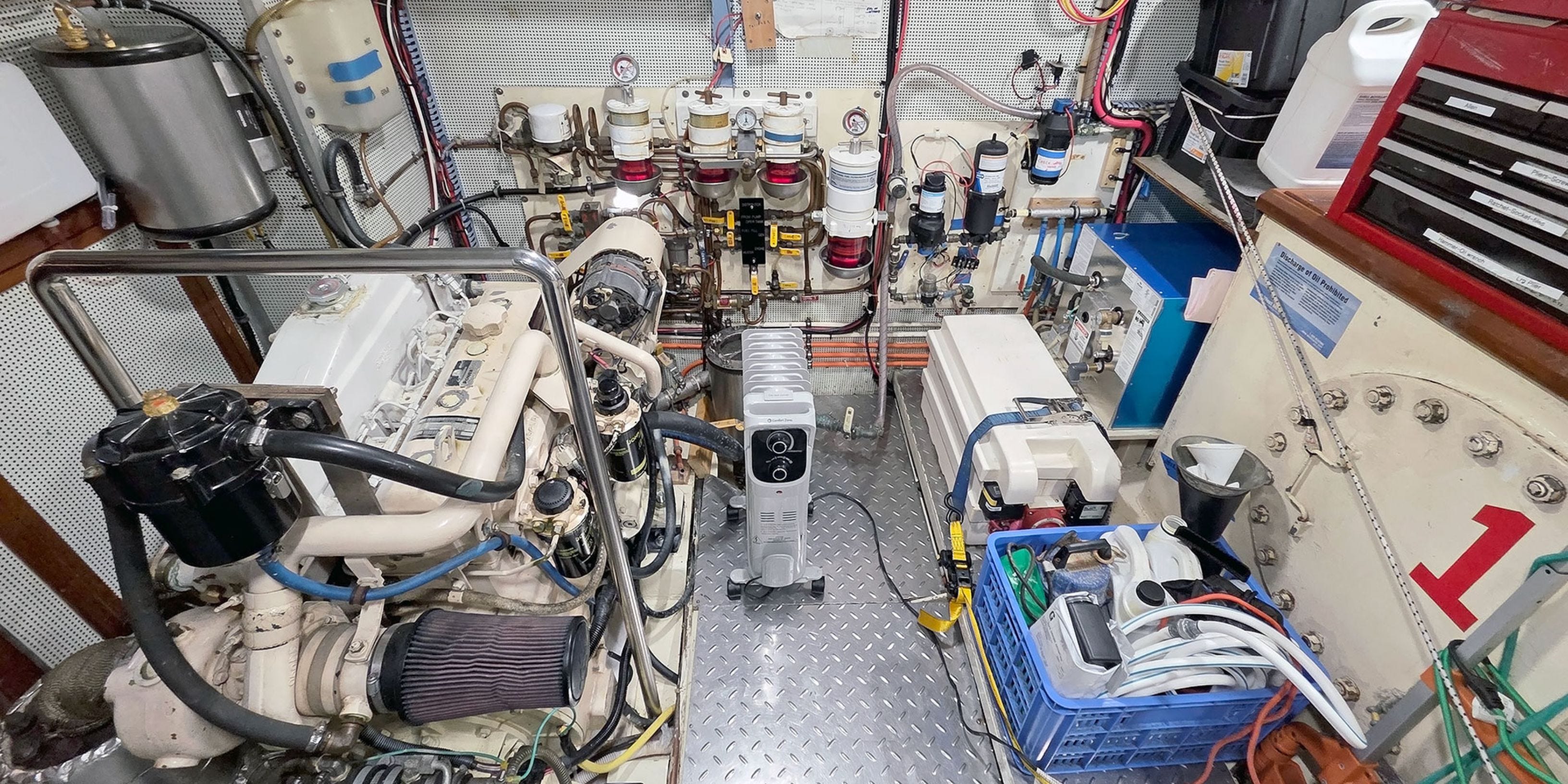
Climate control covers both extremes: Mermaid reverse cycle air conditioning for warm-weather passages, and the Dickinson Antarctic diesel stove installed by the current owner for Arctic operations. The rebuilt Webasto heating system provides additional warmth throughout.
Peking has crossed oceans, survived an ownership transition, been prepared for one of the most demanding voyages in the northern hemisphere, and is now waiting in the last major port town on the Inside Passage. The question is what a serious buyer finds when they look beneath the spec sheet.
In The Wardroom below, the premium section for paying subscribers, we examine the engine in detail inc what 3,550 hours on a John Deere 4045 actually means, and what a pre-purchase inspection could look like. We look at the power system upgrade, the details that I would look at before departure, what the Northwest Passage from Ketchikan actually involves operationally, and how Peking’s asking price compares to the alternatives in the current market.
The Engine: What 3,550 Hours Means…
The John Deere 4045TF at 123hp is one of the most trusted engines in the trawler world, and for straightforward reasons. It is a mechanically governed, turbocharged diesel derived from John Deere’s industrial and agricultural heritage, not a purpose-built marine unit, but a workhorse that has found its way into hundreds of cruising vessels precisely because it is uncomplicated and durable. The fuel injection system uses replaceable pintle injectors rather than the common-rail electronics of modern engines, which means field repairs are practical rather than theoretical.
