

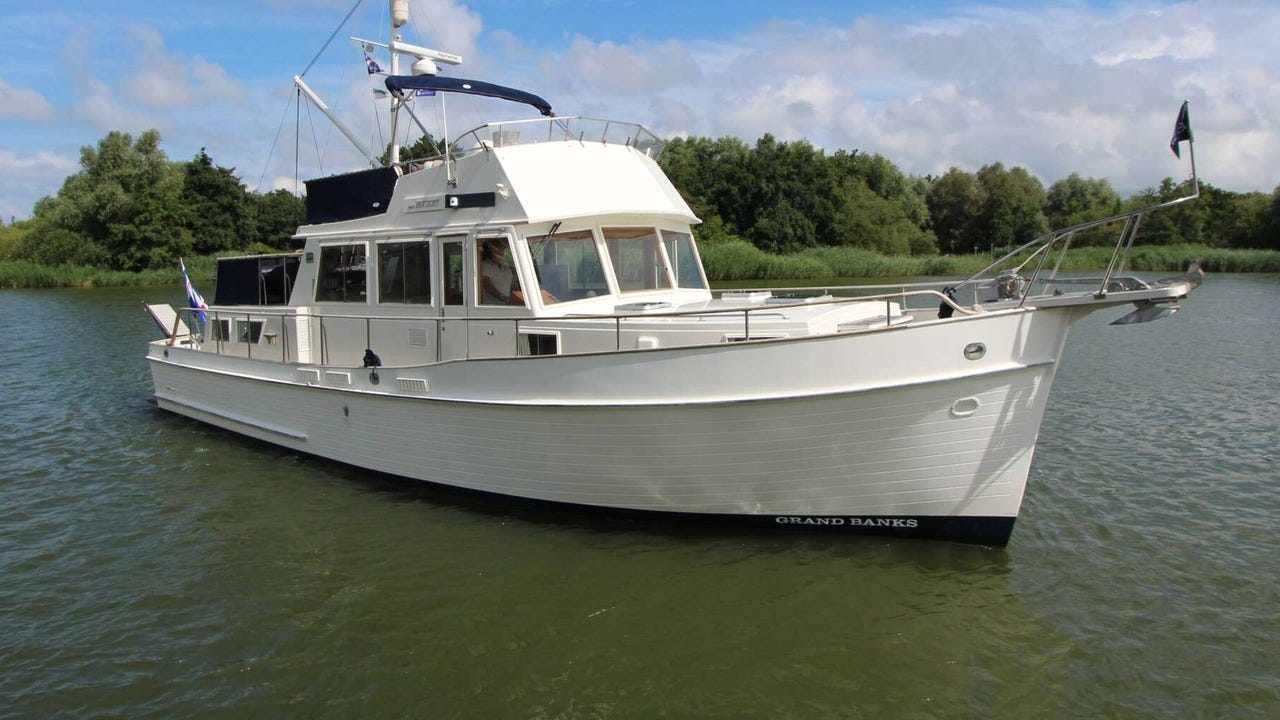
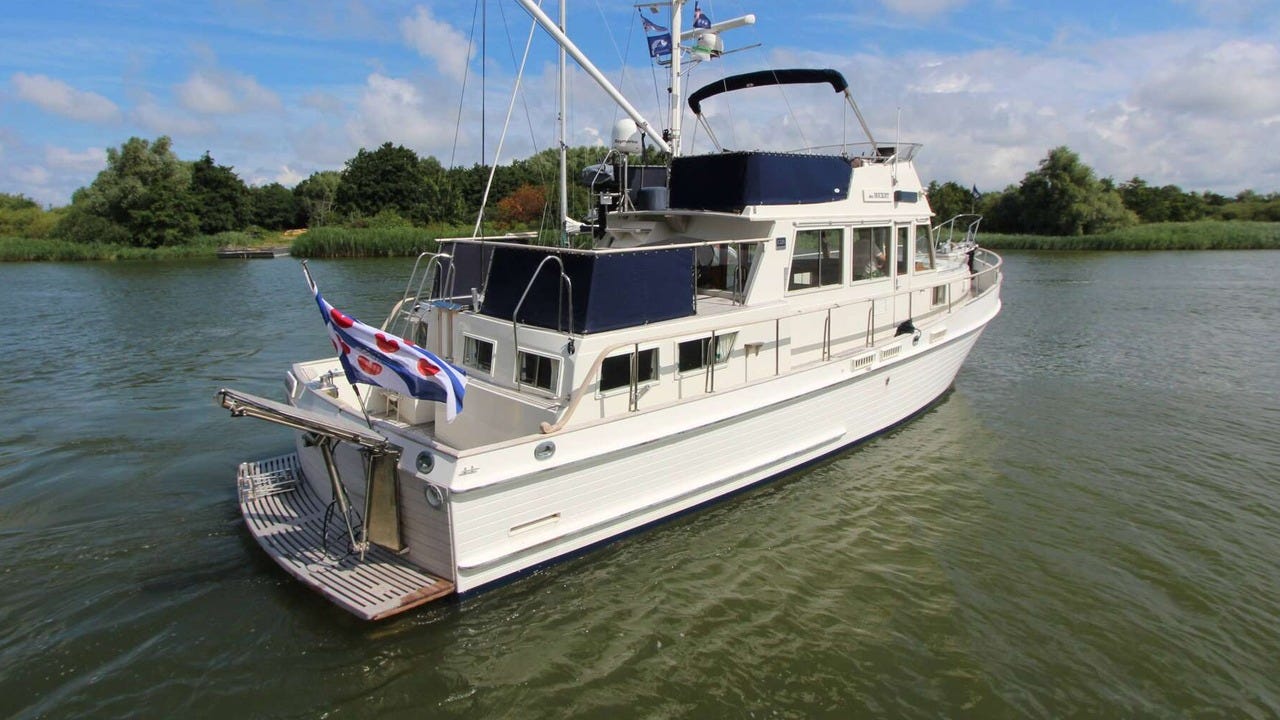
If you have just come from my YouTube video, you already know what she looks like. You have seen the flybridge, the teak decks, the twin Cummins diesels in the engine bay, and the kind of interior that makes you understand immediately why Grand Banks built a cult following that has lasted more than 60 years. What the video could not cover, and what I promised to get into here, is the research I would do if I were genuinely thinking about making an offer on her myself.
First, I want to work out her range. Also, I want to understand what she would cost to run, which is a different question to what she costs to buy. I want to think about what life aboard her would actually look like day to day, because a Fisher Panda generator and 600 litres of freshwater tells you something, but it does not tell you everything. And because I know I have readers in North America and Australia who always ask very specific questions, I have worked out what it would realistically cost to ship her across and what you would need to do to make her legal and practical in those waters.
The boat is a 1988 Grand Banks 46 Classic, listed by De Valk Sneek in the Netherlands at €169,000 VAT paid with Peter Spruyt as the listing broker (+31 (0)515 42 80 30). She is currently sitting in their covered sales marina, which is worth noting: she has been looked after, not left exposed on an open pontoon somewhere. Her name is Mrs Bucket, and I find that quietly brilliant for a Grand Banks.
What Grand Banks Actually Is…
Before we get into her numbers, it is worth spending a moment on the brand itself, because if you are new to the world of trawler yachts (welcome aboard!), Grand Banks is one of the names you will keep encountering, and there is a reason for that.
Grand Banks Yachts was founded in the 1950s by an American expatriate, Robert J. Newton, working in Hong Kong under the company name American Marine Ltd. The boats were designed to do something that sounds deceptively simple: go a long way, slowly, comfortably, and reliably. The 1965 Grand Banks 36, designed by naval architect Ken Smith, launched a movement. Over 1,100 were built, and most are still sailing today. That is not only an impressive production statistic; that is also a longevity record. By the 1980s, production had expanded to Malaysia, the range had grown, and the 46 Classic had arrived.
What set Grand Banks apart in an era when production boatbuilding was racing toward lighter, faster, and, sometimes, cheaper was that they went deliberately in the other direction. And fair play to them for doing that. The teak interiors were teak, fitted by craftsmen who took their time. The GRP hulls were laid up with real thickness. The engine bays were designed to be worked in, not merely opened with a torch. The fuel tanks were sized for passages, not day trips.
The 46 Classic was in production from 1984 into the early 2000s, and over 300 were built. It exists alongside the Heritage and Europa variants, which offer different cabin arrangements on the same hull, but the Classic is the most straightforward of the three. It looks like what it is: a beautiful trawler-style yacht, designed to go somewhere slowly, comfortably, and reliably. That simplicity is why there is still an active owner community decades later, why the pre-owned market holds its value, and why a well-maintained 1988 example at €169,000 is not a gamble.
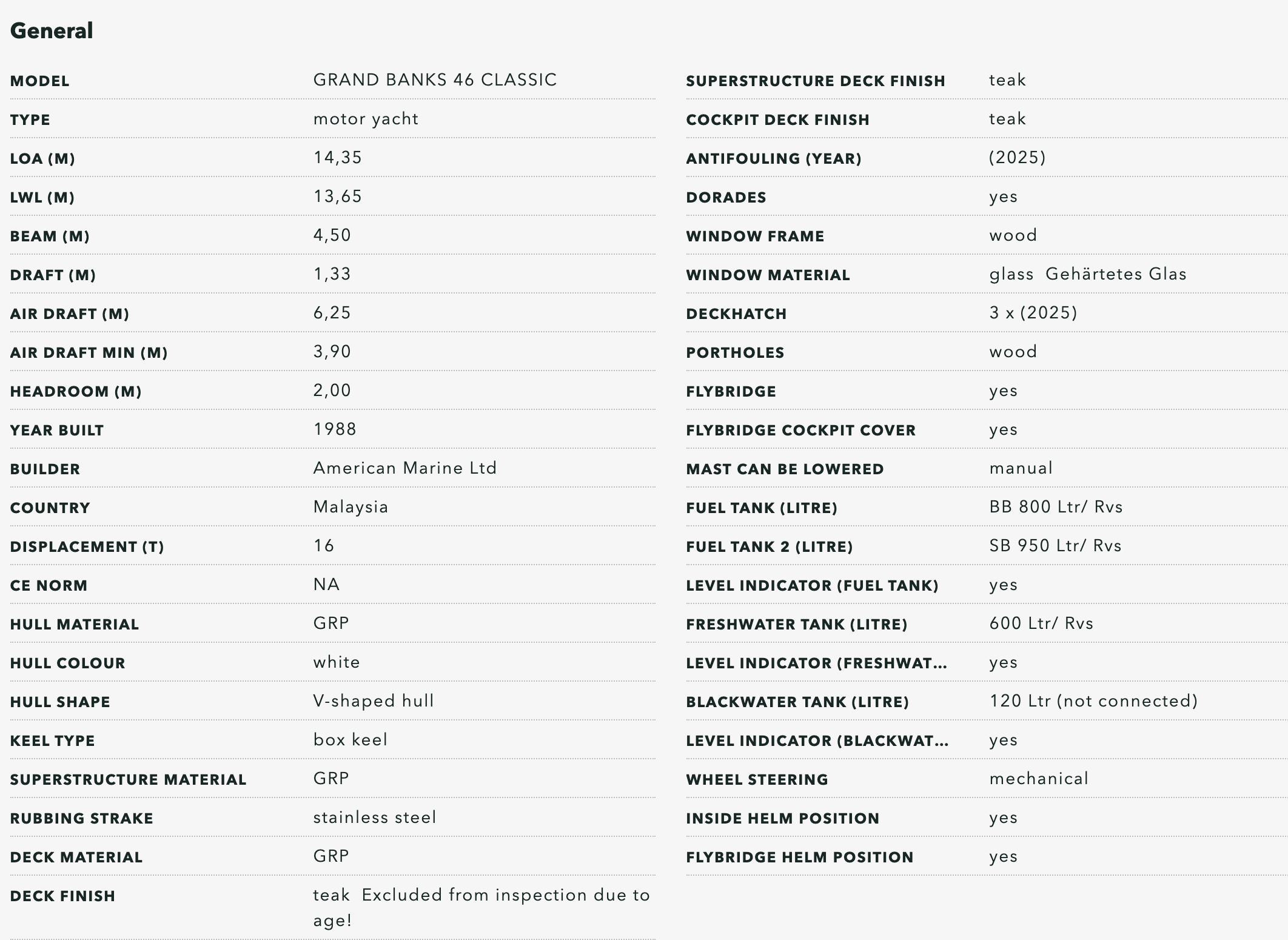
This particular boat was built in 1988. She is GRP on a V-shaped hull with a box keel, 14.35 metres LOA, 4.50 metres beam, 1.33 metres draft. The listing records 2,812 hours on the port engine and 2,800 on starboard. For a pair of Cummins 6BTA5.9M diesels, those are low hours. We will come back to that....
A Note on My 2023 Grand Banks Video
Some of you who have been watching the channel for a while will remember that back in 2023, I filmed a very similar Grand Banks, and that video has since picked up 746,000 views, which tells you something about how much enthusiasm there is for these boats. The two vessels are not identical; the specification evolved across the production run. But they share the same hull, the same design philosophy, and most of the same operating characteristics. Between the two videos, and this article, you should get a thorough picture of what owning a Grand Banks 46 of this generation actually involves.
Her Liveaboard Credentials
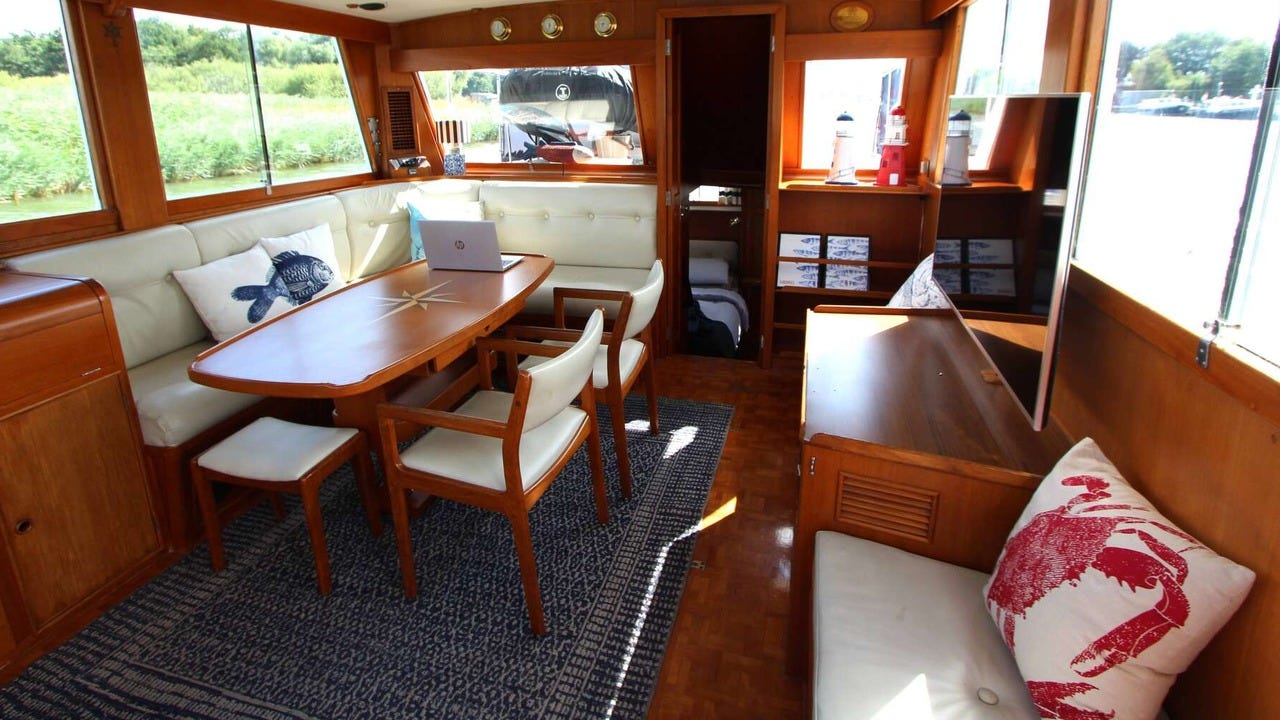
Two cabins and four berths is the headline. But when I am looking at a boat seriously, I want to understand what those numbers mean in practice, not just count them.
The owner’s cabin is aft, which on a displacement trawler is where you want to sleep: lower in the hull and further from the engines, which is the most comfortable position when there is any motion. It has a French bed at 2.10 metres, which is a decent double. There is an en suite toilet, electric, replaced in 2025, so that is current and working. The shower in the aft cabin is listed as not connected.
The forward guest cabin has a V-berth at 2.00 metres with an en suite head and a decent size shower. Two couples can share this boat and maintain their privacy. That matters more than it might sound on paper.
The galley has an induction cooker, which is interesting on a boat with this much generator capacity. The Fisher Panda 6kW generator was installed or refurbished in 2021, now 4 years old, so the service life is ahead of it rather than behind. Combined with three Victron 200Ah service batteries and a Mastervolt inverter and charger at 3,000 watts, she has the electrical infrastructure to run induction cooking properly. That is a meaningful upgrade on older trawlers still relying on gas, particularly for liveaboards thinking about safety below decks.
The Webasto system serves double duty: ducted hot air throughout the accommodation, and the same unit provides the fridge and freezer. The Dometic air conditioning covers the other end of the temperature spectrum. For a boat you intend to use year-round in northern European waters and cruise south in the summer, that combination is close to ideal.
Got a boat?
Know of a vessel, for sale, charter, or otherwise, that you would like me to feature in a future dispatch? You can send me a direct message or email me via john@yacht-buoy.com
Freshwater at 600 litres is respectable. A couple living aboard and being reasonably careful can typically make 100 litres last 3 to 4 days, which means somewhere between two and three weeks of comfortable daily living without a marina fill-up. The one thing I would want to add if this were mine is a watermaker. She does not have one as standard, and 600 litres goes fast if you are living aboard and cruising seriously. For coastal work where fill points are regular, it is manageable. But if I were planning extended passages or genuinely remote anchorages, a watermaker would be the first thing on my refit list. A Spectra or Katadyn unit typically comes in at €2,000 to €4,000 installed, and the electrical infrastructure on board would support one without any modification.
There are a couple of other practical things I would want to understand if I were thinking about making an offer. The blackwater tank is 120 litres but the spec sheet lists it as not connected. European marina and inland waterway regulations around holding tanks are tightening, so its worth keeping this in mind, if relevant to your cruising itinerary.
The hydraulic and electric gangway also caught my nautical eye. On a 14-metre boat that is not a standard fitting, and for me it says something useful about how the previous owner thought about this boat. She was lived in and used, not just shown at boat shows.
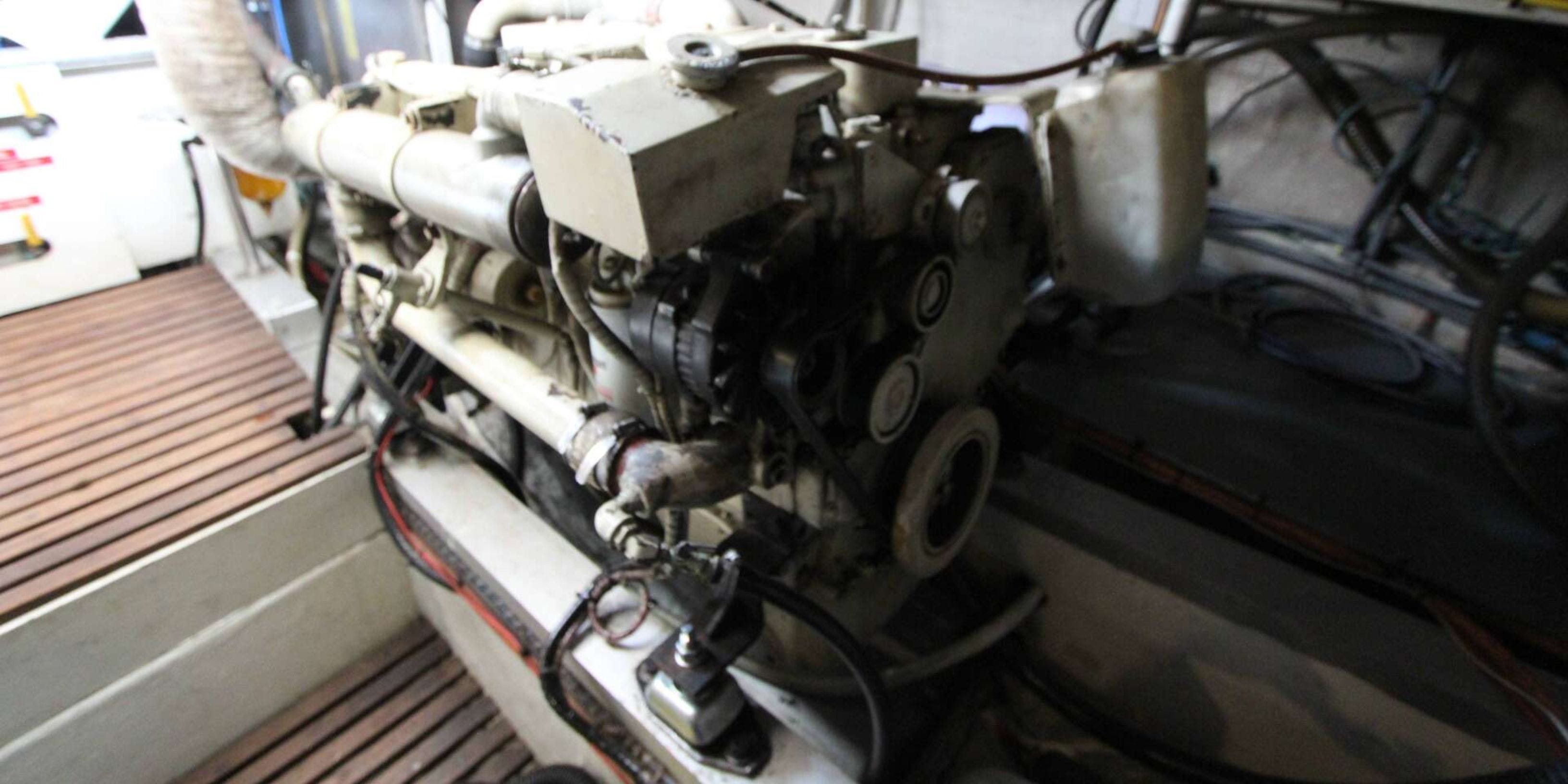
Her Range
The brochure lists no range figure. That is fairly typical for a brokerage document. However, after years of doing this, I know that you, my readers, would like to know how the figures could stack up. So here is how I have done it.
Mrs Bucket carries 1,750 litres of diesel across two tanks: 800 litres to port and 950 to starboard. Allow a 10% reserve, which you should always carry and never plan to use, and you have approximately 1,575 litres of usable fuel.
Her engines are twin Cummins 6BTA5.9M diesels, each producing 210 horsepower. The 6BTA5.9M is a 5.9-litre, six-cylinder turbocharged and intercooled unit with a very well documented fuel consumption curve. At typical displacement cruising revs for a boat this size, the combined burn from both engines works out as follows:
At 7.5 knots, running at around 1,100 to 1,200 RPM, she burns approximately 14 litres per hour across both engines. On 1,575 litres of usable fuel, that gives her a range of around 720 nautical miles and an endurance of around 112 hours, just under five days of continuous running.
At 9 knots, a comfortable trawler pace and the kind of speed you would settle on for a passage, she burns approximately 18 litres per hour combined. Range drops to around 560 nautical miles, endurance around 88 hours.
Push her to 10 to 11 knots, which is approaching the upper end of what a displacement hull of this size wants to do, and fuel burn climbs sharply to 28 to 32 litres per hour combined. Range falls to 315 to 420 nautical miles. There is nothing wrong with running her at that pace for a day to catch a weather window, but it is not the speed she was designed to cruise at, and the numbers reflect that.
The practical point is this: at a sensible 8 to 9 knots, Mrs Bucket has the range to cross the English Channel to the Netherlands and keep going to the Azores, or to cruise the entire British coast without a fuel stop, or to make a proper passage through the Bay of Biscay. She is not a bluewater passage maker in the Nordhavn sense, but she is genuinely capable of extended cruising in European and nearshore Atlantic waters. That is what Grand Banks designed her to do, and the fuel numbers confirm it.
The rest of this article is available to Wardroom members. If you are not yet a member, you can join below; the annual membership costs less than Mrs Bucket’s weekly provisioning bill, and this is the kind of detail that takes time to research properly.
The Wardroom
Her Annual Running Costs
When I am looking seriously at a boat, the running costs question always follows the purchase price question. They are not the same conversation, and I think it is important to have both before you make a decision. For a 1988 twin-engine 14-metre trawler, I was genuinely pleasantly surprised: the numbers are more manageable than I expected, and considerably cheaper than a modern motor yacht of equivalent size would run you.
