

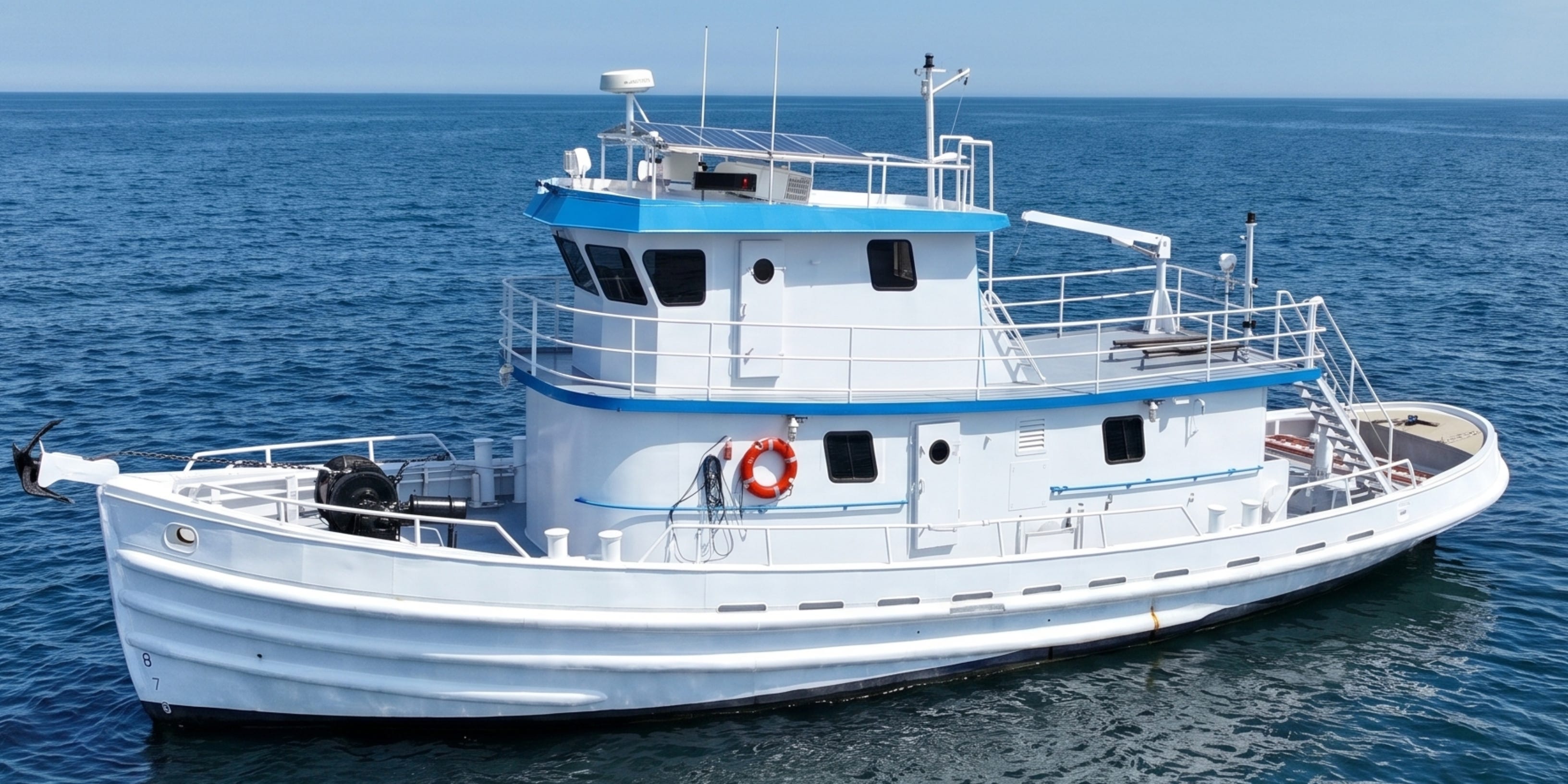
I have been looking at this vessel for a little while, trying to decide whether she belongs in the category of boats you admire from a distance, or the category of boats you actually buy and live on. The more I look at her, the more I think she belongs firmly in the second category. Not because she is finished. Many people would sayshe is not. But because the bones are remarkable, and the potential is the kind that serious liveaboard buyers spend years searching for.
I should point one thing out. My 6 years at sea, was spent on frigates and aircraft carriers. So, when it comes to interiors, my own definition of “luxury” will be very different to most of yours!
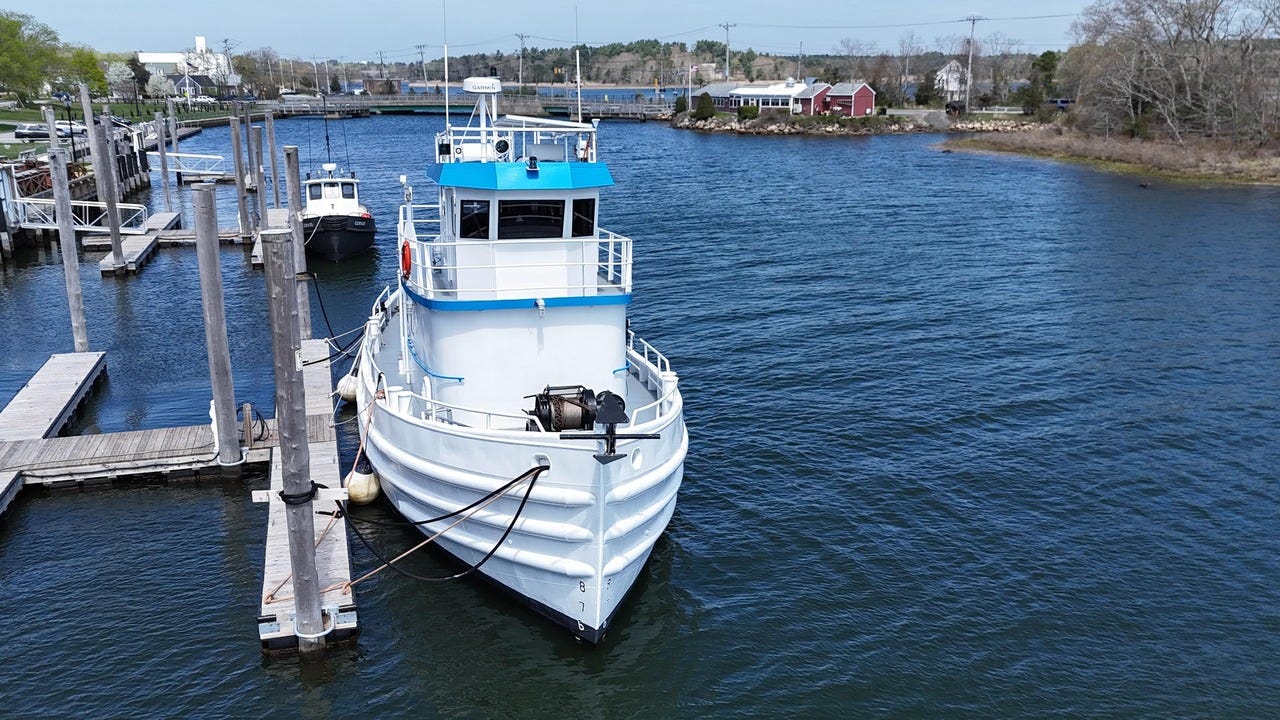
This is a 1954 American steel tug built by the Matton Shipyard out of Cohoes, New York. She is 70.92 feet long, 19.5 feet of beam, and she weighs 125,663 pounds in dry condition. She has been converted to a liveaboard and is now sitting in Wareham, Massachusetts, listed by LC8 Marine at $599,000.
I want to talk about what makes her interesting. Because the headline numbers hide quite a story.
The Yard That Built Her
Matton is not a name you will find in your traditional yacht broker catalogues. It belongs to a different tradition entirely, and that is part of what makes this vessel worth showcasing to you, my subscribers.
The Matton Shipyard operated for 84 years, from 1899 until its closure in 1983. John E. Matton established the yard at Waterford on the Champlain Canal, and in 1916 the operation relocated to Van Schaick Island in Cohoes, where it remained until the end. At peak production, the yard built over 340 vessels: commercial tugs, barges, specialised working craft. During the Second World War it produced five submarine chasers and four Army tugs under military contract. The Cohoes site was eventually listed on the National Register of Historic Places.
This vessel was built in 1954, which places her in the mature era of Matton production. The yard by that point had been building steel tugs for 35 years, and the quality of their work was well established in the American harbour tug and river towing trade. These were not luxury motor yachts to be operated in fair weather conditions. They were tools, designed to work hard in conditions that would destroy lighter construction. That ethos is baked into every plate of steel in this vessel’s hull.
She is a round-bilge displacement design in steel, with dimensions that reflect her commercial origins: 9.67 feet of maximum draft, a beam of 19.5 feet, and a dry weight that puts her firmly in the heavy displacement category. She sat and worked American waterways for decades before someone recognised what a converted tug could offer and began the process of turning her into a home.
Got a boat?
Know of a vessel, for sale, charter, or otherwise, that you would like me to feature in a future dispatch? You can send me a direct message or email me via john@yacht-buoy.com
The Repower
The engine is the first thing any serious buyer will want to understand, and here the news is excellent.
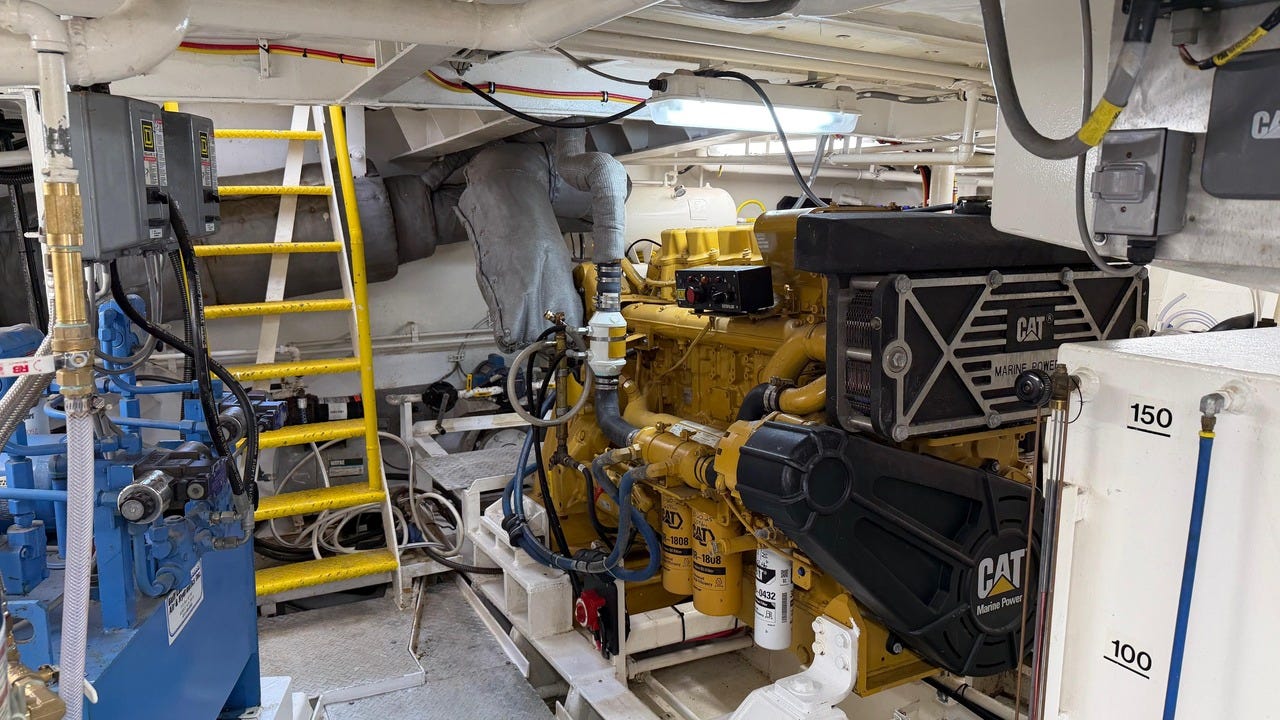
In 2011, she received a complete engine replacement. The original propulsion was removed and a Caterpillar C-18 diesel was installed in its place. The C-18 is an 18.1-litre inline-six producing 600 horsepower at 1,800 RPM in this application. Caterpillar have built marine C-18s to IMO II and EPA Tier 3 standards, and this is a well-regarded engine in commercial marine applications. It drives a four-blade bronze propeller via direct drive.
The engine now shows 667 hours. On a 2011 conversion, that is a very low figure. She has barely been run in. The C-18’s first scheduled service falls at 250 hours, which means this engine has completed two full service cycles and is now roughly 167 hours into its third. At 667 hours in 15 years of ownership, she has barely been worked. At a cruising speed of 9 knots, the C-18 in this application burns approximately 10 to 12 gallons per hour. At 9 knots and a conservative 11 gallons per hour, you are looking at around 0.82 nautical miles per gallon. That number becomes very significant when you understand what she is carrying in her tanks. And this what, in part, really blew me away.
The Tanks
Here is where this vessel stops being merely interesting and becomes genuinely remarkable.
She carries four fuel tanks with a combined capacity of 20,000 gallons. And no, that is not an additional ‘0’ at the end that has been put there by mistake.
Most production trawler yachts in the 60- to 70-foot range carry between 2,000 and 5,000 gallons of fuel. A Nordhavn 62, which is one of the most respected long-range production trawlers ever built, carries 2,652 gallons in her standard configuration. A Kadey-Krogen 52 carries 1,400 gallons. This Matton tug carries 20,000 gallons, which is between 7 and 14 times the fuel capacity of her notional competitors!
At 11 gallons per hour and 9 knots, she has a theoretical range of approximately 17,145 nautical miles. Accounting for sea state, weather, manoeuvring fuel, and a sensible 10% reserve, a practical ocean-passage range in the region of 12,000 to 15,000 nautical miles is realistic. For context, the Atlantic Ocean from New York to the Azores is approximately 1,880 nautical miles. The Atlantic crossing from the Canaries to the Caribbean is around 2,700 nautical miles. She could do either of those passages and barely dip below half-full.
She also carries 1,000 gallons of fresh water and a 300-gallon holding tank.
This is ocean-crossing fuel capacity at a price point well below what purpose-built bluewater trawlers command.
Where Could She Go on One Tank?
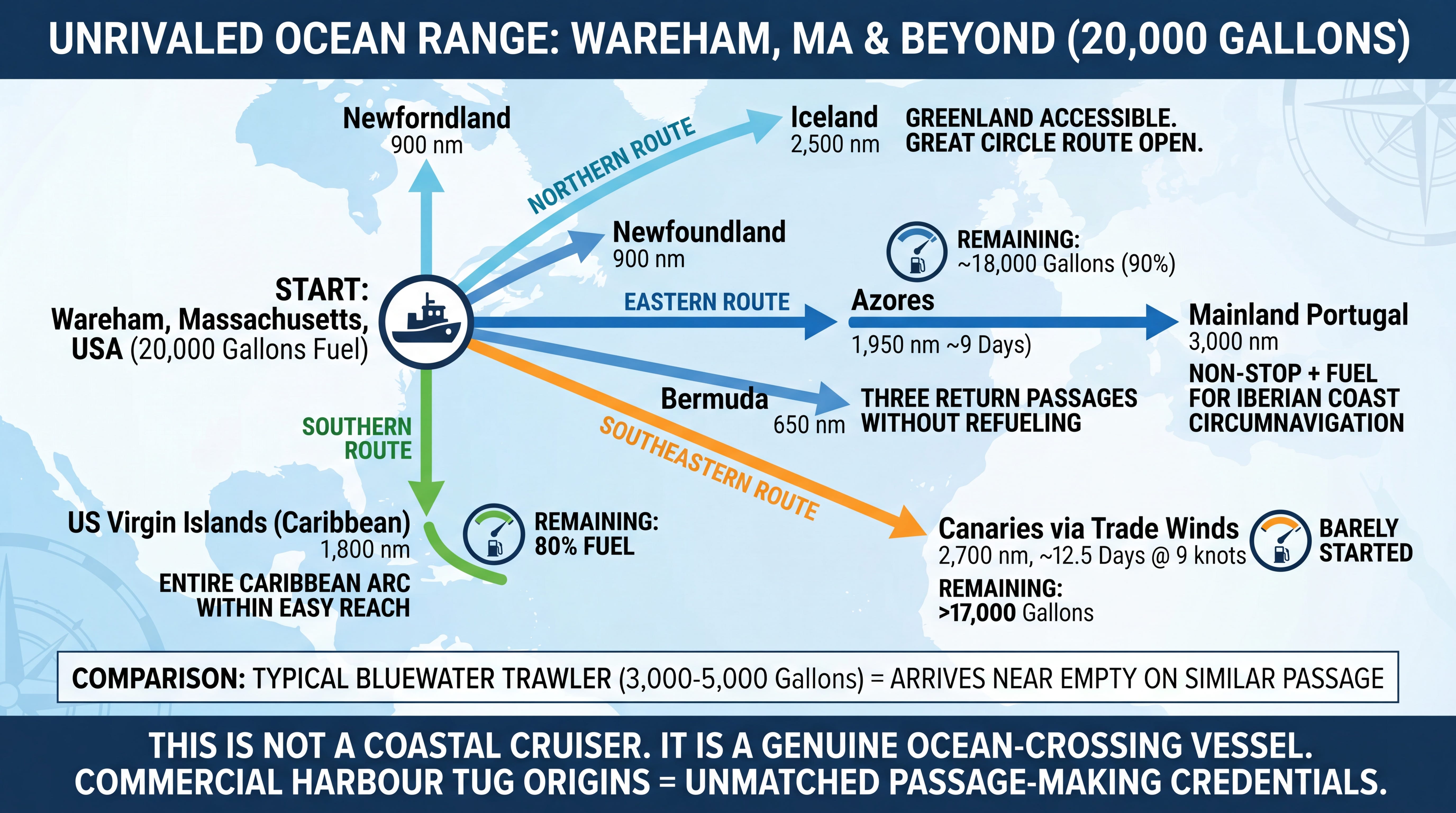
This is the question that makes those numbers real. She is sitting right now in Wareham, Massachusetts. On a single load of 20,000 gallons, with no refuelling stop, here is what becomes possible.
Head east and the North Atlantic opens up immediately. Wareham to the Azores is approximately 1,950 nautical miles. She covers that in around 9 days and arrives with close to 18,000 gallons still in her tanks. From Wareham to mainland Portugal is around 3,000 miles. She does that non-stop and still has fuel to spare for a circumnavigation of the Iberian coast. Bermuda is 650 miles away. She could make three return passages to Bermuda before she needed to refuel.
Head south and the Caribbean is around 1,800 miles from New England to the Virgins, depending on route. She gets there with 80% of her fuel still aboard. From there, the entire Caribbean arc lies within easy reach without touching a fuel dock.
Head north and Newfoundland is 900 miles. Iceland is around 2,500 miles from Massachusetts. Greenland not much further. The Great Circle route through the high North Atlantic becomes accessible to a vessel carrying this kind of range.
If you took the southern blue-water route via the Canaries and the trade winds, that passage is approximately 2,700 nautical miles. She completes it in around 12.5 days at 9 knots, and arrives in the Caribbean with over 17,000 gallons remaining. She has barely even started.
Purpose-built bluewater trawlers take this passage carrying 3,000 to 5,000 gallons and arrive having consumed most of what they set out with. The calculations are not remotely comparable.
This is not a coastal cruiser with offshore pretensions. It is a genuine ocean-crossing vessel that happens to have been built in 1954 for entirely different purposes. The commercial harbour tug was designed to be self-sufficient for extended periods in demanding conditions. Those design priorities translate directly into ocean passage-making credentials that most pleasure craft cannot approach.
So where does a 12,000 to 15,000 nautical mile practical range actually place you on a globe?
The furthest east she could reach from Wareham on one tank takes her well into the Indian Ocean. The route east runs from Massachusetts across the Atlantic (3,000 miles to Lisbon), through the Strait of Gibraltar, the length of the Mediterranean (roughly 2,000 miles to Port Said), through the Suez Canal, down the Red Sea, and into the Arabian Sea. By the time she clears Djibouti at the mouth of the Red Sea, she has covered approximately 8,000 miles. She still has over 4,000 miles of range remaining. That puts Mumbai, the Maldives, Sri Lanka, and the southwestern tip of India all within reach on a single load of fuel. She leaves Wareham and arrives in the Indian Ocean without stopping at a fuel dock. Bonkers.
The furthest west she could reach from Wareham on one tank takes her deep into the Pacific. Head southwest from New England, through the Caribbean, transit the Panama Canal, and turn west into the Pacific. From Wareham to the Panama Canal entrance is approximately 2,200 miles. Through the Canal and into the Pacific, she has well over 10,000 miles of range remaining. That is enough to reach Hawaii (4,700 miles from Panama) and continue to the Marshall Islands, Micronesia, or the northern Philippines. On a single tank, she crosses two oceans.
These are not theoretical abstractions. They are the direct consequence of 20,000 gallons of diesel and a fuel-efficient Cat C-18 at displacement speeds. Most vessels in this price bracket cannot cross the Atlantic non-stop, let alone plan itineraries that span multiple ocean basins without a refuelling strategy!
There is one further dimension to all of this that rarely gets discussed, and it matters enormously for anyone planning to cruise seriously off the beaten track. Fuel quality and fuel availability vary enormously around the world. In remote parts of the Pacific, Southeast Asia, the high latitudes, and much of the developing world, finding diesel is not always straightforward. When you do find it, the quality is not always what you would want going into a modern engine. With 20,000 gallons aboard, you can afford to be selective. You fill up where the fuel is good, in a port where you trust the source. You do not need to take on questionable fuel in a remote harbour because you have run short. You do not need to divert to a commercial bunkering port that adds 300 miles to your passage because it is the only one with sufficient stock. The fuel capacity is not just about range. It is about independence. It puts the owner in control of where, when, and from whom they buy fuel, and that is a meaningful operational advantage in the parts of the world that make a voyage like this worth doing in the first place.
The Liveaboard Systems
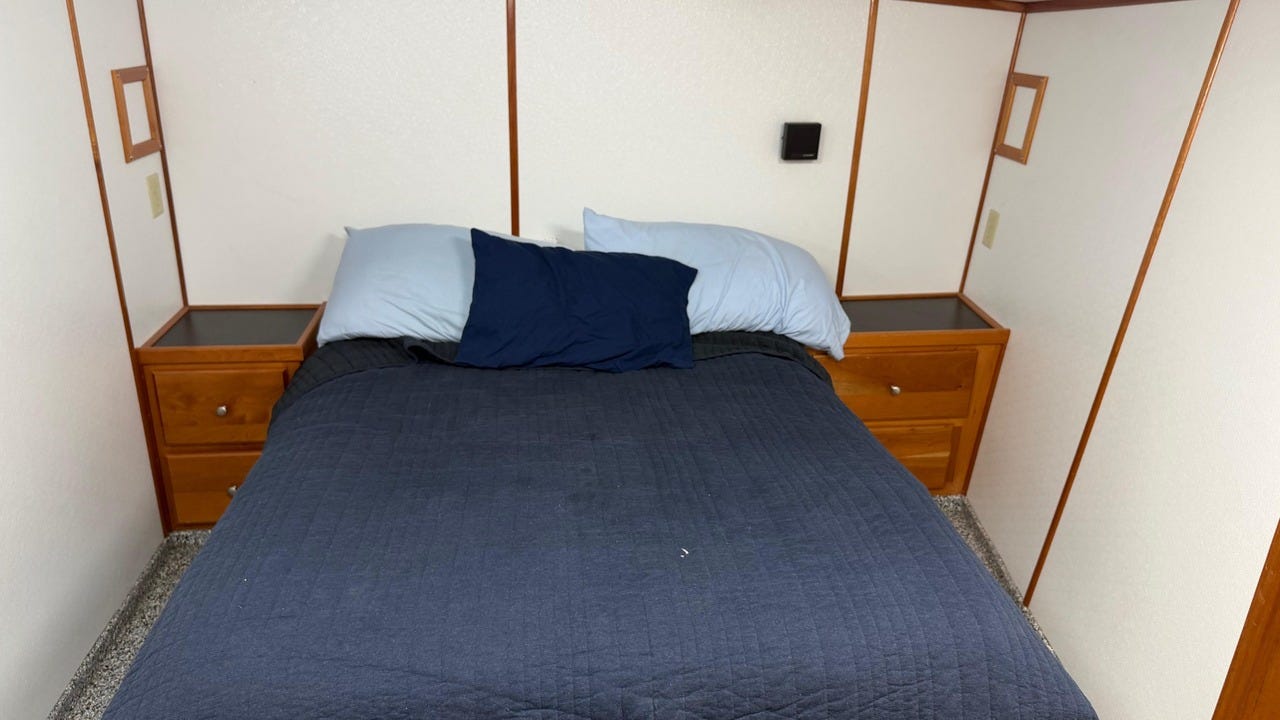
The interior is..., shall we say, ‘honest’. I want to be clear about that before listing what is aboard, because the photographs do not hide it: this is a functional working space that has been fitted for habitation rather than a yacht interior finished to pleasure-craft standards. White painted walls, practical cabinetry, a working galley. It reminds me, in some respects, of the MMS 55 Trawler, another vessel with serious credentials beneath a utilitarian skin.
What is aboard?
Air conditioning and heating are both fitted. There is a washing machine, oven, microwave, refrigerator, and deep freezer. Hot water. Electric and manual bilge pumps. An air compressor. She has a marine head, an electric head, and a chemical head. That level of sanitation redundancy is something you would struggle to find on most production yachts. Air conditioning throughout. A battery charger and inverter.
The electronics fit is comprehensive: radar, AIS, autopilot, GPS, chartplotter, VHF, depth sounder, log and speedometer, radar detector, compass, navigation centre, repeaters, cockpit speakers, and two flat-screen televisions. Shore power inlet and a generator are both fitted.
The listing states two guest cabins. On a vessel of this beam that is likely to mean berths for four guests in dedicated sleeping accommodation, with the owner’s quarters separate. That is a reasonable complement for a liveaboard couple with room for occasional guests, and the combination of systems (the washing machine, the deep freezer, the air conditioning, the 1,000-gallon fresh water tank) all point toward a vessel that was converted with genuine long-term habitation in mind rather than occasional weekend occupation.
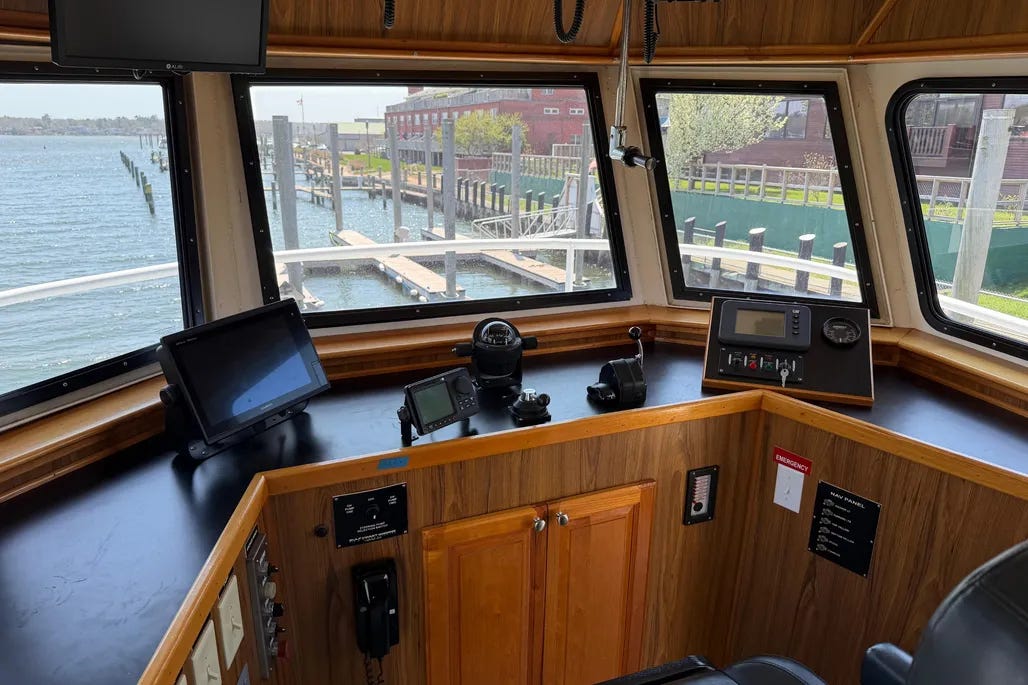
The profile is everything you would want from a classic American harbour tug: the rounded wheelhouse, the workboat sheer, the winch on the foredeck, the towing bollards on the aft deck, the unmistakeable silhouette that draws eyes in any anchorage. She has solar panels on the cabin roof. The significant rubbing strakes on her hull. She looks exactly like what she is: a piece of American maritime history that has been given a second purpose.
This article continues below, in “The Wardroom”
In the premium section, I cover:
- The interior reality: what the current fit-out actually delivers as a liveaboard, and where it falls short of a comfortable long-term home
- Refit costs and where to do the work: three yards near Wareham that handle this kind of commercial-to-liveaboard conversion, with realistic budget ranges from cosmetic to comprehensive
- The draft question: what 9 feet of draft means in practice for East Coast cruising, which harbours and rivers are accessible and which are not
- Stabilisers: what the listing does not mention, what it means for ocean passages, and what it would cost to fix
- Steel hull maintenance across different cruising environments: what 70 years of steel really demands, from the tropics to the Arctic, and how salinity variation changes the maintenance picture
- My honest read on the market: how $599,000 positions this vessel against comparable converted tugs and production trawlers, and what the total investment picture looks like once the refit is factored in
The Wardroom
Premium content for Wardroom members
The Interior: What You Are Actually Buying
In my opinion, what you are looking at in the photographs is not a finished interior. It is a canvas.
