

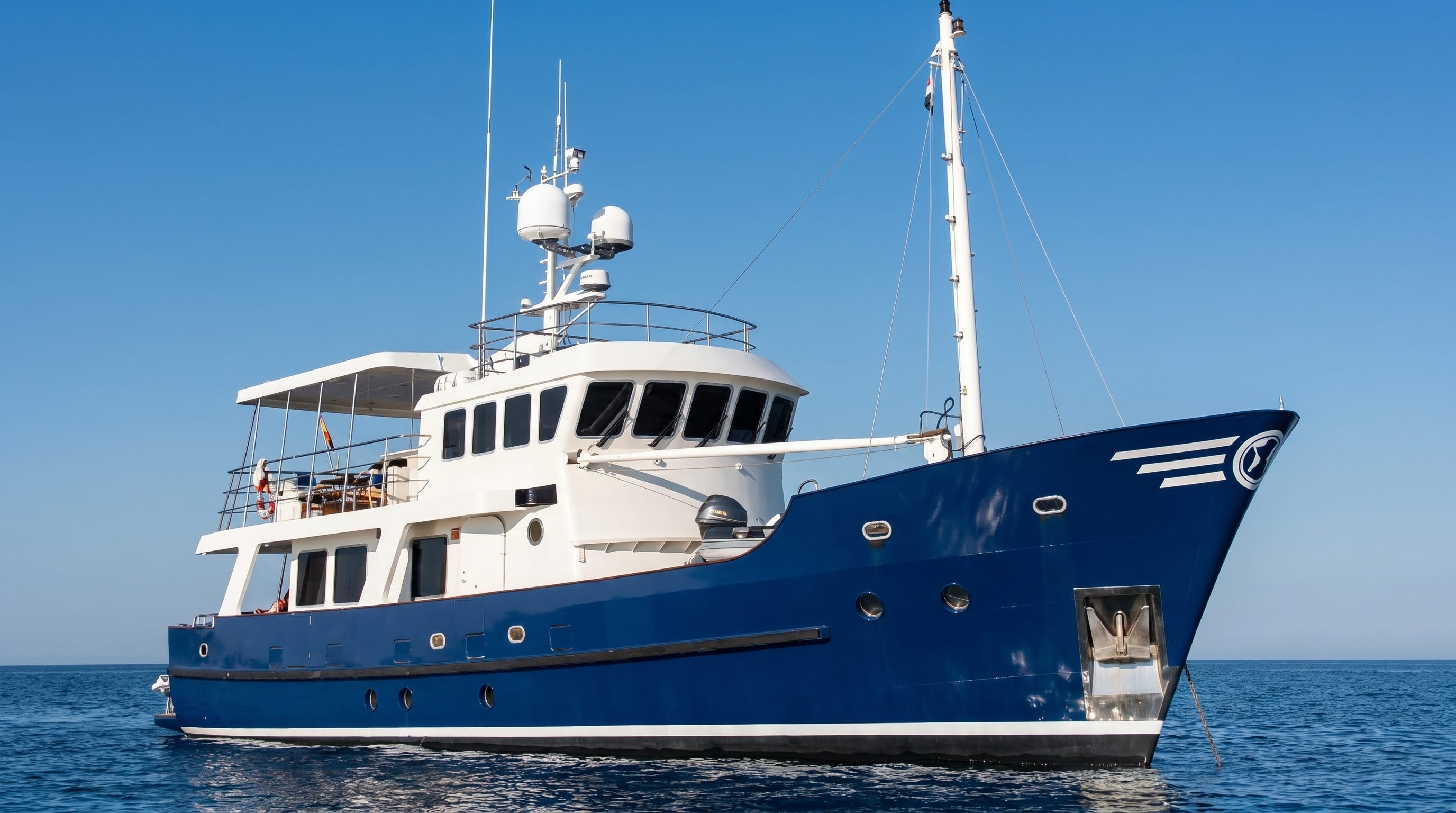
There is a particular kind of explorer yacht that does not ask to be admired from the marina. She sits at the pontoon with that deep navy hull and white superstructure and she says, quietly but clearly, that she is here to work. Not in the commercial sense, but in the way that a serious sailor means it: passages, not day trips; oceans, not anchorages. The kind of motor yacht you provision for three weeks and do not see land until you choose to.
The vessel you are looking at is a Vripack 69 Expedition Trawler, hull number 808662, built in 2004 and lying today in Greece. She is 21.15 metres LOA, displaces 85 tonnes of steel, and carries enough fuel to cross the Atlantic with nautical miles to spare. She was designed by one of the most respected naval architecture studios in the world, and she has been looked after with the kind of attention that only comes from an owner/operator who takes the sea seriously.
She is offered at €890,000, VAT paid with Marc Weijenberg, De Valk Thuishaven (details below). Let’s have a quick look around, before we continue….
Vripack: The Studio That Invented the Trawler Yacht?
To understand what you are looking at, you need to understand who designed her.
Vripack Yacht Design was founded in 1961 in Amsterdam by Dick Boon, the Dutch naval architect widely credited as the father of the modern trawler yacht. In 1968, Boon designed the Doggersbank, a vessel that fundamentally changed how the yachting world thought about long-range motor cruising. The Doggersbank demonstrated that a displacement vessel, built from the same philosophy as a commercial fishing or patrol craft, could be both genuinely seaworthy and genuinely liveable. That idea, which seems obvious in retrospect, was radical at the time.
Vripack has been developing that idea ever since. Today the studio employs more than 40 extremely talented designers, engineers, and naval architects working from their base in Sneek, in the Netherlands, and they have designed over 85 expedition and trawler models in the decades since Boon laid the groundwork. The Vripack 69 sits squarely within that heritage. She is not a departure from it. She is its continuation.
If you have been following my newsletter for any length of time, you will know that we covered the Doggersbank 63 in detail last year. That vessel attracted some of the highest reader engagement we have seen, and the reason was straightforward: readers who understand the Vripack name understand what it means for a passage-maker. The 69 is larger, more recent, and more fully equipped for extended liveaboard use. The design pedigree is identical.
What She Looks Like, and Why It Matters
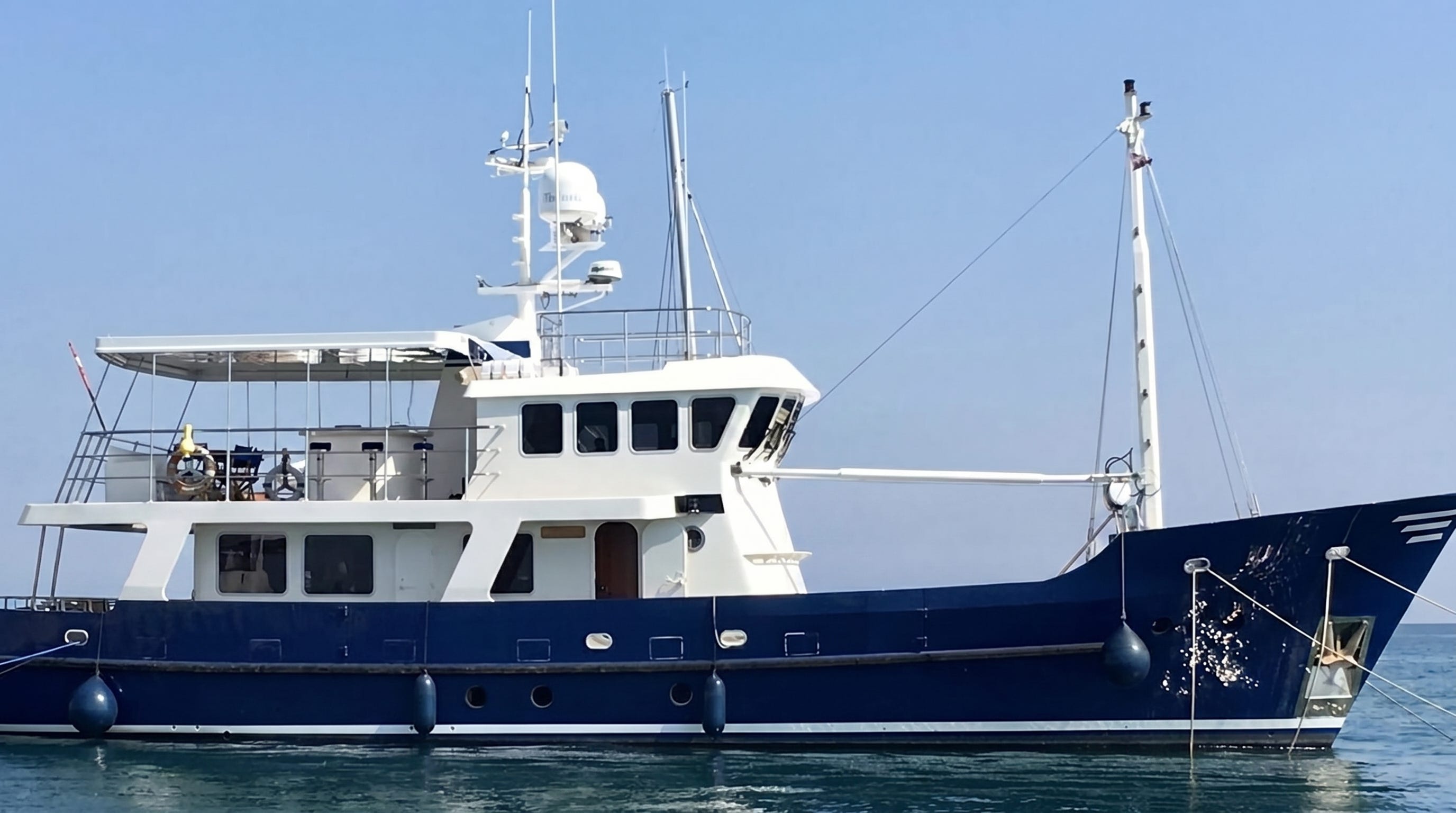
I want to spend a moment on the aesthetics here, because with a vessel like this, how she looks is not merely decoration. It is evidence.
That navy blue hull with the white superstructure is not an arbitrary colour choice. It is the visual language of a working passage-maker: purposeful, understated, built to be at sea rather than photographed in port. The raised pilothouse gives her a profile that reads the same way at anchor off a Greek island as it would in a Norwegian fjord or off the coast of New Zealand. She looks like she belongs on the water, in any weather, in any latitude.
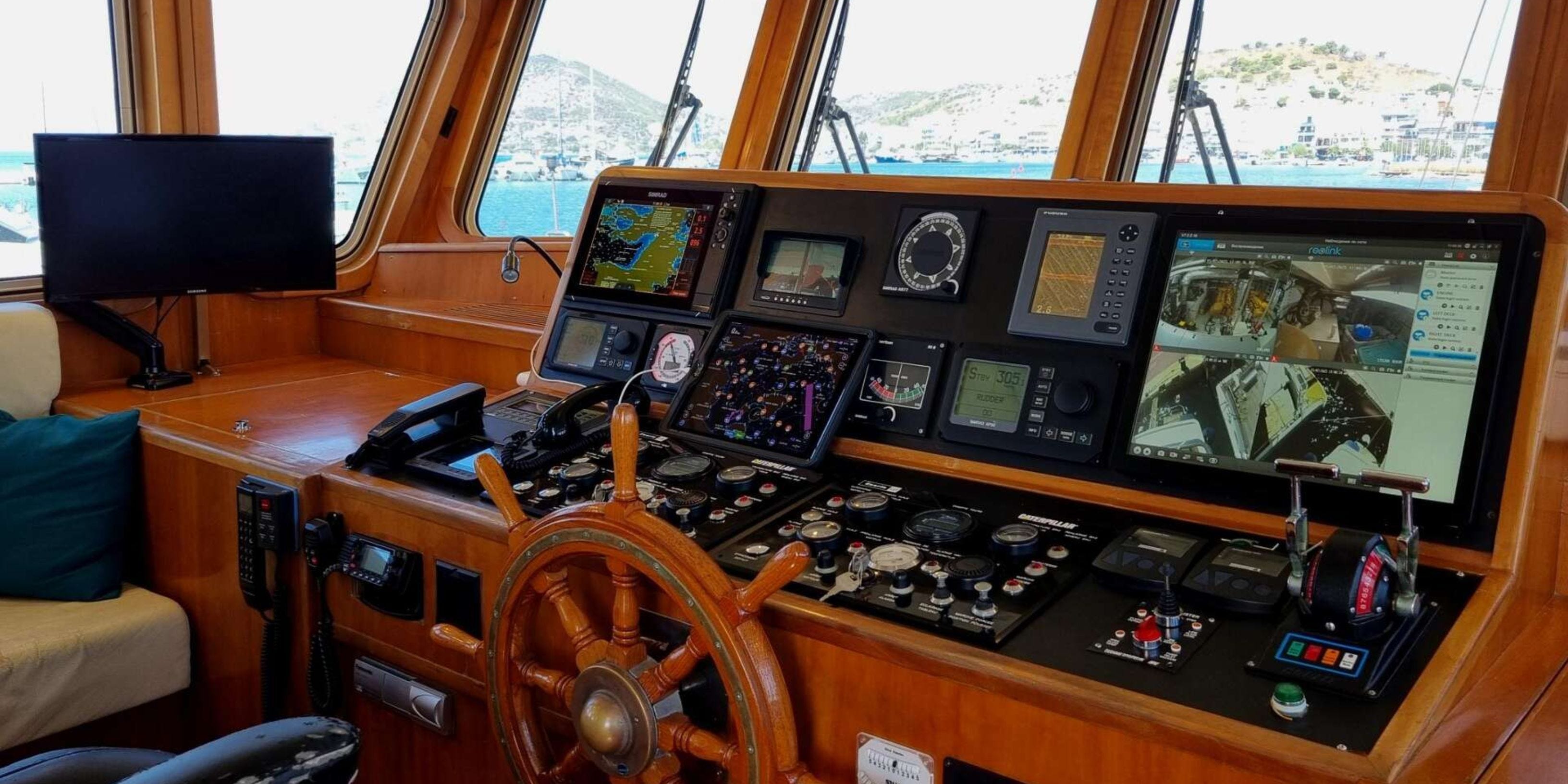
Step aboard and the impression holds. The helm station is a proper ship’s bridge: teak and warm timber throughout, a full Simrad navigation array, the helm chair positioned where it should be, with sight lines forward and aft. This is a working wheelhouse, not a showroom. Behind it, there is a covered entertainment deck with a bar and an alfresco dining area that works in Mediterranean sunshine as well as it would at anchor somewhere colder and more remote.
Below, the saloon is generous. The L-shaped leather settee, the open bar, the access through to the aft deck. The galley is U-shaped with Corian worktops, a Bosch four-burner ceramic hob, a Miele oven, a Neff microwave, a Whirlpool refrigerator and a Liebherr drinks fridge in the saloon. Two stainless steel sinks with waste shredders. A Miele dishwasher. An ice maker. This is not a compromised cruising galley. This is a galley that could feed six people for a month at sea and never feel under-equipped.
There are three double guest cabins, each en suite, each with 2.0 metres of headroom throughout. Plus a crew cabin forward with its own heads. The owner’s cabin has a 2.0m by 1.8m berth. All cabins have individually controlled air conditioning units. Central heating throughout was refitted in 2022.
She has, in short, the interior of a serious liveaboard home. Not a performance compromise, not a stripped-back passage boat. A home.
Got a boat?
Know of a vessel, for sale, charter, or otherwise, that you would like me to feature in a future dispatch? You can send me a direct message or email me via john@yacht-buoy.com
The Question Every International Buyer Will Ask
Here is the question I keep coming back to, and the one I suspect you are already asking: she is lying in Greece, she is designed to go anywhere, and she has the range to prove it. So where could you actually take her?
The 3,700-nautical-mile range at 7 knots is not marketing shorthand. I checked the maths: total fuel capacity across main, secondary, and day tanks runs to approximately 16,700 litres. At 25 litres per hour combined, that is a daily burn of around 600 litres, which across 27 days at 7 knots gives you exactly that range.
The Atlantic is well within reach. The Pacific, with the right routing and a couple of fuel stops, is achievable. Australia and New Zealand, via the Suez Canal or the Cape of Good Hope, are not out of the question for a prepared owner with an experienced crew. This is a vessel that could take you from the Aegean to the Azores to Antigua. Or from the Caribbean to the Panama Canal and on to the Pacific Northwest. Or, if you have time and ambition, to the Tasman Sea.
We will cover each of those delivery routes in detail in the premium section below: the distances, the fuelling strategy, the crew requirements, the timing. But I want to name them here, in the free section, because they are not hypothetical. They are the point of a vessel like this.
That is what a Vripack 69 is for.
The Hull and Why She Can Handle It
The seakeeping credentials of this vessel are worth dwelling on for a moment, because they are the foundation on which everything else rests.
She has a round-bilge steel hull with a long keel, and she displaces 85 tonnes. These are not incidental specifications. They are design choices that have been refined across decades of serious offshore passage-making, and they add up to a vessel that is genuinely comfortable in conditions that would make a lighter, harder-chined motor yacht deeply unpleasant.
The long keel provides directional stability in following seas and heavy weather: she tracks well, resists broaching, and does not demand constant correction at the helm. The round bilge means waves pass beneath her rather than striking the hull, which translates to a much gentler motion in beam seas. The 85-tonne displacement means she carries her momentum through steep, confused seas rather than being thrown about by them. She is CE Category A, which is the ocean-going certification, and she earned it honestly.
She also carries Koopnautic fin stabilisers, which at her cruising speed of 7 knots operate in their optimal range. Theo Koop built a global reputation across 30 years designing hydraulic fin systems, and the brand was ultimately acquired by Naiad, one of the major names in the stabiliser world. At 7 knots, in beam seas, those fins will make a material difference to comfort on extended passages.
The Build and What 22 Years Tells You
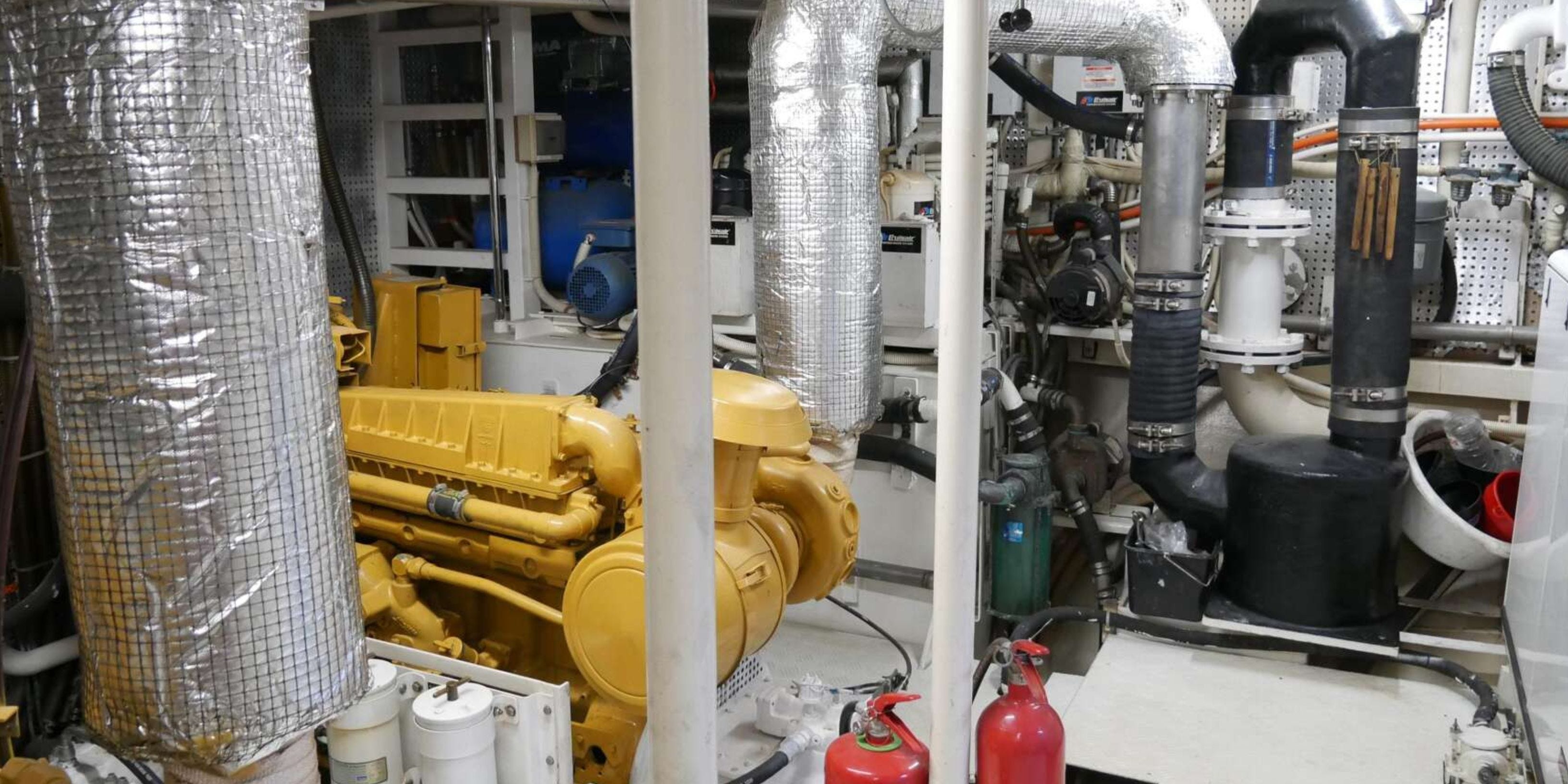
She was built in 2004 by a Chinese yard working to Vripack’s design specification, a collaboration that brought serious Dutch naval architecture to life at a price point that European construction alone could not have achieved. The teak decks were relaid in 2010 and glued. The central heating was refitted in 2022. New propeller shaft seals were fitted in 2022. New start batteries in 2023, new service batteries in 2023, new generator batteries in 2025. The life raft was serviced in 2023. The fire extinguisher system for the engine room was renewed in March 2023.
An owner who is spending money on a vessel maintains her. An owner who maintains her cares about her. The maintenance record here tells a story of ongoing active investment, not neglect. A pre-purchase survey by a qualified steel vessel specialist will tell you everything else you need to know.
This article continues below, in “The Wardroom”
In the premium section, I cover:
- The Caterpillar 3306B engines at 5,500 hours: what that number means, what the engines will need, and what they have left
- The Northern Lights generators at 7,500 and 6,750 hours: context and implications for the next owner
- The liveaboard credentials in full: watermaker, heating, twin A/C, galley, and how this vessel compares to the Nordhavn 62, the Doggersbank 63, and the Northern Marine 69 as a full-time home afloat
- Getting her home: the detailed delivery routes from Greece to North America, Australia, and New Zealand, including distances, fuelling stops, crew requirements, and realistic timelines
- What €890,000 buys you in today’s market: My honest assessment against comparable vessels, and what a realistic post-survey offer looks like
The Engines: What 5,500 Hours on a Cat 3306B Actually Means
Let us start with the question that matters most to any serious buyer: the powerplants..
