

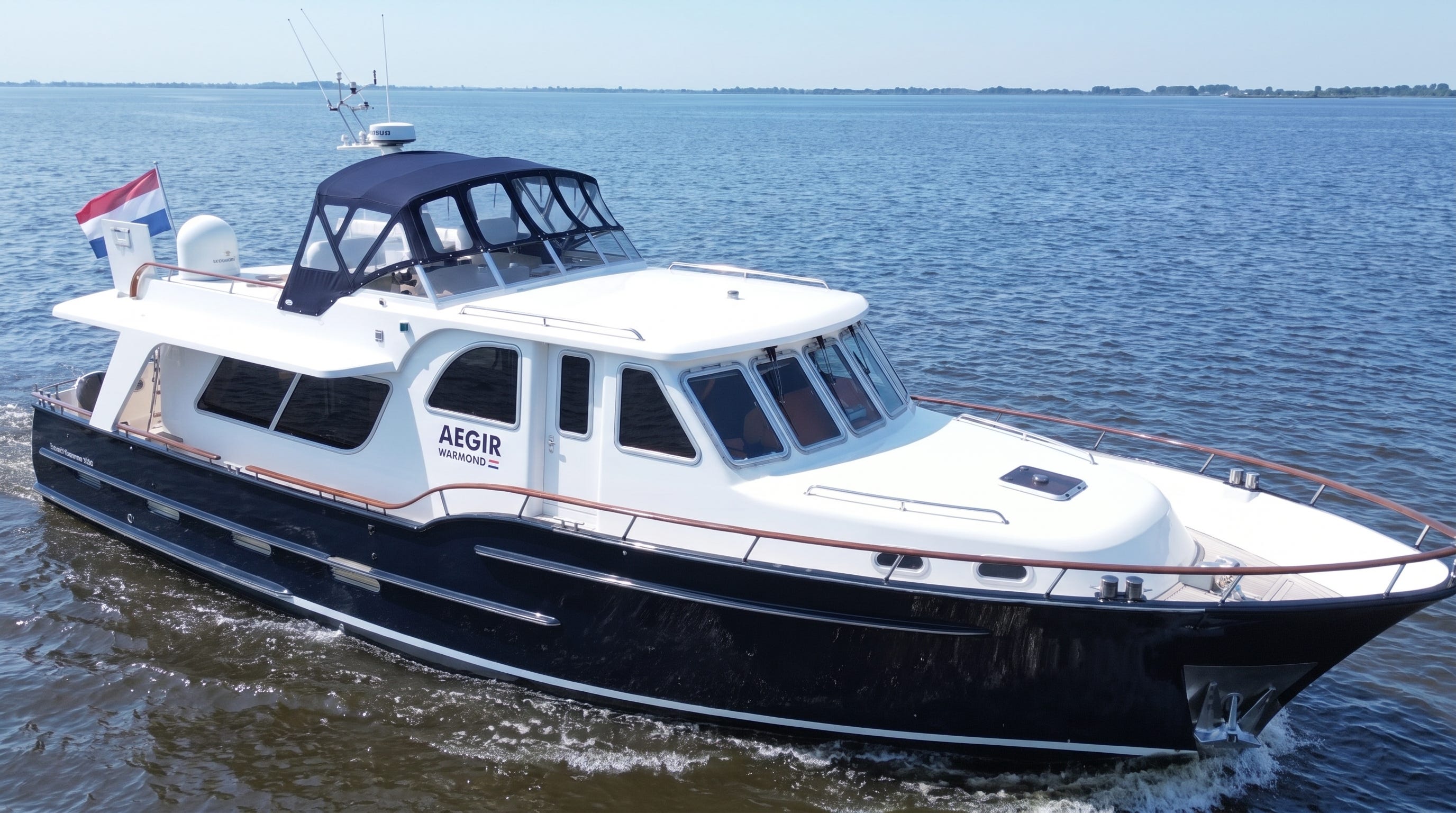
There is a Vripack-designed steel trawler currently lying with De Valk in their covered marina in Sneek called ‘Aegir’, and she is the boat in my latest video tour. Her broker, Henk de Vries, lists her (link below) at €489,000 with VAT paid. This is the companion article, covering what the video did not: her ocean rating, the 2023-2025 refit work, and what she would cost to keep and to move over the next 5 years.
Let us start with her sleek lines, because they give you an idea of what she is before the spec sheet does. Her bow is fine and flared, with high freeboard and a sheer rising towards a substantial stem and anchor arrangement. The topsides run long and fairly straight, a dark blue steel hull under a white steel superstructure with a stainless rubbing strake the full length of her.
Aft, she finishes in a near-vertical transom with a bathing platform and a decent-sized cockpit. The pilothouse carries big windows above a long band of side glazing, and the flybridge is compact and practical. Side decks, high rails and opening gates all point the same way: she was drawn for moving about safely at sea.
The design comes from Vripack in Sneek, and if you have read my pieces on the €695,000 Vripack Trawler 1960 or the Vripack 69, you’ll know why that name matters.
Dick Boon opened the studio in 1961 and built its identity on practical long-range boats. The Doggersbank series helped earn Boon the description “Father of the Expedition Yacht”; the 1985 Doggersbank Offshore became the studio’s international breakthrough, and their research vessel Turmoil, now Pioneer, became the first yacht to run the Northwest Passage in 2001, then the first to do it twice in 2010.
Today the studio numbers around 40+ designers, engineers and naval architects. The broker record lists Searocco Yachts of the Netherlands as her builder; I could not find a fuller history of that yard, so if you know more about Searocco Yachts, then please feel free to leave a comment below.
Her spec carries a CE Category A rating, and it’s worth pointing out what that covers.
Category A is the EU design category for craft designed for winds that may exceed force 8 and significant wave heights of 4 metres and above, excluding abnormal conditions such as hurricanes. In simple terms, her design envelope is offshore gale conditions. It is a design threshold rather than a condition report, though, so on a 2003 boat I would still want the relevant survey, which is standard practice.
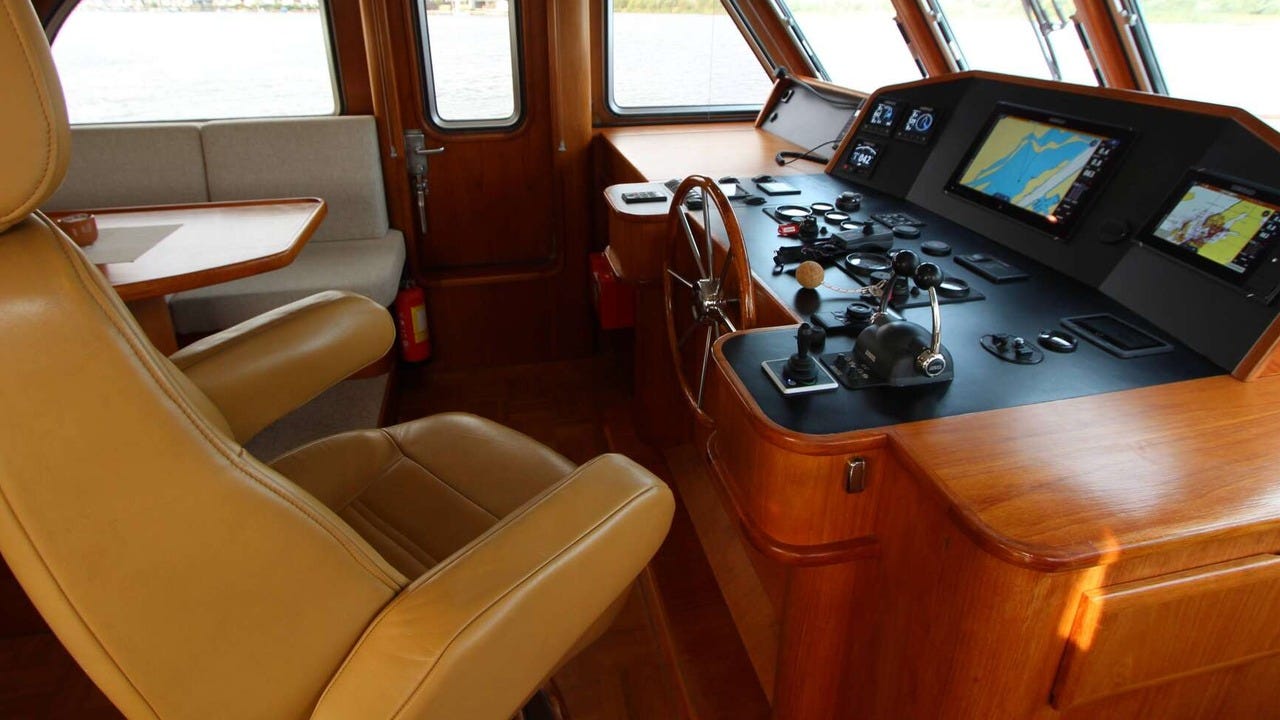
De Valk says a huge amount was invested in her between 2023 and 2025, and the spec sheet backs that up with dates. 2023 brought a Kabola KB40 central-heating system and new Simrad depth and log instruments. 2024 added a 1,500W Lofrans windlass, 100m of stainless anchor chain and a washer/dryer.
2025 was the big year: a full 12V/24V/220V electrical overhaul, new Redtop batteries across the start, generator and bow-thruster banks, twin Simrad NSS9 Evo 3S radar/GPS displays, new stainless propeller shafts with water-lubricated bearings, fresh antifouling and a serviced Onan 7kW generator. That is a serious systems renewal programme and not just a lick of paint with some minor touching up here and there.
Two practical numbers are worth highlighting as well. Her air draft is 5.50m, dropping to 3.60m with the hydraulically lowering mast, which opens up much of the European bridge and canal network; I personally would still measure her in the lowered configuration before committing to a low bridge. Headroom is a generous 2.00m in the saloon.
She is round-bilged with a box keel, and that combination is the heart of her impressive seakeeping story. A round-bilge hull turns smoothly from bottom to topsides rather than meeting at a hard chine, and at displacement speeds that generally means efficient flow and a gentler, more progressive motion in choppy conditions.
The trade is that round-bilge boats can roll more freely, which is exactly why she carries hydraulic fin stabilisers to damp that roll underway. A box keel like hers can provide a deep spine of protected structure low down and contribute to straight tracking; exactly how hers is arranged is one for the surveyor to confirm.
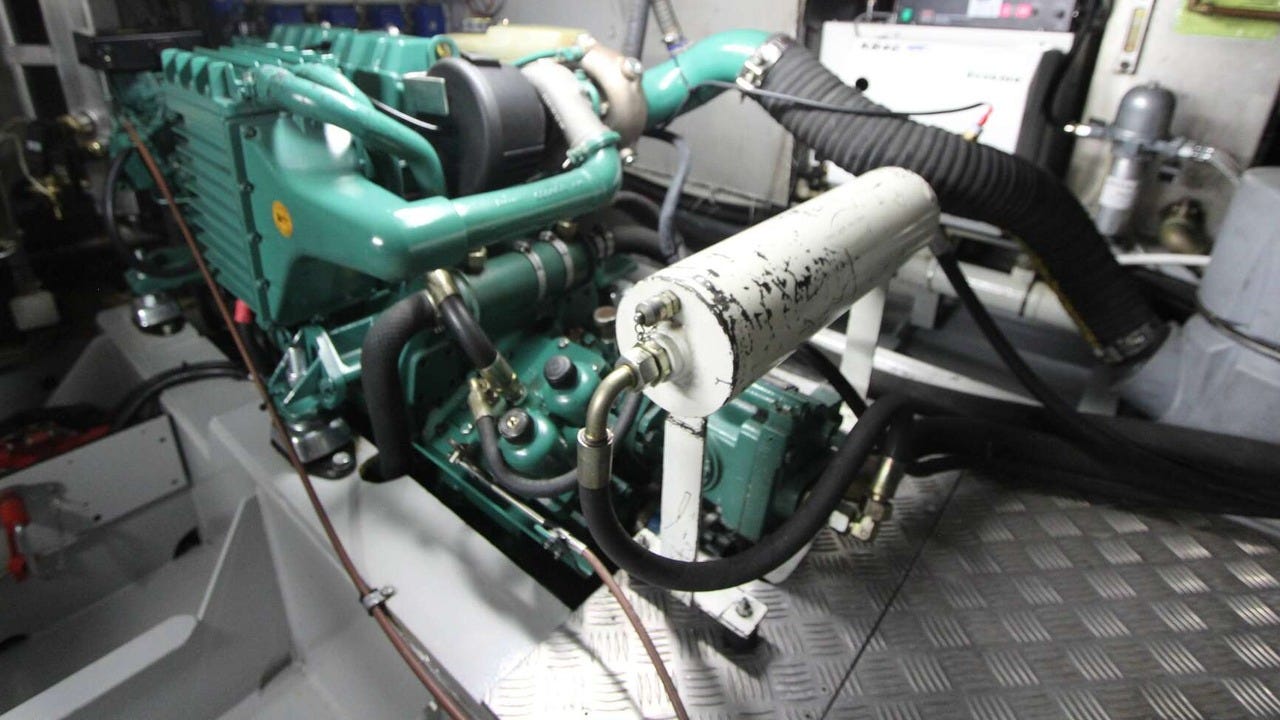
The rest of the file: 14.97m overall, 4.94m beam, a shallow 1.30m draft, 32 tonnes displacement and 5mm steel hull plating. Twin Volvo Penta TAMD41H diesels of 145hp each deliver an 8-knot cruise and 10-knot top speed, fed by 3,200 litres (845 US gallons) of fuel, with 850 litres (225 US gallons) of fresh water. Below, she sleeps 4 in 2 cabins, each with a 2.0m French bed and its own en-suite shower and toilet.
You might be wondering why the fuel capacity for a CE Cat A boat is not larger, but it all comes down to what the owner wanted from the boat, and her range reflects that. Many owners never intend to cross the Atlantic or the Pacific. Instead, they are content knowing they can get from Northern Europe to the Med without stopping every other day for fuel.
And a CE Cat A vessel is exactly what you need if you have your sights on the Bay of Biscay, which can turn very gnarly in a short period of time.
My overall impression is that she has been very well maintained and looked after by an owner who clearly spent a lot of time and effort on what must have been their pride and joy. She is ready to go cruising, and being steel in both her superstructure and hull, she will take on some serious conditions, which is exactly what you would expect with an explorer yacht.
This article continues below, in “The Wardroom”. Thanks to my paying subscribers, I can travel around Europe and film boats like Aegir. So, if you are a premium subscriber or indeed you become one, then I would like to say a massive thank you!
In the premium section below, I cover:
- Steel hull maintenance at 23 years old: what she needs and a realistic 5-year budget
- Stabilisers and engines: service cycles and 5-year cost ranges for the hydraulic fins and the twin TAMD41Hs
- Shipping her to the United States: a working estimate for getting her across the pond.
- My honest assessment of the Atlantic question: whether she can cross on her own hull, and her price against her Dutch steel cohort
