

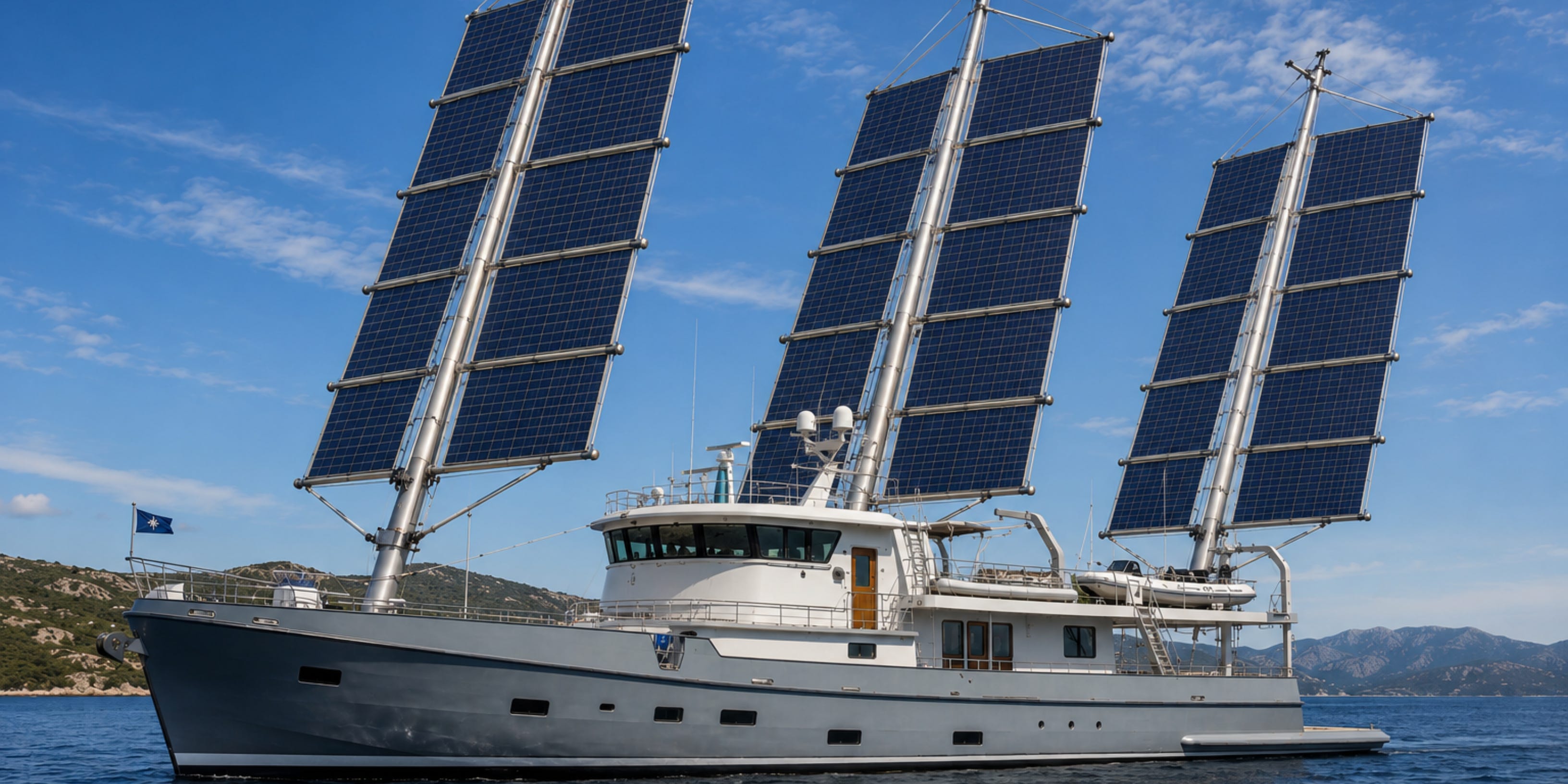
Imagine that somebody showed you a boat with an abundance of solar panels scattered around the coach roof and the deck. You are told that the boat pretty much runs itself, so no marina bill, no need to wrestle with shore power cables in the middle of the night when you arrive late at the pontoon. No extortionate diesel bill and no more having to constantly plan your coastal passages according to your next fuel stop.
Just you, the sun’s rays, and a large battery bank doing all the work while you sit back, relax, and enjoy the seascape, rejoicing in the fact that you have just invested in the ultimate off-grid seaborne adventure.
Of course, this is a genuinely appealing idea both to existing boaters and landlubbers who are yet to be captured by the calling of the sea. The thought of generating your own ‘free’ power, living wherever you decide to drop the hook, and not having to worry about the cost of diesel or how big the marina’s electricity bill is going to be.
For anyone who has spent decades handing over their money to pay for the aforementioned, the phrase “solar powered yacht” sounds like the ultimate life hack.
A solar-powered motor yacht can cut your reliance on shore power and/or diesel, especially as the technology behind solar arrays and batteries accelerates. But what it won’t do, at least, not yet anyway, is take you to true zero.
Even with a motor yacht that is covered in solar panels, you will still need a generator, as you might not be lucky enough to be cruising in the latitudes where the sun is powerful enough (in terms of the solar energy reaching the panels) to give you enough photons to meet your on-board living needs. So, most of the time, you will need to fire up that diesel generator to top up your batteries.
Understanding where the line sits between total autonomy and subsidised autonomy is worth spending a bit more time researching, which is exactly what I did for this article.
The Vessel That Started This Conversation
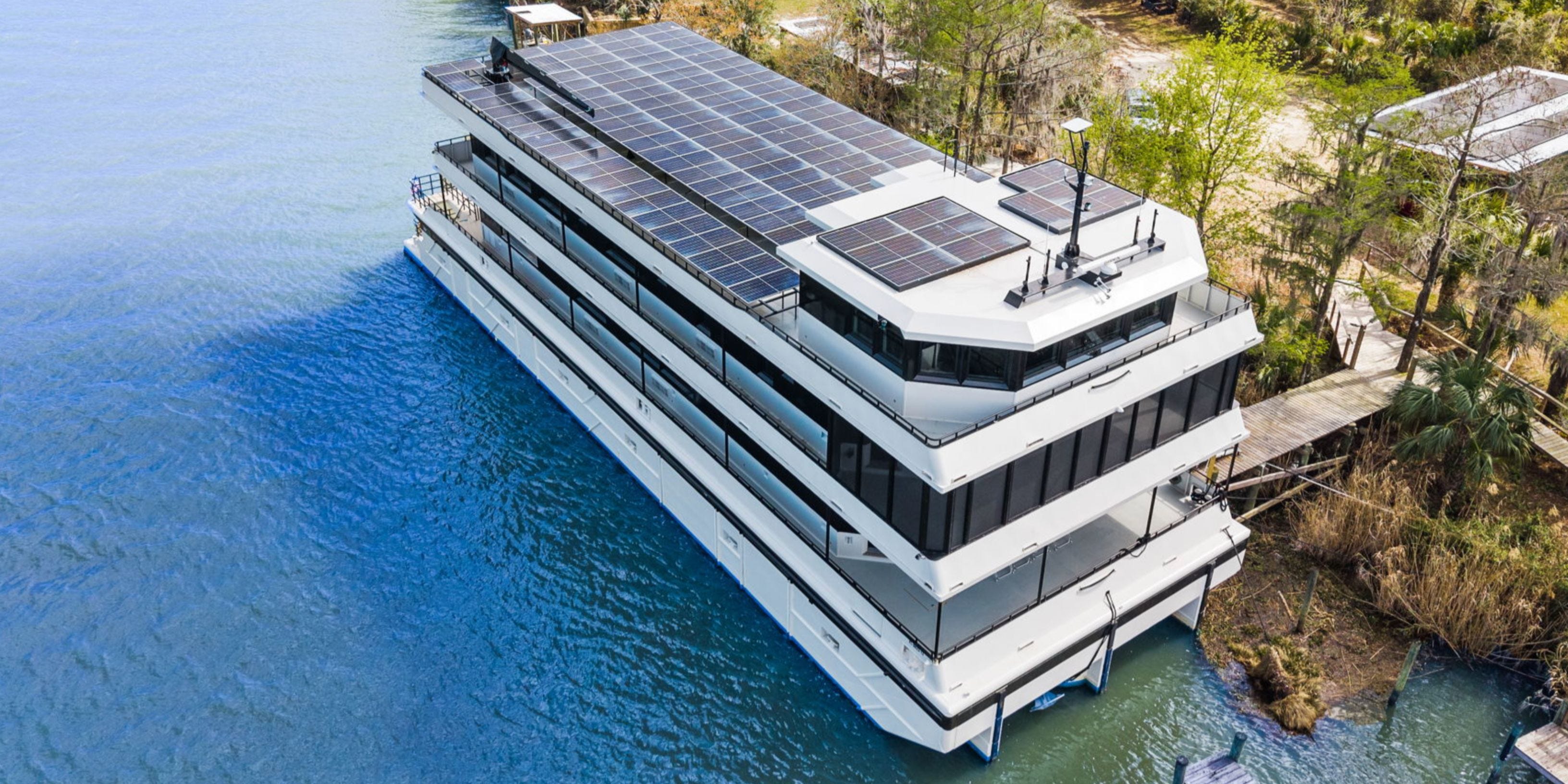
I wrote about an epic solar-powered ‘floating mansion’ recently called ‘Shine Down’ (last time I checked, that article had been read nearly 800k times).
Her asking price of $15M gives you just some idea of how truly epic this bespoke vessel really is. Now, granted, you cannot take Shine Down offshore as she is designed for inland waterways.
She is a 120ft Breaux Brothers GLV-120 that acts as a formidable example of what can be done with the right vision and the right amount of capital. If you want to gain an insight into what it costs to live aboard a solar-powered boat, then Shine Down is a good place to start, not because of her asking price, but because of her capabilities when it comes to making maximum use of current technology.
Shine Down is endowed with 108 high-efficiency solar panels along with a 300+ kWh lithium iron phosphate (LFP) battery bank. That is a serious amount of solar power and storage capacity and is well beyond what a typical cruising boat carries. But does this replace the grid and the diesel, or does it just reduce the bills?
The Numbers You Won’t Always Find in the Brochure
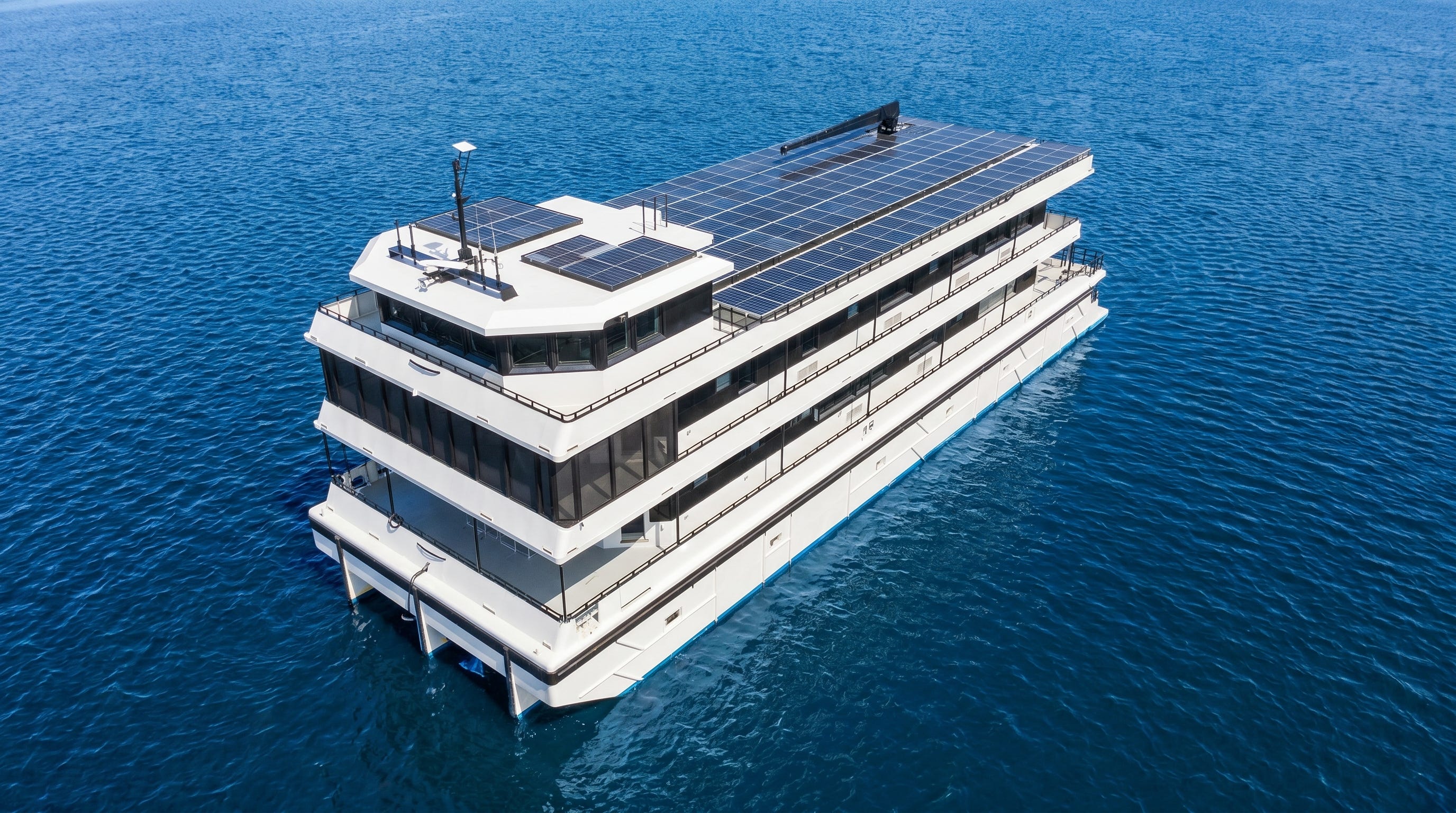
Shine Down is based in Florida. So, with the Floridian sun hitting those 108 modern and high-efficiency panels, you are looking at around 130 to 194 kWh per day, on average. Of course, this depends heavily on the amount of cloud cover and the season. But even taking those two variables into account, you are looking at a serious amount of solar power being generated.
But that number is not fixed, and that is where some issues might start to creep in. Why? Well, a vessel of this size, running AC on a 24/7 basis through an unrenting (by an Englishman’s standards) summer, galley equipment, lighting, water systems, entertainment and nav electronics will normally consume somewhere around 130 to 310 kWh per day.
In the middle of summer, with copious amounts of solar hours and moderate use of the AC, the numbers more or less balance. But, outside of the aforementioned equilibrium, they might not.
For example, during the winter months or when the cloud cover is extremely thick, the amount of solar-generated energy could drop to around 40 to 100 kWh on a typical day. But you will not want to turn off the AC and expose yourself to unrelenting heat and humidity. Of course, there will be exceptions to this ‘rule’, but most people will probably want to retreat to the cool air-conditioned air.
Running the AC on full power means you have a deficit of around 200 kWh daily. Assuming that your batteries are NOT able to absorb the extra use needed, then it will be time to fire up the diesel generator so you can top up the batteries until the photons come back out in force once again.
This is not a failure in design or planning. It is just physics. But it does mean that “off-grid” fossil fuel-free living is harder to accomplish. That is one reason why most solar-powered motor yachts on the market today will have something like: “grid-independent most of the time, with a diesel generator as backup for the rest” in the brochure.
What the System Costs to Buy and Run
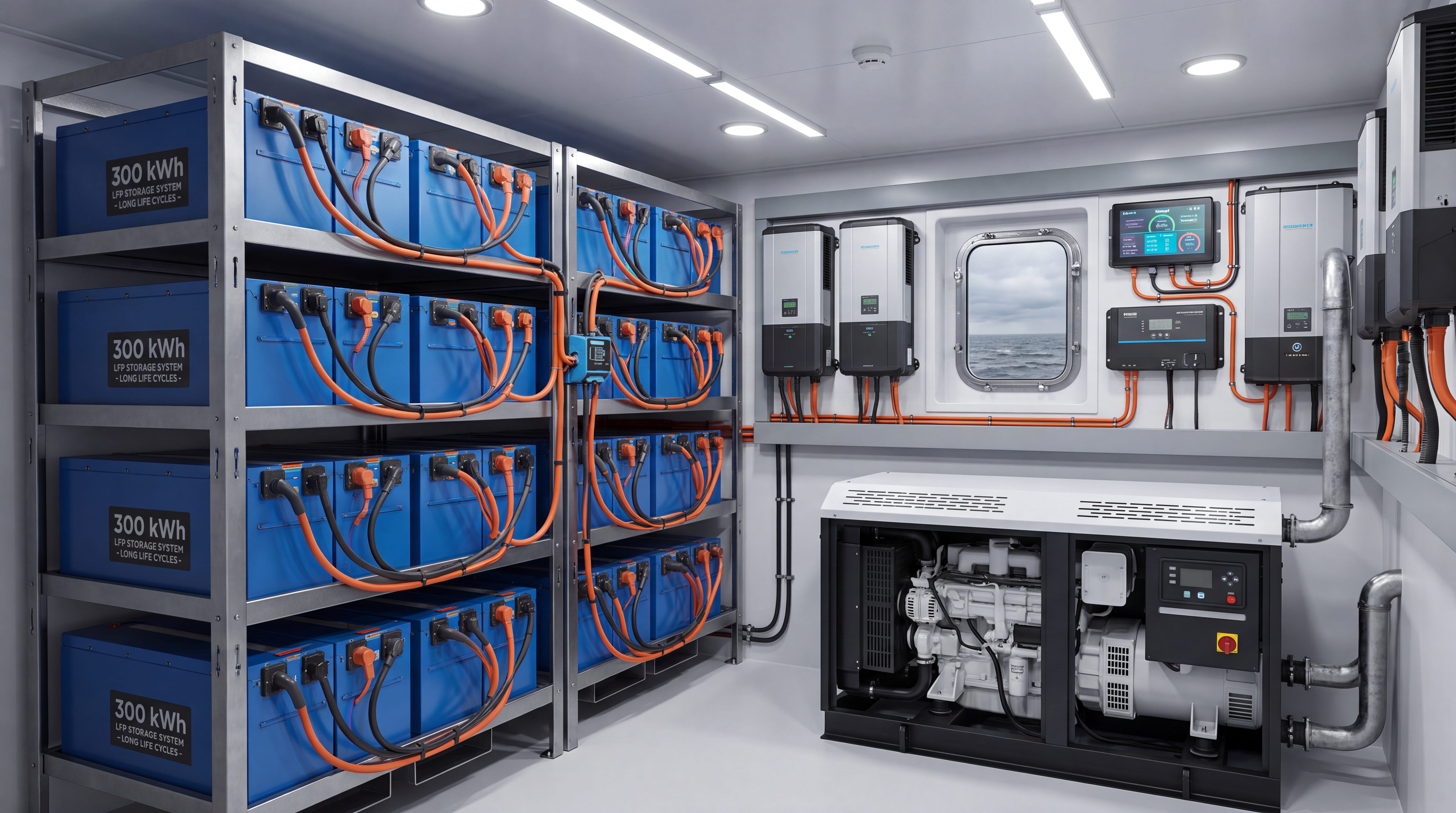
Based on my research, a 300 kWh LFP battery bank runs somewhere in the region of $60,000 to $90,000 based on current pricing (excluding the sort of stuff you can buy on Temu!). That is before you have to fork out on panels, wiring, labour, inverters and charge controllers. Of course, on a smaller vessel, the outlay will be proportionate to, generally speaking, the LOA and beam of the boat.
When it comes to investing in the batteries, then the good news is that, thanks to some very clever chemistry and engineering, LFP batteries tend to be rated for 10 to 20 years of continual service. That is around 6,000 charge cycles at an average of 80% depth of discharge, assuming you have an advanced battery management system that is handling the balancing.
When you run the numbers, the depreciation on a battery bank that size works out to somewhere around $2k to $4.5K a year.
The role that a generator plays on board a solar-powered motor yacht often gets just a few minutes of talk time. It is not just there for emergencies. Anyone who is 100% ‘anti-generator’needs to understand what living on board a boat 365 days a year actually looks like.
A generator is there for the winter months, for the grey days or for when the sun refuses to break through the clouds for weeks on end. So, it would make sense to budget for running the generator some of the time. I am yet to speak with a liveaboard owner who has been able to spend an entire year living just off solar energy aboard a boat. I am sure that will change at some point, so, stay tuned and make sure you subscribe to this newsletter for updates!
Who This Works For
If you operate your vessels in waters where it is reliably sunny for most of the year, keep your AC from being turned on from, say, 10:00 hours until 21:00 hours. You don’t mind firing up the generator for a few hours during the darker months; then a decent solar-powered system will drastically cut your fuel bill. It is a real saving, and for the right owner in the right climate, it is worth the investment.
Personally, I would be interested to hear from anyone who has a decent solar power setup and lives on board their boat 365 days per year somewhere like the Middle East. But, during my own travels in that part of the world, I never came across anyone living on a solar-powered motor yacht. Although I have not been to the Middle East for quite some time, I am sure that has probably changed by now.
If you are envisioning living on board a solar-powered motor yacht, with zero running costs (utilising the anchor way of life), then a production-level motor yacht that does not cost over $1M, as far as I am aware, does not yet exist.
This article continues below, in “The Wardroom”. It is thanks to my premium subscribers that I can travel around and film interesting boats, so it is the premium section where I live to give something back.
In the premium section, I cover:
- The real annual running cost comparison: solar-plus-generator versus a conventional diesel-only power plant, in dollars, across a full cruising year
- Battery bank sizing by boat length: what a realistic system actually costs for a 40, 60 and 100-foot vessel, not just a $15 million outlier
- The solar maintenance calendar: panel cleaning, inverter servicing, and the generator hours you will actually rack up even with a “solar” boat
- My honest assessment of when solar pays for itself: the break-even point, and the cruising pattern that gets you there fastest
- My vision for the future: What I think solar-powered boats of the future might actually look like.
