

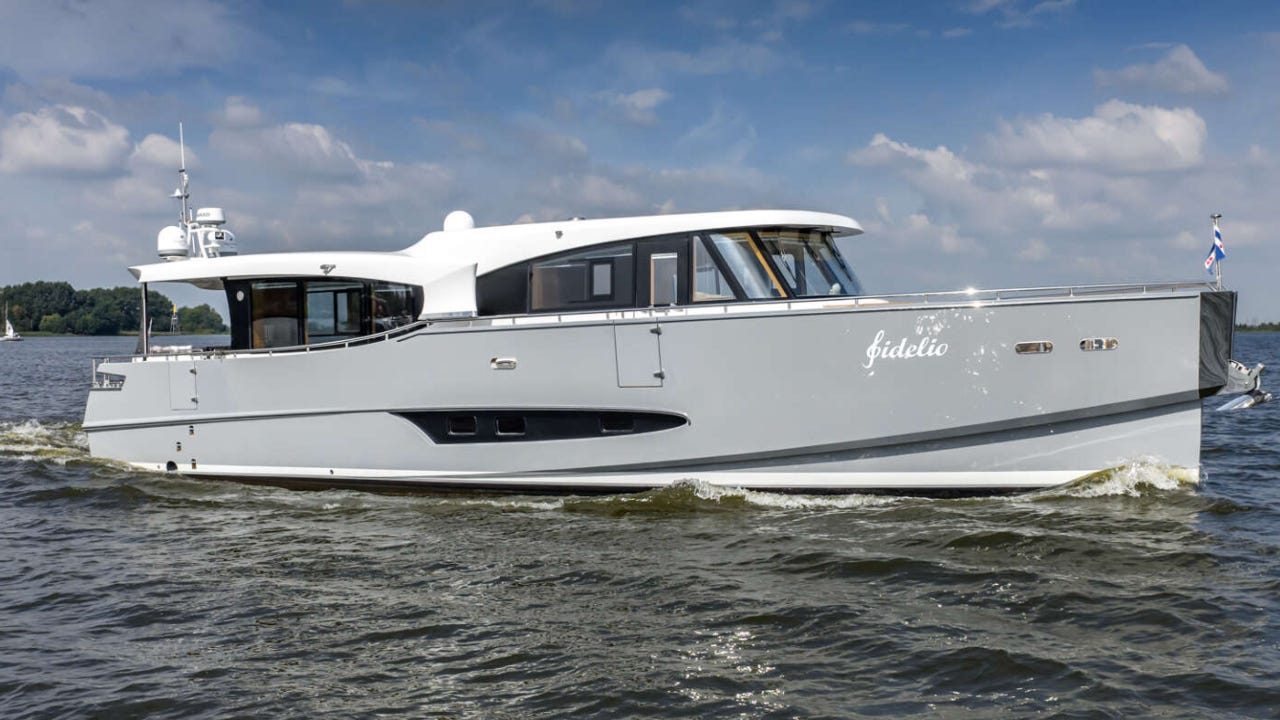
There are boats you encounter that genuinely make you stop and think about how they came to exist. Fidelio is one of them.
Built in 2013 by Jetten Jachtbouw in the Netherlands and designed by Vripack, she was commissioned by an owner who had a very specific vision: a twin-screw, fast-displacement, ocean-going motor yacht with an open transom stern. The kind of boat that could go anywhere, handle serious sea conditions, and do it all with a certain elegance that most production yachts simply cannot replicate.
The design inspiration? A Mercedes-Benz Shooting Brake. If you have not watched the full boat tour video yet, then here it is…Check it out and then I will meet you back here!
The Shooting Brake Concept
The term “Shooting Brake” has its origins in 19th-century Britain, describing a horse-drawn carriage used to carry shooting parties, their game, and their equipment across country estates. When the motor car arrived, the name migrated with it. By the mid-20th century, a Shooting Brake meant something specific in the automotive world: a two-door estate car with a fastback roofline, combining the practicality of a load-lugging estate with the low, sleek silhouette of a sports car. It was a machine of contradictions that somehow worked beautifully together.
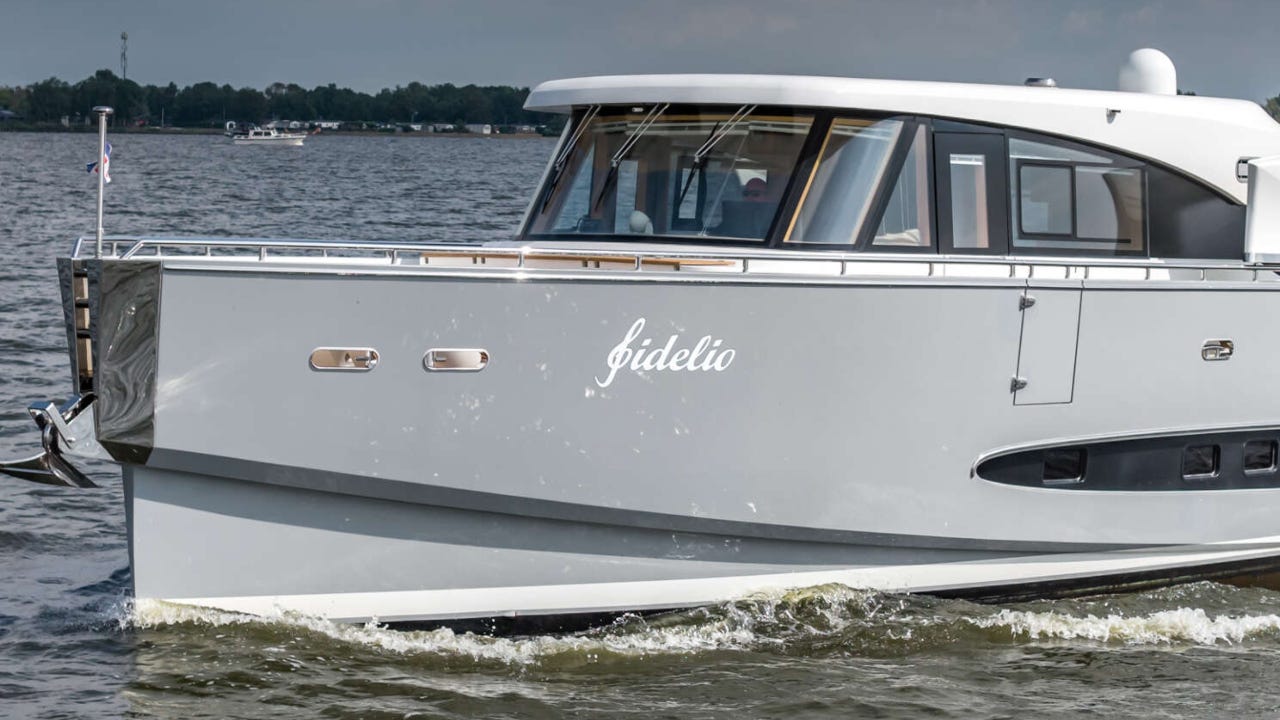
Mercedes-Benz’s own interpretation of the form has always been distinctive, with that signature flowing roofline and wide stance. And it is exactly those proportions that Vripack and Jetten Jachtbouw carried into Fidelio’s design. The low, wide profile. The clean, uncluttered superstructure. The sense of purposeful elegance that does not announce itself loudly but rewards a second look.
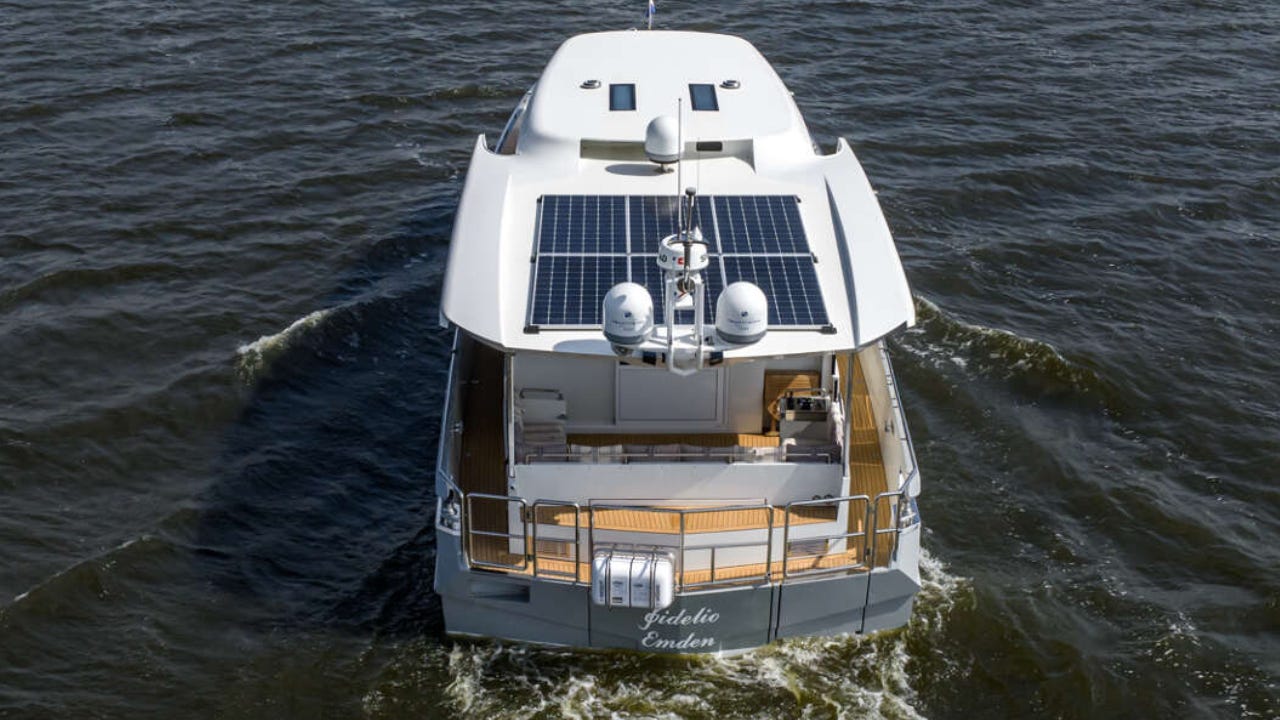
What makes the concept particularly interesting when applied to a boat is the open transom stern.
Where most motor yachts of this size present a closed, wall-like stern, Fidelio opens up at the back. It creates a visual lightness and a practical platform for water access that matches the design language of the Shooting Brake idea perfectly. Purposeful. Elegant. Slightly unexpected.
Jetten Jachtbouw: The Yard That Built Her
Jetten Jachtbouw BV was founded in 1997 and is based in Sneek, in the Friesland province of the Netherlands. Sneek is one of those Dutch towns that takes boats seriously in the way that only a place surrounded by water can. It sits at the heart of the Frisian lake district, and the boatbuilding tradition there is deep and practical.
Jetten built their reputation on steel and aluminium motor yachts, largely to custom specifications. Over the following decades they delivered in excess of 250 vessels to the market, carving out a position as a yard that could handle genuinely demanding briefs. Their range spans from the compact Bully series at around 9 to 10 metres up to larger custom projects, but their particular strength has always been in displacement and semi-displacement designs built for serious use. Long-range, ocean-capable yachts that are meant to be lived aboard and used, not kept in a marina and admired.
The yard went through a restructuring in the mid-2010s and emerged with fresh ownership and direction, a shift that moved the business toward more premium custom builds. What matters for Fidelio’s story is that she was built in 2013, in the period when Jetten was operating at the level of craft that produced boats like this one. A one-of-a-kind commission, delivered by a yard that had the technical depth to execute it.
Got a boat?
Know of a vessel, for sale, charter, or otherwise, that you would like me to feature in a future dispatch? You can send me a direct message or email me via john@yacht-buoy.com
Vripack: The Design House Behind the Lines
Vripack is also based in Sneek, which means that Fidelio was conceived, designed, and built within a remarkably small radius. The studio has been responsible for over 7,500 completed projects across yacht design, naval architecture, and interior design, and their portfolio spans everything from explorer and expedition yachts through to commercial vessels and large luxury builds.
Their co-creative directors, Bart Bouwhuis and Marnix Hoekstra, have built the practice around a philosophy that puts the owner’s vision at the centre and then applies serious naval architecture discipline to make it work. The Moonen 122 Martinique is one of the notable projects in their portfolio, but it is the explorer and long-range displacement work where their approach feels most relevant to Fidelio.
What Vripack brought to this brief was the ability to take an owner’s idea, an automotive concept from a completely different design tradition, and translate it into something that worked structurally, hydrodynamically, and visually as a seagoing vessel. The fast displacement hull they drew for Fidelio achieves its 14-knot top speed without compromising the stability and sea-keeping that a 5,000-nautical-mile range boat demands. That is not a trivial design problem.
The Specifications
At 17.54 metres LOA with a beam of 5.03 metres and a draft of just 1.35 metres, Fidelio sits in an interesting space. She is genuinely ocean-capable, CE Category A certified (the highest offshore classification), and that shallow draft means she can also explore shoal-draught cruising grounds that a deeper vessel would have to bypass entirely.
Her displacement of 45 tonnes on a fast displacement hull with a long keel gives her the hull weight to handle exposed sea conditions, while the hull shape is designed to allow semi-planning performance when you want to push on. The steel hull measures 5mm throughout, rising to 8mm at the keel, and the aluminium roof keeps topside weight low and the centre of gravity where it needs to be for a comfortable motion at sea.
She was antifouled in 2024 and has been looked after accordingly. Her air draft of 3.60 metres is worth noting for anyone with canal passages in mind; that is a practical constraint in parts of the Netherlands and Belgium, though not an unusual one for a vessel of this design.
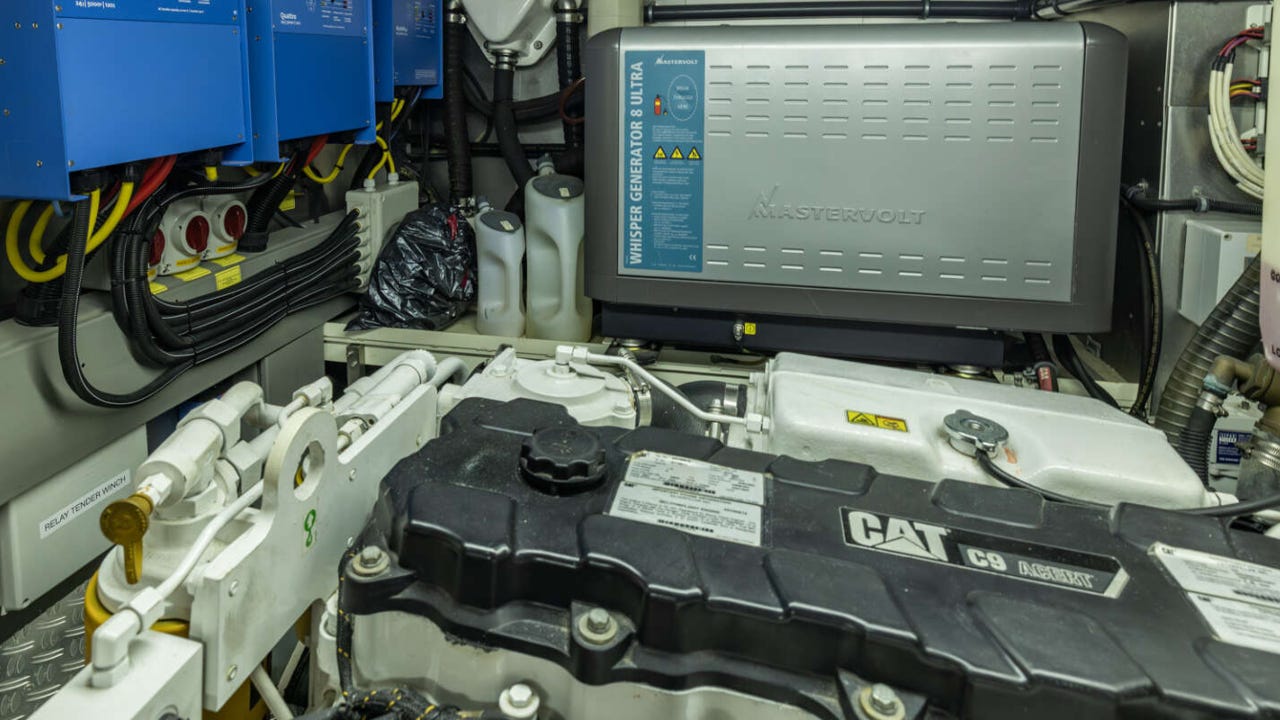
The Engine Room
Twin Caterpillar CAT C9 Acert diesels, each producing 575 horsepower, drive her through ZF hydraulic gearboxes onto stainless steel shafts using Amartech Axiseal shaft seals.
Below, I go deep on what the twin C9 Acert installation actually means in practice: the commercial origins of this engine, the specific service considerations that any serious buyer needs to understand, and the one maintenance interval that should be on your radar before you sign anything. I also break down exactly how the Naiad Multisea II fin stabiliser system works and why it matters on a hull like this, walk through the full electrical and systems setup, and explain why the VAT-paid status on this listing is more significant than it might appear at first glance. That analysis is in the Wardroom. If you are not yet a subscriber, you can join below.
It is a serious installation for a 17-metre yacht, and it comes with a meaningful performance envelope.
Maximum speed is 14 knots. Cruise at 9 knots. And here is the figure that really matters for anyone planning long passages: she carries 5,290 litres of fuel, which gives her a quoted range of 5,000 nautical miles…[Article continues below]
