

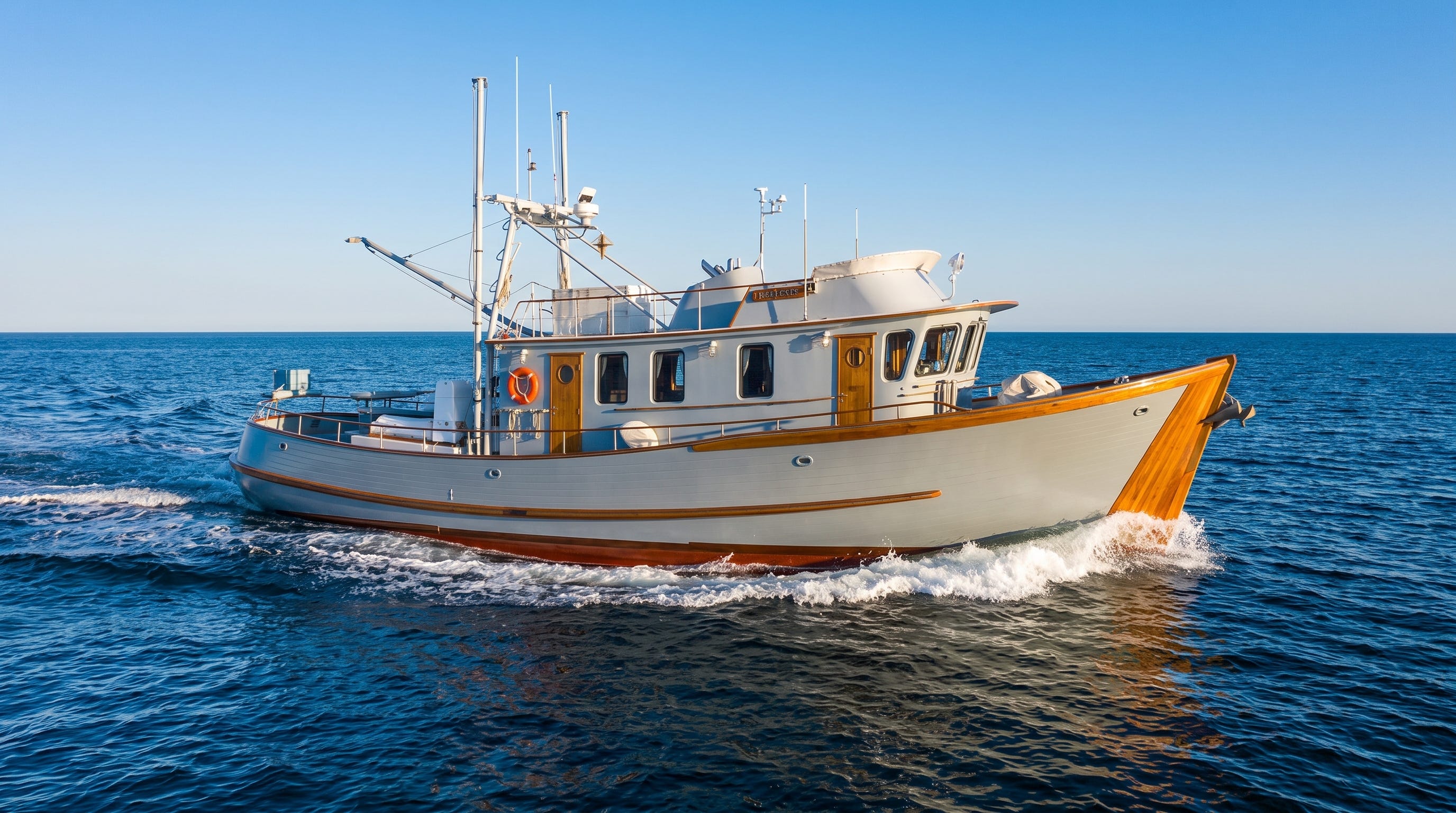
I want to start with a number, because it matters more than any specification this trawler style motor yacht carries...
23,000 incredible hours…..
That is how long it took William Trenholm and his crew to build Sayonara. If you spread that over a standard 40-hour working week, that is 11 years of full-time labour. A decade of evenings, weekends, decisions about frames and futtocks and fasteners, conversation about ballast placement, chats with the designer, revisions, setbacks, and ultimately a vessel that has been sitting in a boathouse in Sidney, British Columbia, since the day she was launched in 1980.
Trenholm was already a man who knew what he wanted. He had built two previous William Garden designs before commissioning Sayonara. He was a well-known figure in Victoria’s yachting and fishing community. When he went to Garden and asked for something heavy, something deep, something patterned after the West Coast commercial halibut schooners that had worked these waters for generations, Garden understood exactly what he was being asked for.
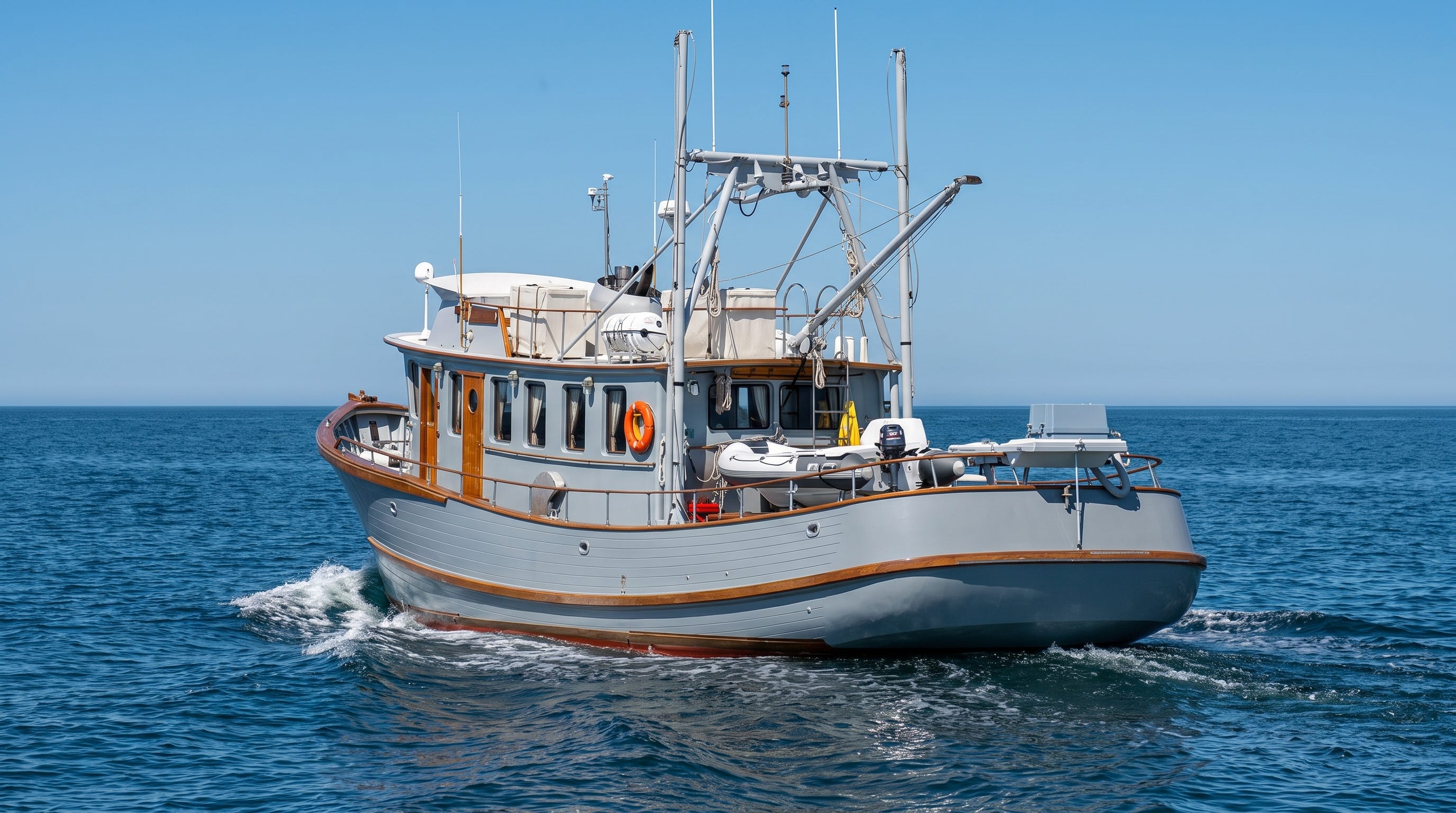
This was not a man who wanted a floating caravan. He wanted a full-specification working cruiser built to commercial standards, in the tradition of vessels that made their living in some of the most difficult waters on the stunning Pacific coast.
She is now listed by Van Isle Marina in Sidney, British Columbia, at $550,000 Canadian dollars. That is approximately $403,000 US dollars at the current exchange rate.
This is the story of how she got there, and what any serious buyer needs to understand before they go and look at her.
William Garden
If you read my JoAhna K article from a few weeks ago, the one about the William Garden escape pod listed at $169,000, you will already know the name. But Sayonara is a different proposition. JoAhna K was a relatively modest 47-footer. Sayonara is 59 feet, built to a heavier specification, with a heavier engine and a longer, more ambitious cruising brief.
William Garden was born in Calgary in 1918, grew up in the Pacific Northwest, and taught himself naval architecture through a combination of apprenticeships and sheer output. By the age of 24, he had already designed 51 vessels, mostly working craft: halibut boats, seiners, trollers, sardine boats. He served in the Second World War at the Adak Ship Repair Base in Alaska, which he later described as the only posting in the army where he was employed doing what he liked.
After the war he moved to Victoria, established a design office on a private island near Sidney, and spent the next four decades producing custom designs for clients who wanted vessels of genuine quality. He designed more than 1,000 vessels across his career, in wood, fibreglass, steel, and aluminium, up to 231 feet in length. He was made a Member of the Order of Canada in 2006 for his contribution to naval architecture and marine engineering.
In 2012, Passage Maker magazine described him as “among the first to design comfortable, always-in-style, trawler-type boats for family cruising.” What that summary misses is the seriousness behind the approach. Garden’s designs were not lifestyle products. They were working cruising machines, built to the standard of the commercial fishing vessels he had spent decades studying, and adapted for private owners who understood the difference between a boat designed to impress and a boat designed to endure.
He died in April 2011, aged 92. Sayonara was featured in his 1977 book ‘Yacht Designs’, under the description “Bill Trenholme’s Boat.” She was in a boathouse at that point, 44 years ago, and she is in a boathouse now.
Got a boat?
Know of a vessel, for sale, charter, or otherwise, that you would like me to feature in a future dispatch? You can send me a direct message or email me via john@yacht-buoy.com
The Halibut Schooner Tradition
When Trenholm asked Garden for a vessel patterned after the West Coast halibut schooners, he was invoking a specific tradition with specific design implications.
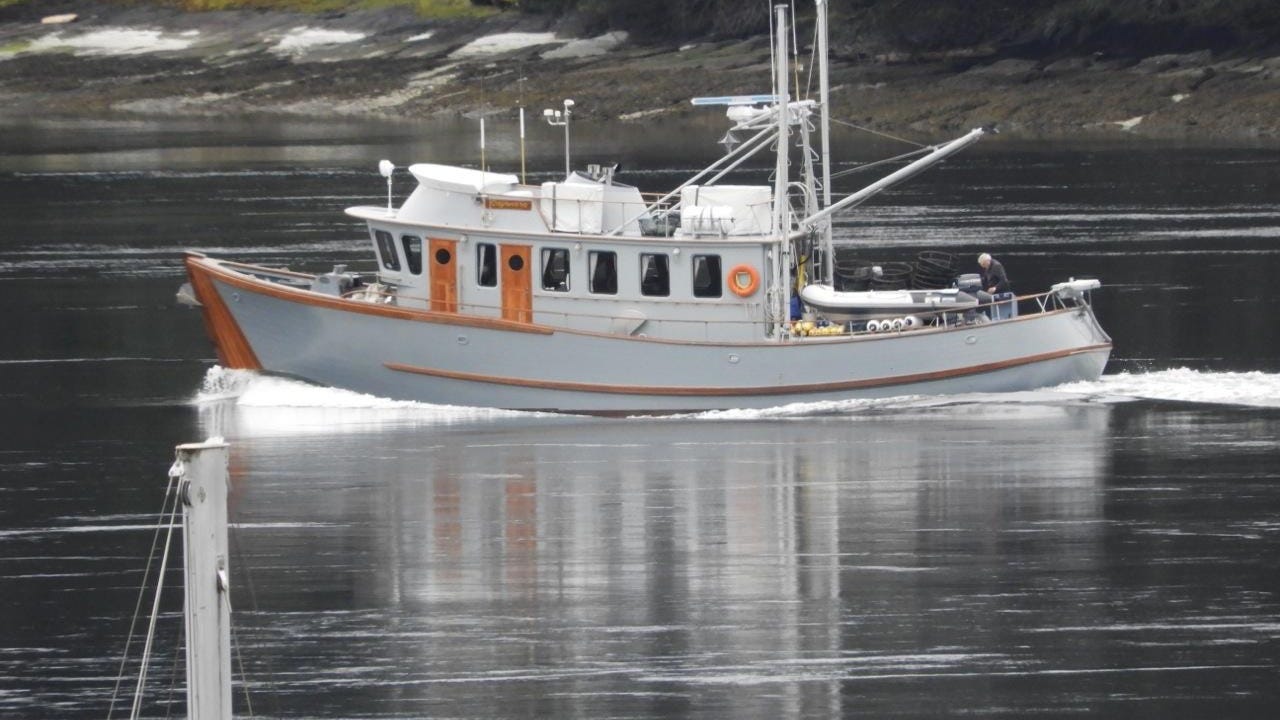
The halibut schooner emerged in the Pacific Northwest in the 1890s as the dominant commercial halibut fishing vessel. These were serious offshore working boats, built to spend extended periods in the North Pacific, capable of reaching the Bering Sea grounds and returning with a hold full of fish. They were deep-drafted, heavy, and stable, with high freeboard for seaworthiness and a wheelhouse positioned aft so the captain could observe the fishing operation forward. They were designed to work in conditions that would make most recreational vessels turn back.
The tradition Garden drew on had been refined over half a century of genuine commercial use. These vessels earned their design features the hard way. The heavy displacement, the deep draft, the substantial structural scantlings, the slow-turning diesel: all of it was proven in conditions that punished shortcuts.
Sayonara is not a halibut schooner. She is a private cruising vessel. But she was designed to carry the structural and engineering DNA of that tradition into a cruising context, and that is precisely what makes her interesting to examine.
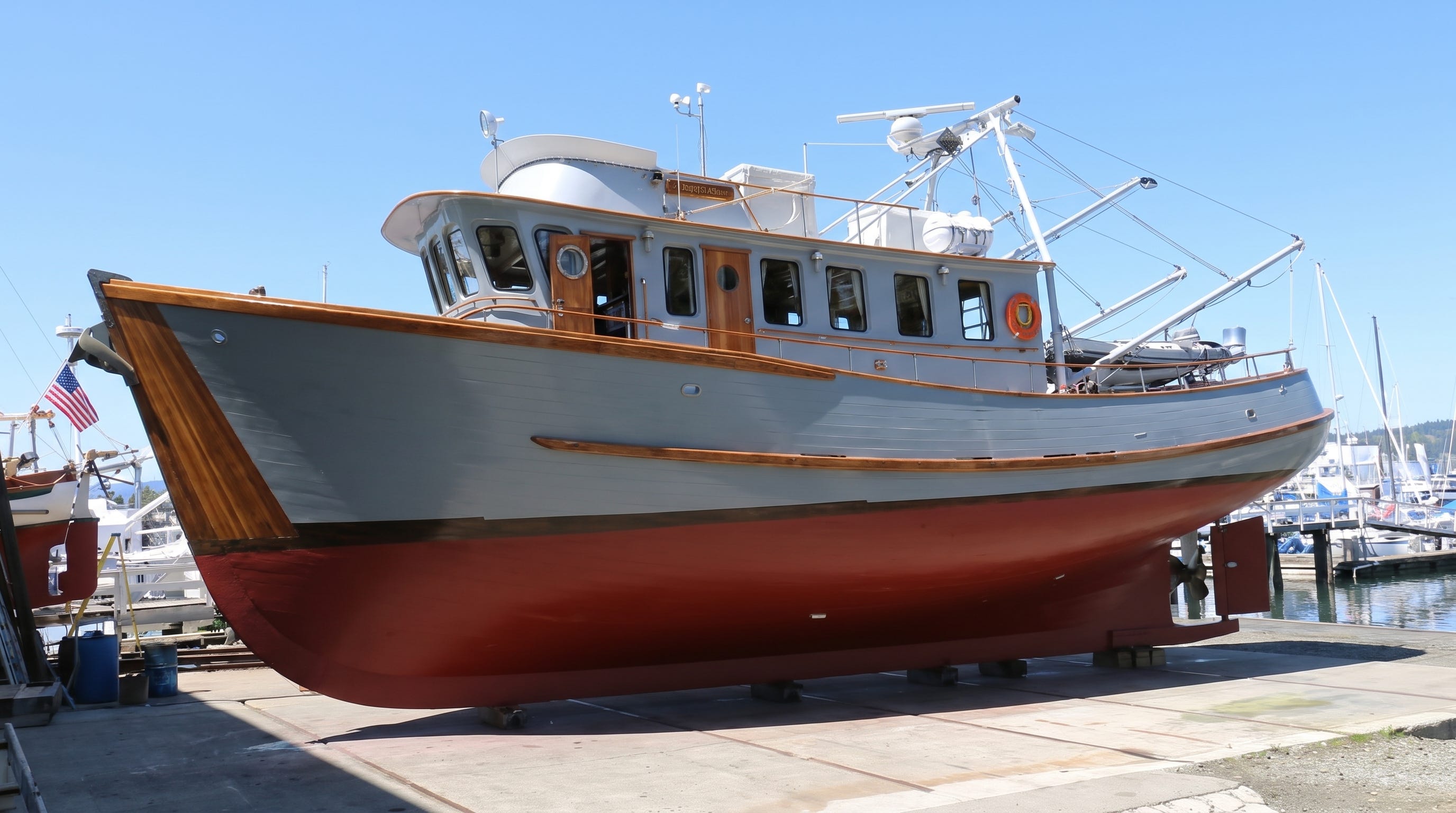
She is built with fir planking on white oak frames spaced at 10-inch centres, with 1.75-inch planking on 2x4 frames. The stem, sternpost, keel shoe, ring timbers, engine beds, and cap rails are all gumwood. Approximately 10 tons of gumwood are used in the vessel’s structure. She is ballasted with lead ballast bar. The hull form is round-bilge displacement, as it would be.
This is serious construction. Not yacht construction in the recreational sense. Commercial-grade construction applied to a pleasure vessel. The materials and methods are those of a builder who intended the vessel to last not a lifetime but several lifetimes.
The Gardner 8L3
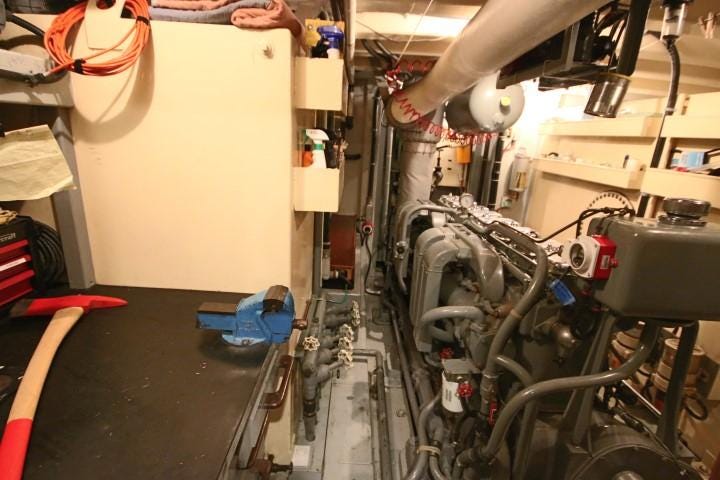
The engine is the heart of this vessel, and any serious buyer needs to understand what they are dealing with before they start thinking about the price.
The Gardner 8L3 is an 8-cylinder inline diesel, first produced in 1932, displacing 24.1 litres with a bore and stroke of 139.7mm by 196.85mm. In Sayonara’s marine application it produces 152 horsepower at 900 RPM. That figure, 900 RPM, is the key to everything about this engine. It turns slowly, it works gently, and it is extraordinarily economical.
At Sayonara’s cruise speed of 8.6 to 9 knots, the Gardner burns 4.5 gallons of diesel per hour. On her 2,200-gallon tanks, that gives her a theoretical range of roughly 4,200 to 4,400 nautical miles. To put that in context: from Sidney, British Columbia, she could reach Hawaii with fuel to spare. She could cruise the Alaska Inside Passage for weeks without touching a fuel dock. On a single tank, she could reach Mexico and still have diesel remaining.
Modern trawlers of equivalent size with modern high-performance diesels typically burn 2 to 4 times as much. The Gardner’s specific fuel consumption of 0.328 pounds per brake horsepower per hour is exceptional by any era’s standards. It is a number that would be respectable in a modern engine, and it was achieved in 1932.
The engine community around the Gardner 8L3 is one of the most devoted in the marine world. Owners speak about it the way other people speak about classic motorcycles or particular vintage aircraft: with genuine reverence for what the engineers got right. Gardner Marine continues to provide sales, service, and spare parts to this day. The engine was designed from the outset to be rebuilt rather than replaced. Cast iron block, common marine fasteners, straightforward architecture. A well-maintained 8L3 can accumulate 30,000 hours or more before a major rebuild becomes necessary. The engine in Sayonara has the hours that belong on a vessel that has been kept, not worked.
Sayonara’s 8L3 drives a four-blade 54-by-44-inch bronze propeller through a Twin Disc 514 gearbox with an Omega drive system at 2.92:1 reduction. The steering is a three-station hydraulic system with Wagner T-10 ram, rebuilt in 2023.
Is there anything you would like to see more of in Yacht Buoy?
The Boathouse
I want to dwell on this for a moment, because it is genuinely significant.
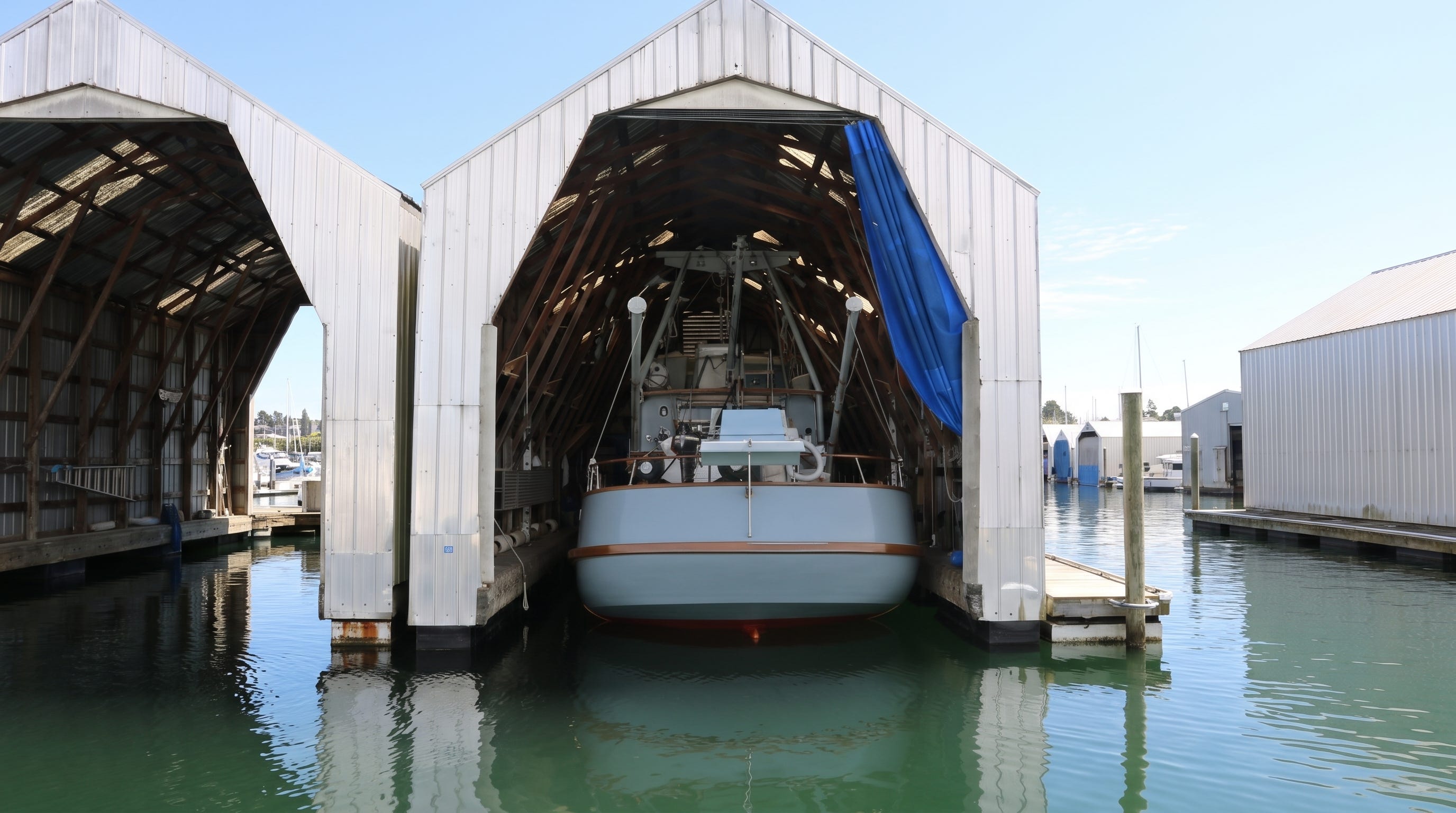
Sayonara has been housed in a boathouse since the day she was launched in 1980. She has never been moored in open water as her permanent berth. She has cruised the West Coast of Vancouver Island every year, including at least one voyage to Alaska, but she has always come home to a roof.
For a wooden vessel, this matters more than any other single factor in her history. The principal enemy of wooden boats is the wet-dry cycle: planks swelling when the vessel is in the water, shrinking when she is out, opening and closing seams repeatedly until the caulking fails, water finds its way into the structure, and rot begins its work. A vessel that lives on an open mooring is fighting this cycle continuously. A vessel in a boathouse is not.
Sayonara’s planking has been continuously wetted when she is cruising and fully protected when she is not. She has never dried out in the sun on an outdoor hardstanding with cracking paint and opening seams. The hull has been preserved in the condition most consistent with longevity: consistently used, consistently sheltered.
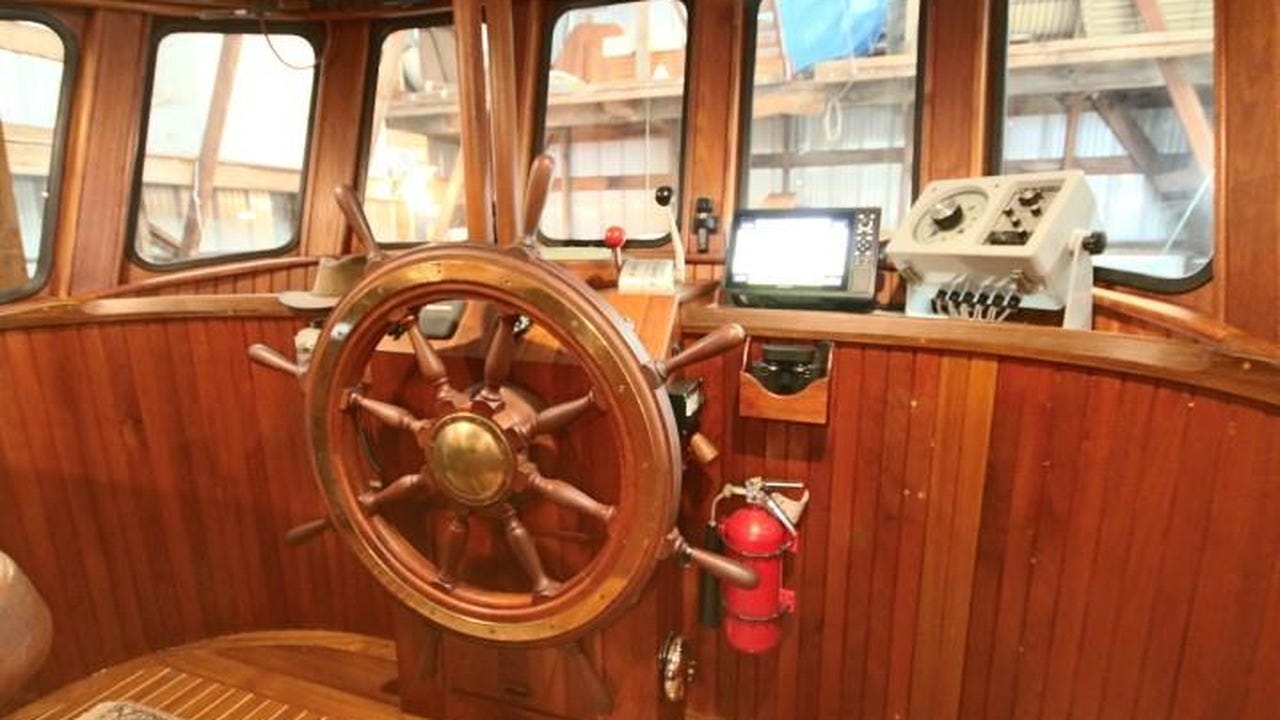
The current owner, an architect by profession, which explains some things about the quality of the interior refurbishment, undertook extensive interior work over recent years. This included new teak and holly cabin soles throughout the wheelhouse, galley, salon, and aft cabin, Quartz stone countertops in the wheelhouse and galley, a completely renovated aft head with new electric head, washing machine, and full shower, new Garmin electronics suite replacing the old instrumentation, and a rebuilt hydraulic steering system.
All of this interior work is described as new and unused. The vessel is being sold because of a recent change in the owner’s plans. The forward cabin and forward head, which were next in the renovation sequence, remain in their original condition. The owner, as an architect, has offered to assist the new owner with this remaining project if they wish.
The renovation is not complete. But what has been done is done to a high standard, and what remains to be done is well understood.
What She Carries
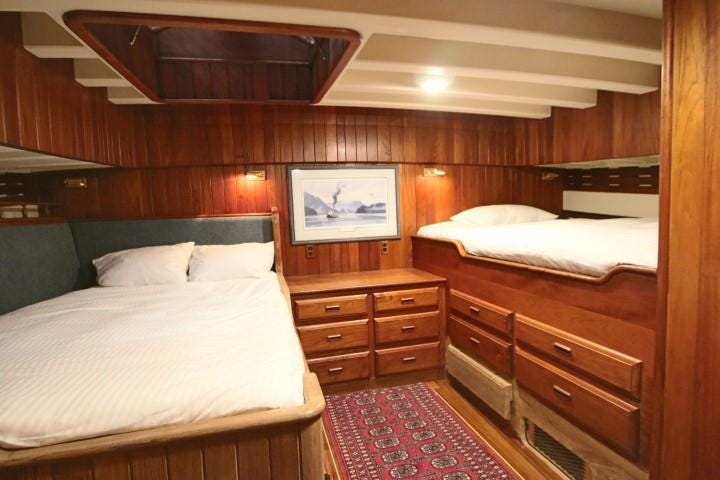
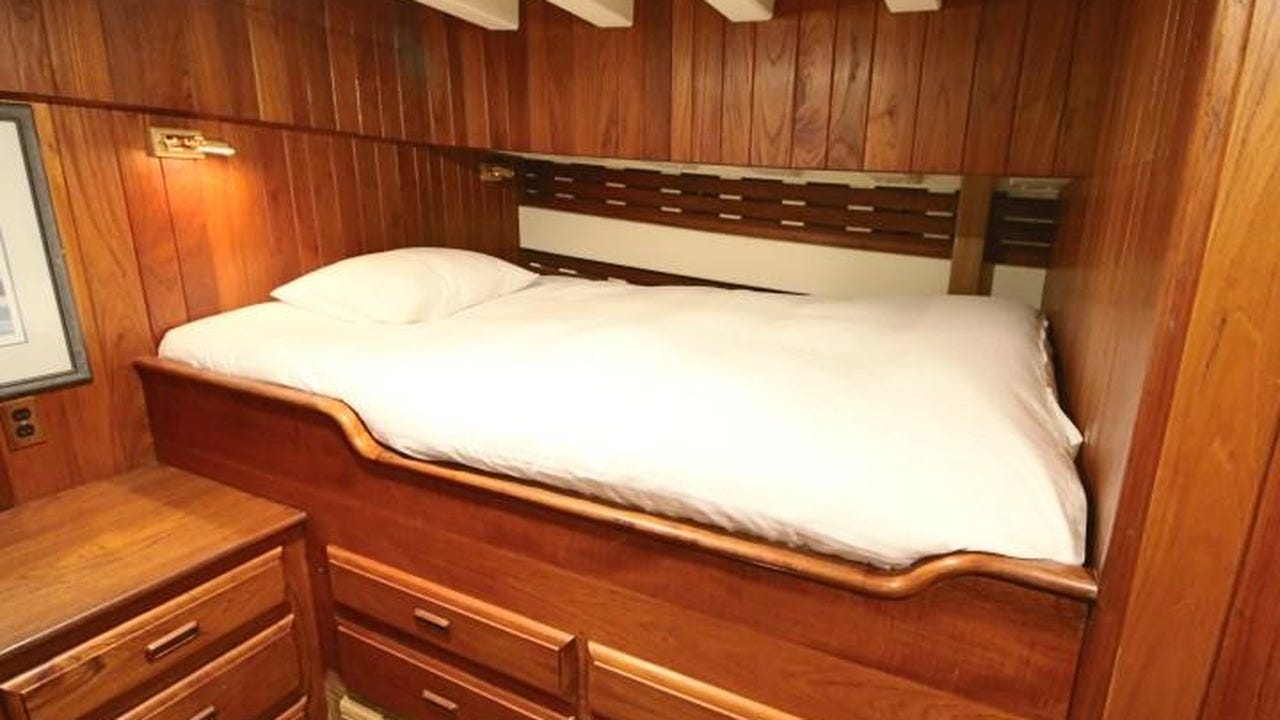
The accommodation runs to three separate cabin areas: a focsle forward with four berths, a middle cabin with two berths and a two-piece head, and the aft cabin with two queen berths and a three-piece head. On a 59-footer with 16 feet of beam, these are real spaces, not cramped compromises.
The galley runs a Dickinson diesel range, which both heats the main deck level and provides domestic hot water, alongside a custom stainless steel refrigerator with a separate freezer aft of the main salon. The salon features a horseshoe settee around a large teak table that seats six, with a lift mechanism allowing it to serve as a coffee table at anchor.
Electrical systems are somewhat complex: 32-volt, 24-volt, and 12-volt DC systems alongside 110-volt AC, with the principal system running on 32 volts. The battery bank uses eight four-volt lead-acid mining-type batteries in series, providing 650 amp-hours. A Kohler 12.5kW diesel generator provides shore-equivalent AC power. The principal alternator is a 32-volt 80-amp Dickinson unit driven by the engine.
Stability at anchor and in a beam sea is provided by a paravane system: two delta-shaped fish deployed from welded alloy tubing booms extending outboard. This is the stabilisation method of choice on serious ocean-going fishing vessels of this tradition, and it suits Sayonara’s character precisely. There are no electronics to fail, no hydraulics to service, no power requirement. The fish go over the side, the booms are lowered, and the roll dampening begins. At anchor in a swell, the improvement in comfort is immediate and significant.
The anchor system is a Harrison and Robbins hydraulic winch with 110 feet of 5/8-inch chain and 600 feet of 1-inch nylon rode, and a 350-pound Forfjord anchor. The dinghy is a 12-foot RIB with a 20-horsepower Yamaha outboard, launched and recovered by a hydraulic winch and boom system.
Safety systems include a Halon fire suppression system in the engine room, four 10-pound and two 3-pound ABC extinguishers, EPIRB, all Canadian Coast Guard prescribed safety gear, and high-water alarms. There is a built-in vacuum system with two outlets.
This article continues below, in “The Wardroom”
In the premium section below, I cover:
- The wood hull question: what a pre-purchase survey on a 46-year-old wooden vessel actually involves, what the surveyor will focus on, and what buyers should budget for the process itself, before any remediation
- Annual maintenance costs in honest numbers: what owning a wooden trawler of this size and age actually costs per year, compared to a GRP or steel vessel of equivalent displacement
- The forward cabin and what it will take: realistic budget for completing the renovation that the current owner did not finish, and the trades you will need access to in the Sidney area
- My honest assessment of $550,000 CAD: how this price sits against the current wood trawler market in North America, what the Gardner engine and Garden pedigree add to the valuation, and what a realistic all-in acquisition budget looks like once survey, the remaining renovation, and ongoing ownership are factored in
The Wood Hull Question
Let me be direct with you about this, because it is the question that will define whether Sayonara is the right vessel for a particular buyer.
