

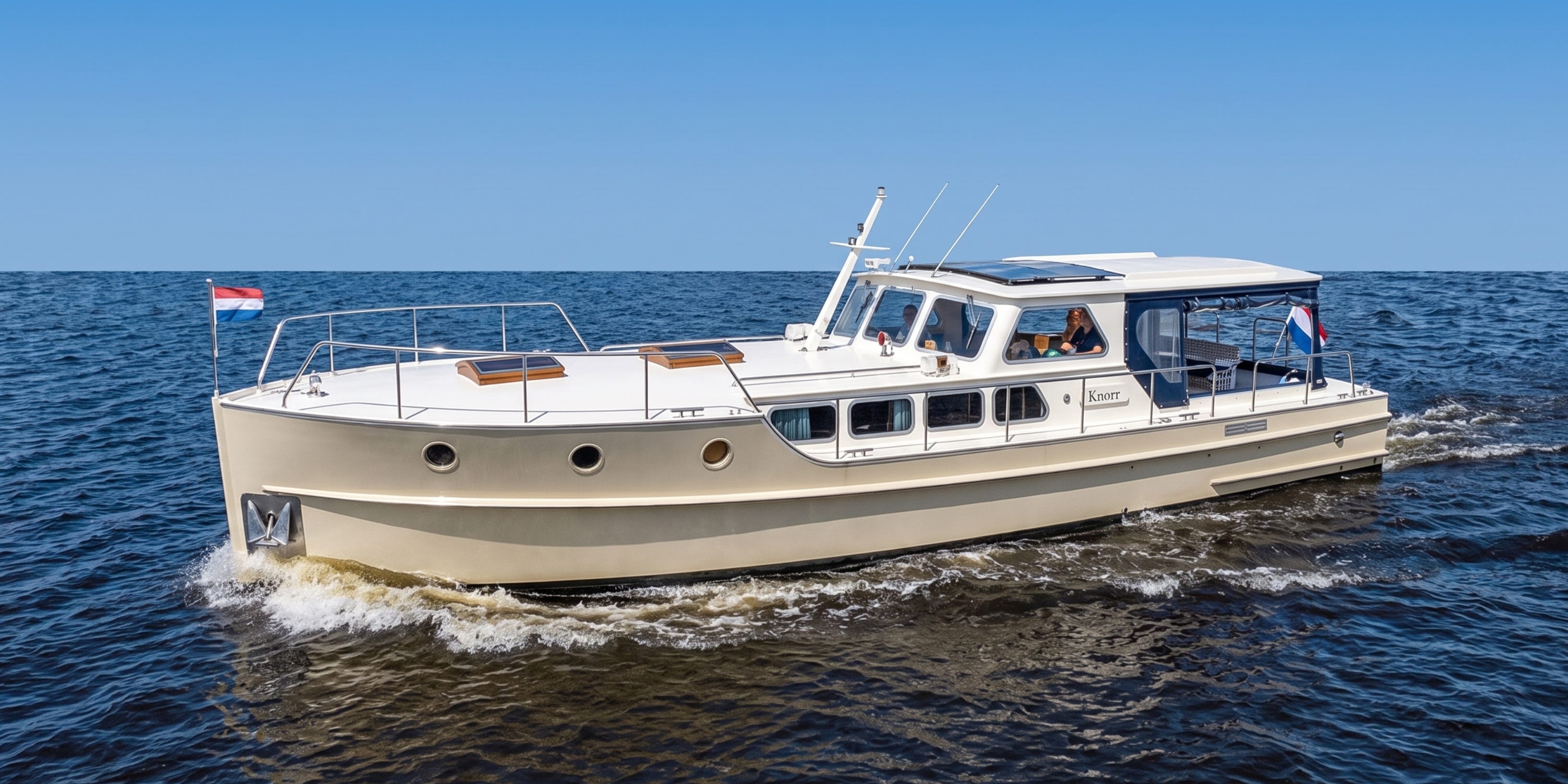
Look along her cream-coloured hull, past the round portholes and up to that enclosed wheelhouse. The Kruiskamp Bakdekker 1400 has a lovely sense of proportion: a long foredeck, an uninterrupted sheer and an aft seating area tucked behind the superstructure. There’s space to move around outside, while the large wheelhouse windows bring the view indoors.
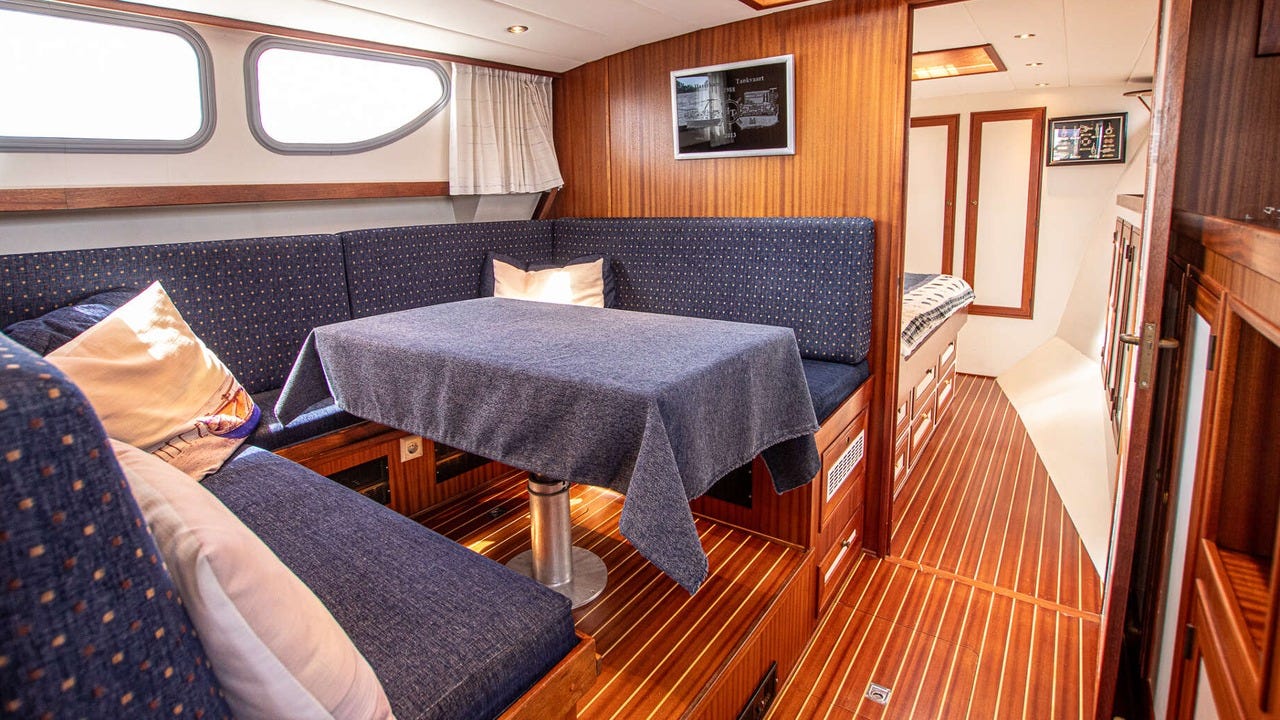
Built in 2005, she’s listed with Joep Molenaar at De Valk Loosdrecht for €229,900, VAT paid (link to listing below). Her listed dimensions are 14m by 4.20m, with a 1.20m draft and 18-tonne displacement. That’s around 46ft of steel cruiser, with a single Perkins and a domestic fit-out that makes longer stays aboard feasible.
Where she comes from
Kruiskamp Almelo’s own yachtbuilding story starts in 1991 with a Shogun 33OK. Its historical portfolio includes Shogun, Rogger, Bakdekker, Sleper and Twenkruiser designs, supplied from bare hulls through to completed boats. The company’s website now says it has stopped taking new work, which is a shame.
Bakdekker is the type/model name here, rather than a separate builder. This example dates from 2005, and Kruiskamp still documented the 1400 in a 2016 brochure. A reliable launch date or production total hasn’t emerged. That later brochure describes a standard package and not this boat’s individual build specification.
What the chines mean afloat
Her steel hull is hard chine, with an angular change between hull surfaces rather than the curved transition of a round bilge. Those edges can help damp rolling as water separates around them. How much they help depends on the shape, conditions, speed and loading.
You can’t realistically rank the boat’s seakeeping from that label alone. A broad, stiff boat may resist an initial heel yet return quite sharply; a round-bilged boat can have a more gradual motion. Beam, centre of gravity and underwater geometry matter quite a lot in both cases. Neither shape tells us her ultimate stability, which also depends on reserve buoyancy and where water can enter as she heels.
In head seas, bow entry, deadrise, speed and wave steepness influence relative impact with the motion of the waves. Hard chine doesn’t automatically mean slamming, any more than round bilge automatically means ocean-going. My No Limit 13.20 article offers another steel-hull design to explore alongside this one.
A Perkins and some unusual batteries
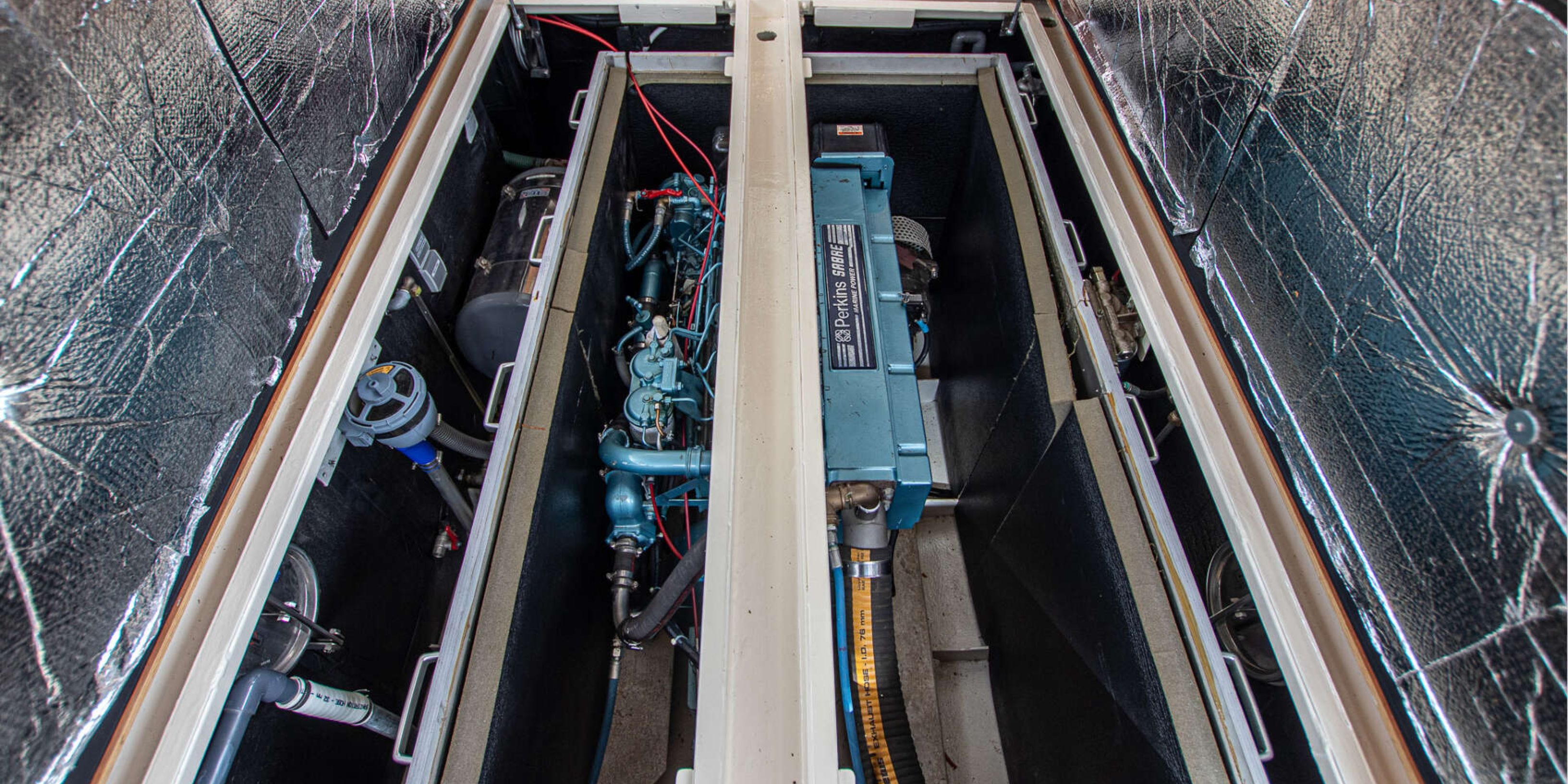
De Valk lists a 135hp Perkins Sabre M135, showing 3,127 hours, driving a four-blade propeller through a ZF Hurth gearbox and shaft. Hydraulic steering serves inside and outside helms, with an electric bow thruster for close manoeuvring.
The M135 is a naturally aspirated six-cylinder diesel with rotary-pump fuel injection. Routine oil, filters, belts and cooling-system checks are familiar jobs for a competent owner. Perkins’ handbook includes a 400-hour or 12-month service trigger, whichever comes first, so low annual hours don’t remove the calendar commitment. Injector and valve work definitely belong with someone trained for them.
I don’t often see Rolls batteries on the boats I cover. These are Rolls Battery Engineering products from Canadian manufacturer Surrette. De Valk lists two S12-230AGM batteries, dated 2022, specifically for the bow thruster. Each is 12V and rated at 210Ah over 20 hours, or 230Ah over 100 hours.
Low bridges and European waterways
Her listed minimum air draft is 2.95m, and her mast lowers manually. The exact stowed configuration and loaded draft still need to be measured for a chosen route.
For Dutch cruising, Rijkswaterstaat’s route information provides the bridge, lock and water-level checks. On the Canal de Bourgogne, published 38.5m by 5.1m locks, 3.5m headroom and depths from 1.6m look promising on paper. Availability is separate: the central section’s 2026 season ended on 7 September.
The Canal du Midi needs closer attention as its published restrictive lock dimensions are 29.7m by 5.5m, with 1.4m water depth, leaving little draft margin. Bridge arches offer 3.3m on the centreline but less towards the sides.
This article continues below, in “The Wardroom”
In the premium section below, I cover:
- Category C: what her plate tells us and why, despite her pedigree, she is a CE Cat C boat rather than CE Cat ‘A’
- The Great Loop: dimensions, shipping and electrical preparation.
- Running costs: annual and 5-year examples, plus yard bills.
- My honest assessment of the asking-price context: De Valk alternatives and who she suits.
It is thanks to my premium subscribers of this newsletter that I am able to cover the costs associated with featuring these boats, such as travel costs, time, etc., so if you do become a paying subscriber, or are already one, then thank you!
Category C, with a useful job to do
Under the current EU definitions, C covers design conditions up to Beaufort 6 and 2m significant wave height. Category A covers design conditions with winds exceeding Beaufort 8 and significant wave heights exceeding 4m, excluding abnormal conditions. These are design categories, not instructions to head out whenever the forecast falls below a number!
