

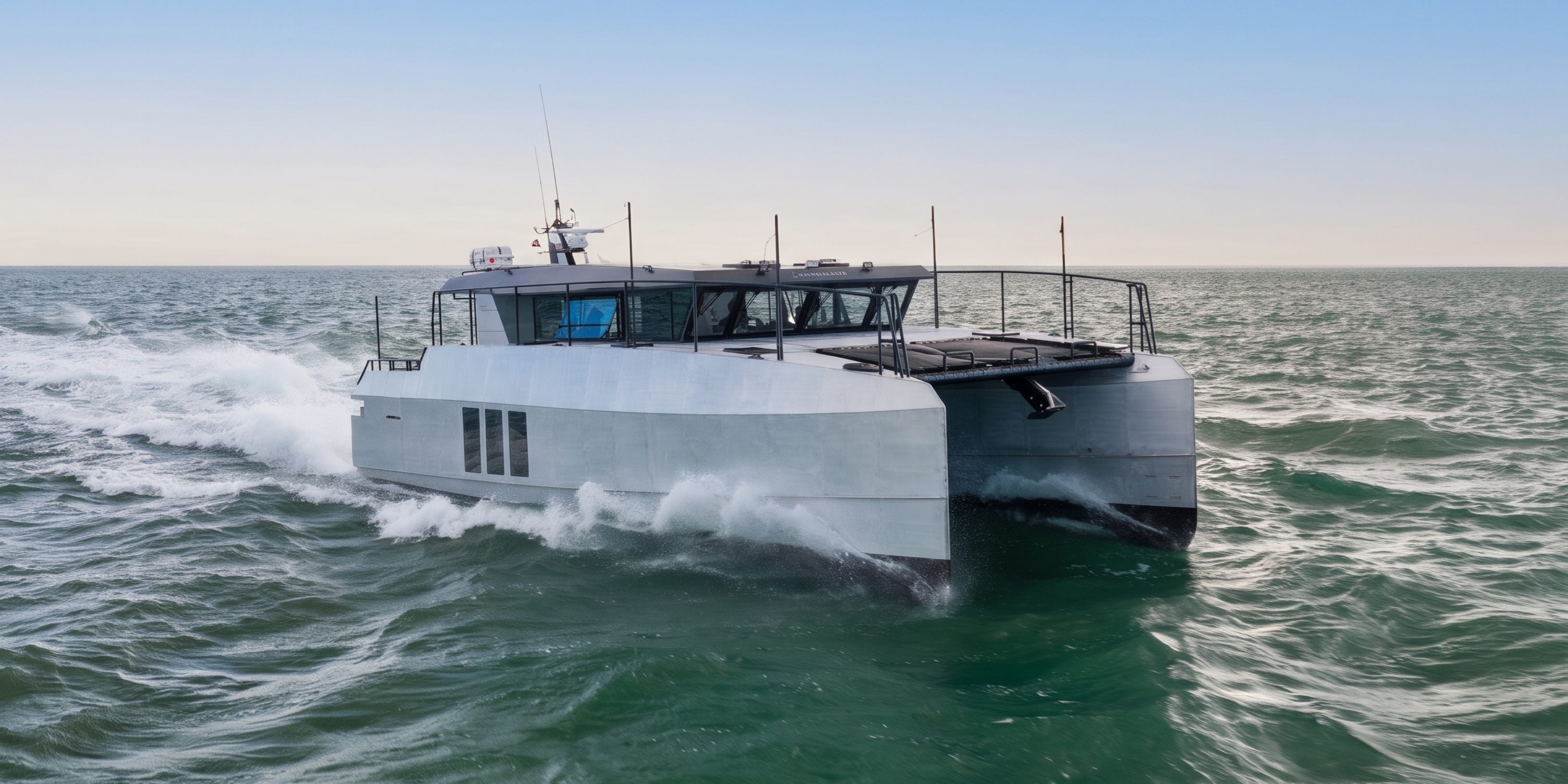
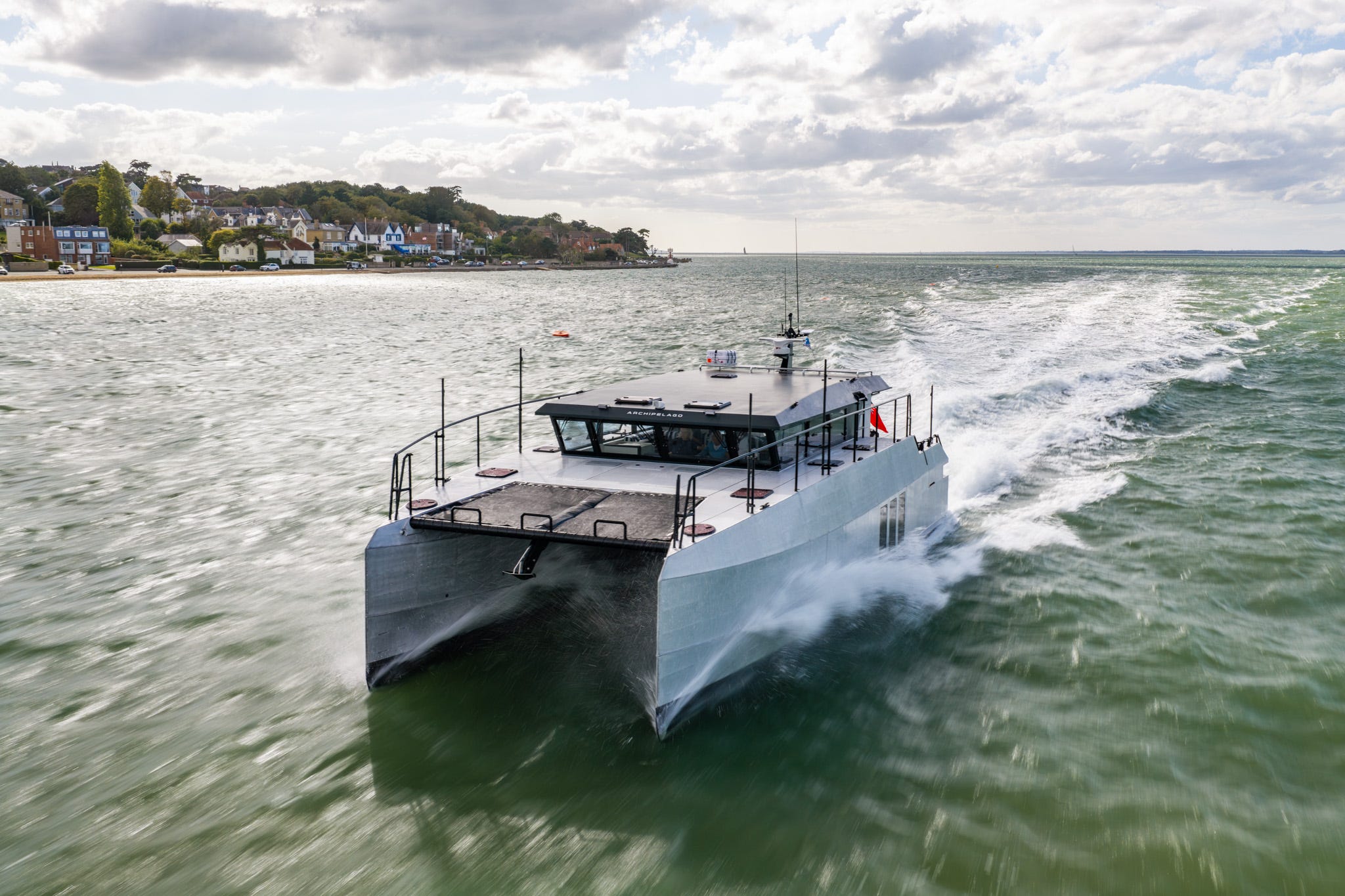
Back in 2022 I featured hull 1 of the Archipelago 47, and that walkthrough has now had nearly 300,000 views. In late October I went back to the builder’s facility on the Isle of Wight with Archipelago’s founder, Dr Stephen Weatherley, for an exclusive look at hull 2 of the Archipelago 47: a yard visit, sea trials, and a sunset run back to the mainland. She was in the final stages of her fit-out, so this is a behind-the-scenes look at a boat that isn’t quite finished, and a lovely chance to see how a British yard shapes a 47ft explorer catamaran around one owner’s plans.
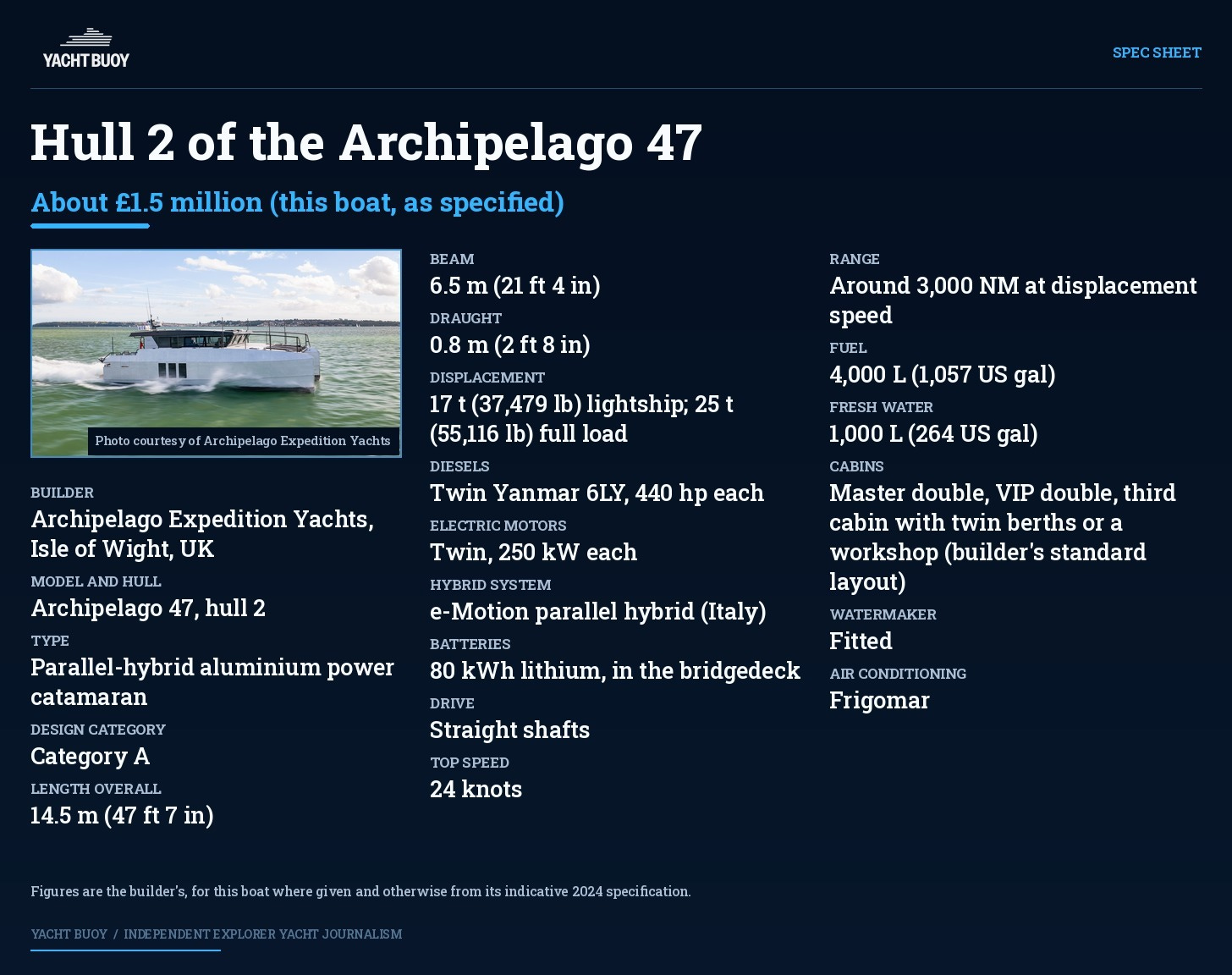
Figures are the builder’s, for this boat where given and otherwise from its indicative 2024 specification.
Her builder puts hull 2, as specified, at about £1.5 million, roughly €1.8 million or $2.02 million at the ECB reference rates for 5 November 2026. She isn’t for sale; she’s a private commission, and that’s the price of this particular boat, hybrid system, owner’s fit-out and all.
Who are Archipelago Expedition Yachts?
Let’s start with the builder. Stephen, the son of a British engineer, has spent his life around boats. By the company’s own account, he wanted to cross oceans with ease and economy, but a traditional heavy displacement cruiser didn’t give him the freedom or the speed for a day trip to the Isle of Wight or a few days’ fishing with his children. That’s where the A-47 came from. The naval architects are Chartwell Marine, based near Southampton, and the boats are built on the Isle of Wight.
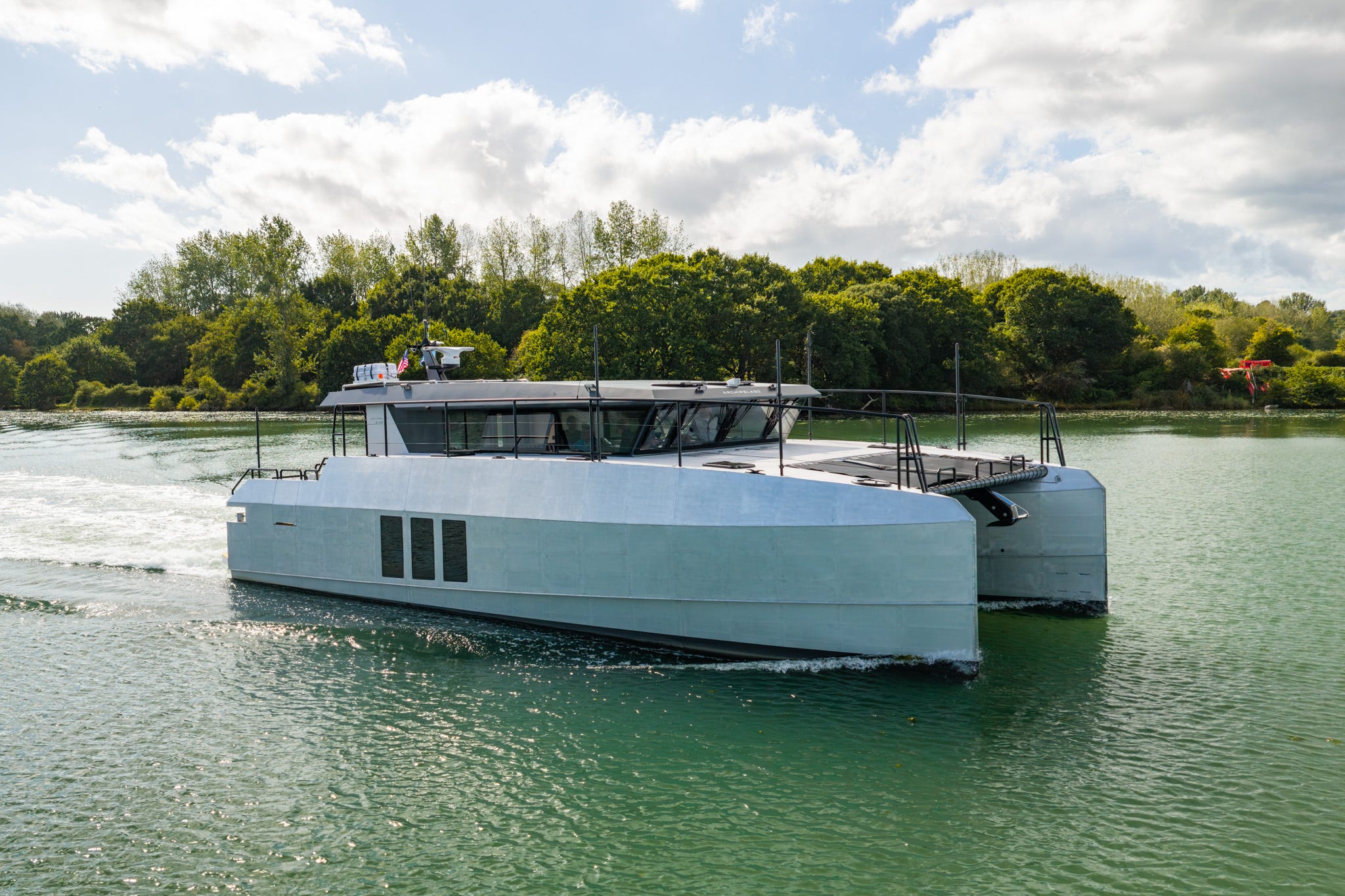
Archipelago sums up its DNA as safety, simplicity, space, speed, shallow draught and stability. Every boat is an aluminium catamaran, hybrid by design, and the builder says all of them can be beached or dried out, and that they need no gyros and no stabilisers, for simplicity and maintainability. As the International Institute of Marine Surveying points out, aluminium is both light and strong, which suits a boat meant to be tough and quick.
The range runs to five designs. The A-40 is the builder’s pocket-sized explorer catamaran, the 47 made a little smaller; Archipelago says her reduced beam and 12.2 m length let her fit most marina finger berths. The A-47 is the original. The A-52 Flying Bridge lengthens the 47’s hull, adds a little beam and gains an upper helm. The A-63 is a 19.2 m design with methanol engines and a methanol-to-hydrogen fuel cell, which Archipelago describes as zero-emission when run on bio-methanol. And the A-80 is a custom 24 m by 11 m platform the builder says can carry 16 tonnes of payload, helicopters included.
What’s in the build hall now
Some news from the yard: Archipelago has two Archipelago 40s in build at the moment, and one of them is 100% electric, with a range of 100 nautical miles between charges. I’ll be doing a video feature on them in the not-too-distant future.
What makes hull 2 special
Two things set hull 2 apart from hull 1, and both come back to her propulsion. She has a parallel hybrid system from e-Motion of Italy, pairing her twin Yanmar 6LY diesels with twin electric motors, fed by 80 kWh of lithium batteries housed in the bridgedeck. “Parallel” means the electric motors work on the shafts alongside the diesels. e-Motion describes four ways such a system can run: on the diesels alone, on battery power with the engines off, on both together for a boost, and in a charge mode where the running diesels turn the motors into generators. That gives an owner a choice between quiet electric running and diesel power for open water, with her builder’s top speed of 24 knots and a range of around 3,000 nautical miles at displacement speed.
The second change is a neat bit of thinking. Archipelago extended hull 2’s bridgedeck forward by one full frame compared with hull 1, both to house the batteries and to give her more room in the accommodation. She carries 4,000 litres (1,057 US gallons) of fuel and 1,000 litres (264 US gallons) of fresh water, with a watermaker and Frigomar air conditioning. And as I say in the video, she draws just 0.8 of a metre, yet her builder has designed her to Category A for offshore passages, with aluminium hulls made to take the ground.
Built around her owner
Every Archipelago interior is built to its owner’s own needs, so even the third cabin can be twin berths or a workshop. The builder includes hours of naval architecture in the price of every boat, and it encourages future owners to visit the build.
Hull 2’s owner has taken that partnership to heart. He’s an American who has been closely involved in her build, and he plans to run her single-handed in European waters. I think there’s something rather wonderful about a British-built catamaran shaped around one person’s idea of the cruising life.
Life aboard
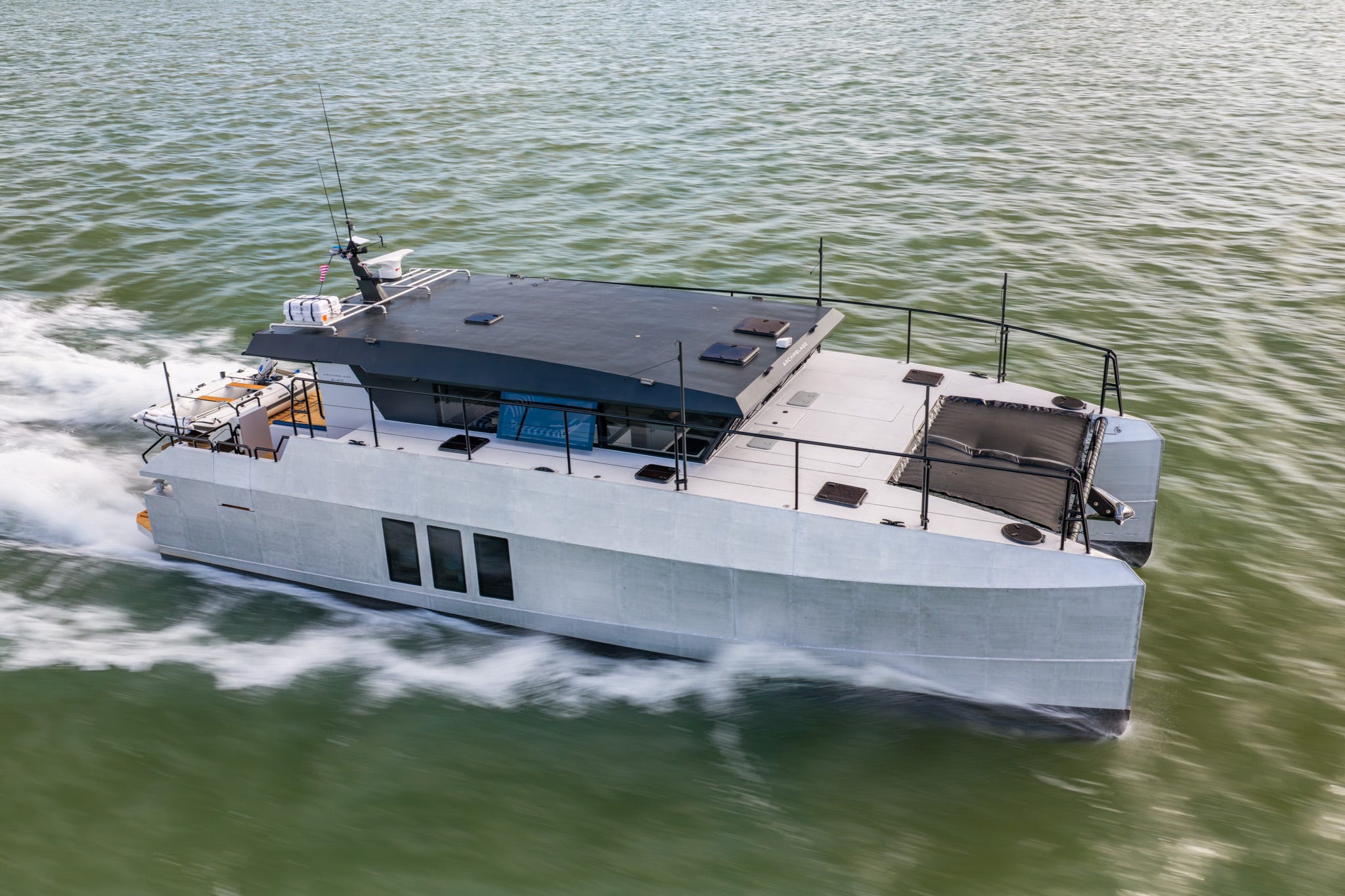
The builder’s standard layout has a master double, a VIP double and that flexible third cabin, and Archipelago describes the 47 as taking up to 8 people. Two double cabins let a couple host friends or family with everyone in their own space, whilst the third cabin can become a workshop for an owner who would sooner have a bench than extra guests.
One of the 47’s cleverest ideas is what the builder calls its saloon divide. You can’t safely navigate at night from a brightly lit helm station, Archipelago points out, so the helm can run the boat from a dark, well-equipped wheelhouse whilst everyone else stays in a warm, lit lounge with underfloor heating and the galley. The skipper keeps their night vision, the crew stay cosy, and both winter boating and extended stays aboard look far more inviting. The 47 is also wheelchair accessible as standard, in keeping with Stephen’s wish to open boating up to more people.
For water, the World Health Organization uses about 50 litres (13 US gallons) per person per day as an intermediate domestic level of service. On that yardstick, her 1,000-litre tank (264 US gallons) gives 20 person-days, about 10 days for a couple or 5 for four people, before the watermaker comes into play.
How she compares
Against hull 1, the difference is the hybrid and the longer bridgedeck that carries its batteries. The more interesting comparison is with a very different kind of explorer.
Last month I wrote about Aegis, a 2000 Nordhavn 40, a full-displacement monohull. Nordhavn’s published N40 figures give a cruising speed of 7.5 knots and a draught of 1.45 m (4 ft 9 in), whilst hull 2, by her builder’s figures, reaches 24 knots and draws 0.8 of a metre. They answer different questions. The Nordhavn carries a heavy monohull a long way at a steady, lower cruising speed. The Archipelago offers a long displacement-speed range too, plus the option of covering ground quickly and tucking into some shallower anchorages.
In the premium section below, I’ve put numbers on her fuel and set out how I’d manage a new build like her.
This article continues below, in “The Wardroom”
A huge thank you to everyone who already supports Yacht Buoy as a premium subscriber, and a warm welcome if you’re joining today. Your support keeps both the YouTube channel and this publication going, independent and advert-free, so I can keep writing about and filming boats like hull 2.
In the premium section, I cover:
- What she costs to run, worked out: litres, US gallons and pounds per 1,000 nautical miles at displacement and cruising speed, and how far 4,000 litres (1,057 US gallons) goes with a 10% reserve
- The hybrid in practice: what 80 kWh and her electric motors mean at the anchorage, and the questions I’d put to the builder
- If I were acting as the buyer’s rep: how I’d manage a new build with a yard like Archipelago, from contract to handover
- Where she belongs on the water: what Category A, twin hulls, 0.8 m of draught and 24 knots mean in practice
- My honest assessment: who an Archipelago 47 suits, and what a new build like hull 2 asks of her owner
What she costs to run, worked out
Her builder’s figures let us put numbers on her fuel, and I’ve done the arithmetic so you don’t have to.
