

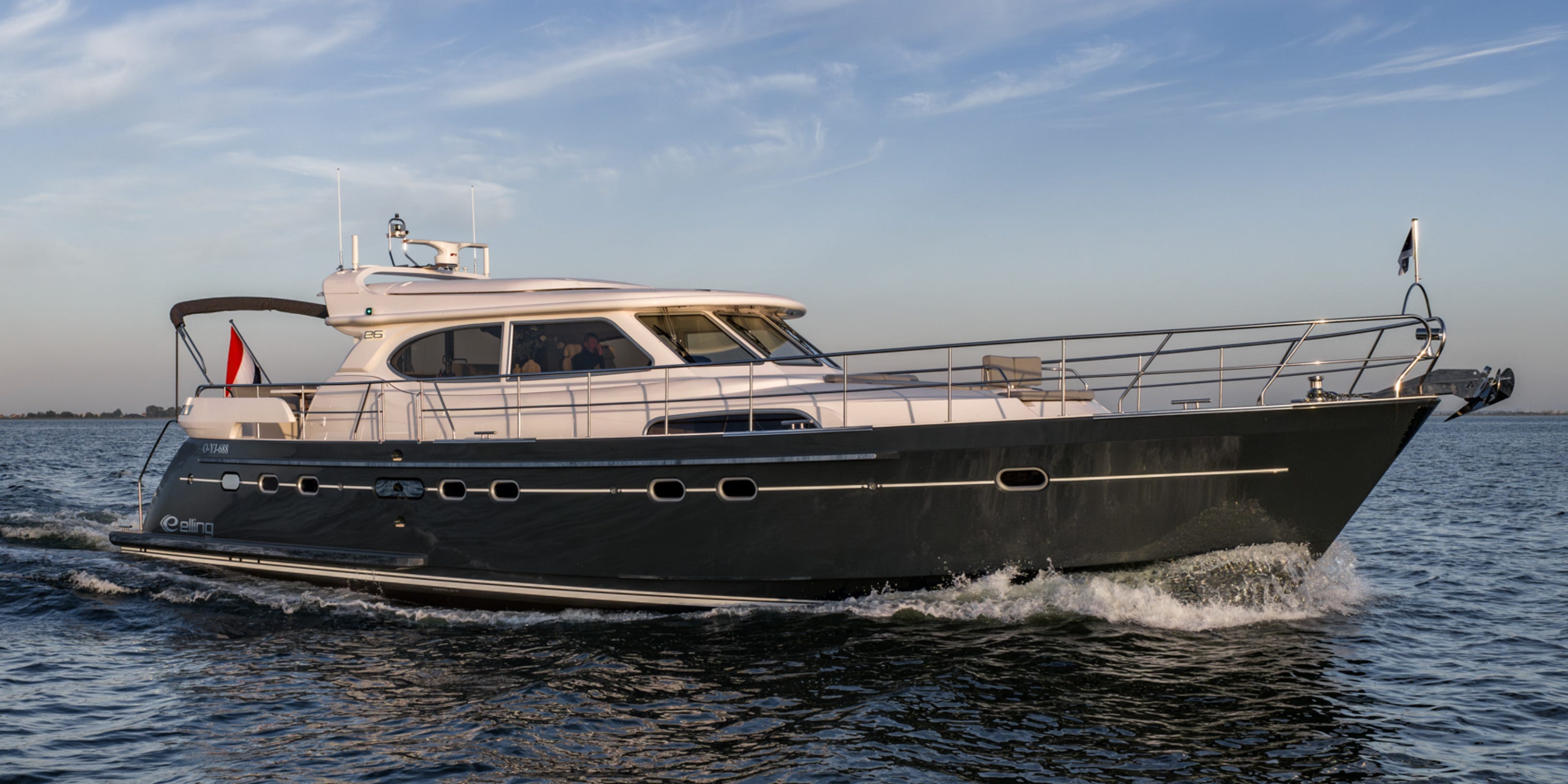
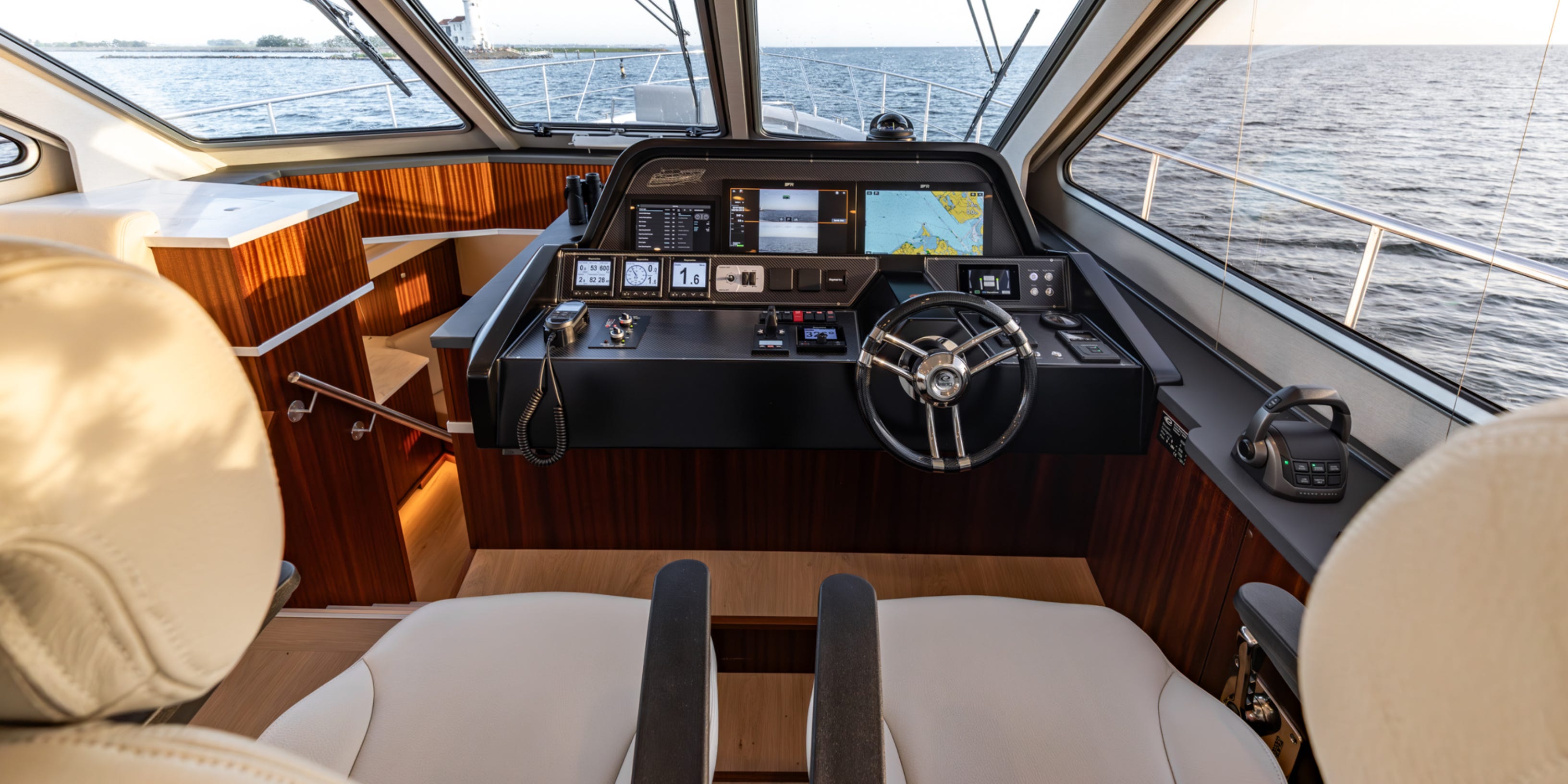
It was gusting around 25 knots when we took this brand new Elling E6 out for a mini sea trial. The wind was coming off the land, so the sea state was slight, and she handled the conditions very well. Her extra speed meant we could nip out and nip back in again, and since typical explorer yachts top out at around 10 knots, that extra power makes a great difference.
Elling and her owner invited me aboard to film a full tour when she’d only just been launched. I first wrote about Elling Yachts in April 2025, and at the start of the tour I asked what makes an E6 so capable. This piece answers that in more depth, so it makes sense whether or not you’ve watched the video.
Built to come back upright
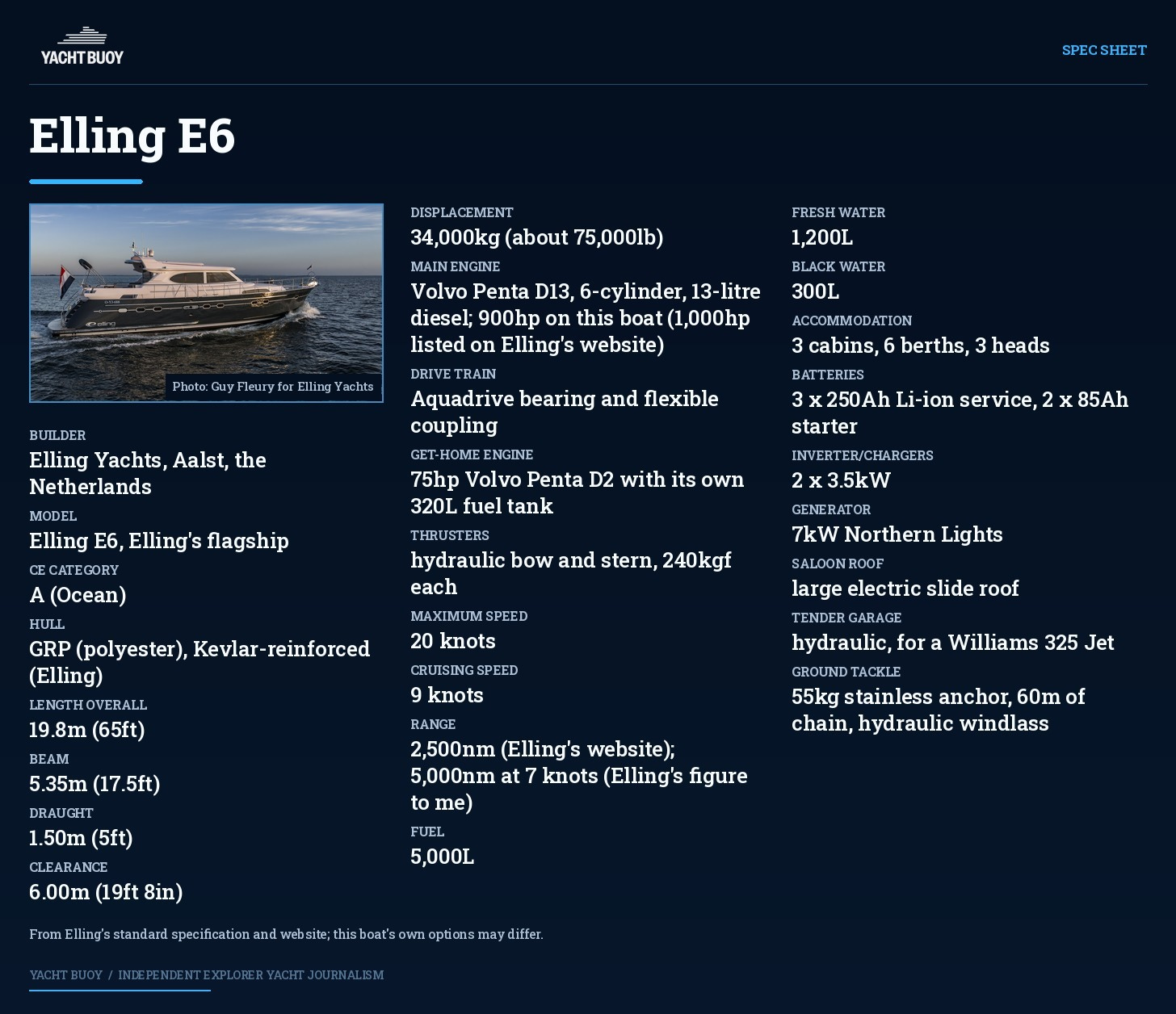
Let’s start with where she comes from. The E6 is the flagship of Elling Yachts in Aalst, in the Netherlands, and was first launched in 2016. The business behind Elling has roots in workboat building going back to 1972; the first Elling yacht, the E3, followed in 1997 and the E4 in 2004, with E4s crossing the Atlantic from 2008.
She carries CE Category A, the “Ocean” rating. Under the Recreational Craft Directive, that’s the design category for open-sea passages where winds can exceed Force 8 and significant wave heights reach 4m and above, excluding abnormal conditions such as hurricanes and rogue waves.
Then there’s the part that sets Elling apart. The yard describes an ocean-going, Kevlar-reinforced hull with “exceptional stability and unique self-righting safety system”, and says the E6 has been “engineered with capsize technology”. Self-righting means the hull and superstructure are designed to bring her back upright if she’s ever rolled right over, and Elling didn’t leave that idea on paper. In March 2014, as I mentioned in my earlier piece, they rolled a production E4 through a full 360 degrees in a controlled test. That was an E4 rather than an E6, but it shows how seriously the yard takes the principle. Kevlar, the trade name for aramid fibre, is used in composite laminates for its toughness and resistance to impact, a welcome quality in an ocean-going hull.
Power comes from a single Volvo Penta D13. Elling’s website lists it at 1,000hp, and this boat’s owners chose the 900hp version. Alongside it sits a 75hp Volvo Penta D2 spare engine to get her home if the main engine stops, and Elling’s standard specification gives it its own 320-litre tank, so it isn’t relying on the main fuel supply.
Elling publishes a range of 2,500 nautical miles, with a 9-knot cruise listed, and the yard told me she’ll cover 5,000 nautical miles at 7 knots. Doubling the range by slowing just 2 knots sounds unlikely until you remember that water resistance climbs steeply with speed, so each extra knot costs more fuel than the last. Ease back, and the fuel burned per NM falls much faster than your speed does.
Why 20 knots is a seamanship tool
Many explorer yachts are built around a full-displacement hull and economical speed, and the Nordhavn 40, M/Y ‘Aegis‘, I featured on 26 October belongs to that fine tradition. The E6 can cruise that way too, but she also has 20 knots on tap by Elling’s figure, and on a passage that gives you options.
Picture a hypothetical 60-nautical-mile hop with a 6-hour weather window. At 10 knots you’d need all of it; at 20 knots you’d be tied up in about 3 hours. If a forecast changes, covering ground quickly gives you more say over where you are when the weather arrives, which is our nip out and nip back in on a bigger scale. A full-displacement trawler rewards patience and keeps things simple, whilst the E6 gives you a choice of additional speed as-and-when you need it. Each suits a different kind of owner.
A quiet saloon, with the engine close by
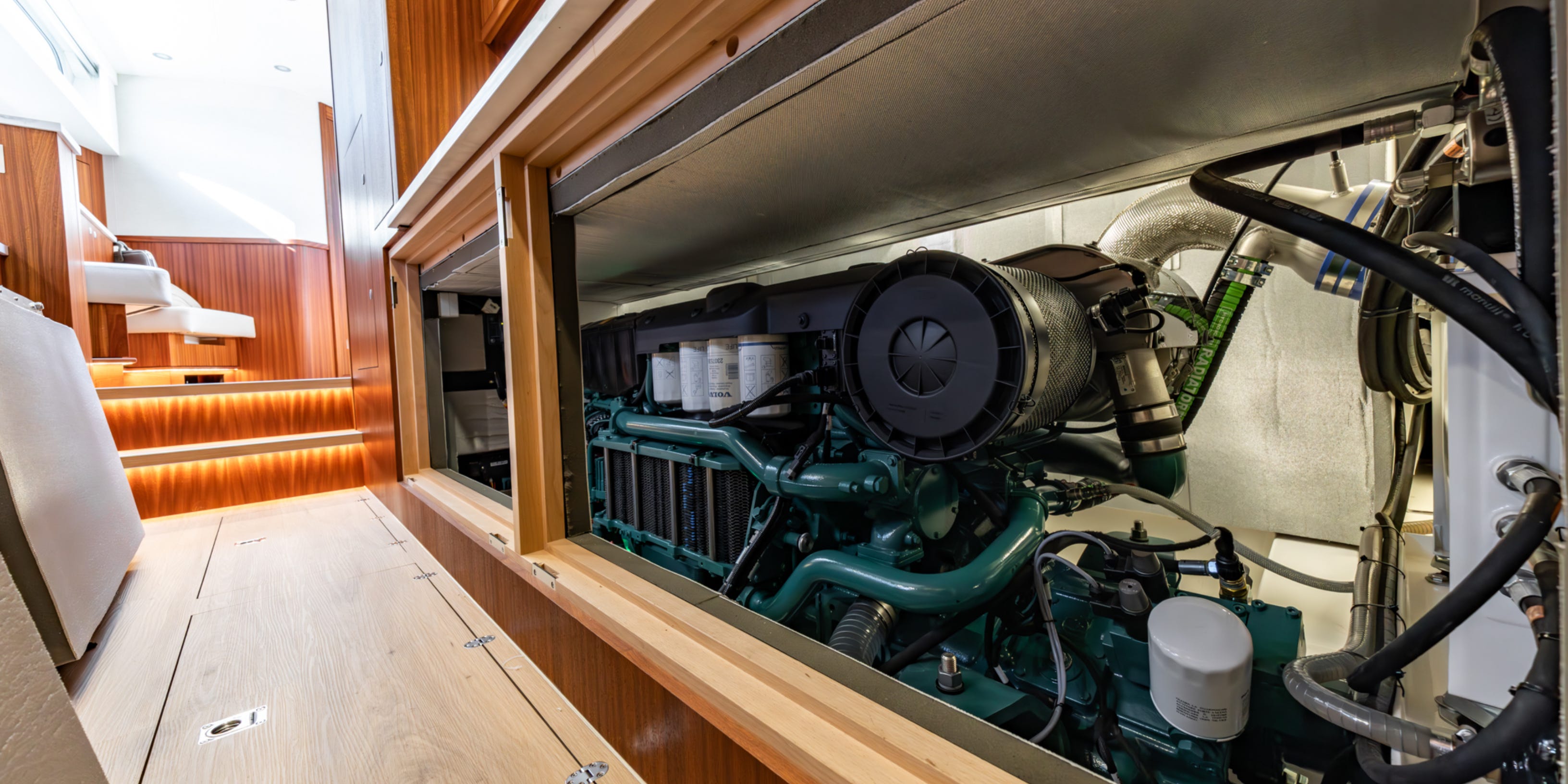
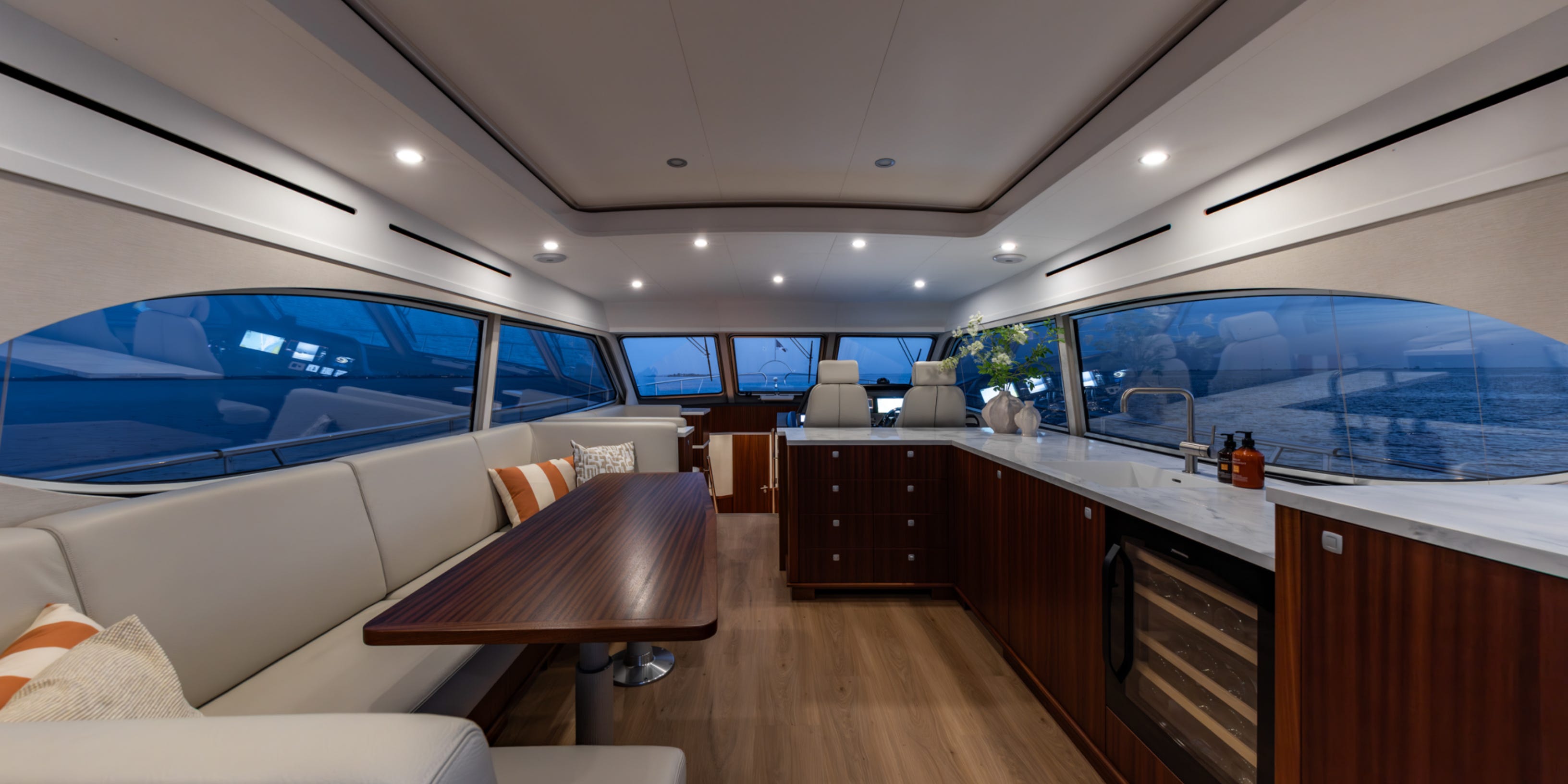
The sound levels in the saloon were very good, and I think some people are surprised by that, considering the engine on the E6 sits behind soundproofed access panels in the master cabin and the galley.
Elling credits an Aquadrive bearing and flexible coupling in the drive train for an “extreme low noise and vibration level”. Aquadrive explains that its thrust bearing takes the propeller’s push into the hull, whilst its coupling cuts the engine vibration that travels through to the boat. Elling also moulds the engine bed into the hull “for maximum strength and vibration absorption”, promises “excellent engine room insulation”, and lists double glazing in the deck saloon and a dual-chamber exhaust silencer as standard.
Life aboard
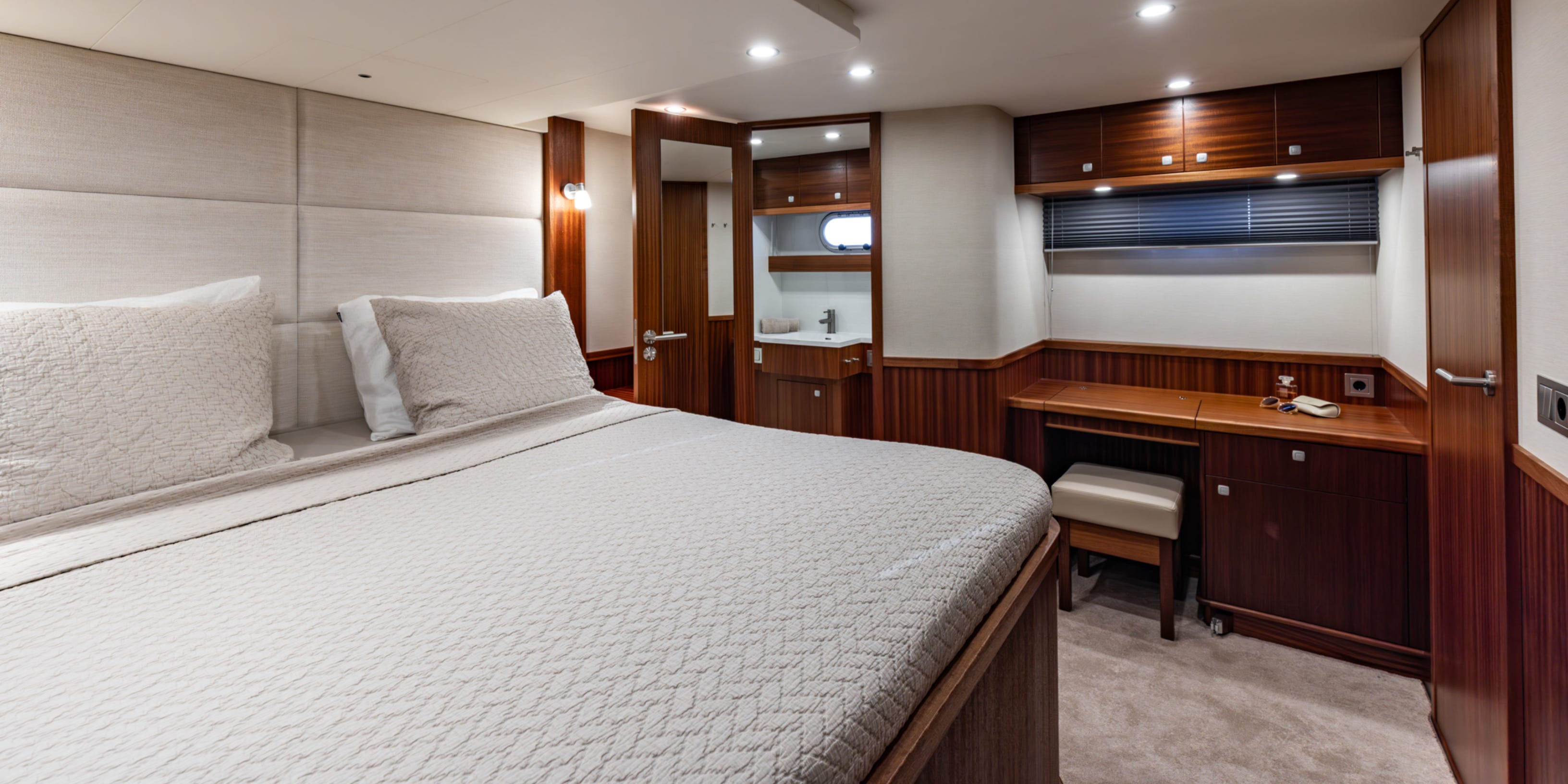
Down below, Elling’s standard layout gives three cabins, six berths and three heads. The owner’s cabin has a king-size bed you can reach from both sides, a desk and its own full-size bathroom aft; the forward cabin has a queen-size bed and the forward bathroom; and the side cabin has two single berths and access to the third head. Both bathrooms have separate showers and heated towel rails, which makes a full boat far more comfortable.
The galley is set up for full-time living aboard: Corian worktops, a four-ring cooker, a full-size fridge with a separate freezer, and a washing machine with a separate tumble dryer. The large electric slide roof opens the saloon to the sky on a warm evening, and aft, a hydraulic tender garage keeps a Williams jet tender out of the weather and quick to launch.
For nights at anchor, the standard specification lists three 250Ah lithium service batteries, two 3.5kW inverter/chargers and a 7kW Northern Lights generator to top them up. Elling calls the E6 “fully equipped” for “long term living on board”, and her 1,200 litres of fresh water go a long way. The Boat Galley suggests planning on about 25 litres per person per day, so a couple using 50 litres a day would have roughly 24 days before needing to refill, before any reserve.
Whether she could cross the Atlantic on her own fuel is another question, and I’ve worked through it, along with her fuel costs, in the premium section below.
This article continues below, in “The Wardroom”
A huge thank you to everyone who supports Yacht Buoy with a premium subscription, whether you’ve been here a while or have just joined. You keep both the YouTube channel and this publication going, so I can carry on filming and writing about boats like this one without adverts.
In the premium section, I cover:
- Fuel and range, worked out: litres, hours and euros per 1,000 nautical miles at 9 and 7 knots, with a 10% reserve
- Could an E6 cross the Atlantic on her own fuel? A real E6 crossing by way of Greenland, set against her range
- Self-righting in practice: what it depends on, and how it sits alongside CE Category A
- Living with one main engine: what the spare engine and its own tank add, and keeping them ready
- If I were acting as the buyer’s rep on a new-build E6: the questions I’d ask Elling before signing
- My honest assessment: who the E6 suits and what she asks of an owner
Fuel and range, worked out
Range figures are easy to quote and harder to picture, so I’ve turned Elling’s into litres, hours and euros. I’ve done the research, so you don’t have to.
