

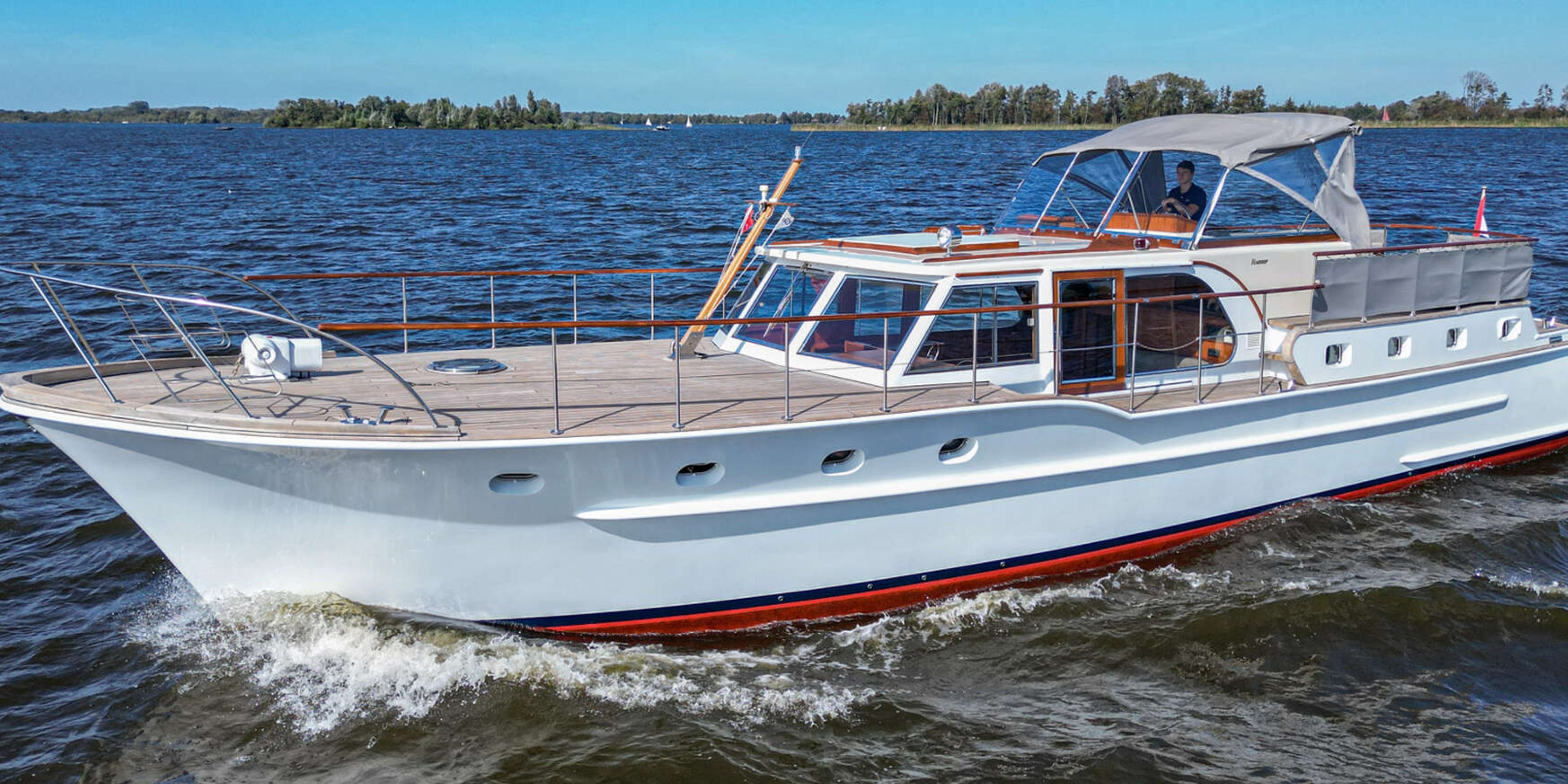
A Feadship built in 1965, refitted in 2018/2019, and offered with a prime and very sought after berth in the middle of Amsterdam is quite a combination, and Mumtaj is all three. She was built at the Van Lent yard in Kaag, one of Feadship’s founding yards and known today as Royal Van Lent. Her listing says the total refit cost more than €500,000, and it offers a berth at Marina Westerdok that a buyer may be able to take over. She’s for sale with Mark Hesselmans via De Valk Loosdrecht at €285,000, VAT paid (link to listing below), roughly $319,000 or £238,000 at the ECB’s reference rates for 3 November 2026. So what does it take to keep a classic like her?
Photos courtesy of the listing broker
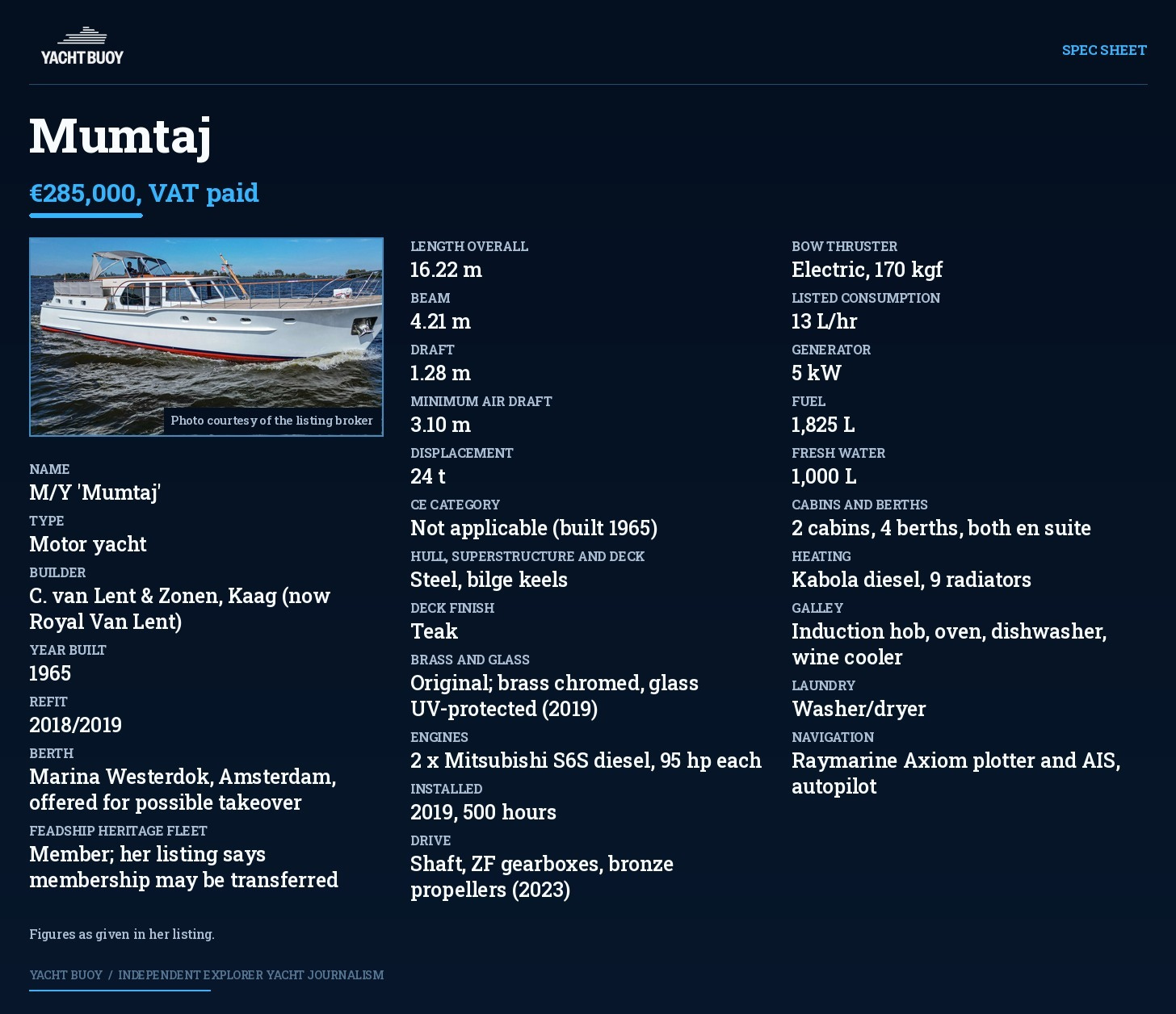
A Feadship badge, and where it comes from
Let’s start with the badge. After doing some research, I found that Feadship’s own history has Cees van Lent and Hein Akerboom establishing Jachtwerf De Kaag in 1917, and Van Lent joining the Dutch yards that began building custom yachts under the Feadship name in 1949; the Royal designation followed in 2001. So in 1965 Mumtaj came from C. van Lent & Zonen at Kaag, as the Feadship Heritage Fleet names the yard. For a buyer, that badge is provenance: a custom yacht from one of the yards that gave Feadship its reputation. I’ve written about another of their classics, a Van Lent built in 1956, and the appeal is much the same.
One of her listing photos shows a Jubilee Certificate presented to “Feadship M/Y Mumtaj” for her 55th anniversary, 1965 to 2020, dated 14 August 2020. It’s a fantastic thing to have aboard, and it shows the Heritage Fleet recognising her as one of its own. Her listing says the membership can be taken over; I cover what it costs and offers in the premium section below.
Steel, teak and a shallow draft
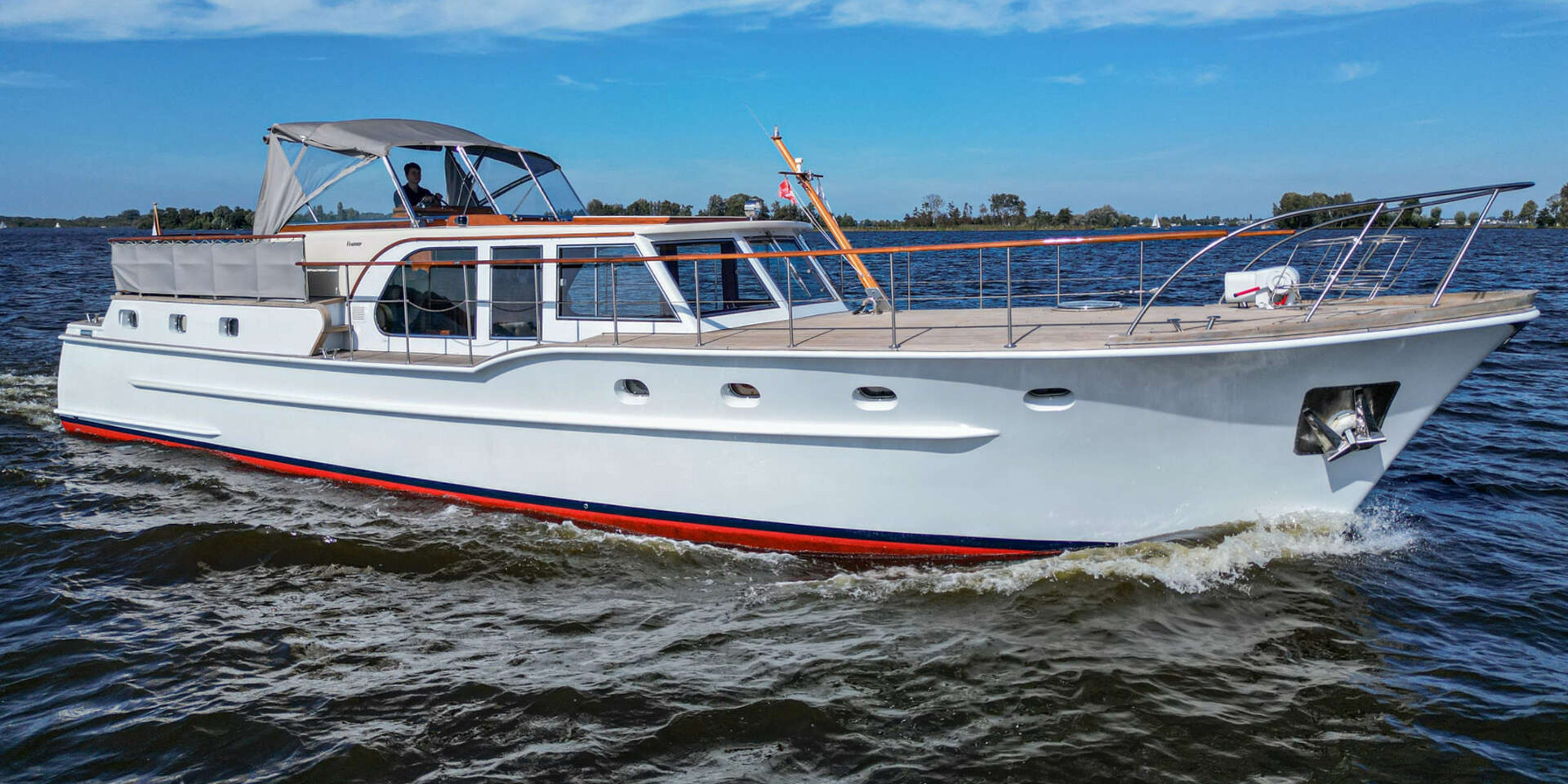
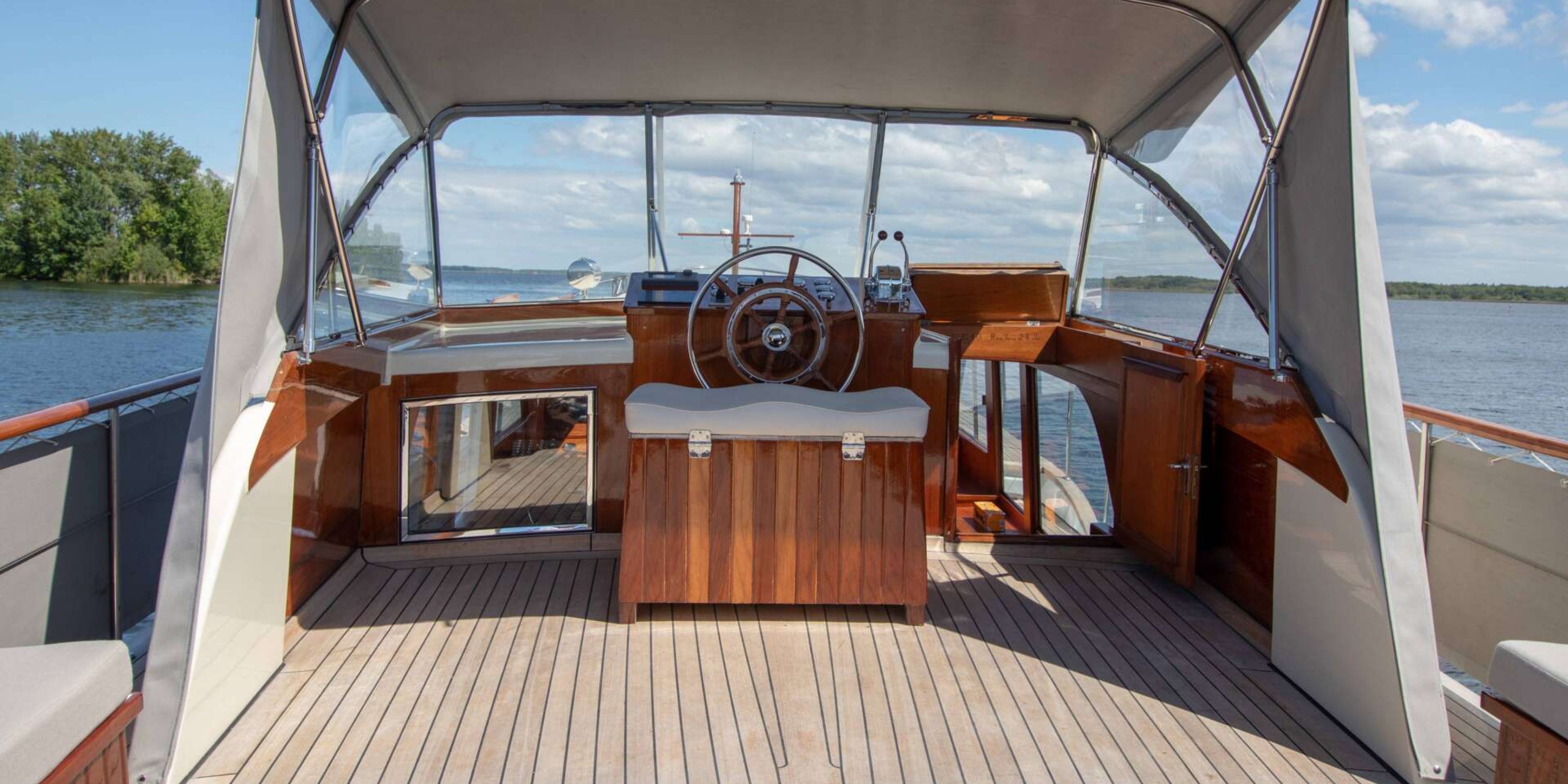
She’s a long, low motor yacht, 16.22 m overall with a slim 4.21 m beam, painted white and trimmed in timber. A broad teak foredeck leads to a wheelhouse with large windows all round, with a covered outside helm and cockpit aft. Her original brass window frames, deck hatch and portholes were chromed in 2019 and the original glass UV-protected, and the hull was repainted in Snowwhite Allgrip. Keeping the original brass and glass, and refreshing them, is exactly how you’d hope a classic would be refitted.
Her hull, superstructure and deck are all steel, she sits on bilge keels, and she displaces 24 tonnes. Her 1.28 m draft and 3.10 m minimum air draft are the sort of numbers a seasoned Dutch inland skipper plans around: one bears on which channels she can use, the other on which fixed bridges she can pass under without waiting for an opening. Each route still needs checking against its clearances and the day’s water level.
Her twin 95 hp Mitsubishi S6S diesels were installed in 2019 and show 500 hours, turning bronze propellers renewed in 2023. She also has a 170 kgf electric bow thruster for tight berths.
Built in 1965, she has no CE design category. The Recreational Craft Directive, which introduced categories A (open-sea passages) to D (sheltered waters), took effect in 1998. Her listed particulars point towards inland and sheltered use, with each route checked as above, and I look at going further in the premium section.
The appeal of a Dutch classic
Classic Dutch steel motor yachts have a loyal following, and it’s easy to see why. Steel is strong and can be repaired by welding, a well-maintained steel hull can serve for generations, and the teak, timber, and brass of a 1960s custom yacht give her real character.
With any older boat, a buyer’s first question is what has been renewed. Her listing says the 2018/2019 refit renewed the teak decks, floors, ceilings, galley, electrics, and engines, which are among the biggest jobs on any older boat. By her listing’s account, that’s a substantial head start, and the invoices and a survey will show a buyer how far it all goes.
Life aboard
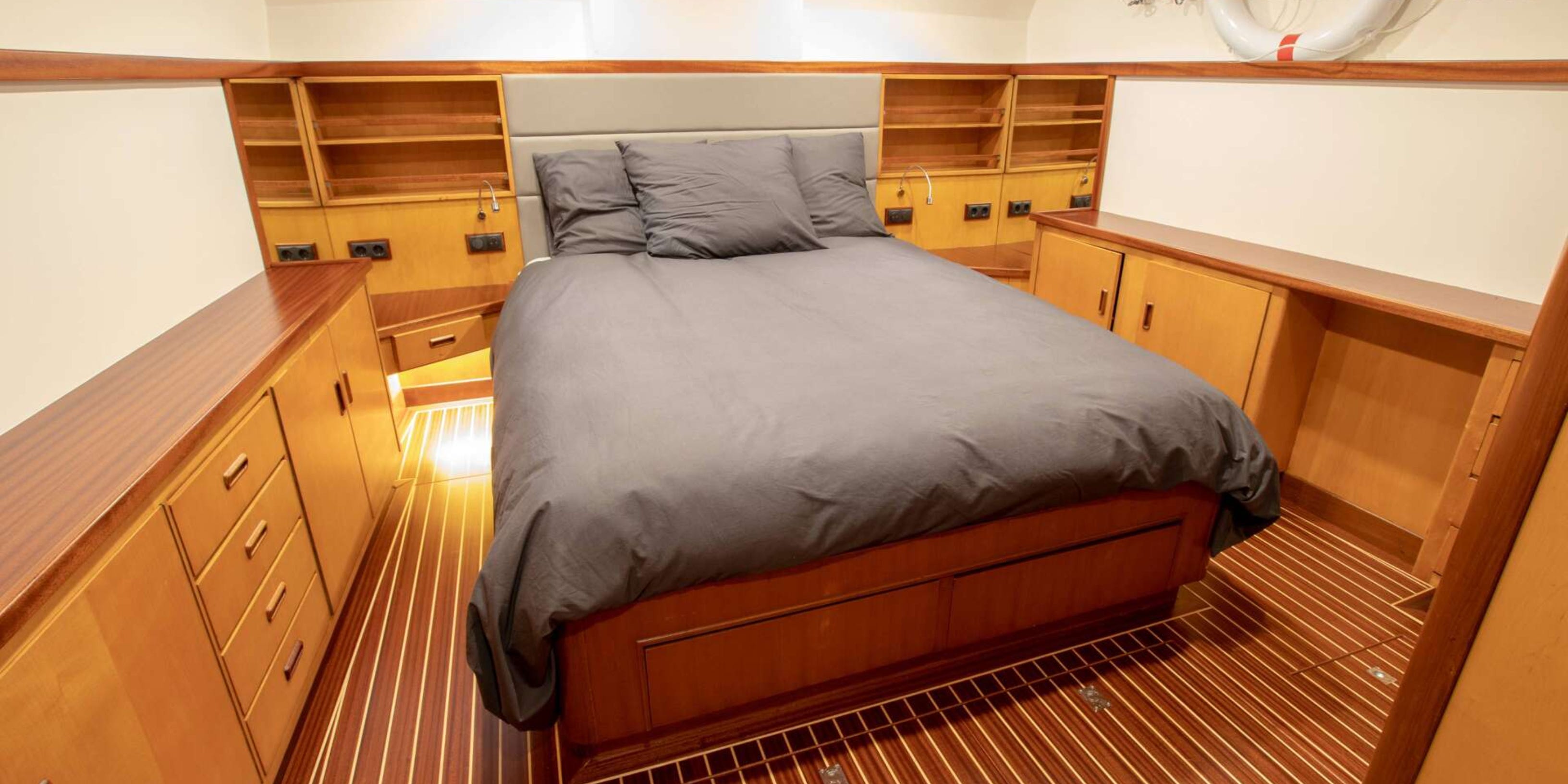
Inside, she’s set up for two people who like their comforts, with room for friends. The owner’s cabin has a French bed and the guest cabin a V-berth, and each has its own en-suite shower and electric head, so guests needn’t share with their hosts. The saloon and wheelhouse are finished in warm wood, with teak and holly floors and about 2 m of headroom.
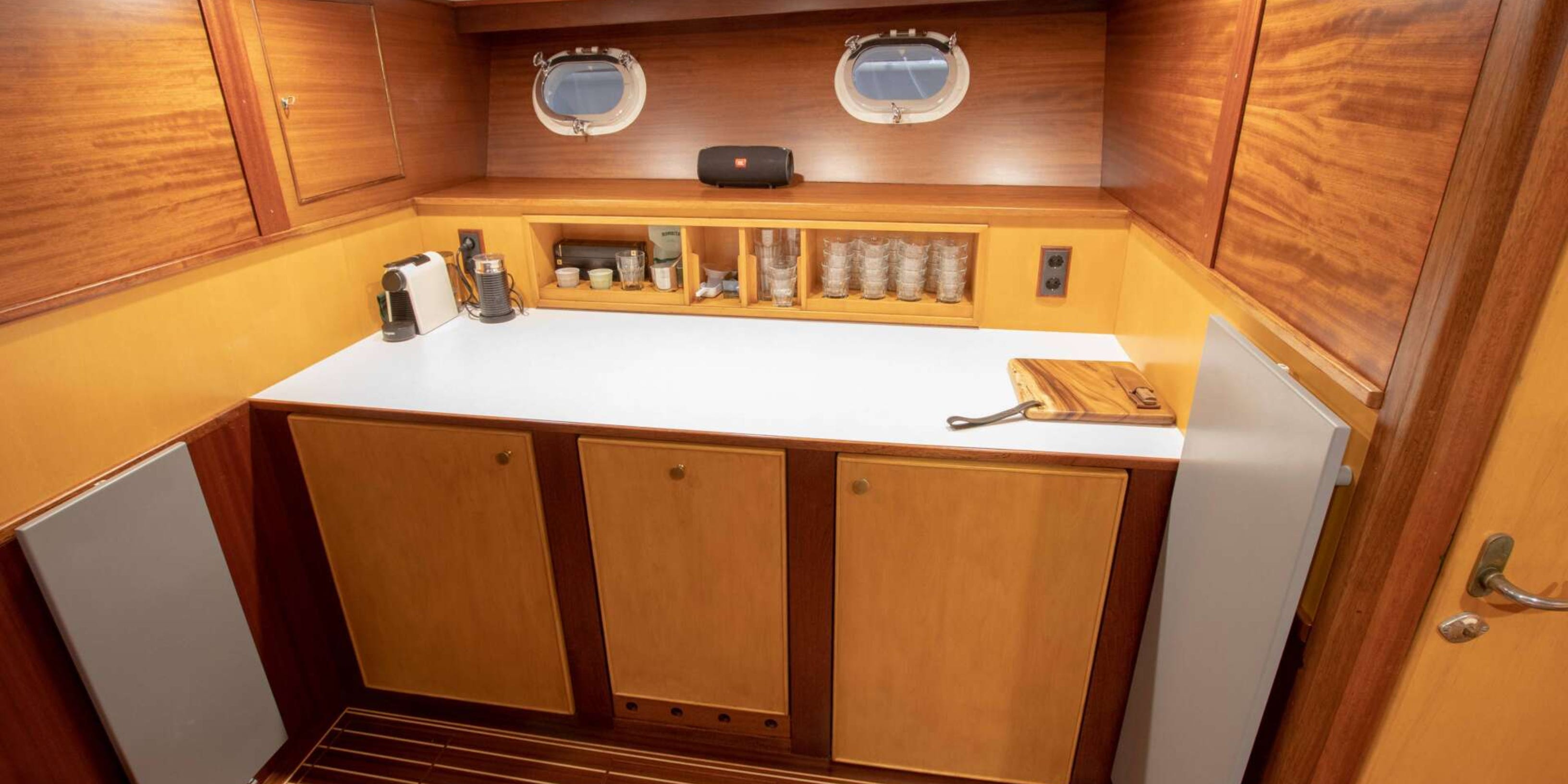
The galley is more complete than you might expect on a classic: induction hob, oven, fridge/freezer, dishwasher, and a 34-bottle wine cooler. There’s a washer/dryer too, and Kabola diesel central heating feeds nine radiators, a cosy prospect for a Dutch winter.
Her 1,000 L freshwater tank goes a long way for two. The World Health Organization’s domestic-water guidance uses about 50 L per person per day where washing and laundry happen at home, which gives two people roughly 10 days between fills.
Westerdok is a short walk from the Jordaan, the Noordermarkt, Haarlemmerstraat, and Centraal Station, about as central as Amsterdam gets. If the berth comes with her, picture a few weeks there in spring: breakfast in the wheelhouse, the Noordermarkt on foot, and a train from Centraal when you fancy going further. Whether that can become full-time living aboard is a question for the marina, which I cover in the premium section. I looked at life aboard a larger Dutch boat in my piece on Ge-Jo, a 22 m Dutch classic.
How she compares
For a sense of where her price sits, M/Y ‘The Swaen’ makes a useful comparison: another 1965 Dutch steel classic, built by Akerboom and listed at €225,000, VAT paid, exactly €60,000 less. She’s the bigger boat, at 16.98 m by 4.56 m, with a 1.60 m draft and 30 tonnes displacement. Her twin 100 hp Ford Lehman diesels were overhauled in 2000 and show about 900 hours, and her listing says she was renovated about 25 years ago. Both boats have two cabins and four berths, but The Swaen’s cabins share a bathroom, whereas both of Mumtaj’s are en suite, which is a huge selling point for a potential buyer.
On paper, they do suit different buyers: Mumtaj’s engines were installed in 2019 and, by her listing’s account, she was refitted in 2018/2019, whereas The Swaen is the larger boat, renovated about 25 years ago. Which suits you depends on whether recent renewals or extra space matters more.
This article continues below, in “The Wardroom”
Thank you to everyone who supports Yacht Buoy as a premium subscriber, whether you’ve been with me for a while or have just joined. Your support keeps both the YouTube channel and this publication going, and lets me keep writing about and filming boats without adverts.
In the premium section, I cover:
- What her listed figures let you work out, from fuel per running hour at a dated Dutch diesel price to the Heritage Fleet’s dues, and what needs a quote
- Keeping her in Amsterdam: the berth questions to settle in writing, the city’s emission-free zone, and one option for longer spells away from shore power
- What her listing says the 2018/2019 refit renewed, the care she’ll still need, and what the Heritage Fleet offers members
- Where a 1965 classic with no CE category belongs on the water, plus my buyer’s-rep checklist
- My honest assessment
What her figures let you work out
I’ve worked through her listed figures to separate what keeping her costs from what needs a quote, and I’ve done the research, so you don’t have to.
